When a guardian asks whether a lavender diffuser is safe around a senior cat, a simple “safe/unsafe oils” list rarely helps. What usually matters most is intensity, total exposure time, and whether the animal can choose to leave. A clear way to teach that is to start with the still: one steam distillation creates two very different aromatic tools—essential oil and hydrosol.
Key Takeaway: Animal aromatics are best approached as an intensity decision. Steam distillation produces both a concentrated essential oil and a gentler hydrosol, and that distinction helps practitioners choose lower-impact options, set realistic topical baselines, and create safer household scent habits. In most everyday settings, hydrosols, short exposure, ventilation, and animal choice offer the clearest foundation.
How distillation changes essential oil intensity
Even within the same plant name, essential oils can feel very different. Distillation time, temperature, pressure, and the plant part used can shift the profile, which changes how sharp, heavy, or gentle an aroma feels.
Practitioners often notice this immediately. One lavender reads bright and airy; another feels dense and herbaceous. Those differences reflect real compositional changes that start in the still.
Plant part matters too. Work on lavender shows profile shifts between flowers-only and whole-plant distillation, and between fresh and dried material. In day-to-day use, that can influence how “present” an oil feels in a room and how assertive it seems on skin.
It also helps to think in chemical families, not only plant names. Reviews outline common chemical families such as terpenes, esters, ketones, phenols, oxides, and salicylates. Some profiles tend to feel naturally softer; others are more likely to feel intense or irritating in close quarters.
Storage is part of intensity management. Veterinary guidance links oxidized terpenes with greater irritation concerns, which is a strong reason to prioritize fresh oils, tight caps, cool storage, and smaller bottles you can use while they’re at their best.
When a familiar oil suddenly seems sharper than usual, that signal is useful. Stepping down intensity, switching to a hydrosol, or pausing altogether is often the most skilled move.
Topical use: keep essential oils low, local, and purposeful
With animals, topical essential oils should be a deliberate choice. When they’re used, keep the approach low-intensity, localized, and easy to stop.
Safety guidance is consistent that concentrated oils can be risky around pets. Veterinary references also note multiple routes of exposure, including skin contact, inhalation, and ingestion after grooming.
For household use, oral use is a firm red line. University guidance advises never by mouth, and it’s worth saying plainly before anything else.
For dogs, a conservative body-wide baseline is a 0.25% dilution for general topical use, adjusted for size, coat, age, and context. In a 30 ml bottle of carrier oil, about 2 drops of essential oil gives roughly a 0.25–0.3% blend for a medium-sized dog.
That micro-dilution is often enough, and many situations call for even less. Start small, keep it local, and consider whether a hydrosol would meet the goal with less impact.
- Keep blends very dilute.
- Use spot applications rather than broad coverage.
- Avoid eyes, nose, mouth, genitals, and other delicate areas.
- Make sure the animal can move away.
- Have an off-ramp ready, such as wiping the area or bathing if needed.
For horses, practitioners may sometimes work slightly higher in a small local area because of coat, scale, and airy living spaces, but still well below typical human-use patterns. Patch testing remains a sensible baseline.
Why hydrosols are often the better everyday choice
For many households, hydrosols are the most practical aromatic tool for animal settings. They create a sense of presence without the concentration burden of essential oils.
Hydrosols contain only a small amount of volatile material. Published analyses describe low volatile levels, which helps explain their softer scent and gentler feel.
In a home or coaching space, this usually creates a light-touch atmosphere rather than saturation. That makes hydrosols especially useful for small animals, scent-sensitive companions, and careful introductions.
Professional guidance also presents hydrosols as a gentle alternative in animal contexts when used with care. They are often the easiest place to begin while you observe response and preference.
Hydrosols also ask for good handling. Because they’re mostly water and mildly acidic, they’re more perishable than oils. Refrigerate them, date the bottle, and use them within 6–12 months while they’re still fresh and well kept.
Simple uses include:
- A light room mist into open space, never directly onto the animal’s face.
- A cloth dampened with hydrosol for paws or coat after outdoor time.
- A light environmental scent before rest, with a clear option for the animal to leave.
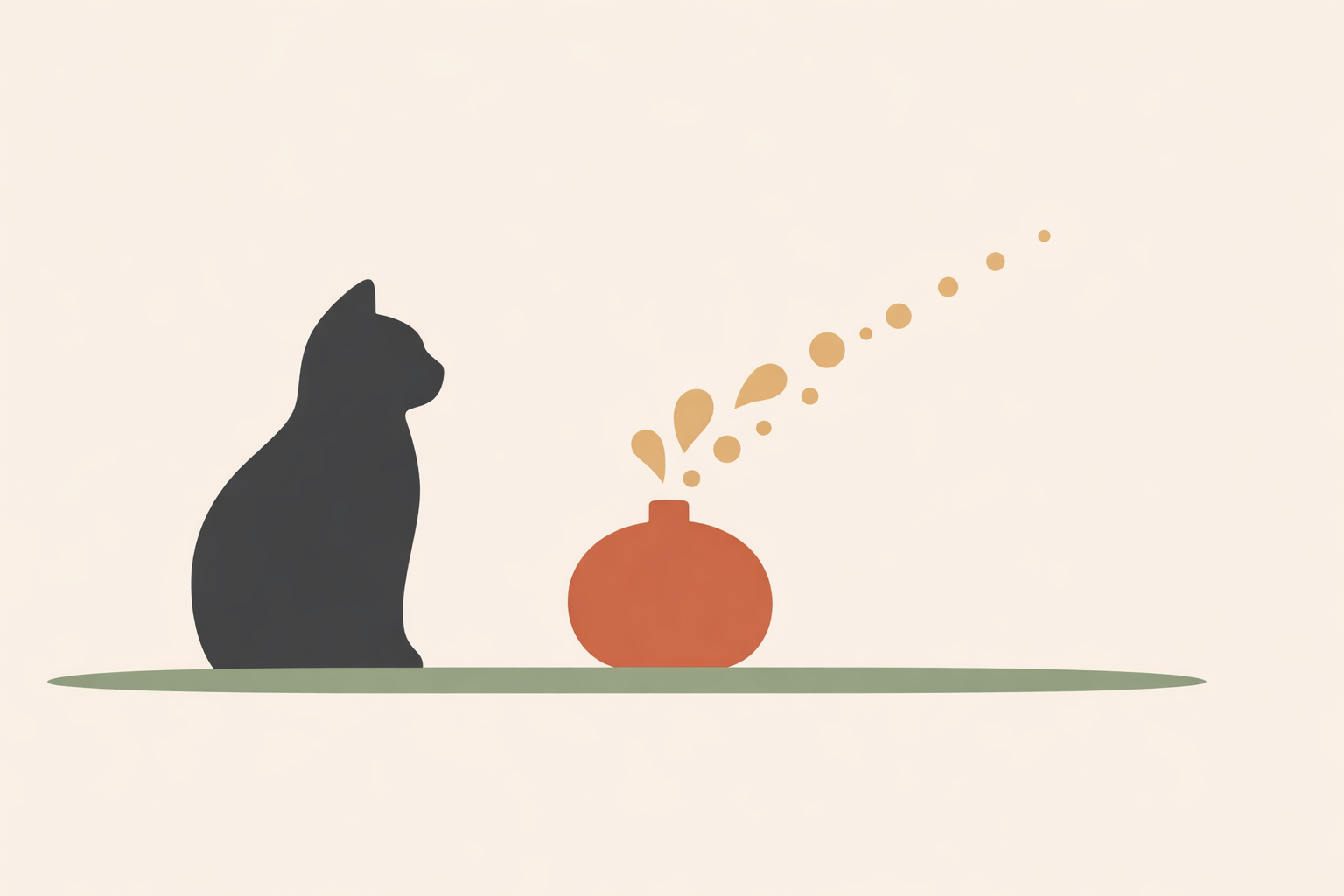
For a cat who shares a bedroom, a single mist toward curtains or bedding in the wider room often makes more sense than oil diffusion. The environment shifts gently, and the cat keeps distance and choice.
Diffusion and room exposure: what animals actually experience
If an aroma is in the air, it becomes part of the animal’s environment. That matters even when nothing touches the skin.
Diffusion is meaningful exposure because animals can inhale compounds, and droplets can settle on fur or surfaces and later be taken in through grooming or licking. That’s why “air only” doesn’t capture the real-life picture.
Veterinary guidance also notes that respiratory distress can occur when essential oils are inhaled in small, poorly ventilated spaces. Ventilation and duration do as much safety work as the oil choice itself.
Animals also perceive scent with far more intensity than most people expect. Their body language tends to be the most honest feedback: leaving the room, hiding, agitation, or sudden avoidance are all worth respecting.
Birds deserve special caution. Safety guidance advises avoiding diffusion around birds because of their respiratory sensitivity and small size.
A conservative diffusion pattern is straightforward:
- Prefer hydrosols for everyday room ambiance.
- If using essential oil in a diffuser, keep it to 1–2 drops total in a full chamber.
- Diffuse for only 10–15 minutes.
- Keep the door open and allow free movement.
- Follow with a full break and fresh air.
- Empty the diffuser after use and clean spills quickly.
This aligns with guidance to use brief diffusion and good airflow rather than prolonged saturation.
How to explain animal-safe aromatics clearly to guardians
Guardians usually grasp this quickly when it’s framed around intensity rather than marketing labels. The still provides a simple, reliable teaching model.
Say it plainly: steam distillation yields two products, a strong one and a gentle one. Around animals, begin with the gentle option, keep exposure short, ventilate well, and watch the animal’s response.
That framework naturally becomes a set of easy household rules:
- Start with hydrosols whenever possible.
- No oral use at home.
- No confined diffusion.
- Keep topical essential-oil blends very low.
- Let the animal leave, and treat that choice as useful feedback.
- Store bottles securely and clean spills right away.
It also helps to set expectations: animals can’t describe overload in words. Stories about essential-oil self-selection can sound reassuring, but they’re not a solid safety plan. Quiet tolerance is common, so the practitioner’s job is to keep intensity low and choices obvious.
In daily practice, this usually looks like hydrosols for ambiance, ventilation as standard, essential oils reserved for rare and carefully diluted applications, and a steady willingness to step back when the response is unclear. For practitioners building a broader foundation in animal wellness, that same low-intensity mindset carries across species and settings.
Conclusion: let the gentlest option lead
When you remember that one distillation creates both an essential oil and a hydrosol, decisions get easier. You can choose the gentlest option that fits the moment and still work with the full depth of the plant.
This approach honors traditional craft while matching the realities of modern homes. It respects the power of scent, the sensitivity of animals, and the practitioner’s responsibility to work with nuance.
Keep the compass simple: hydrosols for everyday aromatic support, short and ventilated sessions if essential oils are diffused, very low dilutions for rare topical use, and careful attention to freshness, storage, and animal choice. When any animal can’t easily leave the space, or when respiratory sensitivity is a concern, skip diffusion and keep the environment neutral. That is also the kind of practical judgment emphasized in animal aromatherapy certification training.
Train in Animal Aromatherapy
Build safer, lower-intensity protocols with the Animal Aromatherapy Certification for real-world animal households.
Explore the Certification →