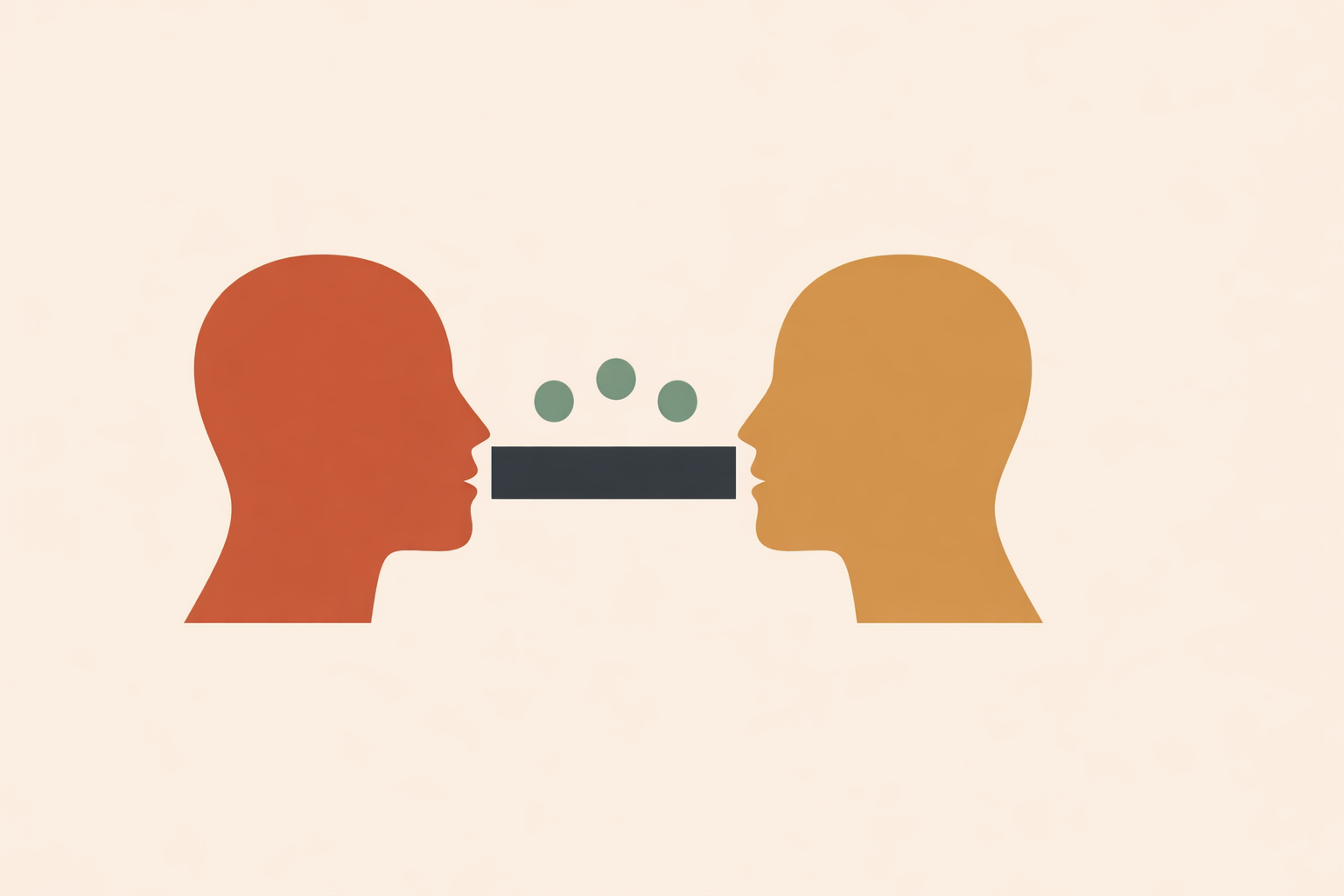
Many mindset and manifestation coaches lean on insight and scripts: analyzing attachment styles, drafting “I statements,” and trusting that clarity will carry into conflict. Then a client hits a charged moment—voices rise, a boundary gets ignored—and all the beautiful language disappears. Another client asks for the perfect sentence to finally be heard. That gap matters: sessions create understanding; everyday life demands behaviors that still work under pressure. And when a relationship isn’t safe enough for vulnerability, “say it better” stops being responsible coaching.
Healthy communication is behavioral and observable. It’s built from small, repeatable moves practiced in real context. When coaching stays anchored in micro-skills, safety, and lived realities, clients build habits they can actually use when it counts.
Key Takeaway: Durable communication change comes from coachable micro-behaviors anchored in safety, not from insight or scripts alone. The article first reframes healthy communication as visible actions and offers micro-skills that translate insight into repeatable moves; it then shows how to screen for danger, coercive control, and cultural context before inviting vulnerability. Next, it maps patterns instead of personalities, separating observation, emotion, need, and request. It trains active, assertive listening, followed by honest expression with clear requests, real boundaries, and straightforward repair. Finally, it makes skills stick through rehearsal, implementation intentions, a 30-day plan, and daily rituals—so clients can perform under pressure.
Screen for Safety, Context, and Values First
Before inviting more openness, check for safety and fit. Communication skill and relationship safety are not the same thing. Coaching should not encourage vulnerability with someone who uses threats, stalking, intimidation, or repeated retaliation.
If warning signs show up—property damage, uncontrollable shouting, threats of self-harm, or monitoring—shift away from “say it better” and toward safety planning. In these conditions, joint exercises and vulnerability scripts can increase risk.
Control can be quiet, too. Isolating someone from friends, tracking money, or monitoring messages are forms of coercive control. If a client fears credible retaliation, the work focuses on boundaries, options, and supportive resources, not polishing the perfect line.
Context and values matter just as much. Inclusive coaching doesn’t assume heterosexual partnerships, marriage, monogamy, or any single “right” family structure. Useful questions include: “In your world, what does respect look like?” and “What helps you feel safe enough to speak honestly?”
Many traditional communities hold conflict and safety collectively, through elders, mediators, or circles. Collective spaces can build relationships, share power, and support problem-solving in ways that one-on-one communication tools can’t always provide.
Coachable moment: “If raised voices continue, I will pause and step outside for five minutes. I’m willing to continue when we can speak calmly.” If even a basic boundary like that is ignored or punished, safety takes priority over skill drills.
- If the other person escalates when boundaries are set, stop the conversation.
- Differentiate discomfort from danger. Discomfort calls for skill practice; danger calls for protection.
- Do not assume every conflict can be solved by better wording.
Map Patterns, Not Personalities
Clients often explain conflict with identity language: “This is just who I am.” That framing can feel final. Patterns are more workable than labels because they can be observed, practiced with, and changed.
Start by separating observation, interpretation, emotion, need, and request. It lowers the odds that assumptions masquerade as facts. Instead of “You never care,” a client can say, “When plans changed without checking in, I felt anxious and disconnected.” Then: “I need clarity.” Then: “Would you tell me by Thursday if plans shift?”
Mini-map: “What happened? He answered texts late. Body? Tight chest. Emotion? Worried. Story? ‘I don’t matter.’ Need? Reassurance. Request? ‘Could you let me know when you’ll be free to text?’” That shift turns “I’m needy” into “I have a clear ask.”
A growth-oriented lens keeps the focus on skill-building rather than self-judgment. Identity-based language can support direction when it stays flexible, much like growth mindset coaching: “I’m becoming someone who speaks clearly and stays connected to herself during disagreement.”
- Belief to test: “If I need reassurance, I’m needy.” Experiment: Ask once, clearly, then notice the outcome without self-judgment.
- Belief to test: “Difficult talks always go badly.” Experiment: Prepare one “I feel/need/would you” statement, deliver it when calm, and debrief afterward.
- Belief to test: “I can’t handle conflict.” Experiment: Practice a two-minute pause plus one feeling word, then track how your body settles.
Coach Active, Assertive Listening
When someone hears “We need to talk,” the body often reacts before the mind organizes a response. That’s why strong coaching trains receiving, not only speaking. Active, assertive listening gives real attention without giving up self-respect. It avoids both shutdown and debate-mode.
A clean listening sequence works well in real life: pause and orient attention, let the other person finish, reflect the central message, tentatively name the emotion, ask what matters most, then respond to what was actually said.
Many Indigenous talking-circle practices honor a rhythm where one person speaking is met by others listening to remember rather than to rebut. That structure is simple, and it changes the quality of attention in a lasting way.
Assertive listening statements are often associated with lower anger, more willingness to resolve conflict, and greater satisfaction than passive or aggressive responding. In day-to-day coaching practice, paraphrasing is a standout tool because it slows reactivity and helps the speaker feel accurately heard.
Try this micro-skill: “So what I’m hearing is that when I canceled last minute, you felt unimportant and worried I don’t prioritize us. Did I get that right? What part matters most right now?” Then, if needed: “I want to respond, and I also need five minutes to gather my thoughts.”
Listening is not agreement. A client can acknowledge someone’s experience without taking blame for everything, abandoning a boundary, or undoing a sound decision.
- Attention: Put the phone down and orient your body toward the speaker.
- Reflect: “You’re saying X; you’re feeling Y.” Keep it short.
- Clarify: “What matters most about this?”
- Boundary: “I can continue this conversation at a calmer volume.”
Coach Honest Expression, Clear Requests, and Real Boundaries
Many people swing between sugarcoating and snapping. Assertive expression holds a steadier line: clear without contempt, firm without force. Many traditional lineages teach a version of this as speaking directly with care.
A practical formula helps clients move from reactivity or appeasement into grounded speech: When [specific situation] happens, I feel [emotion]. I need [value or condition]. Would you be willing to [specific request]?
Example: “When deadlines shift same-day, I feel anxious and scattered. I need stability to do my best work. Would you be willing to confirm changes by 3 p.m. the day before?”
Concrete requests are easier to respond to than global character critiques. “Be more considerate” invites debate. “Please text me if you’ll be more than 15 minutes late” invites action.
Boundaries describe what the client will do, not what someone else must feel or think. “If the conversation becomes insulting, I will pause and return later,” or “I’m not available to discuss this while voices are raised.” That keeps self-respect in the client’s hands.
When repair is needed, keep it straightforward: name what happened without exaggeration, acknowledge impact, take responsibility for your part, state what will change, ask what would help rebuild trust, then follow through. Many traditions hold similar steps through apology, restitution, and renewal.
- Replace “You always ignore me” with “When I share and don’t hear a response, I feel alone. I need acknowledgment. Would you be willing to reflect back what you heard?”
- Replace “Fine, whatever” with “I’m overwhelmed. I need ten minutes to reset. I’ll come back at 6:15.”
- Replace “If you loved me, you’d just know” with “Could you check in with me once during late shifts this week?”
Make Communication Skills Stick Through Rehearsal and Ritual
In a session, a client can deliver a beautiful request. In real life, stress scrambles words and tone. Rehearsal closes that gap by moving skills from ideas into the body through repetition.
Start with role-play and adjust the details that matter: tone, speed, posture, and wording. Behavioral coaching and many traditional teaching lineages lean on guided practice for a reason: it offers a safer space to try new responses, receive feedback, and refine them.
Then add implementation intentions: simple if–then plans that link a cue to a response. This type of planning is widely used because it improves follow-through in everyday life.
Examples:
- If I notice myself explaining the same point twice, I will pause, name my feeling, and make one request.
- If voices rise, I will say, “I’m pausing for two minutes to reset,” and set a timer.
- If I feel rushed to answer, I will say, “I’ll text you my thoughts by 5 p.m.”
Mindset and behavior change practices can strengthen this when they stay rooted in action. Identity cues, visualization, and gratitude help clients arrive more intentionally and remember who they want to be in the moment. Consistency does the heavy lifting.
30-day practice:
- Week 1: Listening reps. Each day, reflect one sentence and name one feeling you think you heard. Track three wins in a notes app.
- Week 2: Feeling words plus one request. Practice the “I feel/need/would you” line on low-stakes topics like plans, chores, or scheduling.
- Week 3: Boundaries. Choose one boundary line, rehearse it aloud daily, use it once in real time, then debrief.
- Week 4: Repair and review. Initiate one repair conversation. Review the month and update your if–then plans.
Daily 5–8 minute ritual:
- Arrive: Three breaths, one hand on heart, one on belly.
- See it: Visualize a 30-second clip of yourself using your one skill today.
- Say it: “I am becoming someone who speaks clearly and stays kind.”
- Plan it: Choose one if–then for the day.
- Close: Name one moment of connection you are creating.
Supportive accountability keeps momentum without turning practice into surveillance. Brief voice notes after a hard conversation, a simple tracker for rep counts, or a weekly message celebrating one courageous moment can be enough.
- Rehearse out loud. Words land differently in the mouth than in the mind.
- Keep one skill per week. Depth beats breadth.
- Celebrate micro-wins. “I paused once today” is a real win.
Conclusion
Healthy communication grows where clarity, courage, and care meet. Insight helps, but week-by-week practice reshapes what clients do under pressure: the pause before replying, the one feeling word, the clear request, and the boundary that gets kept.
When coaching maps patterns rather than fixed personalities, screens for safety and context, and pairs mindset with micro-skills, clients build a steadier sense of agency they can feel in their bodies and carry into daily relationships.
It also helps to respect the wider net. In many settings, elders, mediators, and circles hold conflict and safety with deep wisdom, and communication lives inside that larger weave. When threats or retaliation are present, skill-building steps back so safety can lead.
For practitioners rooted in both tradition and evidence-informed practice, the work is to make change usable. One rehearsal, one ritual, one conversation at a time—this is how values become habits, and habits become a new way of relating, including in mindset and manifestation coaching.
Coach Mindset Under Pressure
Build practical coaching tools in the Mindset and Manifestation Coach for Women Certification to support real-world behavior change.
Explore the Certification →