Many facilitators assume mandalas become calming through mood, coloring pages, or symbolism. In practice, people often rush into decoration, the page gets crowded, and attention starts to scatter. What’s usually missing is structure.
Calm mandalas are a form problem first. A clear center, balanced rings, steady repetition, and enough breathing space make it easier to support focus and reflection without overloading the process with interpretation.
Key Takeaway: Calm mandalas come from form-first design and sensitive facilitation, not decoration alone. The most reliable foundations are a clear center, concentric rings, even radial divisions, repeated motifs, and intentional empty space. From there, gentle pacing, choice, and respectful framing help the process stay grounded and useful.
Why circles help attention settle
Circles often help attention settle because they gather attention in a simple, contained way. The eye can return to the center, follow the rings, and rest in repetition without needing to solve too much at once.
This is one reason circles and mandalas have been used across cultures as focusing devices for ritual, teaching, and reflection. Their role as containers for contemplation is longstanding, and that continuity matters. Traditional makers and facilitators trusted this form because it works in lived practice.
Modern research points in a similar direction. Mandala-based art interventions have been associated with reduced anxiety and shifts in stress-related physiology in structured settings. Research on visual symmetry also suggests that regular forms orient attention consistently, which helps explain why balanced circular designs are often easier to stay with.
In facilitation, the mechanism is easy to see: the circle invites steadiness, the center gives the eye a home base, and repetition gives the mind one manageable choice at a time. For people who feel scattered, a circle can act like a soft anchor.
The anatomy of a calm mandala
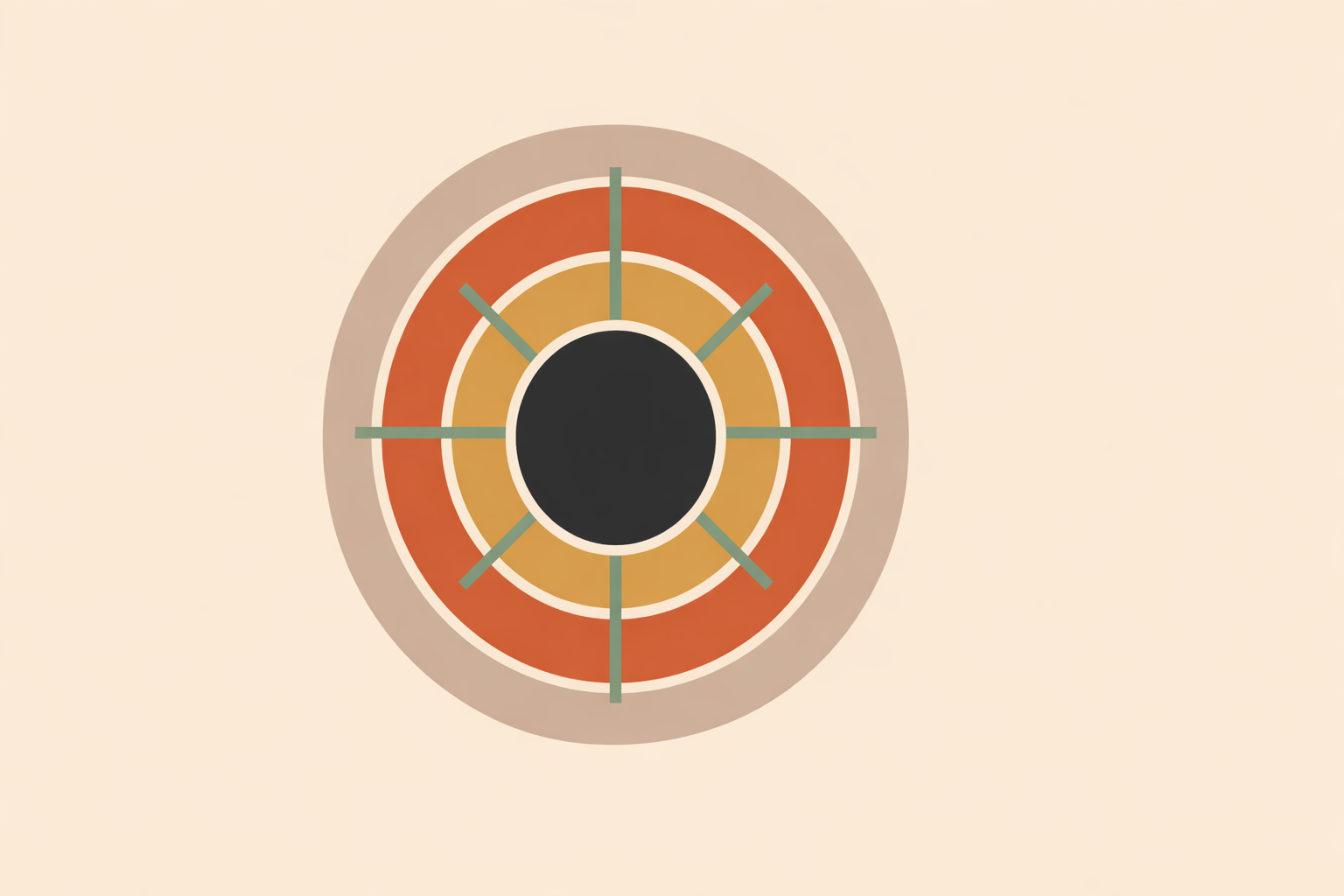
A calm mandala usually depends on four structural elements: a center, concentric rings, even radial divisions, and breathing space. Before symbolism or color, these create order.
Start with a clear center where attention can land. Add rings to set distance and pacing. Divide the circle into equal sectors so motifs can repeat cleanly. Leave enough open space that no area feels visually crowded.
Many facilitators find it helpful to begin with 3 to 7 rings and 8 to 16 sectors. It’s a practical starting range that offers structure without becoming fussy.
Balance matters. When no quadrant feels heavier than another, the design tends to read as harmonious. Research on symmetry and regular visual forms supports this sense of visual harmony, and most makers can feel it directly while drawing.
Teach the geometry first, then invite personal reflection later. This keeps the process clear and leaves room for meaning to emerge naturally rather than being imposed.
Step 1: Prepare the space, tools, and tone
Keep the setup simple. A quiet table, basic tools, and a clear invitation do more for calm than elaborate materials.
- Tools: paper, pencil, eraser, compass, ruler or protractor, and coloring materials
- Opening tone: “This is an invitation. You choose your pace, where to pause, and what to share.”
- Pacing: use a predictable arc such as arrive, draw, reflect, and close
Choice is part of the structure. If you’re guiding others, keep participation flexible and language non-pressuring. A simple “pass is always welcome” helps people stay in agency.
A clear ending supports settling, too. Time-bounded sessions with predictable closure often help people engage more fully because the process has edges.
For people who are distressed or simply overstimulated, the circle can become a soft anchor. Structured mandala activities have been linked with focused attention and short-term ease, and facilitators often see the shift as soon as the center is marked and the perimeter is traced.
Step 2: Build the grid first
Begin with the scaffold. Ornament comes later.
- Mark the center. Place a light dot near the middle of the page.
- Draw the outer boundary. Use a compass to create the main circle.
- Add rings. Keep the center fixed and add inner circles at regular intervals.
- Divide the circle. Mark equal angles and draw light spokes from center to edge.
This grid alone can start to quiet the mind. Structured mandala drawing has been associated with reduced stress, and many people notice the settling begins before any color is added.
If you enjoy proportion, you can experiment with consistent relationships between rings. Using something like the golden ratio can add a subtle sense of rhythm. It’s optional, but often pleasing.
Draw lightly. A clean, gentle grid gives the later stages room to breathe.
Step 3: Fill the rings with balanced repetition
Once the structure is in place, let repetition do the work. Choose one simple motif, place it clearly, and repeat it around the ring.
Each ring can carry one “family” of shapes. One ring might hold petals, another dots, another leaves or diamonds. This creates rhythm without demanding constant invention.
- Start with one motif. Draw it once with care, then echo it around the ring.
- Keep density balanced. If one ring is detailed, let the next ring stay simpler.
- Leave empty bands. Open rings reduce visual noise and support a calmer rhythm.
Empty space is not “unfinished”; it’s part of the design. Intentional gaps help the whole mandala feel quieter and more spacious.
If a shape turns out imperfect, keep going. Mandala work doesn’t require flawless symmetry to feel supportive, because steadiness grows through repetition and follow-through.
Step 4: Ink and color for calm
When the pencil structure feels settled, refine only what you want to keep. Ink slowly, then erase the scaffolding once dry.
Use line weight gently. Slightly thicker outlines can define ring boundaries or major motifs, while finer lines hold detail and let the eye move outward at an easy pace.
Color tends to feel calmest when it follows the geometry. Choose a limited palette and repeat it with the symmetry rather than coloring impulsively section by section.
- Keep the palette small: three to five colors is often enough
- Repeat deliberately: mirror color choices across sectors or rings
- Test first: try small swatches before filling larger areas
Simple, repetitive color choices are often experienced as soothing by facilitators and makers alike. Structured mandala coloring has also been associated with emotional regulation, which aligns with what many people report after a well-paced session.
Step 5: Use the finished mandala for reflection
Once the mandala is complete, reflection can stay simple. The image is not there to be decoded by someone else. It is there to be noticed.
Let the maker speak first. Favor prompts that invite observation before meaning.
- Solo prompts: “Where does my eye land first?” “What part of the circle feels spacious?” “What quality does this center hold today?”
- Paired reflection: describe structure before sharing feeling or meaning
- Closing choice: keep it, title it, date it, or let it go
It helps to name two different languages: the language of form and the language of symbol. Form includes center, rings, symmetry, spacing, and repetition. Symbol is any personal meaning the maker chooses to give those forms. Keeping them distinct prevents overreach while still honoring inner experience, much like sharing symbolic meanings of shapes responsibly.
In group settings, a predictable ending supports the whole process. Five quiet minutes, one final breath, or one word from each participant is often enough. No one needs to explain more than they want to.
Closing thoughts
Calm mandalas do their work through simple means: a center that steadies, rings that pace attention, symmetry that reduces guesswork, and repetition that helps the mind soften. Traditional practice recognized the value of this form long before contemporary studies began describing similar effects.
As you guide yourself or others, keep the frame as careful as the drawing: clarity before symbolism, choice before commentary, and cultural respect throughout. When the setup is gentle, the grid is clean, and the motifs have room to breathe, mandala-making becomes a grounded, adaptable tool for classrooms, studios, and contemplative spaces.
Over time, a small stack of completed mandalas can become its own quiet record of steadiness. Not perfect circles. Just honest ones, made with attention, and for those deepening a broader spirituality and ritual practice, that record can matter.
Explore Sacred Geometry Certification
Deepen your form-first mandala practice with Sacred Geometry Certification and build confident structure through guided geometric fundamentals.
Explore Sacred Geometry →