When someone needs to settle quickly, many practitioners turn to creative exercises because they give the mind and hands somewhere to go. Yet a blank page and a table full of pens can create its own kind of pressure: too many choices, no clear starting point, and the feeling of having to “perform” creativity.
Step-by-step mandala drawing meets people with gentle structure. A circle, a center point, and a few repeating rings offer a clear path that supports focus without requiring artistic confidence. It works well in one-to-one sessions, groups, and online spaces because the sequence is simple, adaptable, and easy to repeat.
Key Takeaway: Step-by-step mandala drawing gives clients a contained, repeatable process that narrows decision load and supports steadier focus. The strongest version is simple: a clear framework, a few repeating motifs, a limited color palette, and reflection that stays descriptive before it becomes symbolic. Used with consent, cultural care, and light structure, it becomes a reliable support practice across settings.
Why a contained page helps people settle
Small boundaries are often a kindness. A letter-size page, one clear circle, and no more than three colors at the start give enough structure to hold attention without feeling restrictive. This is especially supportive early on, when too many options pull the mind in several directions at once.
A limited set of materials can support focus better than a wide spread of tools and an open brief. In practice, a pencil, eraser, ruler, and two or three colors are plenty to begin.
The circle itself also reassures. It signals “enough space” to make something coherent, without so much space that the task becomes vague. For many people, that clear edge helps the process feel safer and easier to enter.
Preparing yourself, the space, and the client
Before the first line is drawn, your clarity holds the practice. Offer a short explanation, name a few choice points, and keep the pace unhurried. A straightforward frame works well: this is a structured drawing practice to support focus, rhythm, and present-moment awareness.
A simple opening script can be: “I’ll offer the steps, and you can choose your level of detail, your colors, and how much you want to share afterward.” It keeps agency with the client while making the start easy.
Keep the setup clean and uncomplicated. Useful basics include:
- Plain paper
- A soft pencil and eraser
- A ruler
- A compass or round object for tracing
- Four to six colored pencils
The space doesn’t need to be elaborate. A steady surface, comfortable seating, and minimal visual noise are usually enough. If you use music, make it optional and quiet.
In culturally mixed spaces, naming the frame with respect matters. You can acknowledge that circular pattern work appears across many lineages, and clarify that this practice is being used as a personal focusing exercise, not as a recreation of sacred designs. That context helps the work stay grounded and ethically held.
Step 1: draw the circle, center, and grid
Begin with the simplest framework: a circle, a center point, and light guiding lines. This creates stability without making the task feel technical.
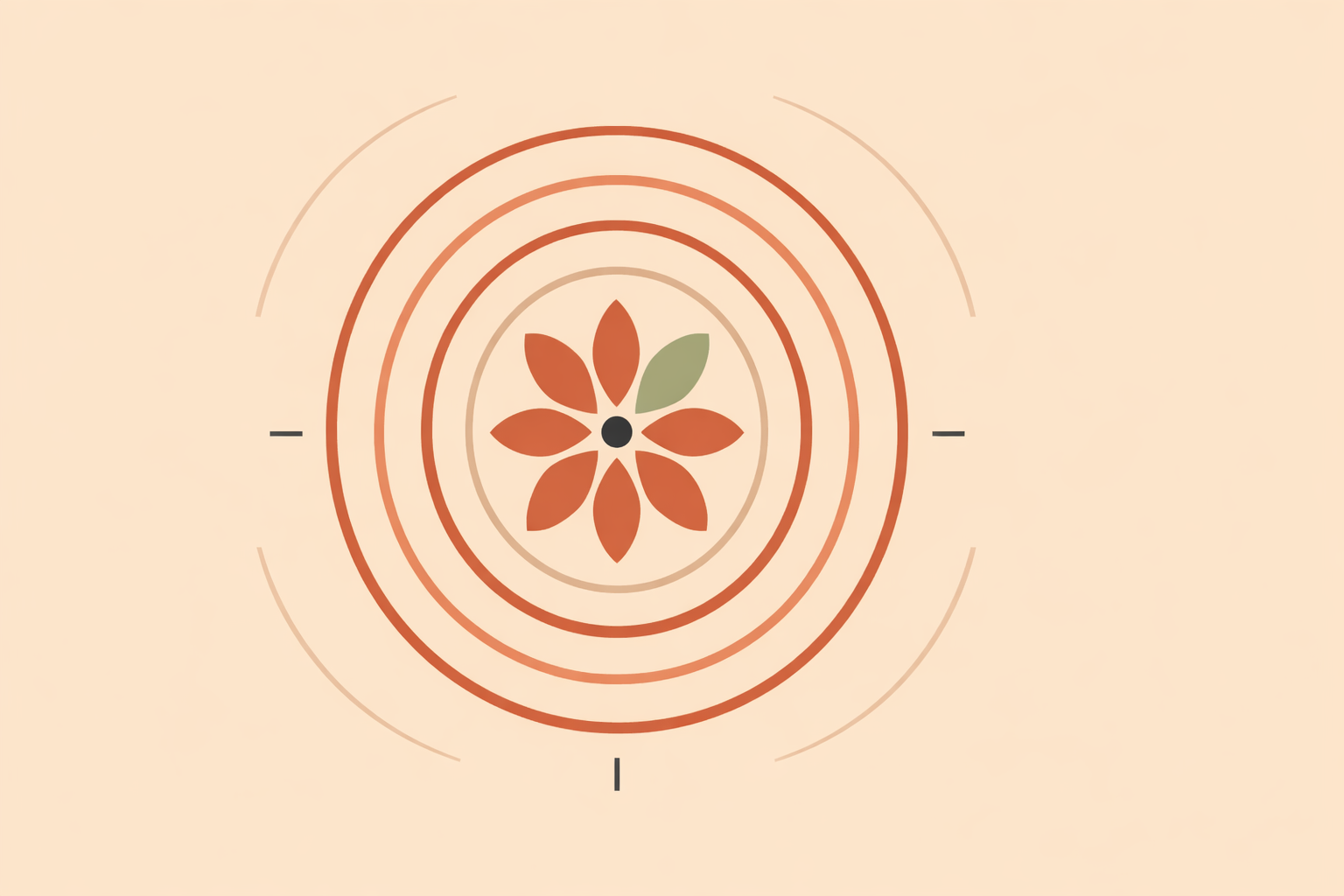
Draw the outer circle with a compass or trace a mug. Mark a center point, then add three to five light rings. Next, create a basic grid by drawing vertical, horizontal, and diagonal lines through the center to form evenly spaced sections.
This stage matters because it gives the page orientation. Instead of inventing an image, the client responds to a clear structure, and that steadiness carries into the next step.
A spoken walkthrough might sound like this:
- “Let’s draw one light circle.”
- “Now mark the center.”
- “Add three guiding rings.”
- “Then divide the circle with a few light spokes.”
Keep the tone relaxed. Precision isn’t required; the lines are guides. Near-symmetry often feels more welcoming than perfection.
Step 2: build repeating patterns ring by ring
With the frame in place, move into repetition. This is where the mandala starts to gather rhythm. Repeating motifs—dots, petals, arcs, lines, scallops—give the hand something predictable to do, and attention often settles as a result.
Offer only a few choices at a time. For example:
- Ring 1: dots, short lines, or seed shapes
- Ring 2: petals, arches, or triangles
- Ring 3: scallops, leaves, or zigzags
This gradual build keeps momentum without flooding the person with options. It also lets you respond in the moment: simplify if tension rises, or add detail if engagement deepens.
Many people prefer structured shapes to open-ended storytelling, particularly at the start. That preference matches reports of greater relaxation with structured mandala work than with more open-ended drawing tasks.
Counting can reinforce rhythm: “one motif in each section” or “two petals between each pair of spokes.” When the pattern becomes steady, the process begins to carry the person forward.
Step 3: bring in color and texture carefully
Introduce color simply. Start with two or three options, not the full pencil case. You might suggest one color near the center and another for outer rings, or an alternating pattern across sections.
With clear structure, color can improve mood and deepen the settling quality of the practice. Keeping the palette limited helps color feel supportive rather than pressuring.
Texture changes the tempo of the drawing. Hatching, stippling, and soft shading each ask something different from the hand. Many practitioners notice that short, even marks help some people feel more collected, while broader shading helps others soften and feel more grounded. Let the client’s response lead.
Personal symbols can be invited, but they don’t need to take over. A small wave, a seed-like shape, a star, or a repeated leaf form is often enough. Meaning can arise on its own without being forced.
If someone gets stuck choosing a color, slow down the moment rather than explaining more. Offer three pencils, let them pause with each, and allow preference to emerge in the quiet.
Guide reflection without taking over meaning
Reflection lands best when it starts with description. Before asking what the mandala means, ask what the person notices. That keeps the experience anchored in what’s present and reduces practitioner projection.
This descriptive-first approach aligns with client-led meaning practices in expressive work: stay close to what is visible before moving toward interpretation.
Useful opening questions include:
- “What do you notice first?”
- “Where does your eye go?”
- “Which part feels busiest?”
- “Which part feels quietest?”
If the client wants to go further, you can then open a gentle symbolic layer, including a more careful way of sharing shape meanings:
- “Do any of these shapes feel personally meaningful today?”
- “Does any part of the page echo something from your week?”
- “Is there a section you feel drawn toward or away from?”
This sequence keeps reflection spacious. Your role is to witness carefully and support the client’s own connections, not to decode the drawing.
To close, offer choices about what happens to the mandala. Options to keep it, photograph it, or leave it with you can support autonomy and help the experience settle.
Adapting the process across ages and settings
The core sequence—framework, pattern, color, reflection—translates across many settings. What changes is usually the scale, the tempo, and the context.
This structure has shown good feasibility across different adult contexts, and it also adapts smoothly for younger participants, groups, and online sessions.
For younger participants:
- Use a larger circle
- Reduce the number of rings
- Offer chunkier tools
- Keep reflection short and concrete
For groups:
- Use shared timing cues
- Demonstrate each step clearly
- Normalize different outcomes from the same instructions
- Keep sharing optional and brief
Even with the same steps, mandalas naturally vary. That mix of shared structure and individual expression is part of what makes the practice so workable.
For online settings:
- Send a printable template in advance if possible
- Use a top-down camera view for demonstrations
- Keep instructions slow and specific
- Describe visual actions aloud as you draw
Most adaptations can be handled through three practical levers, consistent with guidance to adapt context while preserving core elements:
- Scale: larger or smaller tools and shapes
- Tempo: shorter or longer time in each ring
- Context: language, examples, and cultural framing suited to the setting
Across formats, cultural care stays central. If you reference specific lineages, do so accurately and with restraint. Often, the most respectful option is inviting participants to work with forms and symbols rooted in their own lives, rather than borrowing sacred imagery from traditions they don’t belong to.
Keep the practice simple enough to repeat
The real strength of step-by-step mandala drawing is repeatability. A clear structure makes it easier to offer consistently, refine your guidance, and learn what supports different people.
Keep a short version ready: one circle, two rings, two motifs, two colors, and a few minutes of reflection. That’s often enough to create a noticeable shift without making the session feel heavy.
If it suits your style, track a brief pre- and post-rating to see what changes over time. Using repeated steadiness scores can guide practice, especially alongside a short client note about what felt supportive or difficult.
Over time, you’ll see patterns. One person settles with dots and soft shading; another responds best to larger petals and a slower pace. The framework stays the same, while your guidance becomes more precise.
A circle can be a modest thing, yet it often becomes a place to land. Keep the steps clear, keep the choices kind, and let rhythm and repetition do their quiet work within spirituality and ritual practices or more focused sacred geometry work.
Study Sacred Geometry
Deepen your mandala work with structured pattern principles in the Sacred Geometry Certification.
Explore Sacred Geometry →