With adult clients, the default move is familiar: book tutoring, assign worksheets, and watch for progress on a test. Then the same client misses a bus, freezes at the till, or avoids opening a bill, and the lesson never touches the moments that actually derail their week. Dyscalculia and math anxiety tend to show up as overload during ordinary tasks, not just as wrong answers in a quiet room.
In real life, tools get labeled “cheats,” confidence drops, and clients start to vanish between sessions. You can feel the gap: instruction is happening, but daily life is not getting easier.
What helps more is a shift toward lived support: build numeracy where adults actually make decisions, and measure progress by calmer days, steadier money habits, and more reliable travel. The work blends skill, disposition, and environment. Instead of adding more abstract practice, build better scaffolds inside the tasks that matter.
Key Takeaway: Adult numeracy support works best when it is built into everyday decisions rather than tutoring alone. Start with the person’s week to identify real pressure points around time, money, and movement. Then normalize calculators, checklists, timers, apps, and visible prompts as standard scaffolds; turn recurring demands into repeatable micro-routines; keep cognitive load low; and co-create a small personal system the client can rely on. The aim is not perfect number performance but more ease, confidence, and steadiness in daily life.
Start with the person’s week, not a worksheet
Start by mapping where numbers already appear. Ask the client to walk you through a typical week and notice where time, money, measurements, and movement begin to stick.
Keep questions concrete:
- Where do numbers slow you down?
- What do you avoid because it feels confusing?
- Which moments create the most stress: shopping, bills, lateness, directions, receipts, schedules?
- What already helps, even a little?
This approach fits what many adults describe: money, time, directions often become repeated friction points. You’ll hear familiar patterns around shopping totals, budgeting, timekeeping, and travel planning, plus difficulties comparing prices or estimating how long tasks will take.
Brief think-alouds often reveal more than formal testing. Ask, “When you look at this receipt, what pulls your attention first?” or “At what point do you start to lose the thread?” You’ll see where overload begins and which supports will actually fit.
Also look for inherited or cultural strategies already working in the person’s life. Labeled jars, envelope systems, visual tallies, routine market lists, and family ways of tracking shared resources are practical wisdom with real staying power.
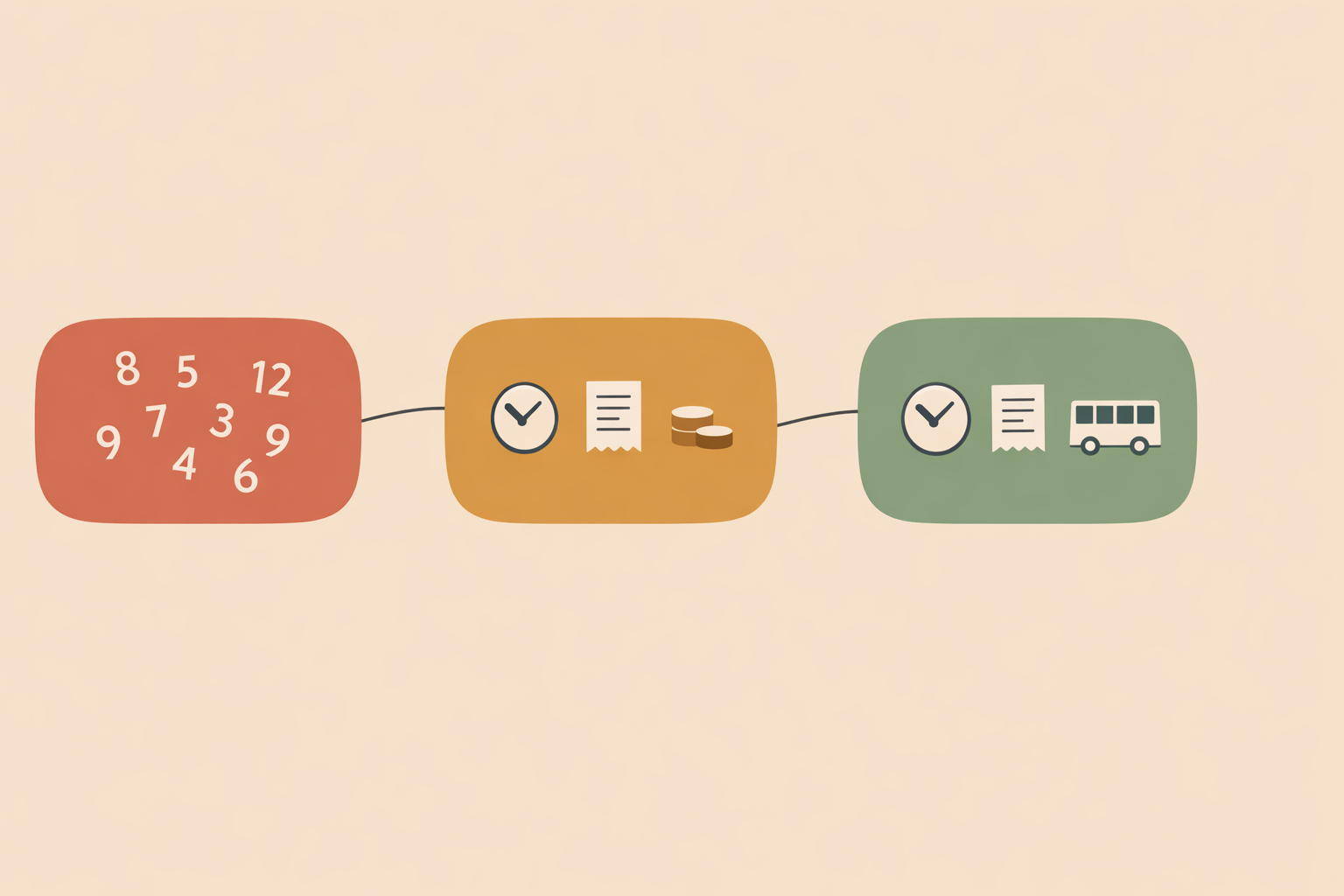
Concrete move: Make a one-page week map with three columns: Time, Money, Movement. Add specifics (“leave by 7:45,” “£15 groceries,” “Bus 8:10”), circle the two biggest pressure points, and begin there.
Treat tools as scaffolding, not cheating
The fastest way to reduce overload is often to stop asking the brain to hold everything alone. Tools are part of how many adults become steadier and more independent with numbers.
Useful supports can include:
- calculators for all number tasks
- written step-lists
- saved phone notes or templates
- budgeting apps
- timers and alarms
- calendar reminders
- conversion charts
- visible prompts in the environment
For many adults, calculators and checklists reduce unnecessary cognitive burden right away. The goal is a doable task that gets done, not a performance of effort.
Written prompts are especially supportive because they keep only one action in view at a time. A bill-paying checklist, a shopping template, or a short note like “open app → check amount → confirm account → send → review” can prevent the mid-task “blanking” that stops progress.
Time support often needs to live outside the mind, too. Alarms, visible timers, and padded estimates tend to work better than relying on “keeping an eye on the clock.”
The environment can carry part of the load. A tray for incoming bills, a folder for paid receipts, or a launch point by the door removes friction before it starts.
Concrete move: Create a leave-home station with a short card: Keys → Wallet → Pass → Headphones → Open Maps. Put it by the door and pair it with one alarm that says “shoes on now.”
Turn number-heavy tasks into repeatable micro-routines
Adults usually do better with small, repeatable routines than broad instructions. A recurring task becomes less stressful when it has a visible beginning, middle, and end.
Think in micro-routines such as:
- check the account balance before paying a bill
- enter the shopping budget before leaving home
- open the route and set the leave-time alarm the night before
- use the same order for splitting a dinner bill every time
It also helps to move gradually from concrete experience to symbols. Coins, measuring cups, printed tickets, price labels, and number lines make quantity tangible and often steady attention long enough for confidence to return.
Add a simple “Do → Check” ending to routines. After the action comes a calm second glance: right amount, right account, right date, right bus. This catches avoidable slips without tipping into perfectionism.
Concrete move: For paying a bill, make a five-line card: Open bill → Match name → Match amount → Pay → Check confirmation. Use the same card every time until it feels familiar.
Reduce cognitive load first
When someone is overloaded, even simple number tasks can feel impossible. Anxiety and distraction can disrupt working memory and make decisions less reliable. Research on math anxiety links it to working memory interference, which closely matches what many practitioners observe.
Reducing cognitive load is often the most supportive first move. Keep the task visually clean, slow the pace, and let one scaffold do its job before adding another.
Useful adjustments include:
- closing extra tabs and windows
- muting notifications
- working from one written prompt at a time
- keeping materials physically visible
- choosing one goal for the session
- pausing early when confusion starts rising
Introduce support at the first sign of confusion rather than waiting for a full freeze. Early scaffolding protects attention and keeps the task within reach.
Concrete move: If a client freezes during an online payment, close everything except the bank tab and the bill. Place a sticky note beside the screen: “Match amount first.”
Support math anxiety through language, pacing, and short practice
Adults don’t arrive with number habits alone; they arrive with history. Many have spent years hearing they are careless, incapable, or “bad with numbers.” Respectful support makes room for that reality while still moving forward.
Language matters. Calm, practical wording often works better than correction-heavy phrasing:
- “Let’s slow this down.”
- “We only need the next step.”
- “The checklist can hold this for us.”
- “Let’s make the task easier, not harder.”
Short, structured practice tends to land better than marathon sessions. In learning and coaching, distributed practice is linked to better retention than cramming, and adults often feel the difference immediately in their stress levels.
A simple rhythm can help:
- 5 minutes to settle and set up
- 10 to 20 minutes on one real task
- 5 minutes to review what helped
- 1 small repetition planned before the next session
This keeps momentum without exhausting the person. Repeating one calmer grocery trip three times often builds more confidence than one long session filled with strain.
Concrete move: Keep a visible script for rising stress: “Pause. Breathe. Name the next step. Open the tool. Continue slowly.” Reuse it until it feels familiar.
Build practical systems for money and time
Money and time are where many adults feel dyscalculia most sharply. When those two areas become steadier, the whole week often feels more manageable.
For money, simplify and automate carefully. Many adults benefit from automated payments, low-friction tracking, and a separate place for bills. Practical guidance commonly includes automatic bill payments. Pair automation with a small buffer so payments don’t hit the account too tightly.
Bucket-style budgeting can be grounding too. “Bills,” “Weekly,” and “Flex” is often enough. Visible separation reduces decision fatigue because each pot has a job.
For time, rely on anchors rather than estimation. Fixed reference points (leave by 7:45, commute 35 minutes, lunch 30 minutes) reduce guesswork. Timers and alerts make duration external, which is often far more workable than relying on internal time feel.
Concrete move: Set up three money buckets named in plain language or with emojis, and pair them with one weekly check-in. For time, choose three daily anchors and put them into the calendar with alerts.
Help the client build a personal numeracy operating system
What lasts is rarely a stack of lessons. What lasts is a small system the person can return to under pressure.
A personal numeracy operating system might include:
- one calculator app they trust
- one bill-paying checklist
- one shopping template
- one travel routine
- three regular alarms
- two or three anchor numbers that matter every week
Used consistently, these pieces can increase confidence and independence in everyday numeracy. The system doesn’t need to be perfect; it needs to be familiar.
Keep it small enough to live with. Start with the highest-friction task, make it reliable, then expand slowly.
It helps to take the long view. Dyscalculia is widely understood as a lifelong difference, so sustainable support matters more than one-time fixes. Success also needs to be defined by the person: paying bills without dread, getting to work on time three days in a row, or completing the shop without panic can all be meaningful milestones.
Most cautions come down to pacing and fit. Keep supports respectful, avoid overwhelming the person with too many tools at once, and treat stress signals as guidance to simplify. Over time, modest scaffolds often become the rails that make an ordinary Tuesday feel workable again.
Explore Dyscalculia Support Coaching
Build practical, low-load support plans with the Dyscalculia Support Coach Certification for real-world time, money, and travel routines.
Explore Dyscalculia Support →