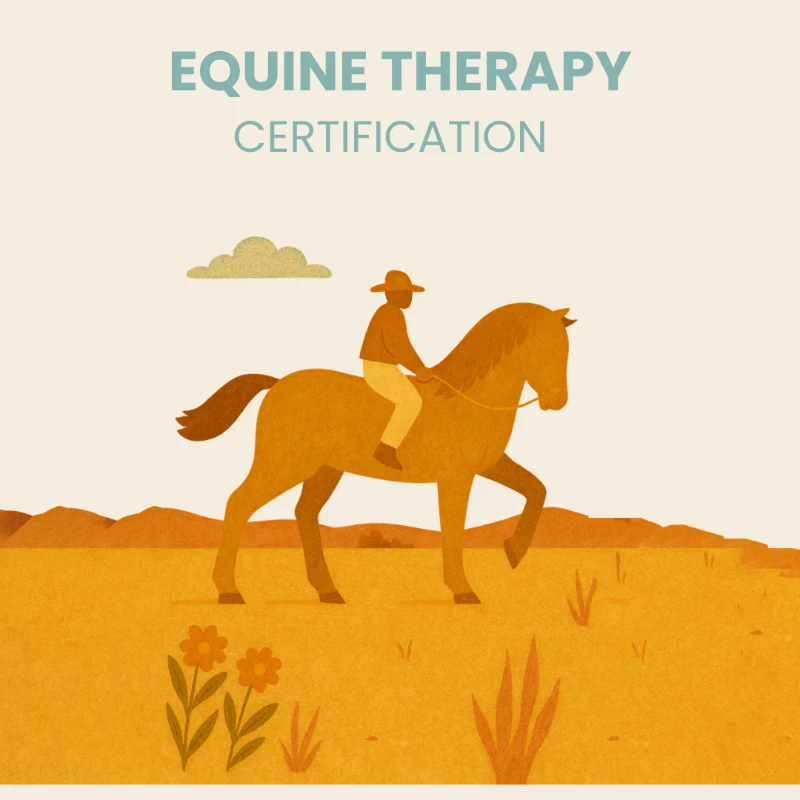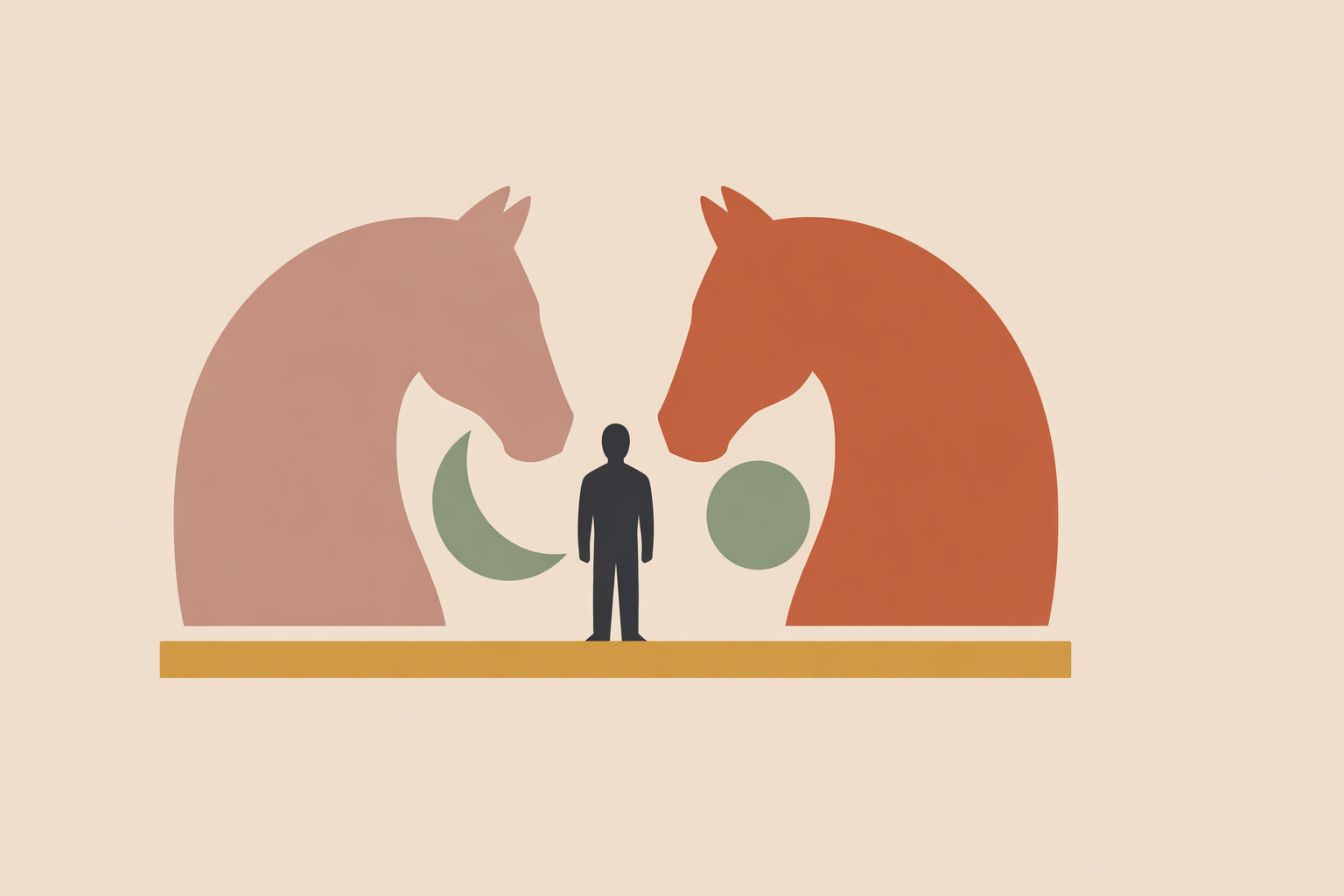
Starting an equine-assisted practice is, at its heart, an act of stewardship: sharing the quiet, regulating presence of horses with your community. Held well, people often arrive scattered and leave steadier—more connected to breath, body, and the living intelligence of the herd. Practitioners regularly describe the herd’s calming effect on highly anxious participants.
That settling is often supported by simple, rhythmic tasks. Grooming, leading, and other repetitive movements can support nervous regulation, creating a felt sense of calm that can carry into everyday life.
Horses also tend to reflect what’s happening inside us. Many ground-based programs observe that horses can mirror emotions, offering real-time information about intention, tension, and presence. Because it’s largely experiential, this work can feel more accessible for people who don’t connect with talk-heavy formats.
As Dr. Allan J. Hamilton famously put it, horses are “divine mirrors.” Build your practice around that truth—so your work stays ethical, resilient, and supportive for both humans and horses.
Key Takeaway: The most sustainable equine-assisted businesses are built on clear scope, ethical horse-first systems, and a safe, consent-based client journey. When welfare, training boundaries, and practical operations align, the work stays resilient and supportive for both the herd and the people it serves.
Clarify Your Why and Root Your Equine Practice in Relationship
The practices that last are built on a clear why—one that honors horses as sentient partners and keeps relationship at the center. When that foundation is strong, later decisions about services, facilities, pricing, and pacing become simpler and more aligned.
Horses teach through presence. Many equine-assisted approaches describe horses as living feedback—responding to human emotion and behavior in ways people can feel immediately. As Linda Kohanov writes, “Horses help us to learn about ourselves,” which is often exactly what participants are seeking: self-awareness that is embodied, not merely intellectual.
Over time, families and communities often describe steadier coping and deeper confidence. One parent shared that horse time helped their child “manage and overcome many obstacles,” a reminder of what consistent relationship can nurture (family experience).
Honouring horses as teachers, not tools
Let your vision include mutual benefit, not one-sided “results.” Ethical guidance for human–animal interaction emphasizes mutual benefit as a core design principle. Many traditional horsemanship lineages have carried this for generations: the horse as relative, teacher, and partner. Start there, and your boundaries, session pace, and daily decisions naturally become more respectful for everyone involved.
Choose Your Equine-Assisted Service Model and Scope
Scope is protection. When you’re clear about what you offer (and what you don’t), you safeguard your herd, support participant trust, and make collaboration far easier.
A helpful distinction is between coaching/learning services and regulated clinical services. The EQUUS Foundation clarifies that regulated services belong with appropriately licensed professionals, while many equine programs focus on learning, horsemanship, and personal development. Ethical guidelines also call practitioners to work within scope and training, building equine-specific competence before integrating horses into client-facing work.
For many businesses, the heart of the offering is unmounted, ground-based work: grooming, leading, boundary setting at the rope, and herd observation. These non-riding sessions often create the kind of practical, embodied learning that people can’t “think” their way into. Many facilitators notice the deepest learning happens when participants can do, feel, and reflect—rather than explain themselves perfectly.
These experiences can also complement other supports. As Temple Grandin reminds us, “Horses can help us to develop a sense of trust, empathy, and compassion.”
Coaching, learning, and clinical partnerships
Choose a service mix that matches your training and your community’s needs. Many programs focus on equine-assisted coaching and learning, horsemanship, and adaptive riding, while maintaining strong referral pathways when regulated services are needed. Others co-create dual-facilitator offerings with licensed partners. What matters most is clean boundaries, shared ethics, and transparent communication.
Set Up Ethics, Legal Structure, and Everyday Protection
Integrity is felt long before it’s spoken. Your ethical framework, paperwork, and legal structure are how people and horses learn they can trust your program.
Start with ethics and welfare. Field guidance emphasizes equine welfare, participant safety, and mutual benefit. EQUUS Foundation guidance also centers welfare standards when designing workload and programming. Put those principles into daily practice: rest days, reasonable session limits, choice for the horses, and clear stopping rules when a horse signals “enough.”
Then set up your operational basics. In many regions, that includes an IRS EIN, forming an LLC (or similar structure), and obtaining local licensing. Because equine activities carry inherent risks, specialized equine liability insurance is widely recommended—ideally through providers who understand equine-assisted work.
Strong informed consent is part of respectful practice. Clear documents should describe inherent risks, safety rules, emergency procedures, goals, and boundaries, supported by plain-language consent documents. Pair paperwork with a simple, repeatable orientation so participants know how to move around horses safely.
“The patience, knowledge, compassion and non judgmental support...were always with me.”
That felt sense of safety becomes the container where meaningful change can unfold.
Ethical frameworks and informed consent
Write your commitments down, then make them real: equine-first scheduling, consent-based participation (for humans and horses), and transparency about what your services can and can’t offer. Revisit policies as your herd, team, and community evolve.
LLCs, permits, and insurance
Keep admin steady and simple: one organized home for documents, calendar reminders for renewals, and a small circle of trusted advisors (equine-savvy attorney, accountant, insurance broker). In this work, consistency beats complexity.
Design a Facility Where Horses and Humans Can Thrive
Your space shapes the experience. A calm, well-planned facility makes safety easier, reduces stress on the herd, and helps participants arrive with less friction.
Start with the fundamentals: zoning, safe access, and enough land to care for horses well. Many start-up resources suggest roughly acres per horse as a planning baseline, adjusted for your climate and management style. Build outward with secure fencing and gates, non-slip footing, and a layout that separates quiet areas from busier zones. If you offer mounted work, plan for mounted access considerations such as ramps and level pathways.
Equine welfare remains the anchor. Guidance highlights fairness to horses—avoiding overwork, respecting age and comfort, and matching activities to temperament and capacity. Support that with calm, progressive training so horses feel safe with close human contact and everyday unpredictability. When turnout, shelter, and social groupings support natural behavior, sessions tend to feel calmer and clearer for everyone.
Plan to reassess regularly. Ethical practice includes ongoing monitoring of equine suitability over time. And since horses are often deeply responsive to human emotion, a quiet, well-considered environment is a form of respect they can feel.
Location, zoning, and accessibility
Choose details that widen the welcome: clear signage, a calm waiting area, gender-inclusive restrooms, and pathways that support mobility devices. Shade, seating, and sensory-friendly zones are not extras—they’re part of real inclusion.
Selecting and preparing horses as partners
Create clear criteria for herd members—temperament, age, and physical comfort—and introduce program work gradually. Retire or reassign horses proactively as needs change, and keep listening for what each horse communicates about the work.
Build a Team That Honors Tradition and Professional Standards
Strong programs are carried by strong teams. The best teams blend traditional horsemanship wisdom with clear roles, consistent communication, and ongoing skill-building—so the experience stays grounded for humans and horses.
Many programs use a dual-facilitator model: an equine specialist focused on horse behavior and safety, alongside a human-services professional focused on the participant’s process. Guidance highlights the distinct equine specialist role in handling, behavior, and risk management. For adaptive riding, driving, or vaulting, choose instructors known for welfare-centered instruction and discipline-specific competence.
Ethical codes also emphasize ongoing supervision and continuing development as your work deepens. Alongside formal learning, honor the traditional lineages that shaped your horsemanship—elders, mentors, and community knowledge—while staying mindful not to extract from cultures you don’t belong to. As Pat Parelli puts it, “Horses have a unique ability to teach us about leadership and the importance of communication.”
Core roles and collaborative models
- Equine specialist: Safeguards horse welfare, reads herd dynamics, manages risk, and co-designs sessions.
- Coach/facilitator: Holds the human learning arc, somatic awareness, reflection, and integration.
- Collaborating professionals: Licensed partners for any regulated services, plus bodyworkers, farriers, veterinarians, and cultural advisors.
It’s also wise to take an honest inventory of your capacity. Guidance in this field consistently notes the physical and emotional demands of the work, especially across seasons. A sustainable team plan protects your long-term presence—and your horses’ well-being.
Plan for Longevity with Budgets, Pricing, and Systems
In equine work, numbers are part of care. A clear budget and simple systems protect your energy, your staff, and your herd’s stability.
Map your start-up and first-year costs: legal setup, insurance, land or facility costs, fencing and footing, equipment, training, marketing, wages, and day-to-day horse care. Practical resources recommend creating a detailed start-up budget and getting accurate insurance quotes from equine-informed providers. If you lease your facility, it helps to negotiate clear, multi-year leases that spell out responsibilities like repairs, manure management, and fencing.
From there, price for sustainability—not optimism. Include herd care, admin time, professional development, supervision, and realistic no-show buffers. Some resources share indicative team rates to help you start modeling, but your final pricing should reflect your actual costs and the quality of support you provide.
Finally, set up lightweight systems you’ll be grateful for later: inquiry-to-intake workflows, session templates, herd workload tracking, and a simple cash-flow view. Build in time off and cross-training so the program isn’t dependent on one person. Experienced practitioners repeatedly point to the ongoing demands of the work—so plan for recovery as carefully as you plan for delivery. As Viggo Mortensen says, “Go slow to go fast.”
From start-up costs to sustainable pricing
- List each cost line once, then add a modest buffer so surprises don’t compromise horse care or safety.
- Price your core offering to be genuinely sustainable; if you offer sliding-scale or sponsored spots, fund them intentionally.
- Protect cash flow with deposits, clear cancellation policies, and waitlists.
Design a Safe, Somatic, Experiential Client Journey
A strong client journey is simple and body-aware. It begins before the first visit, stays consistent in the paddock, and supports integration afterward—while honoring consent, culture, and the horse–human relationship throughout.
Start with intake and orientation. Legal guidance recommends clearly describing inherent risks, safety rules, emergency procedures, privacy, and communication boundaries in your consent forms. Then make it practical: demonstrate safe approaching, grooming basics, and how to pause when anyone—human or horse—needs space.
In session design, many facilitators lean into ground-based work. These ground-based sessions can support embodied learning through leading, grooming, and herd observation. Over time, equine-assisted learning has been associated with improved emotional regulation, self-awareness, and life skills—especially when it complements other support systems.
Horses often offer honest, immediate responses. That can become powerful material for reflection—especially when a horse’s approach or resistance becomes feedback about what’s happening in the moment.
“After the first session I was amazed by how standing with the horses in the pasture and interacting or just observing their interactions with me and each other brought such real, tangible, and instant feedback on my own state of mind and on relationship dynamics.”
For many communities, the non-verbal nature of this work feels especially welcoming. It has less verbal dependence, inviting learning through outdoor experience rather than perfect words.
Intake, consent, and risk management
- Before arrival: Send clear directions, clothing guidance, and sensory notes (dust, manure, animal sounds).
- Onsite orientation: Teach boundaries at the rope, where to stand, how to read basic signals, and how to pause.
- During sessions: Assign roles, track herd signals, and build in water-and-breath breaks.
- After sessions: Offer a short debrief plus integration prompts (journaling, noticing practices, simple routines).
Crafting sessions that honour body, emotion, and culture
Design for choice. Offer multiple ways to participate—watching from outside the fence, grooming, leading—so people can stay within their “window of tolerance” (their workable range for feeling safe and present). Keep it consent-based for the horses as well, so their “yes” stays real. Welcome participants’ own cultural practices—gratitude, silence, song—without borrowing from traditions that aren’t yours.
Conclusion: Let Your Equine Therapy Business Evolve With the Herd
The most enduring equine-assisted practices behave like living systems. A clear why shapes your scope; scope guides ethics and structure; structure supports a safe facility and herd; that safety supports strong facilitation; and sustainable finances keep the whole ecosystem steady.
As your experience deepens, your practice should keep refining. Best-practice guidance encourages continuous reflection, grounded in ethical basis and the principle of mutual benefit. Keep listening to your herd, your participants, and the wider field—and let what you learn shape your next iteration.
Lead with care and respect. As Shannon Knapp reminds us, “Horses are incredible teachers of forgiveness, acceptance, and unconditional love.” Build from that center, and your practice can endure—supporting your community with skill, steadiness, and heart.
Train as an Equine Therapy Practitioner
Build ethical scope, safety, and session design with the Equine Therapy Practitioner course.
Explore Equine Therapy Practitioner →