When low mood enters the room, many practitioners instinctively add more talking: another reframe, another explanation, another worksheet. Yet depressive states often reduce language, initiative, and ease in one-to-one conversation. You can keep offering good prompts and still feel the session thinning out.
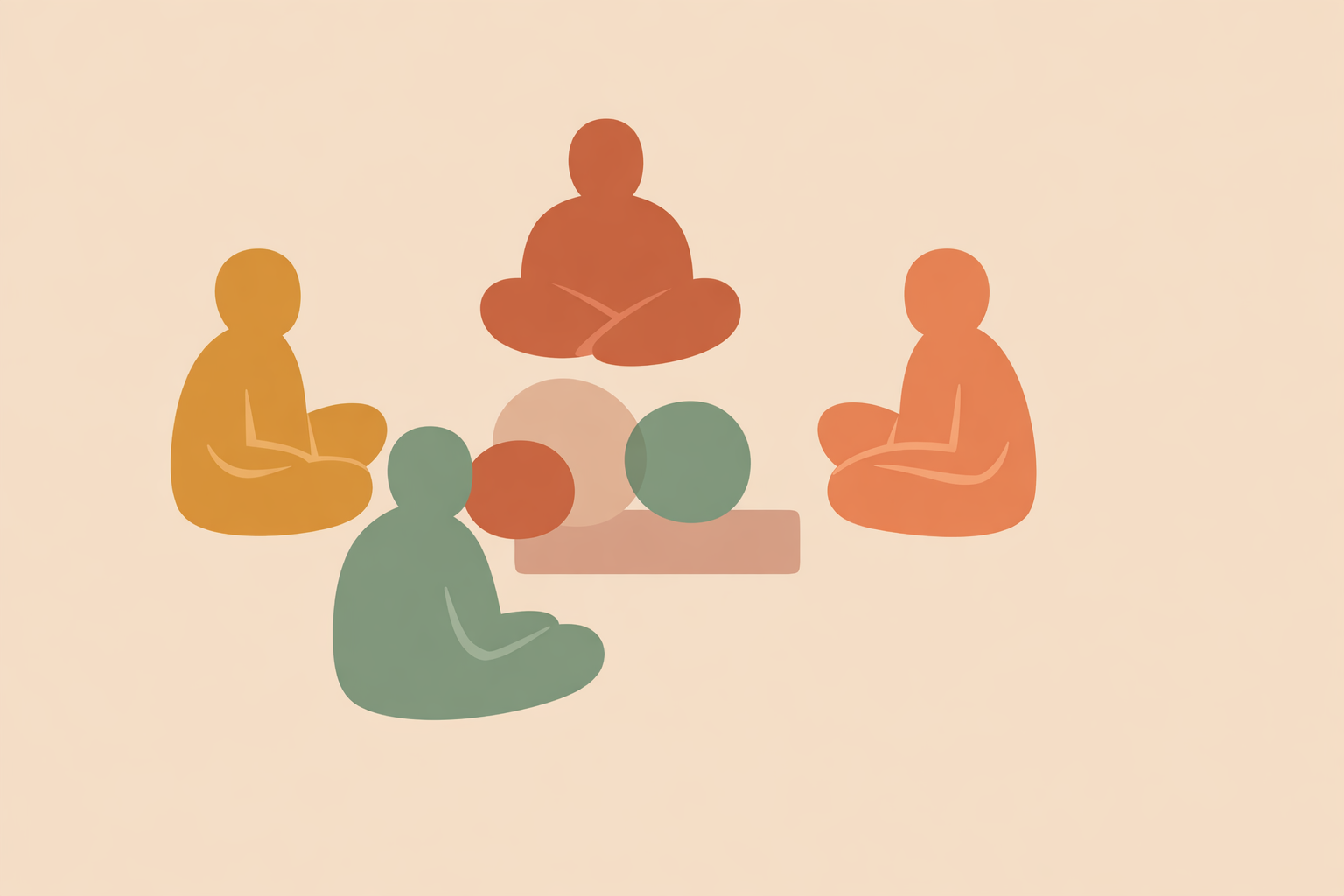
In practice, the issue is often the container holding the work. Small-group art therapy shifts that container in a grounded way. When you combine image-making with a predictable circle, people aren’t asked to rely on verbal fluency alone. Hands can move before words arrive, and silence becomes shared rather than isolating.
Meaning can emerge through color, shape, texture, and gentle witnessing. That change is often enough to make new forms of participation possible.
Key Takeaway: Small-group art therapy supports low mood by combining making, witnessing, and shared meaning inside a steady, low-pressure structure. The group format can reduce isolation, ease the burden on verbal processing, and help people reconnect with energy, choice, and self-recognition through simple creative practice.
Why small-group art therapy works well for low mood
Small groups offer something one-to-one work cannot always provide: shared presence without the pressure to perform. For people moving through depressive states, that matters. Low mood often narrows attention to loss, flattens the sense of self, and makes contact feel effortful.
In a small creative circle, no one has to carry the whole hour through speech alone. The prompt, the materials, and the group rhythm do some of the holding, so participation stays possible even on quiet days.
Evidence also points in this direction. Group-based arts interventions have been linked with improved outcomes for people experiencing depression and anxiety. Many facilitators recognize this immediately: when the room is structured around making, pausing, and witnessing, people often reach material that never quite arrives in a purely conversational setting.
Small-group art therapy is especially supportive because it can reduce isolation without requiring strong verbal ability. A review found group visual art expression supported meaningful emotional improvement in adults. Just as importantly, it creates a gentler social field. Participants can sit beside one another, make something, and feel a sense of belonging before they’re ready to explain themselves.
Traditional cultures have long understood the value of communal making during grief, transition, and inner heaviness. Shared craft and symbolic objects help restore belonging while giving experience a visible form. Small-group art therapy carries that thread forward in a contemporary, consent-based way: simple materials, clear agreements, and space for each person to work at their own pace.
Groups also protect facilitators from over-functioning. In one-to-one sessions, it’s easy to compensate for low energy by prompting more or trying to “lift” the room alone. In a well-held group, the structure supports momentum, and the facilitator guides rather than carries every moment.
Often, the shifts sound modest but matter deeply: “I could focus today.” “I felt something move.” “I didn’t feel as alone.”
How art-making shifts experience from within
Art-making engages attention, sensation, and meaning at the same time. Instead of asking someone to explain their inner world from a distance, it gives a direct way to meet it. The hands move, the body joins in, and color, texture, and form create a channel for feeling that doesn’t depend on polished language.
Research also supports what practitioners have observed for generations: visual art therapy can ease depressive symptoms in adults. Making images can interrupt familiar low-mood patterns by widening experience, so attention is no longer locked into one groove.
When hands move, attention often anchors in the body. Low mood can pull people into heaviness, looping thought, and passivity. A stick of charcoal, a brush loaded with color, or the pressure of pastel on paper gives the nervous system something immediate to meet.
Texture and color can also feel safer than direct disclosure. One study found clay art therapy was associated with stronger improvements than a visual art comparison activity, suggesting tactile, embodied making can be especially supportive for some people. Many participants find it easier to show despair as weight, mud, fog, tearing, or density before they can name it plainly.
Once an image exists, it can be witnessed. That’s often where personal narrative begins to reorganize. Someone may fill a page with dark marks, then notice a small opening of white space in one corner. That detail can become the start of a different self-story: not that everything is better, but that something in them is still orienting toward movement or possibility.
This is why art in groups can be deeply restorative. It gives experience form and relationship, and as the image becomes shareable, the person is no longer alone with what it carries.
A simple small-group format that lowers pressure
For a beginner-friendly group, keep the structure modest and predictable. Low mood usually responds better to clarity than novelty overload. A steady rhythm helps participants settle without guessing what’s expected.
A practical starting point is a 75- to 90-minute session with 6 to 8 participants. Evidence suggests structured multi-session formats can be effective for adults experiencing mild to moderate low mood. In day-to-day facilitation, this size is often large enough for resonance and small enough to hold with care.
A basic session flow might look like this:
- Arrival and settling: 5 to 10 minutes of quiet arrival, materials laid out simply, minimal demands.
- Grounding: 5 minutes of breath, body awareness, or sensory orientation.
- Making: 20 to 30 minutes with a clear, contained prompt.
- Witnessing and sharing: 20 to 30 minutes of optional reflection using supportive sentence stems.
- Closing: 5 minutes to name one word, one sensation, or one takeaway before leaving.
Prompts work best when they’re open enough for individuality but contained enough to reduce overwhelm. For example:
- A color that meets me in the morning
- The shape of my energy today
- What feels heavy, what still moves
- An inner weather map
You don’t need elaborate materials. Dry pastels, colored pencils, simple paint, collage paper, safe glue, and a few textured elements are often enough. Humble materials lower performance pressure and keep attention on process rather than product.
A clear sign the container is working is usually a softening of isolation. People often leave feeling less alone, more settled, or more able to notice themselves. Those are meaningful foundations for deeper change.
Useful mechanisms inside the group process
Several mechanisms are doing the work at once in a well-run art-therapy circle.
- Shared nonverbal experience: People participate together without needing to speak continuously.
- Embodied attention: The body and senses help stabilize focus.
- Symbolic expression: Feelings can be placed into image rather than forced into explanation.
- Witnessing without fixing: Others can notice and reflect without taking over the meaning.
- Narrative flexibility: New interpretations often emerge through the image itself.
Two techniques tend to work especially well. Non-dominant-hand drawing can soften perfectionism and rumination by making polished performance less likely. Descriptive witnessing in pairs or trios can also be powerful: participants describe shapes, colors, and textures first, and only then explore meaning. The image gets to lead.
Naming what appears in the image matters too. Once a person says, “This patch feels like the part of me that disappeared,” the experience becomes visible and workable. In groups, that naming is often strengthened by peers responding with care rather than analysis.
Over time, these moments add up. People begin to recognize not only pain, but also preference, impulse, contrast, humor, tenderness, and choice. They feel more resourced and more like themselves.
Who this format is for
In non-clinical settings, small-group art therapy is generally best suited to adults with low to moderate depressive states who can consent to the process, participate in a shared space, and remain reasonably safe between sessions. This aligns with research on mild to moderate states.
A brief pre-group conversation helps assess fit while staying warm and respectful. Useful questions include:
- What draws you to a creative group right now?
- How do you usually support yourself on difficult days?
- How do you tend to be in groups: quiet, expressive, hesitant, observant?
- Is there anything that would help this space feel workable for you?
This isn’t about gatekeeping. It’s about matching the person to the right container. Some people thrive with shared rhythm and gentle witnessing; others need different support before joining a group.
If someone is in acute crisis, highly destabilized, or unable to stay safe between sessions, a low-mood-focused art group isn’t the right setting. Clear redirection is often the kindest path, because this format is designed for supported exploration and steady relational work.
How many people, how long, and what structure tends to work
For most facilitators, 6 to 8 participants is a strong starting range. It offers enough diversity for resonance while preserving intimacy, and it leaves room for quieter members without draining the group’s energy.
An 8- to 10-week series of 75 to 90 minutes per session is a practical format for beginners. This matches broader findings that group arts interventions can create meaningful and lasting benefits when there’s enough continuity for trust to build.
A helpful arc looks like this:
- Weeks 1 to 2: orientation, agreements, sensory play, low-pressure prompts
- Weeks 3 to 5: themes of heaviness, energy, inner weather, and self-image
- Weeks 6 to 8: contrast, resource, relationship, and integration
- Weeks 9 to 10: consolidation, closing reflections, and transition
Keep the session shape consistent while letting themes evolve. Predictability supports safety, and small variations keep engagement alive.
Group agreements that make deeper work possible
The strongest groups don’t become safe by accident. They become safe because the culture is named, modeled, and revisited.
Co-creating agreements in the first session is one of the simplest ways to support that, especially in creative and expressive therapies. It helps participants feel the space belongs to them too, not only to the facilitator. Common agreements include:
- Speak from the “I”
- Respect each person’s image and pace
- Advice is optional, not automatic
- Silence is a valid form of participation
- Share stories outside the group only in ways that protect privacy
These basics shape the whole field. They reduce pressure and support dignity, making it more likely that people risk honesty rather than performance.
When the circle feels steady, participants often go deeper than they expected. They try something messier. They speak from the image instead of about it. They discover that being witnessed doesn’t automatically lead to judgment or correction, and that experience of belonging can last well beyond the final session.
Closing thoughts
Small-group art therapy supports low mood by offering another path in. Hands move, images hold what words can’t yet carry, and the group witnesses without rushing to fix. Over time, heaviness often loosens because something more spacious has been made around it.
This work doesn’t require elaborate materials or theatrical facilitation. It asks for clear structure, humane pacing, respectful agreements, and trust in the quiet intelligence of guided art-making and therapeutic arts process.
Cautions belong in good practice: screen carefully, be clear about what the group can and can’t hold, and have a plan for referral when someone needs more immediate support. Within those boundaries, a small circle, honest prompts, and steady rhythm can help people feel less alone and gradually more themselves.
That is the quiet strength of small-group art therapy: simple, communal, and deeply human.
Train in Therapeutic Arts
Build on these group art therapy foundations in the Therapeutic Arts Certification.
Explore Therapeutic Arts →