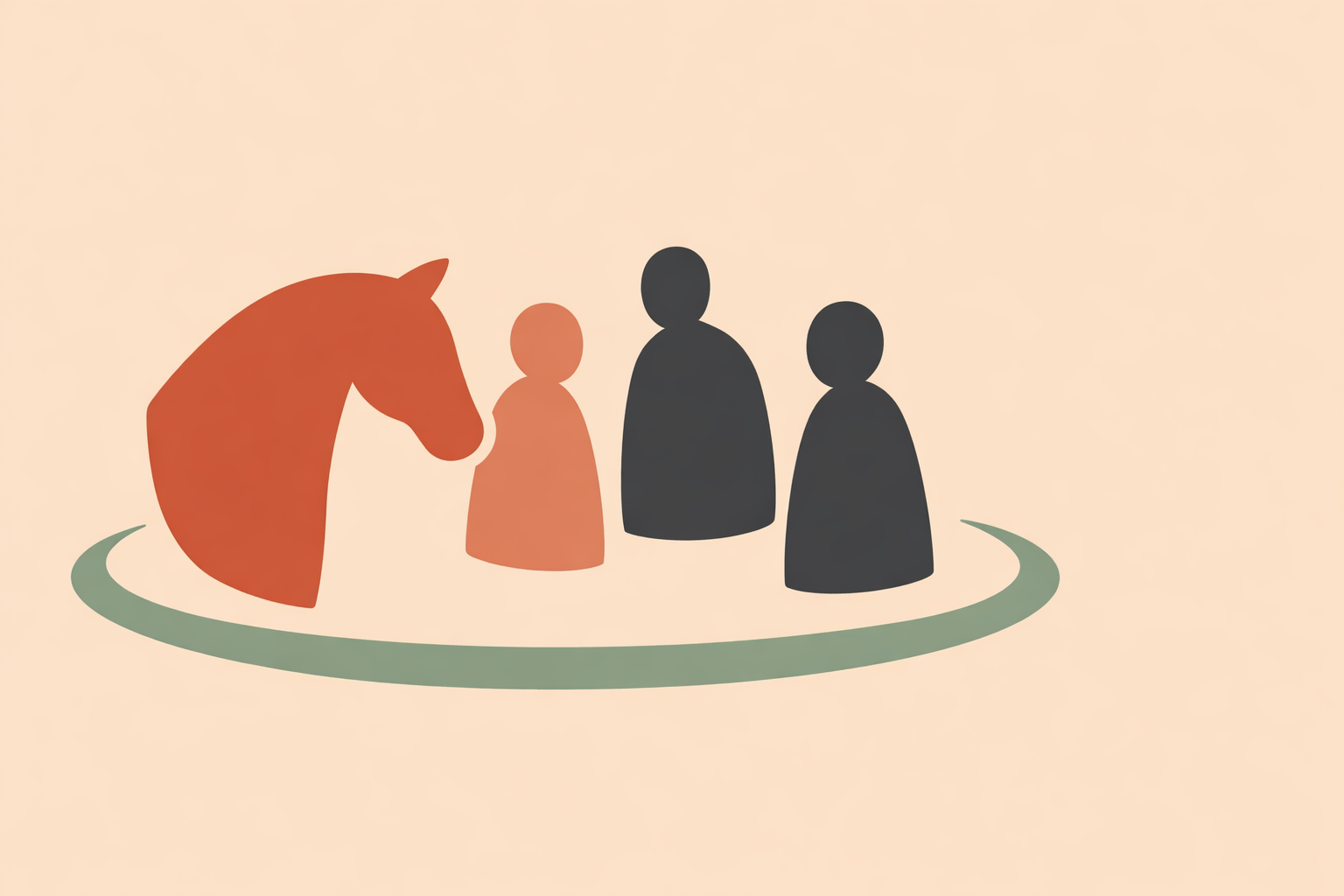
Most team-development work still happens in rooms built for analysis: slide decks, retrospectives, and frameworks meant to improve communication. Those tools can sharpen language, yet they can miss the in-the-moment behaviors that shape outcomes under pressure: pacing, presence, timing, and shared attention. In the arena, those patterns show up quickly. A horse responds to what a group is doing, not what it says it values, and that makes learning immediate.
Key Takeaway: Equine psychology can make team learning more embodied, observable, and practical. Horses respond closely to movement, posture, vocal tone, attentiveness, and space, which helps facilitators and teams notice how leadership and collaboration are being expressed in real time. The most useful sessions stay grounded in observable behavior, clear consent, and strong horse welfare, then translate what happens in the arena into simple, portable shifts in everyday teamwork.
Why Equine Psychology Works So Well for Team Development
Teams often try to resolve recurring patterns by talking about them. Conversation helps, but it doesn’t always change how people rush, interrupt, hesitate, or coordinate when the stakes feel higher. Equine work offers a live relational setting where those habits become visible without anyone needing to “perform insight.”
Practitioners regularly see teams land on steadier self-awareness, clearer signals, and leadership that feels more aligned. The impact comes from the horse’s immediate feedback and the facilitator’s skill in helping the group read the moment without turning it into a personal story.
A simple example shows why this sticks. A team lead strides forward while speaking quickly and cueing several people at once. The horse steps away. The lead slows down, checks that the group is ready, and approaches with clearer pacing. The horse stays engaged. The group doesn’t need a long debrief to understand what changed; they felt it.
That’s why arena-based learning often lands so strongly. Instead of discussing clarity, the team has to create it.
How Horses Read the World
Strong facilitation starts with the horse. Horses are highly responsive to patterns in their environment, and reviews suggest they’re sensitive to human posture, attentiveness, facial expression, vocalization, odor, and other cues. Small shifts that a team barely notices in itself can register clearly to the horse.
Many facilitators also see a reliable theme: sudden human intensity (even with good intentions) can create uncertainty, while slower, more coherent behavior supports ease. Research reviews echo the broader point that human communication can influence equine stress and arousal, especially when emotional tone is part of the interaction.
This is where traditional horsemanship brings real value. Long before modern terminology, skilled handlers learned to watch breath, rhythm, posture, proximity, and pressure. That “quiet noticing” remains one of the most dependable foundations for this work and for animal wellness.
At the same time, good practice requires humility. A horse moving away isn’t a verdict on a person. It can reflect sensory load, learned associations, herd dynamics, discomfort, or a simple preference for more space. Observation comes first; meaning comes second.
Reading Equine Cues Without Projection
The most useful arena insights come from what can be seen and described, not from interpretation. Reviews of equine behavior support tracking behavioral signs such as ear position, head carriage, muscle tension, approach, withdrawal, and other changes in expression, while noting that single signals need context.
Context is everything in the arena. Training history, environment, restriction, social setting, and temperament can all shape what you see. The facilitator’s job is not to announce what the horse “thinks” about someone; it’s to track what changed before and after a cue, then help the team connect their actions to the horse’s response.
A helpful translation pattern looks like this:
- Observation: “When three people stepped in together, the horse increased distance.”
- Pattern: “We may be moving faster than our coordination allows.”
- Experiment: “Let’s assign one lead, one spotter, and one tempo caller.”
- Learning: “With fewer mixed cues, the horse stayed with the group longer.”
This keeps the work grounded and protects both people and horses from projection. The arena gives feedback, and the feedback needs clean language.
What Horse Responses Can Reveal About Team Patterns
When a team speeds up, crowds space, or stacks too many cues at once, horses often withdraw, pause, or disengage. When a team softens, sequences requests clearly, and allows choice, connection becomes easier to invite. Practitioner experience supports this strongly, and welfare literature also recognizes the value of free-choice interaction and agency in shaping more positive horse–human encounters.
For teams, these moments often mirror familiar patterns far beyond the arena:
- too many leaders at once
- unclear role boundaries
- urgency replacing coordination
- strong intention without enough listening
- hesitation disguised as politeness
The horse doesn’t “diagnose” the group. The horse makes the pattern hard to ignore.
And because the learning is embodied, it tends to last. Teams remember what it felt like to shift from scattered effort to coordinated action, then they can recreate that state on purpose.
Designing Ethical and Well-Held Equine Team Sessions
Good design is the foundation. The best sessions keep consent, emotional pacing, and horse welfare at the center from the start, much as trauma-session red flags often show what happens when those basics slip.
For participants, this means genuine choice and clear expectations. Observing counts as full participation, and roles like observer, timekeeper, note-taker, or welfare monitor can be just as valuable as being closest to the horse.
It also means boundaries around meaning-making. Facilitators should not frame a horse’s behavior as personal judgment or symbolic “truth.” The work is strongest when it stays with behavior, impact, and experimentation.
For horses, the same respect applies. Sessions should be structured around agency, rest, and the least intrusive approach possible. Widely used guidance for equine-assisted services emphasizes minimally aversive methods and strong welfare standards, including attention to rest, movement, food, water, shelter, and freedom from prolonged stress.
A simple pre-brief can set the tone well:
- You choose your level of engagement.
- We focus on observable behavior, not character stories.
- If the horse signals uncertainty, we pause and adjust.
- Breaks matter for both humans and horses.
Cultural respect matters too. Many communities have deep, long-standing relationships with horses. If you include gratitude, silence, or other reflective elements, name them carefully, keep them optional, and avoid borrowing practices without context.
Simple Arena Exercises That Build Team Awareness
The most effective exercises are usually simple. Short, well-held activities reveal plenty, then leave time to integrate the learning.
1) Shared Walking, No Lead
- Invite 3 to 5 people into a safe enclosure with a horse at liberty.
- Ask the group to walk together so the horse chooses to accompany them for a few steps.
- Keep the first minute silent.
- Debrief around pace, spacing, and who was actually setting the rhythm.
2) Lead-and-Pause Clarity Drill
- One person leads softly while another tracks the group’s breath and tempo.
- The task is to walk, pause, settle, and continue without escalating pressure.
- If tension rises, the reset is to do less, not more.
3) L-Shape Coordination Exercise
- Create a simple path with cones.
- Assign clear roles such as lead, spacer, tempo caller, and welfare monitor.
- If mixed cues appear, stop and reorganize before continuing.
- Debrief around role clarity and how the team made decisions.
4) Observation and Distance Mapping
- Have participants notice what changes as they adjust distance, gaze, posture, or pace.
- Keep the focus on noticing rather than “getting a result.”
- Use this to build sensitivity before any more active task.
Groups are often surprised by how much a steadier exhale or a small posture change can shift the horse’s willingness to stay connected. That fine-grained awareness is one of the great strengths of this approach and sits close to the foundations taught in equine therapy certification.
Bringing the Learning Back to Everyday Teamwork
The arena matters most when teams leave with something they can use. Usually it’s a practical shift, not a grand insight.
Examples include:
- slow down before giving the next cue
- name roles before moving
- reduce the number of voices in a pressured moment
- pause when the system becomes noisy
- notice whether intention and impact match
These lessons often aren’t new intellectually. Equine work makes them real in the body, and that’s what helps teams repeat them when it counts.
Closing Perspective
Equine psychology brings team learning back to something immediate and honest. Horses respond to presence, pace, attention, and coherence in ways that help groups see themselves more clearly. When facilitators stay anchored in careful observation, respectful language, and strong welfare, the arena becomes a place of precise, practical learning.
Like good craftsmanship, this work doesn’t rely on mystique. It relies on solid horsemanship, skilled facilitation, and the discipline to let the moment speak for itself. With that foundation, even a small exercise can leave a team with something they can carry forward: clearer pacing, better coordination, and a more embodied sense of how to move together well.
Explore Equine Therapy Certification
Connect arena-based team insights to professional practice with the Equine Therapy Certification.
Explore Equine Therapy →