Facilitators who bring pattern work into groups often meet the same moment: participants arrive excited about spirals, someone names the golden ratio as a universal law, counts don’t match, and the room gets a little tight. Others want the beauty without the big claims. The real opportunity is to keep the wonder and turn it into pattern literacy people can use in art, design, and reflection.
A grounded Fibonacci session works best when measurement and symbolism are treated as two different languages. Teach a few reliable phyllotaxis basics, practice careful looking, and then make space for meaning without forcing one “correct” conclusion. That’s how the work stays inspiring and honest.
Key Takeaway: Responsible Fibonacci work combines pattern literacy with ethical facilitation. The most useful approach is to separate observation from interpretation, teach a few clear ideas about sequence, golden angle, and parastichies, and create a consent-based structure that leaves room for uncertainty. From there, groups can move naturally from counting and tracing into reflection, design experiments, and collaborative making without turning the spiral into a mythic certainty.
What Fibonacci Patterns in Nature Actually Look Like
Start with the sequence itself: 0, 1, 1, 2, 3, 5, 8, 13, and so on. In mathematics, successive ratios tend toward the golden ratio. From that comes the golden angle, about 137.5 degrees, a value often used in plant-growth models.
In those models, plant-growth models often use divergence angles near 137.5 degrees, and minimize overlap by spacing new growth away from what’s already there. For group work, the practical point is straightforward: repeated spacing rules can create elegant visible order without any top-down blueprint.
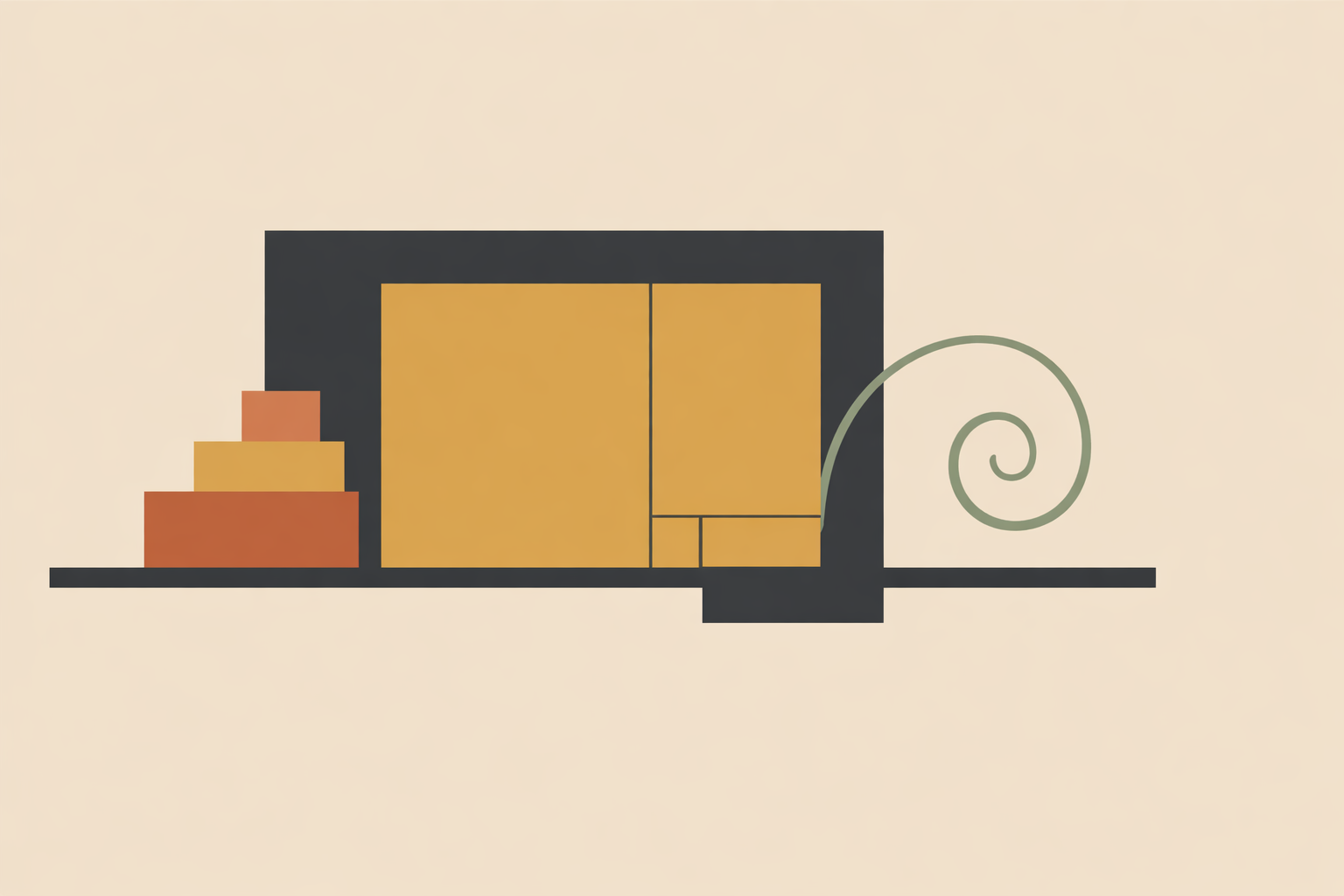
It’s also worth clearing up a common confusion. The familiar “Fibonacci spiral” is best understood as a teaching graphic: adjoining squares with quarter-circle arcs. In living forms, shells and seed heads often resemble logarithmic spirals more than that tidy classroom drawing.
What people often notice in sunflowers, pine cones, and agave are counter-rotating spiral families called parastichies. In many specimens, 8 and 13 (or 34 and 55) appear together as visible count pairs. These patterns are common, but they aren’t a rigid law. Phyllotaxis is better understood as a prevalent tendency with multiple expressions, including shifts between spiral and whorled arrangements.
Current plant science increasingly points to growth dynamics rather than numerology. In particular, auxin movement is considered a key process in shaping phyllotactic patterns, and visible spirals can emerge from local spacing effects rather than plants “knowing” Fibonacci.
For facilitation, that distinction keeps the tone clean: patterns can be remarkable without needing to be mystical proof.
How to Explain the Golden Angle Simply
If the group wants a hands-on explanation, draw a center point on paper and keep placing dots by turning roughly 137.5 degrees each time. After several placements, spiral families begin to show up. People feel the logic in their hands: a small repeated choice can build large-scale order.
Mathematically, emergent spiral families appear when new elements are placed repeatedly at angles approaching the golden angle. In practice, that means the pattern can be taught as a beautiful consequence of spacing rather than a secret code.
This is often where the room relaxes. The question shifts from “Is this a cosmic rule?” to “What happens when simple rules repeat over time?”
Preparing a Safe and Respectful Fibonacci Session
Lead with choice. Pattern work can be absorbing, but nobody needs to participate in the same way. An invitation such as “Join in if this feels supportive; observing is also welcome” establishes consent without making it heavy.
Before the activity begins, set a few agreements:
- Confidentiality: personal sharing stays in the group
- Respect: no fixing, no advising, no unsolicited interpretation
- Choice: anyone may pass on any part of the process
- Accuracy: observation and interpretation are not the same thing
Be transparent about your role. You’re guiding observation and inquiry, not delivering final meanings. If you use circular layouts or mandala-like structures, name inspiration carefully where known and distinguish a modern reflective exercise from living ceremonial practice.
Care for materials matters too. Use photographs, already-fallen cones, or gathered references where appropriate. This keeps the work grounded in reciprocity rather than extraction.
Two short phrases often steady the room: “If it helps, you might…” and “You’re welcome to pass.”
A 20-Minute Fibonacci Group Activity
Here is a simple flow that works in classrooms, workshops, studios, and community spaces:
- 2 minutes: quiet looking without counting
- 5 minutes: sketch or trace visible spiral families
- 3 minutes: count one direction, then the other
- 5 minutes: compare in pairs and note differences
- 3 minutes: optional symbolic association, one per person
- 2 minutes: closing observation or question
Normalize variety from the start. In one large sunflower-counting project, about 73.6% of reliably counted spiral pairs were Fibonacci numbers, while many others were not. That range helps participants stay curious instead of trying to force the specimen to “behave.”
When counting, keep the guidance concrete:
- Trace one visible spiral family all the way to the edge
- Then switch directions and count the other family
- Mark approximate counts if the outer ring becomes irregular
- Write “about” or “uncertain” when needed
You can support this process with established counting protocols drawn from phyllotaxis teaching practice. The goal isn’t a perfect answer. The goal is learning how to see, compare, and describe what’s actually there.
A useful facilitator line is: “Aim for approximate, not exact.”
Moving from Counting to Meaning
The cleanest bridge into reflection is to keep two languages side by side: one for what is observable, and one for what the pattern evokes.
For example:
- Observation: “I notice two spiral families, about 21 and 34.”
- Association: “It evokes steady unfolding.”
- Question: “What changes when I trust process more than control?”
This can be organized as a three-column page:
- Observation
- Association
- Question
It also helps to introduce a simple “claim ladder” so participants can hear the difference between levels of statement:
- Observable structure: “I traced 34 counterclockwise curves.”
- Math description: “That is a Fibonacci pair.”
- Scientific explanation: “Spacing dynamics near 137.5 degrees can support this arrangement.”
- Symbolic interpretation: “It feels like growth with room to breathe.”
- Overclaim: “This pattern guarantees transformation.”
That ladder keeps the work balanced. It protects imagination without turning personal meaning into a fact claim.
Design Extensions: Spirals, Grids, and Collaborative Layouts
Once participants can see and count, they’re usually ready to build. A teaching spiral is a good next step: draw adjacent squares sized 1, 1, 2, 3, 5, 8 and add quarter arcs. Name it clearly as a model, not a copy of any plant.
Golden rectangles also work well as composition experiments rather than fixed rules. Compare the same poster or collage arranged three ways: with a golden rectangle armature, on a rule-of-thirds grid, and with a centered layout. Then ask what changes in eye flow, emphasis, or felt rhythm.
Spiral armatures can guide design choices in type layout, collage composition, and image sequencing. They work best as a scaffold. Invite participants to place elements along the armature, then intentionally break the pattern once and notice what that does to the composition.
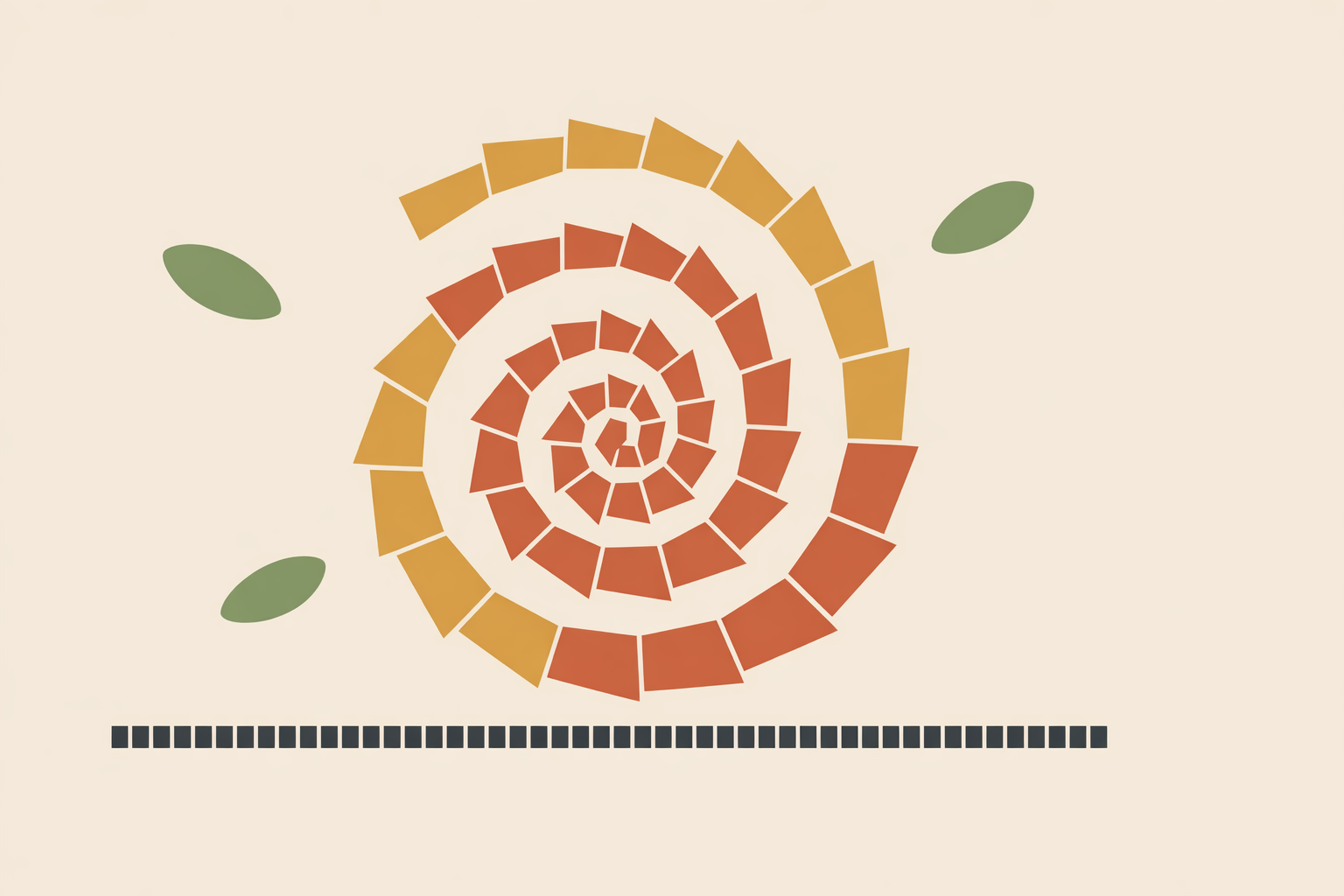
Collaborative work is equally rich. Invite each person to make a simple unit such as a square, leaf form, or paper seed. Arrange the units together as a spiral, then as a branching network, then as a tiling, photographing each stage. The value is in constructing and comparing patterns, not proving that one arrangement is universally best.
Even beyond botany, it helps to stay modest. Many “tidy spirals” people believe they see in larger natural scenes are partly shaped by human pattern-perception. Careful comparison serves groups better than sweeping claims.
Adapting the Work for Different Bodies and Contexts
Inclusion begins with setup. Large, uncluttered images, clear labels, audio description, raised-line tracing, and explicit clockwise/counterclockwise markers make the activity easier to follow. If participants feel uneasy with numbers, welcome approximate counts and bring technical language in after the pattern feels familiar.
Simple adaptations often make the biggest difference:
- Use large-print images with high contrast
- Pair color with line styles or symbols
- Offer verbal reporting instead of drawing when preferred
- Normalize “about 21” and “uncertain” as valid responses
- Provide seating, shade, and non-contact options for outdoor sessions
Indoor work benefits from standardized images that reduce visual noise and make comparisons easier. Outdoor work offers sensory richness and living variation, and it benefits from extra flexibility plus explicit opt-outs.
People also enter pattern through different doors: art, mathematics, ecology, ancestral knowledge, or simple curiosity. No one needs to adopt a spiritual frame to belong in the process.
Bringing Fibonacci Work Into Ongoing Group Practice
When a group meets a spiral with clear eyes and generous boundaries, attention steadies. Imagination wakes up. People can feel connected without needing to agree on a single interpretation.
A simple facilitator checklist helps maintain that quality:
- Define a few core ideas accurately
- Demonstrate before inviting participation
- Offer a pass option
- Keep observation distinct from interpretation
- Care for materials and place
- Protect privacy in sharing
Approached this way, geometry becomes a bridge rather than a verdict. A sunflower’s parastichies can lead into ecology, visual composition, contemplative reflection, or collaborative making. The aim is not to prove that every spiral is golden. It is to practice how patterns are observed, constructed, interpreted, and communicated together.
As sessions repeat, let the practice evolve through feedback, place, and community. Small revisions in language, pacing, and accessibility often matter more than adding more theory. Over time, Fibonacci patterns become what they have long been in traditional arts and reflective practice: steady, usable companions for shared inquiry and growth.
Explore Sacred Geometry Certification
Deepen your pattern literacy with the Sacred Geometry Certification, building from observation into design and reflective practice.
Explore Sacred Geometry →