Concept design moves fast and locks in early. Teams polish a few promising masses, clients react to images, and before anyone has tested light, airflow, or refuge, the project commits to a form that will govern comfort for decades. Early-stage concept decisions tend to lock in and are difficult to shift later, so late fixes—bigger overhangs, nicer materials, more plants—rarely repair a massing that blocks daylight or severs contact with sky and landscape. Generative tools are now widely used in practice, with a recent survey showing growing adoption of AI tools across architecture studios, yet they are still often pointed at prettier renders instead of a wider field of viable 3D choices. The practical question is not how to get flashier imagery, but how to use generative design to surface better early options that protect human experience and ecological fit.
Used well, generative design is a disciplined way to explore a living 3D design space, not a handoff to software. By translating intent into parameters, constraints, and meaningful indicators, teams can generate and compare options against what actually matters—daylight, circulation, porosity, thermal comfort, and nature-connectedness—while keeping authorship and cultural coherence centered. The aim is to decide earlier, with evidence and judgment, which forms can carry biophilic quality and climate logic before detail design narrows the path.
Key Takeaway: Generative design is most useful at concept stage when it turns values like daylight, airflow, refuge, and nature-connection into testable parameters and metrics. That widens the field of viable massing options before “lock-in,” helping teams choose forms that support comfort, ecology, and cultural coherence.
What generative design really is: from sketches to a living 3D design space
Generative design isn’t “software taking over.” It’s a way of teaching a system what matters so it can help you explore many coherent options—quickly and fairly—without losing the project’s intent.
Put simply, you define goals, limits, and variables, and the tool generates alternatives that follow that logic. Generative workflows ask designers to set goals, constraints, and parameters, then produce many candidates instead of one manually modeled solution.
The mindset shift is powerful: instead of obsessing over one “hero” concept, you shape a living 3D design space—a family of possibilities that respond to the site, climate, and way of living.
This is also where “parametric” and “generative” often get mixed up. Parametric design lets you adjust inputs and see a model change. Generative design goes further: it automates variation, evaluates outcomes, and helps you compare options against your aims. Essentially, parametric tools help you steer; generative tools help you steer while also revealing routes you may not have considered.
For practitioners who value traditional patterns, this is especially useful. A courtyard culture, a shaded veranda edge, a layered threshold, a roofline tuned to rain and heat—these are meaningful ideas, but they’re time-consuming to test by hand across many variants. Rule-based approaches have been used to translate typologies into rules that generate many consistent variants, letting the “grammar” of tradition stay intact while new configurations emerge.
Most workflows follow a steady loop: generate, evaluate, evolve, select, refine. Guidance describes this as a process that iteratively explores and improves candidates rather than trying to produce one perfect answer in a single pass. That rhythm matters—it keeps the work grounded in purpose, not novelty.
Industry guidance also emphasizes generative design should be objective-driven. That’s how you keep the focus on fit: fit to place, fit to climate, fit to human experience.
“The best way to predict the future is to invent it.” — Alan Kay
Generative design supports that kind of invention—by building a structured field of possibilities before committing to one.
Translating your bio-architecture intent into parameters, constraints, and KPIs
A strong generative study starts with a clear story. Then that story is translated into parameters, constraints, and KPIs so exploration stays rooted in human needs, ecology, and cultural coherence.
This step is a craft in itself. Too vague, and outputs drift. Too mechanical, and the work loses soul. The sweet spot is making place-based wisdom legible to a system without flattening it.
Start with the narrative: who uses the space, and what rhythms matter—gathering and solitude, morning and evening light, seasonal shifts, movement between inside and outside? Then bring in inherited intelligence: courtyards, shaded edges, transitional verandas, thickened walls, clustered rooms, roof forms tuned to rainfall or heat.
From there, structure the brief. Generative primers describe this as specifying desired outcomes and the variables that can change. Practically, that looks like:
- Parameters: what can vary (courtyard width, roof pitch, façade depth, orientation)
- Constraints: what must hold (boundaries, setbacks, height caps, access rules, minimum daylight thresholds)
- KPIs: what you measure (daylight, circulation length, shaded outdoor area, envelope efficiency, visual contact with vegetation)
Keep it focused. The most useful studies are often modest in scope, built around one well-bounded question, so the variations mean something rather than becoming noise.
This is also where traditional and vernacular knowledge shines. Vernacular architecture reflects long-term adaptation to climate, materials, and social life. Those patterns can become rules and constraints, not as nostalgia, but as field-tested intelligence. Research encoding vernacular courtyard logic shows rule-based systems can preserve vernacular intent while exploring new configurations.
A brief might include statements like:
- Preserve a protected central outdoor space
- Ensure primary rooms face vegetation as often as possible
- Support layered thresholds instead of abrupt transitions
- Increase overhang depth on harsh solar exposures
- Keep material volume within a defined limit
That’s not “design reduced to numbers.” It’s intention made testable—so the system helps you protect what matters while you explore.
“Architecture should not destroy natural systems on which life depends.” — Ken Yeang
Done well, parameters and KPIs act like guardians of that principle, keeping early options aligned with ecology and lived quality.
Running your first generative 3D study: a small, focused experiment
The best first study is small enough to understand. Choose one clear spatial idea, a handful of variables, and a short list of checks that reflect real priorities.
You don’t need a huge model to begin—starting small is what makes cause and effect visible.
A practical starting point is a simple parti: a courtyard rectangle, a central spine, a stepped terrace sequence, or a clustered plan. Then parameterize it—identify what can change and within what range. Naturalistico shows how nature-inspired diagrams can become families of massing options through a clear 2D–3D bridge.
Then keep the setup lean. Generative design tends to work best when scoped to specific, well-bounded problems. A first pass might use:
- Parameters: courtyard size, building depth, roof height, glazing ratio, orientation, overhang depth
- Constraints: setbacks, maximum height, minimum usable floor area
- KPIs: daylight proxy, shaded outdoor area, circulation length, envelope efficiency
Once it runs, you’ll often get many alternatives quickly. Teams can iterate on dozens of design candidates in the time it would take to hand-model a few. The deeper benefit isn’t speed—it’s a healthier creative posture. Instead of defending one scheme, you start learning from a terrain of possibilities.
That terrain only helps if the KPIs are well chosen. Generative approaches are especially useful when they reveal trade-offs earlier, while the project is still flexible. Here’s why that matters: the quality of the question shapes the usefulness of the answers.
So keep the first experiment honest. If it’s about the courtyard, let it stay about the courtyard. If it’s about thresholds, test thresholds—not everything at once.
“The goal is to create buildings that are part of the ecosystem rather than separate from it.” — Neri Oxman
A small generative study lets you check whether early massing is moving toward that relationship before complexity muddies the picture.
Reading the cloud of options: balancing metrics, biophilic quality, and cultural fit
Generating options is only half the work. The real design skill returns when you interpret the results and choose forms that balance measurable performance with biophilic depth and cultural coherence.
Strong studies produce a “cloud” of options—not a single winner. Often that cloud contains a Pareto front, where improving one metric worsens another. Generative design discussions describe this as making trade-offs earlier and easier to discuss. More daylight can bring more heat gain; tighter compactness can shorten circulation but reduce spaciousness or outdoor connection.
That visibility upgrades the conversation. Instead of arguing from taste alone, teams can say: here are the few options that balance priorities differently. In practice, even when many options are generated, teams tend to narrow to a small set of candidates for deeper review.
One caution belongs here: over-optimization. If you chase a single KPI too hard, you can end up with an efficient but lifeless scheme. Research shows single-objective optimization can degrade overall quality despite strong numbers. Traditional building wisdom naturally avoids that trap by holding multiple human needs at once—shade and light, openness and refuge, privacy and community.
So once you have a shortlist, bring in questions the dashboard can’t fully answer:
- Does the entry sequence feel welcoming or abrupt?
- Is there a true sense of refuge as well as openness?
- Do proportions echo local building intelligence or feel imported?
- Where does nature become lived presence, not just a view?
- Would it still feel grounded if surface styling disappeared?
Trust also grows when the model is understandable. A review of explainable AI finds that transparency tends to increase users’ trust compared with opaque systems. For design teams, that means being able to explain why an option appears and what assumptions shaped it.
Trust but verify is a wise stance with any black-box system.
Let the tool propose widely, then confirm the most promising options with clearer analysis and human judgment.
“Biophilic design is not simply about adding plants; it is about restoring the human-nature relationship through design.” — David Orr
Read your option cloud through that lens, and selection becomes less about “best score” and more about which form can sustain relationship over time.
Designing with climate and tradition: examples of generative bio-architecture questions
The most valuable generative questions are place-specific. They’re shaped by climate, landscape, and inherited building wisdom—how people have learned, over generations, to dwell well.
Traditional forms aren’t static relics. They’re concentrated environmental intelligence. Generative workflows offer a respectful way to test proportions and relationships with fresh rigor—without reducing tradition to surface aesthetics.
In hot-arid regions, meaningful variables often include courtyard width-to-height ratios, façade porosity, wall depth, and overhang sizing. Simulation work on hot-dry courtyard houses shows that adjusting courtyard aspect ratio, wall thickness, and shading can reduce heat stress while keeping shaded outdoor space usable. Put simply: the study isn’t about “new shapes”—it’s about cooler, more protective outdoor rooms and smoother transitions between sun and shade.
In hot-humid climates, the priorities shift toward wind and shade: breezeways, prevailing-wind orientation, raised floors, verandas, and porous envelopes. Field studies in tropical vernacular houses show elevated floors, large openings, and verandas can enhance cross-ventilation and comfort compared with enclosed concrete buildings. Generative exploration can help refine these layouts—testing how edge spaces, openings, and massing support airflow without sacrificing privacy or refuge.
In temperate settings, teams often look for daylight balance: generous natural light without oversized glazing or weak envelope performance. Guidance highlights that massing, orientation, and room depth can support daylight autonomy while limiting glazing area to reduce unwanted losses and gains. Generative studies are a natural fit for that kind of balancing act.
Bio-architecture can also bring nature-centered indicators into the concept stage, not as decoration, but as core performance. Frameworks recommend tracking visual connection to nature and related qualities so optimization doesn’t become purely technical. Naturalistico’s learning materials similarly frame envelope porosity, atria, ecological buffers, and vegetated surfaces as real design levers from the beginning.
“A low-tech building is better than a high-tech building if the low-tech building is closer to nature.” — Ken Yeang
Generative design is at its best when it helps teams ask stronger “low-tech” questions—about shade, wind, proportion, and belonging—so tradition speaks clearly in contemporary form.
Bringing generative design for better 3D options into your practice
The most sustainable way to adopt generative design is to begin with one real question on one real project. Keep it transparent, stay close to your values, and learn through iteration.
Generative workflows are most powerful early on, when they can surface trade-offs sooner and reduce late-stage massing changes. Used at concept stage, they help teams see—quickly—how form supports or undermines the lived qualities they care about.
A reliable entry point is a well-bounded study: courtyard proportions, shading depth, orientation, roof form, or the relationship between built mass and planted area. Many teams find momentum by starting with well-bounded questions before expanding to more complex, multi-criteria work.
It also helps to document what you’re learning. Naturalistico’s guidance shows how a focused experiment can become a coherent bio-architecture portfolio piece—useful professionally and clarifying personally.
“Architecture is a conversation with the future, and every choice made today affects the habitability of tomorrow.” — Amos Rapoport
Generative design can enrich that conversation—especially when it’s used to expand better 3D options, not just multiply options.
Begin where your intentions are clearest. Take one sketch, turn it into a small design space, test it against climate and lived quality, and read the results with discernment. Then refine.
Used this way, technology doesn’t compete with tradition—it helps it express its intelligence more clearly in three dimensions.
Master 2D–3D Bio-Architecture
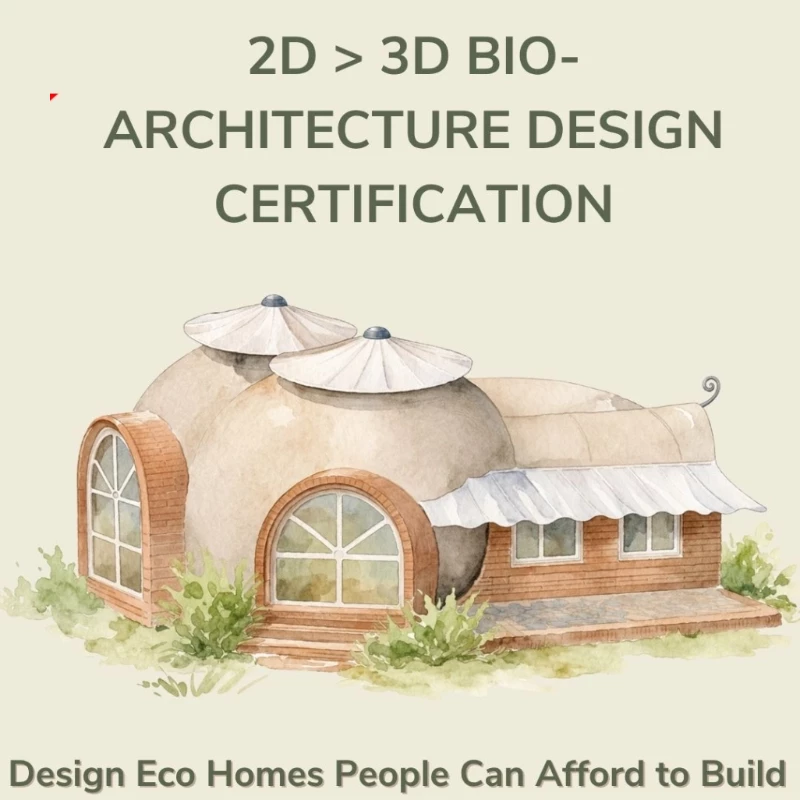
Apply these generative, climate, and biophilic principles in the 2D-3D Bio-architecture Design Certification.
Explore the Certification →