Most practitioners begin timeline work with a straightforward question: what happened, and when? But a long list of events doesn’t always show the pattern underneath. When the body tightens and the story starts to fragment, adding more detail often creates more noise than clarity.
A steadier approach is to read the timeline as a story of shifting states, changing meaning, and learned responses over time. From that lens, mapping becomes less about collecting history and more about finding leverage. You help the person notice where safety narrowed, where coping strategies formed, and where certain beliefs began shaping later choices.
Key Takeaway: Treat timeline mapping as a state-first process rather than a list of events. Start with consent, anchors, and pacing; create a simple visual map; track breath, posture, and voice as you go; identify a few high-leverage nodes; pair them with breath, sound, and movement; and finish with small daily practices that support steadier patterns over time.
Step 1: See the timeline as a nervous system story
A timeline is more than a sequence of events. It’s also a sequence of responses: expansion, contraction, vigilance, collapse, adaptation, and repair. When someone can see their life as one connected arc, the map often becomes easier to hold and work with.
Used well, timeline mapping organizes meaningful moments into a continuous story. Many facilitators naturally work in phases—early safety, emerging body signals, adolescent coping, adult patterns—because it highlights development, not just difficulty.
This matters because updated meaning can reshape self-narratives over time. The map isn’t there to trap someone in the past; it’s there to help them relate to the past differently.
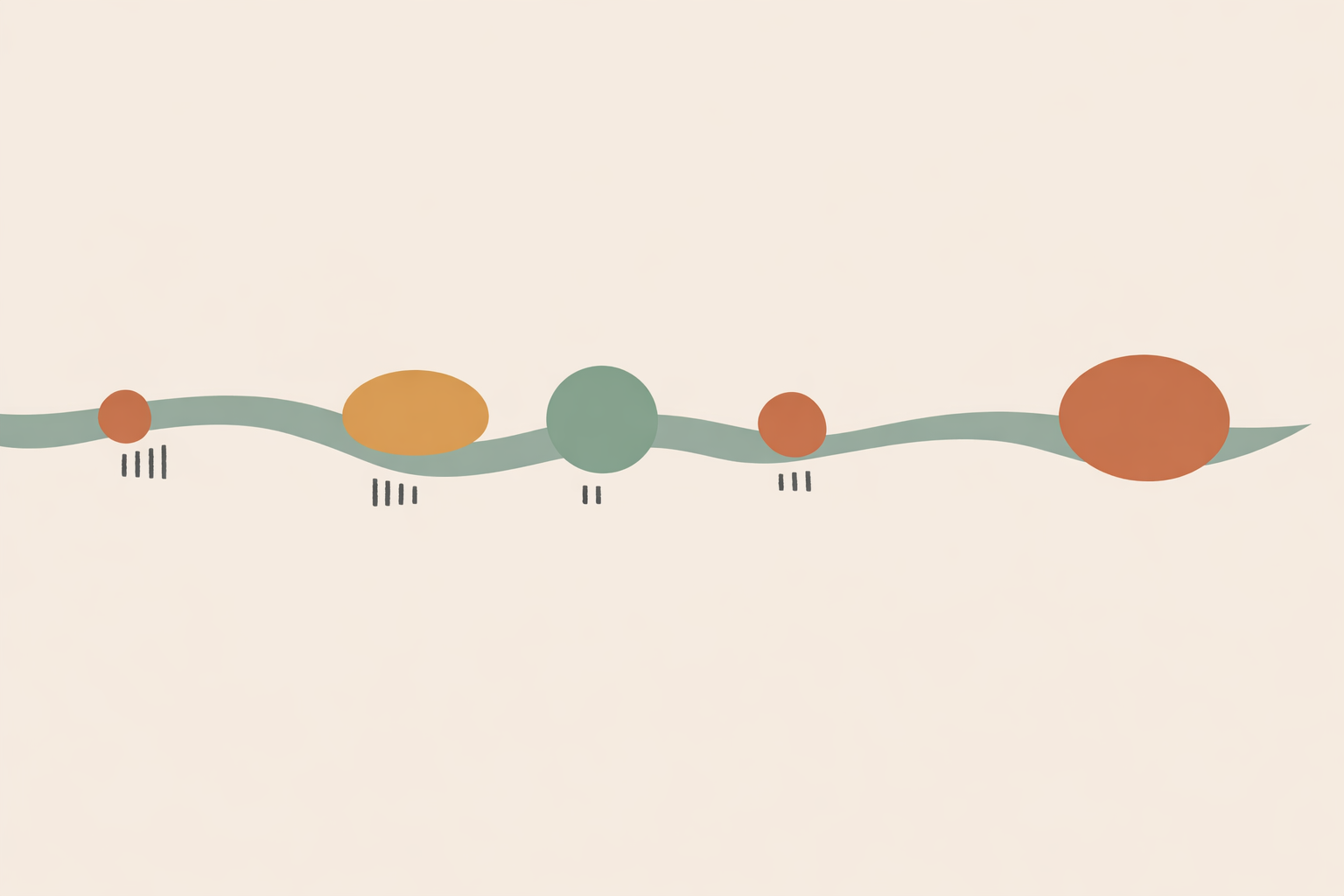
A gentle prompt can open the door without forcing detail: if your life were a river, where did it flow easily, where did it rush, and where did it freeze? Questions like this often reveal state shifts quickly.
Step 2: Prepare with consent, anchors, and regulation
Before you map the past, prepare the present. A steadier body tells a clearer story.
Traditional somatic wisdom has always understood this: when someone feels more settled, they can track experience with more choice. Research-informed somatic writing also suggests that sensations of safety can support processing. Agree on pacing, pauses, and permission before anything else.
It helps to name the rhythm upfront:
- We can go slowly.
- We can pause at any time.
- You do not need to tell every detail.
- We return to anchors whenever needed.
Then establish simple anchors. Orienting to the room, feeling both feet on the floor, or resting a hand on the chest can create an immediate reference point. Breath is especially reliable here, and a lengthened exhale is widely recommended to support a calmer physiological state.
If you use humming, tapping, or shared breath, name the roots of those practices with care and use them by consent, not assumption. Many practitioners blend neuroscience language with ancestral rhythm, and respectful sourcing keeps the work grounded.
A brief setup is often enough: you’ll map a few key moments, not everything, and you can return to the room whenever you want. That alone usually reduces pressure.
Step 3: Create a simple visual map
Once anchors are in place, keep the map simple. Complexity is rarely the goal.
Draw a line and ask where the past feels located in their inner sense of time. Some experience it behind them, others to the left, below, or far away. Externalizing that inner layout often makes the work feel more tangible and less overwhelming.
In most cases, five to seven points are enough. A small number of touchstones often reveals more pattern than a crowded page. Practically, significant events are usually sufficient to show the shape of someone’s history without flooding them.
Mapping also makes repetition easier to see. A clear timeline can highlight recurring patterns in triggers, coping strategies, and identity shifts that may be harder to catch in conversation alone.
Invite symbols rather than long explanations. A flame might represent anger; mist might represent shutdown; roots might represent support. If one event appears unusually large, close, bright, or heavy in the person’s inner map, treat that as meaningful information about where the system still organizes strongly around an old learning.
Grouping helps too. School years, family transitions, breakups, moves, and isolated stretches can be clustered first, then opened only where needed.
Step 4: Track state as the story unfolds
While the timeline is being drawn, the body is giving constant feedback. Track that feedback in real time.
When someone is within a workable window, posture often looks easier, breathing more natural, voice more modulated, and gaze more flexible. These are practical signs many facilitators use to choose pace.
Signs of activation often include jaw tension, shallow breathing, restlessness, rapid speech, or a hard stare. On the other side, collapsed posture, flat voice, slowed breathing, and a glazed gaze can suggest hypoarousal.
If the person can still notice sensations, speak clearly, and stay oriented to where they are, you’re usually in a workable range. If not, pause and return to support.
Useful micro-interventions include:
- Look around the room and name three neutral or pleasant objects.
- Feel both feet pressing into the floor.
- Lengthen the exhale.
- Slow the pace of speech.
- Shift attention briefly to a supportive memory, image, or sensation.
Somatic traditions rely on these small returns to safety before going further, and resourcing can support co-regulation during charged moments. A short prompt like “what is your body doing right now?” often brings choice back online.
Step 5: Find the few nodes that organize the rest
Once the full map is visible, move from breadth to leverage. Not every point carries the same weight.
Look for clusters and early feeder experiences. Later reactions often gather around a small number of earlier learnings. Narrative-oriented work uses past experience to illuminate present patterns, and this kind of re-reading can support perspectives that feel genuinely new.
At this stage, it helps to ask:
- Which moments seem to echo each other?
- What belief appears across several situations?
- Where did that belief first make sense?
- What coping strategy formed there?
Track intelligence as well as charge. Alongside each difficult node, name the adaptations, strengths, and resilience that showed up. A story focused only on rupture can keep someone identified with limitation, while narrative approaches often emphasize highlighting resilience as part of a fuller truth.
Usually, two to four high-leverage nodes are enough. Once those are clear, the rest of the process tends to sharpen on its own.
Step 6: Pair key nodes with somatic and vibrational tools
After you identify key nodes, prioritize state first, then content. Touch the charge briefly, then return to support.
This is where pendulation becomes especially useful. In somatic practice, pendulation means moving gently between activation and a more neutral or pleasant anchor, and it can build flexibility across states without forcing overwhelm.
A basic rhythm might look like this:
- Bring one node to mind for a brief moment.
- Notice what changes in breath, throat, chest, belly, face, or hands.
- Return to an anchor such as the floor, the room, or a supportive image.
- Repeat in short cycles.
Breath and sound often deepen this work. Slow patterned breathing and humming are simple tools many practitioners use to soften activation. A slower exhale is commonly used for this purpose, and nervous system regulation techniques like toning or humming can add a settling sense of rhythm and vibration.
Follow the body’s language. If the memory gathers in the throat, a hand there with a soft hum on the exhale may feel supportive. If charge pools in the chest, tiny rocking or spiraling movements can create more space. Some practitioners also track energetic anatomy—felt currents, pressure, numbness, emptiness—to guide pacing and choice.
As a new response appears near an old learning, the person often experiences that node differently. The memory may feel farther away, less gripping, less bright, or less final. Those shifts are often the early signs of neural repatterning.
Step 7: Integrate the shift with daily micro-practices
The session is only part of the work. Integration helps new patterns hold.
Close by naming what changed: breath softened, jaw released, the image moved farther away, or a new sentence felt more true. Then offer one or two tiny practices instead of a long list.
Short, regular practices are usually easier to sustain than intense effort. General breathing guidance often recommends 5–10 minutes daily to build steadier habits, and many facilitators find micro-practices are more likely to stick.
Simple examples include:
- Three rounds of longer exhales before opening email.
- Orienting to one calming visual point when entering a room.
- A 10-second hum after a difficult conversation.
- Feeling both feet on the floor before speaking in a charged situation.
Many people notice small shifts within several weeks, with broader changes unfolding over months. When a pattern has organized many areas of life, recalibration often takes longer, so it helps to frame progress as an unfolding process rather than a deadline.
Integration can also include language. Inviting someone to speak or write a revised version of their story can support identity change by making new meaning more coherent and memorable.
Finally, close the session cleanly. A hand on the heart, a breath of gratitude toward the younger self, or a brief acknowledgment of effort can help the work feel complete and respectfully contained.
Conclusion: A reflective tool for pattern recognition and change
Timeline mapping works best as a reflective, state-aware process rather than a fact-finding exercise. Begin with consent and anchors, build a simple visual map, track state as you go, identify the few nodes with the strongest organizing force, then pair those nodes with supportive breath, sound, movement, and meaning-making.
Held this way, the timeline becomes a practical tool for self-understanding, regulation, and pattern recognition. It supports clarity without forcing disclosure or intensity, so the person can recognize the shape of their experience with enough steadiness to choose differently.
Timeline mapping is both old and modern. It respects story, rhythm, embodiment, and relationship, while staying open to contemporary language around neuroscience and brain health and adaptation. Use it with care, clear consent, and sensible pacing, and keep extra support options available for anyone who feels easily overwhelmed during reflective work.
Train in Neural Repatterning
Deepen this state-first mapping approach with Deep Neural Repatterning Certification to support safer, steadier nervous system change.
Explore Deep Neural Repatterning →