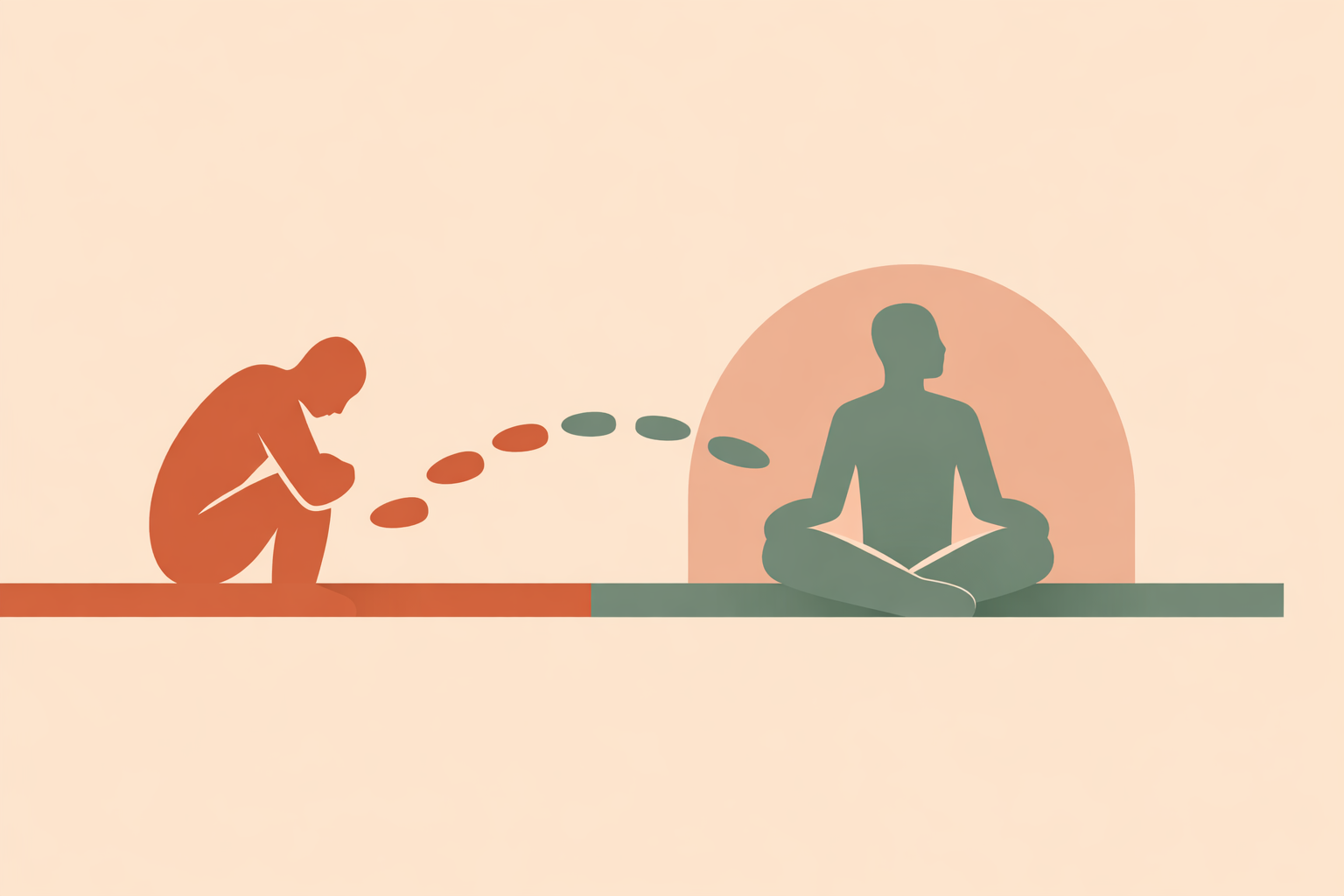
Most practitioners recognize the moment a session is still moving, but it’s no longer landing. A client speeds up, goes flat, repeats the same loop, or loses contact with what they meant to say. In those moments, sharper questions and tighter structure rarely help—because when state has shifted, content-first coaching starts to feel like pushing uphill.
The steadier move is simpler: help the person return to a workable baseline first. That means working with breath, posture, sensory attention, relational pacing, and the meanings being made in real time. These aren’t dramatic interventions—just small adjustments that make the rest of the session workable again.
Think of this as a short, memorizable sequence you can use mid-conversation: steady the body first, then return to insight. You’re not “fixing” anyone—you’re helping their system come back into range so their own clarity can show up again.
Key Takeaway: When stress hijacks a session, reset state before chasing insight. Use a simple sequence—breath, micro-movement, sensory grounding (including brief nature contact), co-regulating presence, then meaning-making—to bring the nervous system back into a workable window so strategy and clarity can land.
Reset Cue 2: Micro‑Movement & Posture
Once breath settles a little, look at shape. The body’s posture often tells you what words cannot—and tiny shifts can bring someone back into a workable window of engagement.
Brief movement can change state fast. Neuroscience-based guides describe short exercise snacks as a practical way to reduce stress and sharpen focus—useful between topics or after a heavy share. Over time, regular movement supports resilient brain networks, including factors like BDNF, which is one reason many traditional systems naturally weave motion and stillness together.
In session, you don’t need a routine. Small posture resets—rolling shoulders, loosening hands, pressing feet into the ground—are often enough. Even everyday guidance highlights gentle movement as a quick state-shifter. Somatic traditions and modern trauma education also share a useful map: the window of tolerance, the zone where thinking and feeling can work together again.
Reading hyperarousal and hypoarousal in the body
The body broadcasts stress before the mind can explain it. Watch for patterns:
- Hyperarousal: Restlessness, tight upright posture, darting eyes, talk that outruns breath. PTSD UK describes hyperarousal in terms of fidgeting and tension.
- Hypoarousal: Slumped posture, slowed movement, flat tone, heaviness. The same resource describes hypoarousal as collapse and shut-down.
Then offer a micro-adjustment with choice, not command:
- If wired: Soften the jaw, drop the shoulders, and exhale while pressing feet into the floor for 10 seconds. Repeat twice.
- If flat: Invite a gentle spinal lengthening, two slow neck arcs, and a 20-second brisk hand rub to bring warmth and presence.
- For both: Orienting—slowly turning the head to take in the room—signals safety and helps attention settle.
These are navigation tools. As posture organizes, attention often follows—and your coaching map becomes visible again.
Reset Cue 3: Sensory Grounding & Nature Micro‑Doses
When stories spiral and words loop, return to the senses—and, when possible, the land. Sensory anchors and brief contact with nature can restore perspective faster than analysis.
Attention is trainable. The classic 5‑4‑3‑2‑1 exercise (five things seen, four heard, and so on) helps interrupt racing thought and re-enter the present through the body’s gates. Mainstream guidance recommends 5‑4‑3‑2‑1 for exactly this kind of moment.
Nature can co-regulate too. Practical guidance encourages people to engage their senses and spend time outdoors for steadiness. Even a short pause outside can help you reclaim your calm before or between conversations.
When story spirals, return to the senses and the land
Here are simple ways to weave this in without making it a “big thing”:
- In the room: “Let’s pause. Name three colors you see, two textures you feel, and one sound that’s pleasant.”
- With an object: A smooth stone, a piece of cedar, or a woven cloth can become a respectful sensory anchor—touch, scent, texture, and a brief moment of appreciation for where it came from.
- At transitions: Two minutes by a window, eyes on the horizon; or a short walk with attention on the feet and air.
Earth-based lineages have long understood that the senses are portals to presence, and the land can be a steady elder. Modern research also points to the role of restorative natural spaces in stress recovery. Together, they offer a grounded, respectful way to interrupt spirals and widen perspective.
Reset Cue 4: Co‑Regulation Micro‑Choices
Your presence is part of the client’s environment. Tone, pacing, facial expression, and genuine curiosity often signal safety faster than any script.
Steadiness is social. Humans have always regulated in groups—through shared breath, rhythm, and attentive witnessing. Today we also recognize that social support buffers stress, and that supportive environments can moderate reactivity in real time. Everyday guidance names connection—reach out, talk to someone—as a core regulation practice.
In a session, co-regulation is built from small, repeatable choices:
- Tone: Speak a shade slower and softer than the client, then let them lead the next speed change. NICABM highlights attuned tone and pacing as a route back into the window.
- Face: Keep your expression warm and unhurried. Think of it like giving the nervous system proof that there’s time.
- Consent: Ask, “Would you like a pause, a breath, or to keep going?” Choice restores agency, and agency supports regulation.
- Repair: If you miss a cue, name it and slow down. Repair is regulating.
Coaching research supports this relational approach. “These differences in brain activity led the researchers to conclude that positive coaching effectively activates important neural circuits and stress-reduction systems,” notes a summary from Greater Good. When your presence evokes possibility rather than pressure, people can think again.
Reset Cue 5: Meaning‑Making & Cognitive Reframes
Once the body feels safer and the relationship is steady, you can reshape the story. Gentle reframes turn “What’s wrong with me?” into “My system is trying to protect me,” restoring dignity and choice.
Under chronic stress, flexible thinking gets harder. Stress can weaken prefrontal connections with limbic regions, and BrainFacts describes the prefrontal cortex as a key hub for planning and regulation. Put simply: when pressure rises, the “wise narrator” goes quiet and the survival story takes the mic—an experience often described as stress hijacks the brain.
Meaning-making invites the prefrontal system back into the conversation. Done well, it’s validating rather than labeling. One guide describes a non-pathologizing approach: acknowledge what hurts, then collaborate on new meaning. Traditional healing arts have always used story, symbol, and re-interpretation to help people carry what’s heavy with more grace and direction.
Practical reframes that respect both brain and lineage:
- Normalize the body’s wisdom: “Of course your system gets loud before a deadline. It learned that speed keeps you safe. Let’s thank it and choose a new rhythm.”
- Shift identity: From “I am anxious” to “Anxiety is visiting.” The self becomes larger than the state.
- Link to choice: “When that surge arrives, what’s your first 20-second ritual—breath, posture, senses, or reach out?”
- Invoke values: “What matters most here?” Values widen the lens and create forward motion.
Tradition and neuroscience meet here: patterns can change, and with practice, circuits adapt to new interpretations. As Richard Boyatzis puts it, “The initiation of sustained desired change starts in the positive emotional attractor.” When a client feels seen and can imagine a kinder future, motivation and learning have room to return.
Conclusion: Let Stress Stop Steering Your Sessions
Stress doesn’t have to drive. With five simple cues—breath, micro‑movement, sensory grounding, co‑regulating presence, and compassionate reframing—you can bring the nervous system back to the helm and keep sessions purposeful, humane, and effective.
These cues work best as layered levers. Start with breath to downshift speed, use posture and small movements to re-enter a workable window, anchor in the senses and the land to interrupt spirals, let your presence broadcast safety, and then reshape meaning so the mind has a better map. Over time, this repetition matters: the brain is highly plastic, and BrainFacts notes it can adapt in healthier ways with steady inputs.
For ethical use, keep it consent-based and culturally respectful: name sources, avoid extraction, and let clients choose what resonates. And keep the interventions small and frequent—many of these can be micro‑dosed across the day to support a steadier baseline.
To deepen this craft, build nervous system literacy through structured study, mentorship, and ongoing community practice—balancing evidence-informed frameworks with the grounded wisdom of traditional approaches. The more fluent you become in the body’s language, the more naturally sessions regain momentum when stress tries to take the wheel, especially when paired with executive function coaching that reduces friction rather than pressure.
Master the Neuroscience Coach Certification
Deepen your session reset skills with the Neuroscience Coach Certification and apply nervous system principles with confidence.
Explore the Certification →