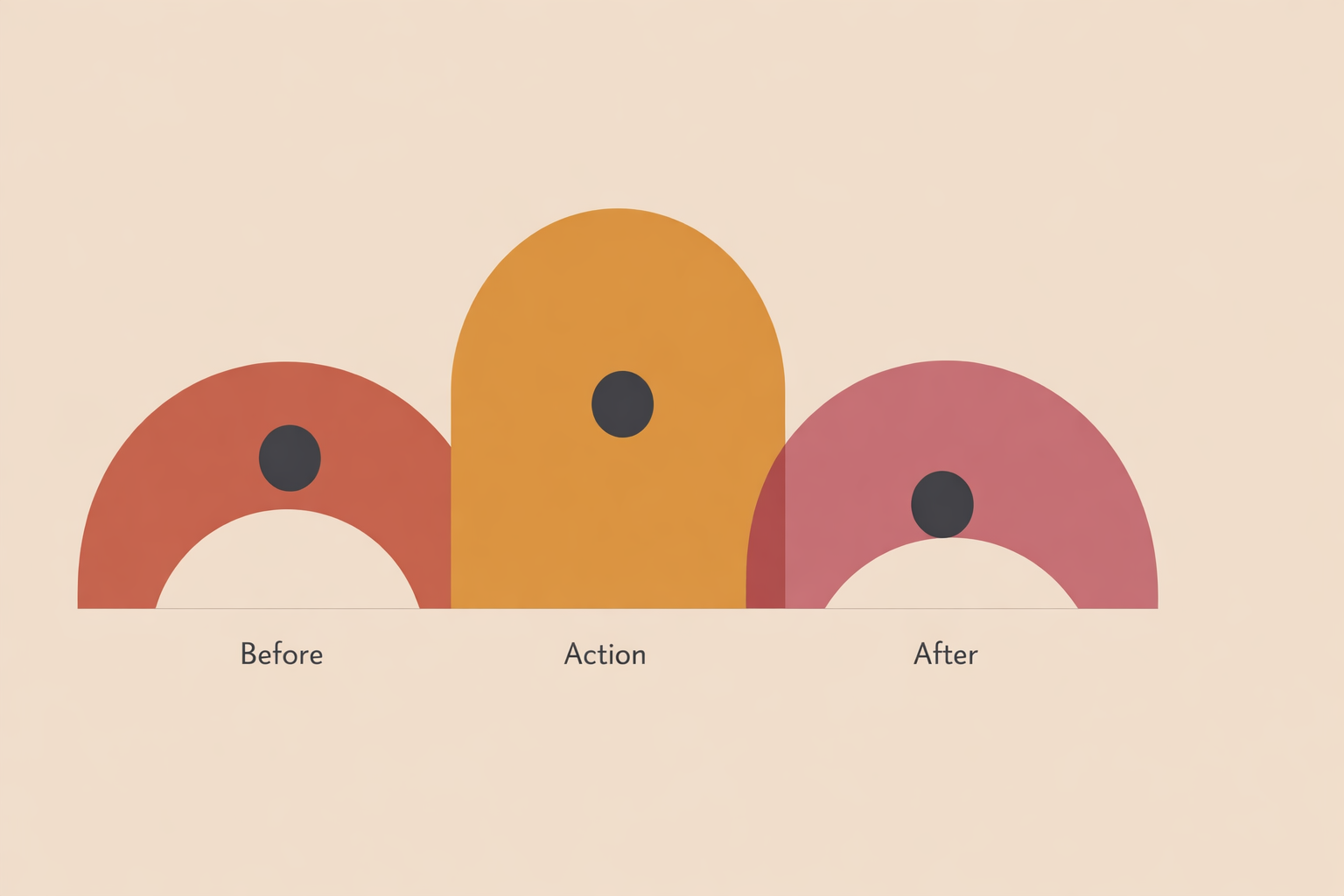
Life transitions can scramble identity, routine, and emotion all at once. In practice, that often shows up in writing that swings between overwhelm and shutdown: one week a client fills pages, the next week they avoid the notebook entirely.
When the response is to keep adding prompts, frameworks, or emotionally intense exercises, journaling can start to feel like another demand. A steadier approach serves most people better, especially when change is already taking so much bandwidth.
Instead of treating journaling as a breakthrough tool, treat it as a reliable container: simple, repeatable, and grounded in real life. A shared arc—acknowledge, understand, decide, practise—helps turn scattered entries into something workable, while clear boundaries keep the process supportive and scope-appropriate.
Key Takeaway: During major life changes, journaling works best as a steady container rather than an intense, one-off release. A simple four-phase arc—acknowledge, understand, decide, practise—helps people organize experience, reconnect with values, and take grounded next steps. When the routine is culturally responsive, private enough for honesty, and held with clear boundaries, it becomes a practical support for transitions such as grief, burnout, relocation, and identity change.
A four-phase journaling framework for major change
Unstructured journaling can easily turn into circling the same material. A simple four-phase framework gives the process a clear path:
- Acknowledge the change
- Understand the present reality
- Decide what matters next
- Practise the next step in real life
The sequence isn’t rigid. People move back and forth. Still, it gives sessions and home practice a dependable spine.
Acknowledge starts with naming what has happened: the event, disruption, loss, or ending. Clear naming often softens avoidance and helps someone meet the moment more directly.
Understand then maps what is true right now: facts, resources, limits, needs, and uncertainties. It grounds the story in what’s actually here.
Decide comes next, when the first wave of reaction has settled enough for values and priorities to come back into view. This phase is about choosing what deserves attention now.
Practise translates insight into lived change through small experiments. The journal becomes a place to notice what worked, what felt difficult, and what needs adjusting.
You can hear the movement in a simple example. Early in a career transition, someone writes: “I was let go on Tuesday. I feel relieved, embarrassed, and frightened.” In the next entry, they map finances, energy, and support. Later, they identify their guiding values for this season. Then they try one concrete step, such as reaching out for a conversation or updating a portfolio. The journal becomes a record of orientation, not just release.
Prompts for each phase
- Acknowledge: “The change I am facing is…”
- Acknowledge: “The part I did not expect is…”
- Understand: “What is true right now?”
- Understand: “What do I know, not know, and influence?”
- Decide: “Given my values, the next right priority is…”
- Decide: “What matters more than urgency right now?”
- Practise: “This week’s one step is…”
- Practise: “After I try it, what did I learn?”
How to create a steady journaling routine
The routines people keep are usually the simplest ones. Complexity can feel motivating at first, then quickly becomes one more thing to manage during an already demanding season.
A steady container might look like:
- a regular time, once or twice a week
- 5 to 10 minutes to begin
- one prompt only
- uninterrupted writing
- a brief closing line or ritual
This structure reduces spiraling while protecting enough privacy for honesty. It also makes change easier to spot, because each entry is held in a familiar shape.
A small opening-and-closing ritual is often enough: “Right now I’m feeling…” to begin, and “The small step I’ll take is…” to end. That closing line helps the writing land back in daily life instead of staying in rumination.
Paper and digital formats both work well. Paper can feel intimate and grounding. Digital notes can be easier to search, store, and protect with passwords. The best format is the one someone will use consistently, with privacy handled in a practical way.
Cultural fit matters more than perfect technique
Not everyone relates to journaling in the same way, and no one should be pushed into a single style. Cultural background, family norms, spiritual life, language, privacy needs, and personal history all shape what reflection feels like.
For one person, a notebook is freedom. For another, it can feel exposed or unfamiliar. Some people think best in lists; others through prayerful reflection, dialogue on the page, poetry, sketching, or brief notes linked to ritual. Some need solitude, while others need community witness before private writing feels safe or meaningful.
A culturally responsive stance begins with curiosity: how they already reflect, what privacy means at home, what forms of expression feel familiar, and what ways of knowing they trust. This approach honors inherited traditions and personal boundaries while keeping the routine realistic.
For relocation, migration, or intercultural transitions, invite depth rather than surface markers. Prompts around home, language, land, ancestry, belonging, and continuity tend to be more respectful than generic identity questions.
Techniques that help clients move through the process
You don’t need dozens of tools. A few reliable techniques, used at the right moment, create plenty of movement.
Sprint writing for acknowledge. Set a timer for five minutes and begin with “What is changing is…” Aim for momentum, not polish. If someone gets stuck, they can repeat the last word, switch to bullet points, or write fragments.
Facts vs. story for understand. Divide the page in two. On one side, write what happened. On the other, write the meaning being attached to it. Separating facts from interpretation often reduces rumination and makes the emotional charge easier to work with.
Values sorting for decide. Choose a small number of qualities to embody in this season, such as honesty, steadiness, rest, courage, or connection. Decisions get simpler when they come from orientation rather than urgency.
Tiny rehearsals for practise. Pick one action that is realistic to attempt this week: a boundary script, one difficult email, one support call, one restorative hour, one honest conversation. The journal then records what happened and what was learned.
With repetition, people move from diffuse feeling to clearer naming, and from naming to direction. That’s where journaling becomes deeply useful in transition work and in creative and expressive therapies more broadly.
Using journaling for grief, burnout, and identity shifts
Some transitions call for tenderness more than strategy. Grief, burnout, and identity change often unfold slowly and unevenly. Journaling supports these seasons by giving the experience somewhere to land, without trying to force speed.
For grief, avoid imposing a timetable. Prompts such as “What I miss,” “What still feels unfinished,” or “What I want to keep carrying forward” create space without demanding closure.
For burnout, look at demands, resources, expectations, and boundaries rather than intensifying self-blame. A page titled “What is depleting me” beside “What actually restores me” can reveal what needs to change in a very grounded way.
For identity shifts, include continuity as well as change. A timeline of past thresholds helps people remember they’ve moved through other chapters before. In that longer arc, the current transition often reads as reorganization rather than failure.
In all three cases, journaling works best when it keeps someone in relationship with their experience, instead of pushing them to manufacture meaning on demand.
Trauma-aware boundaries in journaling support
Depth is not the same as pressure. Journaling can open meaningful reflection, but it should be offered with choice, consent, and clear boundaries.
A trauma-aware approach means no one is pushed to disclose more than feels manageable. They can write privately, skip a prompt, stay brief, or pause entirely. That sense of choice protects the process.
It also helps to be explicit about purpose and privacy: why the exercise is being used, how it will be used, what level of sharing is optional, and how confidentiality will be handled. In groups, clear agreements matter: the option to pass, no unsolicited fixing, and respect for confidentiality limits.
Journaling can be supportive, but it is not a substitute for broader mental health support. Evidence suggests it is best used as an adjunct rather than a standalone answer for significant distress. If writing consistently triggers flashbacks, dissociation, repeated panic, severe hopelessness, self-harm urges, suicidal thoughts, major sleep disruption, or relapse risk, pause deeper processing and support connection with appropriately licensed support.
After intense sessions, have your own closing practice to reset and keep your role clear. A short walk, a few notes, a cup of tea, or a deliberate breath can be enough.
A simple 30-day journaling plan for transitions
For a ready-made structure, keep it light: two or three entries per week, around ten minutes each, with one prompt at a time.
Week 1: Acknowledge and observe
- “What has changed, and what has not?”
- “What am I grieving, even if this change is welcome?”
- “What do I know, not know, and influence this week?”
Week 2: Understand the present
- “Facts vs. story”
- “I notice / I feel / I need”
- “People, places, and practices that support me”
Week 3: Decide what matters next
- “Which values do I want visible in my next decision?”
- “What story about myself is becoming outdated?”
- “One boundary or request I am willing to try”
Week 4: Practise and review
- Write through one recent wobble and a more balanced perspective
- Choose one small action and record what happened
- List evidence that you have navigated change before
- Review: “What helped, what drained me, and what needs adjusting?”
Common signs of progress include clearer priorities, more compassionate self-talk, sharper awareness of needs, more grounded decisions, and a greater willingness to ask for support. These shifts can look modest from the outside, but in transition work they often matter a great deal.
Closing thoughts
Journaling during life transitions doesn’t need to be dramatic to be effective. Its strength comes from repetition, honesty, and just enough structure to keep the process from scattering.
A simple, culturally respectful container helps people name what is changing, stay connected to what still matters, and take the next step without forcing certainty too soon. Held this way, the page becomes a companion: a place where the old chapter can be witnessed and the next one can begin to take shape, whether in personal practice or through journal therapy.
Train in Journal Therapy
Apply this transition framework more confidently with guided methods in the Journal Therapy Certification.
Explore Journal Therapy →