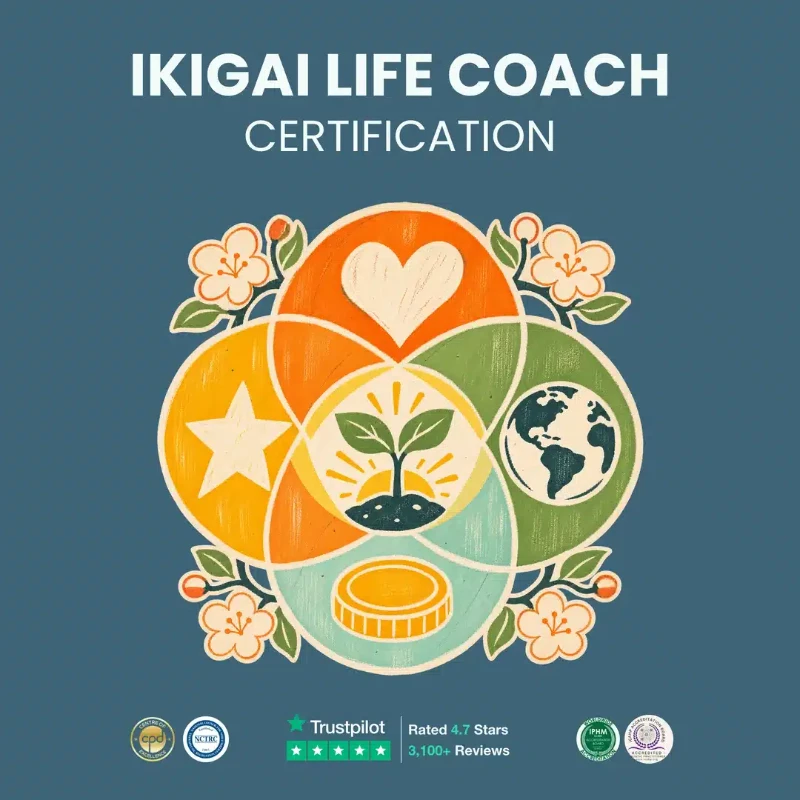
Ikigai work often starts with a neat map: passions, strengths, a purpose statement, and a diagram to hold it all together. It feels clarifying, and clients leave with great language. Then daily life stays the same, and the session slides back into refining phrasing instead of changing patterns.
A more useful approach is to treat ikigai as direction, then give it rhythm through Kaizen: small, repeatable experiments that bring meaning into ordinary routines. When you slow down, look for lived evidence, run tiny tests, and review them consistently, clarity grows through real experience.
Key Takeaway: Ikigai works best as direction, while Kaizen provides the rhythm that turns insight into ordinary action. When you slow the session down, look for evidence in daily life, convert patterns into small experiments, and review them consistently, purpose becomes something lived rather than merely described.
Step 1: Start with Presence Before Purpose
When ikigai work begins with a slower pace, the conversation changes. Clients usually speak with more honesty when they’re not performing an identity and can notice what’s real.
A simple opening is enough:
- Feet on the floor.
- Relax the jaw and shoulders.
- Take three slower breaths.
- Notice the support of the chair.
- Then ask, “What feels most alive for you right now?”
This kind of settling is practical, not decorative. It creates the quality of attention needed for accurate self-observation.
It also helps to name ikigai in an expansive way: it can point to what makes life feel meaningful and to the felt experience of life being worth living because of that connection. From there, purpose becomes something relational and evolving, not a label to “get correct.”
A grounded prompt that keeps things real: “When in the past week did you feel most present, engaged, useful, or quietly satisfied?” Invite a specific moment. A small story usually reveals more than a polished statement.
Step 2: Map Lived Evidence in Daily Life
Once the client is grounded, move from ideals to evidence. Broad statements like “I want to help people” can be sincere, but they don’t yet show you what actually sustains the person.
A one-week audit helps clients notice where energy, meaning, and contribution already appear:
- E = energizing
- N = neutral
- D = draining
- M = meaningful
- A = absorbing
Patterns usually emerge quickly. Mentoring might repeatedly land as M and A. Solitary planning could feel E but not M. Hosting might feel M but also D unless it’s brief and well-contained. Those details are gold, because they point to conditions that support alignment.
Keep the lens on ordinary moments, not impressive ones. Preparing food with care, repairing something, helping a neighbor, sketching for ten minutes, or simplifying a messy process at work can carry strong ikigai clues.
Then turn values into behavior. If a client values creativity, ask what creativity looks like on a normal Tuesday. If they value contribution, ask how it shows up in ten minutes. Purpose becomes workable when it becomes visible, which is also the heart of purpose and life design.
Step 3: Turn Insight Into Small Kaizen Experiments
Once patterns are clear, the next move is not deeper analysis. The next move is a small action that can teach you something.
Create a brief working direction using what the client has already demonstrated: preferred ways of contributing, strengths they naturally use, and values they want to honor. Keep it provisional so it stays flexible and testable.
Then design one experiment that is observable, small, and anchored to an existing routine. In habit research, implementation intentions, cues, and self-monitoring are widely used to help intentions become consistent actions. In day-to-day practice, this looks like attaching a purpose-aligned step to something the client already does.
Examples:
- After Monday lunch, spend eight minutes outlining one onboarding tip for a newer colleague.
- When logging off on Tuesday, send one message offering a short skills-share conversation.
- After Saturday breakfast, give ten minutes to a craft, service, or learning action that reflects the week’s pattern.
The experiment should feel light enough to repeat and clear enough to evaluate. Did it create energy? Did it feel meaningful? Did it fit the week you actually had? A good experiment creates evidence, not pressure.
Step 4: Use Feedback Loops to Refine the Direction
Kaizen is powered by review. Without review, effort becomes noise. With review, small actions become a steady source of learning.
A simple weekly check-in is often enough:
- What did I intend to do?
- What actually happened?
- What felt meaningful, energizing, or flat?
- What supported the action?
- What created friction?
- What is the smallest useful adjustment?
This kind of loop aligns with behavior-change research, where feedback and self-monitoring repeatedly show up as practical supports for sticking with new habits.
Invite clients to review both quantity and quality. Two small experiments paired with “That felt like me” is valuable learning. So is steady follow-through paired with “This drains me,” because it clarifies what to release or redesign.
Over time, direction sharpens through repeated contact with real life.
Step 5: Work Kindly With Friction, Beliefs, and Constraints
Once action begins, friction appears. Some friction is practical (time, energy, responsibilities). Some comes from long-held beliefs that once offered protection. Both deserve respectful attention.
When a client says, “I’m too old,” “I have to choose one path forever,” or “Purpose only counts if it becomes financially successful,” meet it with curiosity rather than debate:
- Whose standard is this?
- What evidence supports it?
- What evidence complicates it?
- What would a small exception look like this month?
Stay realistic about capacity. If someone is stretched thin, lower the threshold. Small commitments are often the most faithful form of the work because they can be sustained.
One helpful planning approach is to scale actions across three levels:
- Minimum: the smallest version worth keeping.
- Standard: the usual version for an ordinary week.
- Expanded: the fuller version for weeks with more capacity.
For example, a client who values sharing knowledge might choose five minutes of note-making as minimum, one short tip shared weekly as standard, and a longer teaching moment as expanded. This keeps momentum without turning consistency into rigidity.
When the week falls apart, keep the review humane: What made this hard? What still matters? What is the kindest restart? That tone builds resilience.
Step 6: Let Your Practice Embody the Same Rhythm
The most convincing way to guide ikigai work is to live the rhythm yourself. When your own practice consistently returns to presence, small experiments, and clean review, clients feel the coherence immediately.
Start with trust rather than polished branding. Ask: What do I want to be trusted for? Then express it in behaviors:
- One short synthesis shared each week.
- One regular moment of community contact.
- One line of reflection after each session: what felt most useful?
This rhythm can also shape your program design. Graduated pathways, simple reviews, and manageable between-session actions reflect the same steady cadence you’re inviting clients to practice, whether in your own work or in ikigai coach training.
Cultural humility matters as well. If you use adapted models, name them as adaptations. If an idea comes from a modern coaching interpretation rather than a traditional Japanese source, say so clearly. Respect for roots is part of integrity.
It’s also fair to be straightforward about the current state of evidence. Many current ikigai models are still conceptual and evolving. That doesn’t weaken the work; it clarifies the aim: supporting reflection, alignment, and meaningful action without making fixed promises.
Conclusion: Let Ikigai Set the Direction and Kaizen Keep the Rhythm
Ikigai does its best work as direction: a lived orientation toward what matters, expressed through ordinary days. Kaizen gives that direction shape through small steps that can be repeated, reviewed, and refined.
You don’t need a perfect purpose statement before you move. Purpose often becomes clearer after a few weeks of honest action, because lived experience reveals what language can’t.
For clients, that can look like ending each session with two questions: What felt most meaningful here, and what small action will you test before we meet again? For your own practice, choose one promise you want to live, then make it visible in a simple weekly rhythm.
Let the direction stay steady. Let the steps stay small. Let the learning stay continuous. That is how ikigai becomes lived.
Explore Ikigai Coach Training
Build your Ikigai-and-Kaizen approach with the Ikigai Life Coach Certification.
Explore Ikigai Certification →