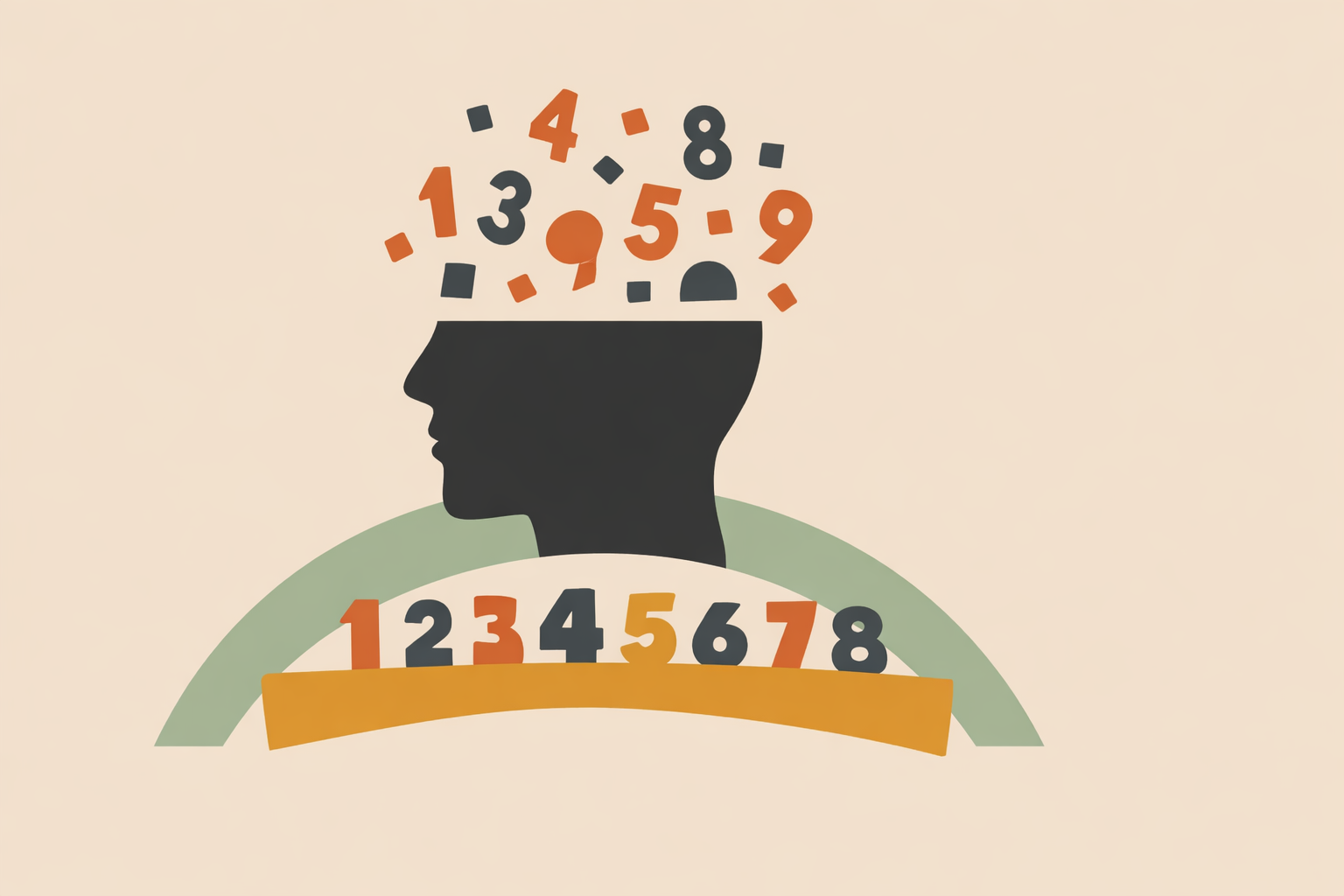
Practitioners who support adults with ADHD often meet the same friction point: a capable client avoids anything with numbers, jokes about being “bad at math,” then freezes when a bill, budget, or travel plan needs attention. In those moments, attention narrows, recall seems to vanish, and even familiar steps fall apart.
The most helpful shift is to stop reading this as a motivation problem. It is usually an access problem. When numbers arrive carrying pressure, memory load, and old embarrassment, the task can exceed what the person can hold in that moment. Support works best when it lowers threat, makes steps visible, and lets tools carry some of the load.
Key Takeaway: Effective support for adults with ADHD and math anxiety starts with access, not pressure. In practice, that means regulating first, making thinking visible, and moving work from memory into the environment. A humane sequence is to settle the blank-out moment, distinguish overload from number-sense gaps, use routines and tools that share the work, rebuild number sense through adult-relevant concrete experiences, and widen safety through accommodations, community, and self-advocacy.
The blank-out moment: regulate before explaining
At the kitchen table, Lena opens a utilities bill and her mind goes white. In that instant, willpower is rarely the issue. It’s physiology and cognitive load colliding with a multi-step demand.
Math anxiety can compromise working memory, so anything that requires holding several pieces in mind becomes fragile. Add time pressure, divided attention, or a sense of being judged, and performance often drops further. This is why more explanation during a shutdown usually backfires: the knowledge is often there, but it’s temporarily hard to reach.
Traditional practice has always understood that learning rides on state. When the body settles, the mind can rejoin the task, and the next step becomes possible.
A simple 90-second reset for math-related shutdown
A short reset lowers threat and creates a workable re-entry point. The exact style can vary; what matters is having a repeatable sequence.
- Posture and breath: Feet on the floor, feel the chair, then take three exhales that are slower than the inhales. If it helps, add a tactile anchor (a bead, stone, or piece of wood).
- Hydration and movement: One sip of water, one shoulder roll, one jaw unclench, or a stand-and-sit. The goal is interruption, not performance.
- Predictable frame: Set a boundary: “We’ll do two steps only, then stop.” Clear limits reduce anticipatory strain.
- Tool choice: Offer agency: “Would you like the calculator, or would you rather I write while you talk?”
Notice what’s missing: no pep talk, no speed target, no pressure to “just try.” Regulation is an access support.
Often, one non-math action breaks the freeze. Scan the page, find the due date, and draw a box around it. That tiny movement can restart the whole system.
How to tell overload from number-sense difficulty
Once Lena can stay with the page, the next step is curiosity. The same wrong answer can come from different roots: overload, a reading slip, a lost procedure, visual crowding, weak quantity sense, or fear. Support improves quickly when you know what’s leading the moment.
Brief, gentle think-alouds are usually enough, especially when they feel collaborative rather than evaluative:
- “What is the first thing you notice?”
- “Which part matters right now?”
- “Where does it start to feel fuzzy?”
- “What do you already know from this page?”
This kind of verbal tracking helps separate emotional overload from a deeper difficulty with quantity, comparison, or sequence, including the kinds of numerical cognition patterns that can hide under “I’m bad at math.” As they talk, look for fixable friction: too many instructions, crowded layout, holding steps in mind instead of writing them down, or anxiety spiking at a specific symbol or choice point. Often, that’s enough to guide the next adjustment.
A practical documentation note can stay focused on conditions rather than labels: “When the task was reduced to one visible step, Lena initiated quickly and stayed engaged.”
Externalize the task: routines and tools that share the work
Many adults with ADHD do better when the environment carries more of the sequence. Externalized steps, fewer decisions, and tools kept within reach can transform follow-through.
For bill paying, a one-page routine card kept where the task happens is often more effective than repeating instructions. Pair it with a pen, highlighter, and calculator in the same folder so the setup is automatic.
- Step 1: Circle the due date and total.
- Step 2: Find last month’s total and compare.
- Step 3: Estimate whether this looks about the same, lower, or higher.
- Step 4: Check what is being charged.
- Step 5: Pay, note a question, or mark it for follow-up.
Implementation-intention scripts support initiation too. “When I open a bill, I will first circle the due date and total,” removes the strain of deciding how to begin and helps many people start more consistently.
Teach calculator use instead of banning it
Calculator support works best when it’s coached, not merely permitted. Without a routine, some people distrust the output or punch numbers in without connecting them to the real decision. With a simple process, calculators build independence.
- Estimate: Is the answer likely closer to 100 or 1,000?
- Enter: Key in each part slowly.
- Check: Does the display look plausible?
- Interpret: What does this answer mean in the real task?
This preserves reasoning while lowering avoidable working-memory strain. The same setup works for travel planning, budgeting, or comparing prices: routine cards, visual timers, and pre-highlighted routes make starting simpler because the work is shared between person and environment.
Rebuild number sense with adult-relevant concrete practice
Once panic softens, many adults want to strengthen number sense quietly and respectfully. A concrete-to-symbol progression works particularly well when it’s grounded in adult life and in practical neurodiversity and learning differences support.
The Concrete-Representational-Abstract sequence fits naturally here: begin with objects and visible quantities, move to sketches or diagrams, then move into symbols. Traditional teaching has long followed this path, using everyday practices like markets, measures, weaving, song, knots, and beads to carry quantity before abstraction.
For adults, the “concrete” stage lands best with familiar materials: receipts, calendars, spice measures, price tags, transit timetables, and budgeting tools. These feel relevant, and they translate directly into daily tasks.
To explore ratio through cooking:
- Concrete: Place 2 teaspoons of one spice and 1 of another side by side. Ask which is bigger, by how much, and whether the relationship changes if both amounts are doubled.
- Representational: Draw two bars to show the 2:1 relationship and shade them.
- Abstract: Write 2:1, then connect it to a total quantity in a recipe or shopping plan.
For place value, receipts and coins work well. Show ten ones becoming one ten, sketch the exchange, then name the symbolic form. Keep the page calm and uncluttered, especially when ADHD and dyscalculia overlap.
Create safety around numeracy practice
Progress tends to accelerate when people feel safe enough to stay with the task. Social conditions matter. Research on math anxiety points to social transmission, where stress around numbers is shaped by interactions and atmosphere. Many learners do best in steady, respectful company rather than high-pressure settings.
Avoid conditions that reliably spike pressure: public correction, sarcasm, forced speed, comparisons, and surprise evaluation. High-pressure and socially evaluative conditions can impair performance, so easing those stressors usually brings engagement back online.
- Written steps instead of spoken-only instructions
- Extra time for decisions
- Reduced visual clutter
- Calculator access
- Permission to sketch, mark up the page, or use a checklist
- A quiet companion presence, if the learner wants it
These supports don’t lower standards. They make the task reachable.
Build self-advocacy into the work
As confidence grows, self-advocacy should grow alongside it. Rehearsed language helps people ask for accommodations, clarify instructions, and stay engaged in number-heavy moments they once avoided.
Useful scripts include:
- “Please put the steps in writing.”
- “I need a minute to process this.”
- “I use a calculator so I can focus on the decision.”
- “Can you show me exactly which amount you mean?”
Role-play strengthens this quickly. You take the part of a manager, clerk, or travel agent while the learner practices two lines and a steady breath. Familiarity is the win; once it’s been spoken in a safe setting, it’s much easier to use in real life.
What progress really looks like
With adults carrying both ADHD and math anxiety, progress usually looks practical rather than dramatic. You’ll see a shorter pause before starting, less bill avoidance, more willingness to use tools, smoother recovery after an error, and a growing ability to ask for what’s needed.
Accuracy matters, but broader measures often tell the real story: time to initiation, time on task, recovery after mistakes, independent tool selection, and transfer into daily routines.
Across all of this, the stance stays consistent: settle the body, make thinking visible, move work from memory into the environment, rebuild quantity through adult-relevant experiences, and widen the circle of safety around learning. With that foundation, numbers begin to feel less threatening and more navigable.
To close, keep a few cautions in view. If shutdown is frequent, intense, or tied to broader anxiety, it helps to pace the work gently and stay within the learner’s window of tolerance. And when deeper learning differences are suspected, a supportive referral pathway can be useful, whether that means broader neurodiversity support or more focused training in dyscalculia support coaching. None of that changes the core truth practitioners see daily: with the right conditions, access returns, and capability shows itself.
Train in Dyscalculia Support Coaching
Apply these access-first strategies more confidently with the Dyscalculia Support Coach Certification.
Explore the Certification →