Most beginners approach acupressure and self-massage by memorizing “top points.” It feels efficient at first, but lists blur quickly, translated names can pull attention away from the body’s actual geography, and point choices start to feel inconsistent.
A steadier approach is to begin with the meridian map. Notice where the sensation is, identify the channel route, then choose one simple action you can repeat and reflect on. This keeps the work practical, traditional, and grounded in what you can actually feel.
Key Takeaway: Better point choice comes from reading the meridian map, not memorizing names. When you start with channel location, Yin–Yang orientation, and simple pattern clues, it becomes easier to make one clear choice, stay consistent, and learn from your own practice over time.
From point lists to a meridian map
Point lists can turn into name-collecting without real orientation. A map works differently: it gives your choice a route, a relationship, and a reason.
Start with one question: where is the area, and which channel travels through it? Once the route is clearer, you’re no longer choosing from “everything you’ve ever learned.” You’re choosing from the few lines that actually pass through what you’re feeling.
This also prevents a classic beginner trap: picking a point because its translated name sounds perfect. Traditional names can be beautiful, but without channel context they’re easy to overread. The route matters more than the poetry.
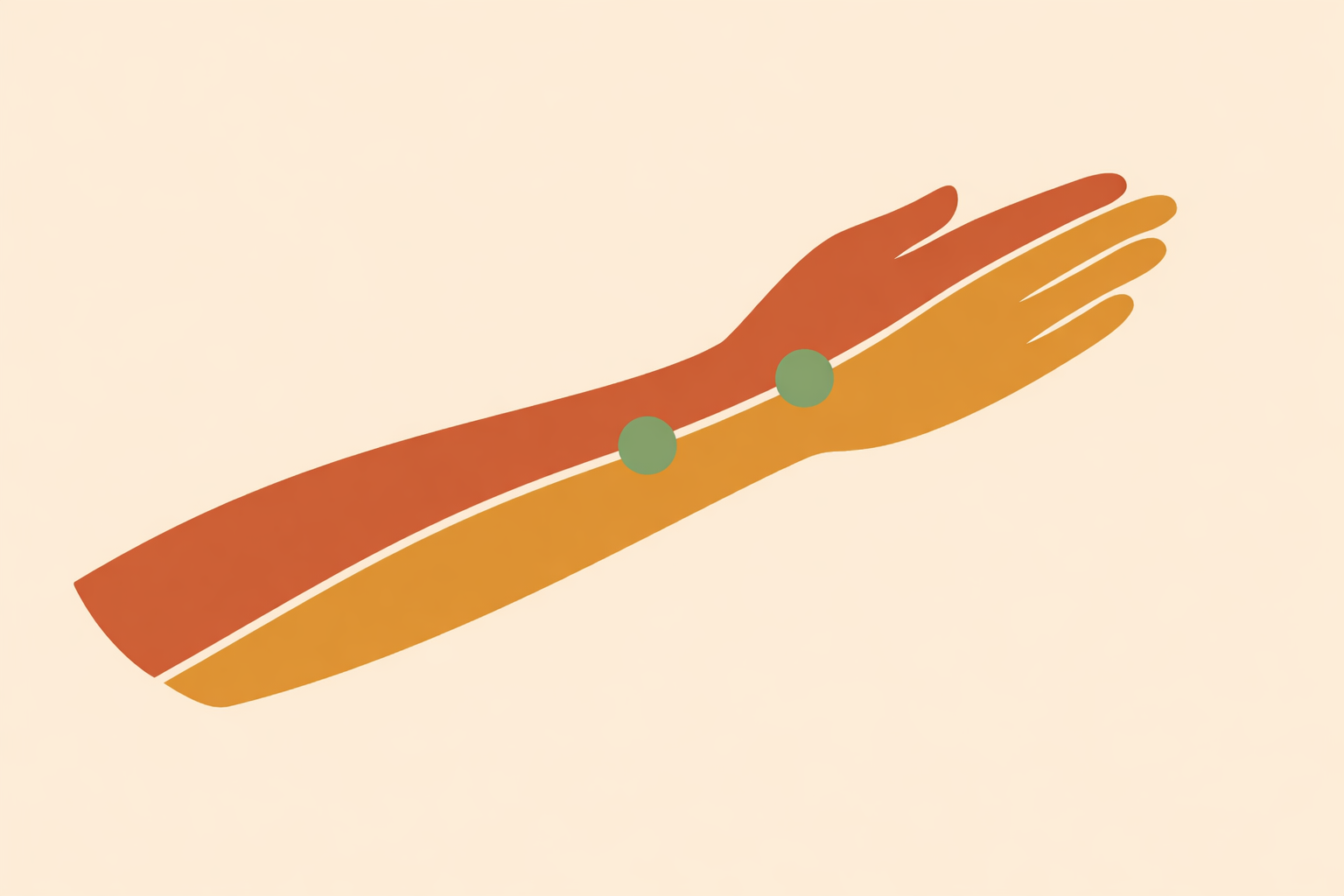
If you feel ropey tension along the outer forearm toward the thumb, for example, begin with outer arm (Yang), hand channel. That quickly narrows your focus to the Large Intestine or San Jiao pathways. Trace the line with your fingers and explore one tender or responsive area with gentle pressure.
For many practitioners, this is what makes the work teachable and repeatable: seeing the body more clearly, rather than memorizing more.
What TCM meridians represent in practice
Meridians are traditional pathways of movement and relationship. They aren’t described in Chinese medicine as one-to-one copies of nerves or blood vessels; they function as a map for reading connection across the whole body.
Traditional sources describe a network through which qi circulates, linking regions into a coherent system. That image is often more useful in practice than trying to force channels into a single modern anatomical category.
In this framework, qi refers to activity, movement, and transformation, while blood refers to nourishment, substance, and grounding as understood traditionally. Reviews describe qi and blood as distinct but closely related aspects of the system.
This is why practitioners pay attention to relationships like warmth and coolness, fullness and emptiness, agitation and ease. The language helps organize what you notice so your choices stay consistent.
This framework also carries deep roots. Modern summaries describe meridian concepts as ancient traditions. For day-to-day learning, the lasting value is that the map supports clear observation and skillful selection.
Meeting the 14-meridian map
The classic beginner layout is the 14-meridian map: 12 regular channels plus Ren and Du. In many lineages, students return to this map again and again because it stays practical.
The 12 regular channels are Lung, Large Intestine, Stomach, Spleen, Heart, Small Intestine, Bladder, Kidney, Pericardium, San Jiao, Gallbladder, and Liver. Ren (the Conception Vessel) runs along the front midline, and Du (the Governing Vessel) runs along the back midline.
At the beginning, the goal isn’t perfect recitation. It’s body literacy: inner and outer surfaces, front and back, arm and leg routes.
One effective study habit is to stand in front of a mirror and trace broad lines with your hands: inner arm, outer arm, inner leg, outer leg, front midline, back midline. When the body becomes the map, the channels become easier to work with.
If you notice a band of tension across the mid-back, for instance, you naturally think “back channels” first rather than hunting for a single “best point.” That shift lays the foundation for confident practice.
Using Yin–Yang and limb location to narrow the map
When the full map feels too big, filter it fast. Ask two questions: is the area on the inner or outer side, and is it on the arm or the leg?
Those two details can narrow your options immediately. Practitioners commonly add broad pattern clues too, like warm versus cool, tense versus depleted, surface versus deep.
This isn’t about forcing certainty. It’s about choosing a sensible starting point and staying consistent long enough to learn from it.
Imagine an outer knee line that feels achy with movement. Outer side suggests Yang. Leg suggests a foot channel. From there, Stomach or Gallbladder become strong first candidates, and you can compare route, texture, and the broader pattern before you settle on one place to work.
Used well, Yin–Yang becomes an orientation skill you apply with your hands and attention.
A simple five-step method for choosing where to work
If you want a repeatable way to choose one area for self-practice, use a small method you can actually repeat:
- Locate the main area clearly: front or back, inner or outer, upper or lower.
- Trace the nearest channel route with your fingers and name the likely meridian.
- Consider the paired channel or related midline if it fits the picture.
- Cross-check with a few pattern clues such as energy, digestion, tension quality, mood, season, or posture.
- Choose one gentle action and observe the response.
This route-first logic matches traditional point selection. Reviews describe points along meridians, which supports starting with the channel rather than pulling a point from memory.
If you notice tightness on the outer elbow, for example, trace the Large Intestine route along the outer arm, remember its relationship with Lung, and choose one responsive spot on the forearm for 45 to 60 seconds of comfortable pressure. Repeat the same approach for a few days and note what shifts.
That structure keeps your learning clean: one channel, one practice, one short observation window.
How to read the map: local, distal, paired, and midline
Once you understand the routes, you can use the map four main ways: near the area, farther along the same line, through a paired channel, or through the front and back midlines.
Local work stays close to the sensation. Distal work follows the same channel away from the area. Paired work explores the Yin–Yang channel relationship. Midline work uses Ren or Du as organizing references for the front or back of the body.
For example:
- A taut band beside the mid-back can be explored locally and also a little above or below along the same route.
- A sense of tightness across the chest may lead you to compare inner arm channels and their outer arm partners.
- A heavy front-body feeling may invite quiet contact along the Ren midline, while back-body restlessness may be approached through gentle awareness of Du.
Practitioner experience also shows that paired or opposite areas can sometimes change how a sensation is felt elsewhere. Even when the change is subtle, this kind of comparison teaches the map through direct experience.
Clarity matters more than intensity. Keep the experiment small so the response is easier to notice.
Common mapping mistakes and safe self-practice
Meridian maps work best when approached with humility and clear method. A few common mistakes can make practice feel confusing:
- Treating the diagrams as literal tubes instead of functional guides.
- Assuming one sensation always has one fixed meaning.
- Choosing only by point name without checking the route.
- Working on too many channels in one sitting.
- Ignoring the influence of sleep, workload, posture, movement, nourishment, or emotional state.
For self-practice, keep the touch gentle and the structure simple. Acupressure is commonly described as gentle pressure applied to traditional locations, and that general “gentle-first” approach serves most people well at home.
Helpful boundaries include:
- Avoid strong pressure on the front of the neck, the eyes, open skin, areas of fresh injury, or over prominent blood vessels.
- Stop if you feel sharp pain, numbness, dizziness, nausea, or a clear sense that something is not right.
- Work with one to three locations at most in a session so your observations stay clear.
- Keep the breath easy and the pressure moderate.
The aim is to do less, with better attention.
Using the meridian map as a long-term practice
The heart of meridian-based work stays simple over time: identify the region, trace the pathway, consider Yin–Yang and a few pattern clues, choose one gentle action, then observe the result.
Some people notice meaningful relaxation, easier breathing, or freer movement from map-based self-practice. Others value the steadiness of it: less guesswork, more precision, and a clearer relationship with their own body.
Over time, brief notes become a personal atlas of how your patterns show up across season, stress, posture, and daily rhythm.
That’s one of the quiet strengths of traditional Chinese medicine: it offers a language of relationship you can live with and learn from. Approach it respectfully, and it can support steadiness and coherence in your well-being.
Keep it kind and consistent, and let the map teach you over time.
Study TCM Foundations
Build meridian-map confidence with Traditional Chinese Medicine Foundations and make clearer, consistent choices in self-practice.
Explore TCM Foundations →