In small beds, the most useful definition of yield is “How much nourishment, stability, and usefulness can this space give over a whole season?” A tidy block of one crop can look productive, yet still leave hungry gaps, invite more pest pressure, and leave soil feeling tired by autumn.
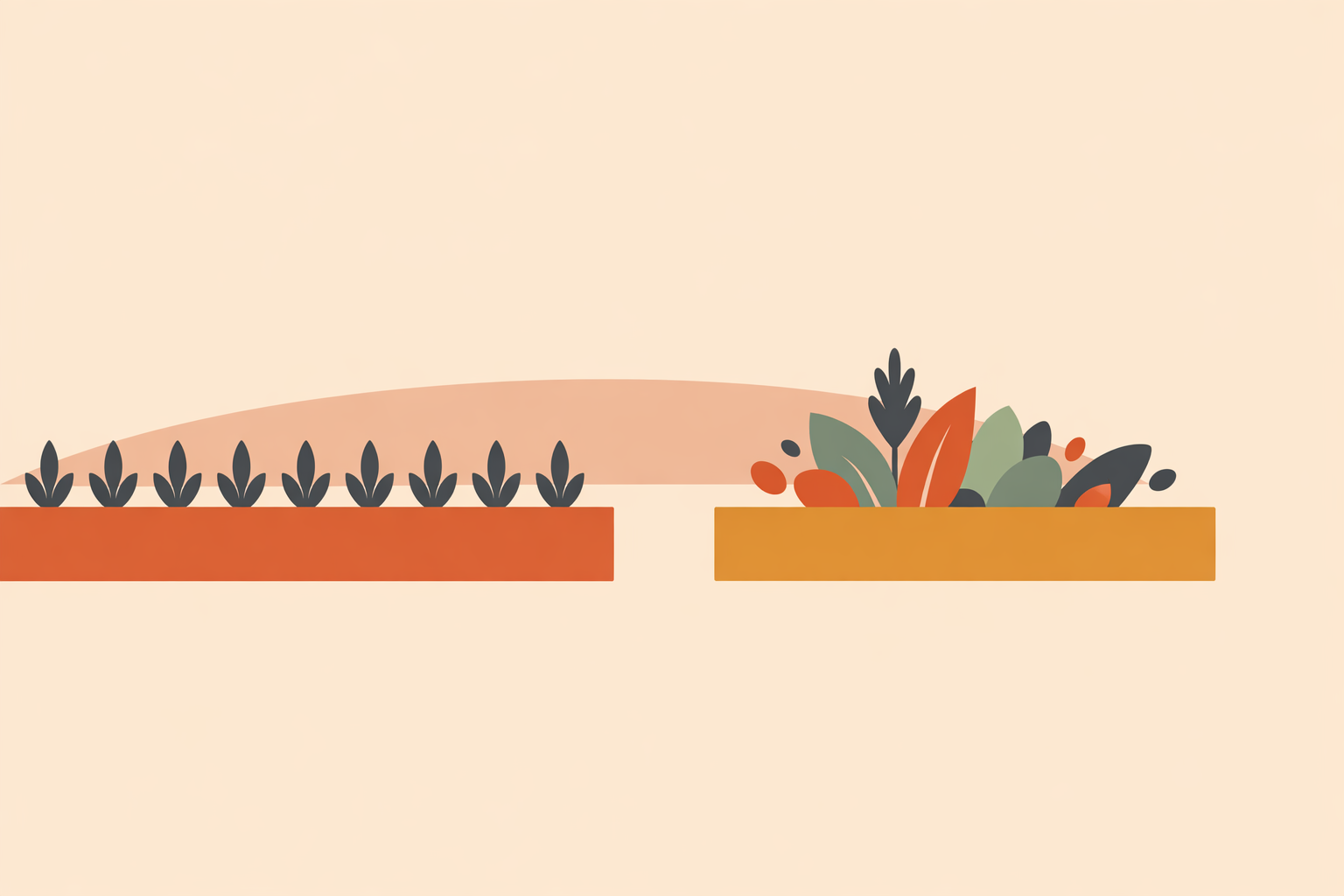
Key Takeaway: In compact permaculture beds, monocultures are best when you need maximum volume of one staple, while polycultures usually give better total harvest, steadier picking, and stronger system function across the season.
What counts as yield in a garden bed?
The clearest way to assess a bed is to count total harvest across everything it produces over time. Permaculture naturally favors that whole-season view.
One helpful tool is land equivalent ratio (LER). It asks whether a mixed planting produces more from the same space than separate single-crop beds would.
If lettuce and scallions together reach an LER of 1.4, that mix produces what would otherwise need 40% more land in separate plantings. That one number captures why small polycultures can feel surprisingly abundant.
Growers’ records often show the same story in real beds. A basil-tomato strip with calendula may not beat a pure tomato row on tomatoes alone, yet it can outperform it on total food and function per metre once basil harvests, petals, season length, and pollinator support are included.
This is why yield in a permaculture bed includes visible harvests and the functions that protect and extend them:
- Edible output across the whole season
- Use of vertical and horizontal space
- Living cover that protects moisture
- Flowers and habitat that support pollinators and predatory insects
- Soil improvement that carries into the next planting cycle
When monoculture is still the better choice
Monoculture still earns its place. When the goal is maximum volume of one staple, a single-crop bed is often the most effective design.
It shines when you want bulk processing and straightforward management. For sauce tomatoes, storage onions, or one coordinated harvest for preserving, uniform spacing and synchronized growth make planning, feeding, and picking far easier.
This simplicity also supports learning. A single-species bed teaches timing, spacing, watering rhythm, and harvest cues without the extra decisions that come with mixed planting.
The trade-off is that dense single-crop beds often need more inputs to keep output strong, especially when airflow is limited or soil life is still building. They can also leave the bed underused before and after the main crop, which reduces season-long productivity.
If sauce is the priority, a 6 m row of determinate paste tomatoes can deliver a clear canning harvest. If the goal is steady household abundance from the same space, a mixed planting often serves better.
The deciding factor is the bed’s job. A monoculture is a focused tool when focus is what you need.
Why polycultures often produce more overall
Polycultures often deliver the best total return per area, along with steadier harvests and stronger resilience. This is where classic permaculture design shows its strength.
Different plants use light, moisture, rooting depth, and timing in different ways. When they’re chosen well, they share the bed rather than crowding the same niche, and more of the space stays productive more of the time.
Traditional patterns like the Three Sisters demonstrate this beautifully. Corn, beans, and squash have fed communities for generations because they stack function across layers of space and time, and that principle scales well to small urban beds and raised planters.
In practice, polycultures often achieve higher land-equivalent performance than monocultures. The gain usually comes from the combined harvest and better use of the footprint, even when each individual crop doesn’t “win” on its own.
A client balcony example makes it tangible. Interplanting dwarf tomatoes, pole beans, and thyme in a 1.2 m trough produced a longer harvest season and a better combined return than any one of those crops would have managed alone. Tomatoes carried the middle season, beans climbed and produced later, and thyme filled the sunny edges without competing.
This is the gift of a good polyculture: it turns small, overlooked niches into ongoing harvest.
How to design productive polyculture beds without chaos
High-yield diversity works best when it’s designed, not improvised. The most productive mixed beds are structured enough to read at a glance and simple enough to harvest without frustration.
Start with complementarity. Each plant should earn its place by doing at least one of the following:
- Providing a main harvest
- Occupying a different height or rooting zone
- Covering bare soil
- Attracting pollinators or beneficial insects
- Extending the harvest season before or after another crop
Shading is one of the oldest, most practical design moves. In hot spells, lettuces tucked under taller companions often stay productive longer. Familiar combinations like tomato, basil, marigold, and nasturtium remain popular because they combine a main harvest with extra edible and supportive roles.
A reliable way to keep a bed tidy is to stack by height and timing:
- Tall layer: trellised cucumbers, pole beans, sweet corn
- Middle layer: basil, bush beans, peppers, kale
- Low layer: lettuce, thyme, strawberries, living mulches
- Edge or insectary layer: calendula, dill, alyssum, yarrow
One simple 1.2 × 2.4 m pattern looks like this:
- Back row: 4 trellised cucumbers
- Middle row: 6 bush beans between the cucumbers
- Front row: lettuces tucked into cooler pockets
- Scattered through the front and edges: dill and calendula
This stays easy to manage while giving vertical production, mid-level filling, quick greens, and flowering support.
It also helps to be honest about attention. Polycultures can require more management than simple beds because spacing, succession, and harvest timing matter more. When the layout is clean, that effort usually returns as steadier picking and fewer empty weeks.
Yield over time: soil, moisture, and resilience
The real strength of polyculture often shows up over multiple seasons. Beds managed with living cover, mulch, and mixed rooting patterns tend to get easier to keep productive.
Diverse plantings with living roots for more of the year often improve water movement, soil structure, and stored moisture. In day-to-day terms, that can look like fewer puddles after heavy rain and less frequent watering in summer.
Layered plantings and small habitat features also support beneficial insects, which reduces losses and saves time. Many growers notice that once insectary plants, mulch, and habitat are established, pest flare-ups settle down.
Practitioner experience commonly shows the same pattern in soil condition. A mulched, interplanted bed often enters spring with more earthworms, more fungal life, and better texture than a bed left bare after harvest. Over time, you can see it in moisture-holding, root growth, and how steadily crops handle stress.
That is why permaculture yield is a multi-year conversation. A bed that gives slightly less of one crop this month can still become the stronger producer over the long run because it’s building its own support as it grows.
Monoculture or polyculture? A practical way to choose
The best choice depends on what you need the bed to do.
Use a monoculture when you want:
- Maximum volume of one staple
- Uniform timing for processing or storage
- Simpler observation and easier planning
- A clear learning bed for one crop
Use a polyculture when you want:
- Continuous harvest instead of one large flush
- Better total output from limited space
- Stronger soil cover and moisture protection
- More pollinator and insect support
- Greater resilience through shifting weather and pressure
Many gardeners land on a hybrid strategy: a bed or two kept simple for staples, with the rest built as well-planned mixed plantings. It’s flexible and forgiving, especially in small spaces.
A four-bed layout might look like this:
- Bed 1: paste tomato monoculture for preserving
- Bed 2: salad polyculture with lettuce, scallions, dill, and calendula
- Bed 3: root mix with carrots, beets, and quick radishes
- Bed 4: corn and legumes with a spreading groundcover
If you are deciding this week, keep it practical:
- Name the bed’s main purpose in one sentence
- Check sun, access, and watering constraints
- Choose either bulk harvest or continuous harvest as the priority
- Add only as much diversity as you can observe well
- Keep notes and refine the pattern next season
Conclusion: the most useful yield is total yield
When the goal is one staple in quantity, monoculture remains a strong choice. When you count what a bed gives across a full season, thoughtfully designed polycultures usually offer more food per square metre, steadier picking, and more vitality in the soil.
Small permaculture beds often thrive with a mixed approach. Keep a few spaces simple where simplicity truly serves you, and let the rest of the garden practice diversity with clear intention. Over time, the most productive beds tend to be the ones where each layer has a role and the whole system becomes more generous year after year.
Design Better Polycultures
Apply these yield principles with confidence in the Permaculture Design Course.
Explore Permaculture Design Course →