


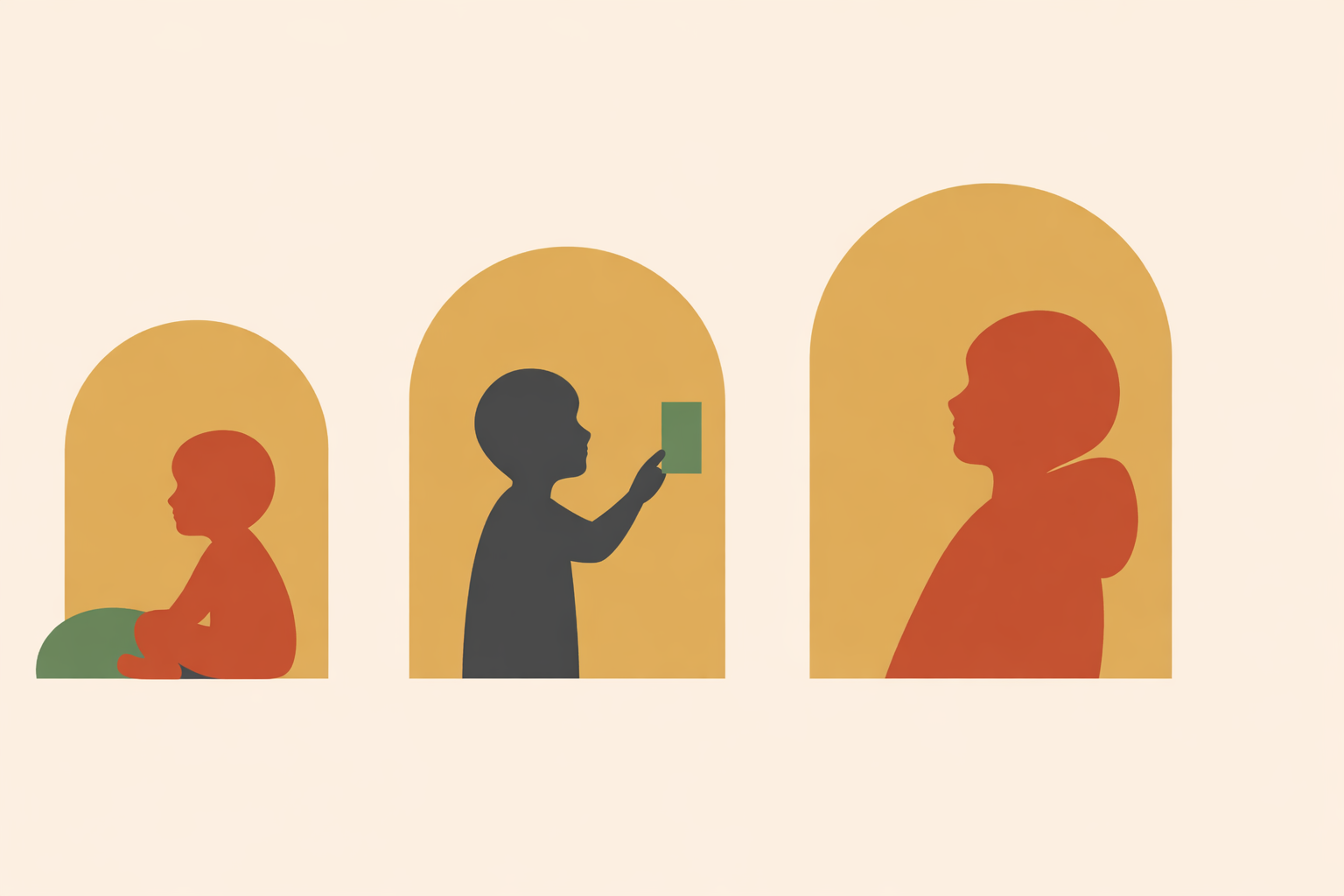
In a single afternoon, you might move from a four-year-old burying cars in sand, to a nine-year-old rewriting UNO, to a twelve-year-old with their hood up and zero interest in chatting. The instinct is to help: add a plot, correct a rule, ask the feeling question. In non-directive work, those habits often backfire.
What tends to help most is a steady adult who watches closely, reflects clearly, and keeps the space dignifying for the child’s age. The stance stays consistent, but the way you express it changes with development.
Key Takeaway: Non-directive play work becomes more effective when facilitation matches the child’s developmental window. For ages 3–6, the core is notice–respond–extend within sensory and simple pretend play, supported by rhythm, repetition, and kind limits. For ages 7–10, the work often moves through games, fairness, mixed feelings, and shared storytelling without the adult taking over. For ages 10–13, progress usually depends on protecting autonomy, using age-respectful creative mediums, and allowing indirect entry rather than pushing for direct talk. Across all ages, the essentials remain the same: observe closely, reflect clearly, validate without assuming, and extend only one notch.
Notice, respond, extend in sensory and simple pretend play
A four-year-old piles three cloths over a toy puppy, taps the bundle with a wooden spoon, and glances up. You track what’s happening, name what you see, then offer one small extension that keeps the child in charge.
- Notice: “You covered the puppy and tapped the top. Three taps.”
- Respond: “You’re watching closely to see what happens.”
- Extend one notch: “Here’s a small blanket if you want it,” or “The spoon can make a quiet tap or a loud one. You decide.”
In this window, sensory and simple pretend are often the most natural “languages”: sand and water, pouring and burying, cooking play, animal figures, arrivals and departures, wrapping and unwrapping, hiding and finding.
Usable example: a five-year-old pushes toy cars nose-first into kinetic sand. You match their pace. “That car went in nose-first. Now it’s hidden.” When they press harder, you add, “There’s more sand if you want a deeper place.” If they hand you a car, you follow their rules and mirror their tempo without inventing a new storyline.
Use rhythm, ritual, and kind limits
With younger children, settling tends to come through repetition more than explanation. Research suggests repeated actions help build early socioemotional foundations, and predictable musical routines can support engagement in young children. Traditional play cultures have long carried this wisdom through clapping games, drum patterns, and call-and-response songs.
In the room, ritual can be tiny and still powerful. A hello might be placing one stone in a bowl and taking one breath together. A goodbye might be ringing a soft chime and putting the stone back. Repeated openings and closers often help the child arrive without you needing to steer.
Keep limits calm, brief, and consistent:
- State the limit: “I’m not for throwing.”
- Allow the feeling: “It’s okay to want to throw big.”
- Offer a real choice: “The beanbags can hit the target, or the blocks can crash on the mat. You choose.”
When rhythm is steady and choices are real, many young children test, rest, and return. That back-and-forth is often where early confidence grows.
Sample session note: “N, 3y11m—gravitated to water table; repetitive pouring settled attention; offered one-choice extension (larger cup) after 6 minutes; baby figure wrapped and unwrapped several times; goodbye drum beat of four taps supported transition.”
Quick Set 2: Non-Directive Play Moves for Ages 7–10
For school-age children, the quickest adjustment is to ask fewer questions than you want to. Track the action, reflect the dilemma, and let the child’s sense of fairness and competence set the pace.
Track story, agency, and mixed feelings without taking over
In these years, play often leans into rules, friendships, team roles, wins and losses, and more layered plots. Your sequence stays simple, but your words can hold more complexity:
- Observe: “In your story, the sidekick broke the rule and still scored.”
- Reflect: “Now the captain is torn. Cheer or call it out.”
- Validate: “That’s a tough spot. Both choices matter to you.”
Keep reflections concrete and tentative: “You put the figure behind the house,” “That tower fell and you started again,” or “Part of you wants to win and part of you wants it to feel fair.”
Composite scenario: a nine-year-old designs a board game where a smaller piece can jump two spaces if it “helps someone.” The child tries the move, hesitates, and looks at you. Instead of approving or correcting, you mirror: “You found a helping move that changes the game. You’re deciding if it still feels fair.” When they choose, you reflect the value underneath: “You kept the rule this time. Fairness mattered more.”
Let games and shared stories carry the work
Rule-based games bring values into the room without demanding direct disclosure. They go off track when the adult starts teaching, testing, or fixing. Co-play under the child’s rules keeps the work child-led while still well-held.
Try a sequence like this with an eight-year-old who keeps bending UNO rules:
- “You changed the rule so you could stack those cards. That makes the game faster.”
- “Part of you likes the speed, and part of you is checking what I’ll do.”
- “We can play with your house rules if we’re both clear on them. Want to say them out loud?”
Shared storytelling can be just as strong. Evidence suggests reduced anxiety in children in one trial, and many practitioners value stories because they allow feeling, distance, and authorship to coexist.
In a co-created tale, add texture rather than plot. If the child says, “The fox left the group,” you might offer, “The trees got very quiet.” If they say, “Everyone forgot,” you might add, “The moon noticed.” You match tone and world-building without slipping in a lesson.
Across many traditions, children have practiced fairness and conflict repair through games, riddles, and shared tales held by a light adult structure. The playroom can echo that same shape: a clear container with plenty of room for the child to lead, especially in child-centered play therapy.
Sample session note: “K, 7y2m—cooperative marble maze; chose to keep all marbles at first; reflected agency (‘You’re setting the rule’); later revised to ‘one marble each’; named mixed feelings about sharing; left with a clear sense of self-authored success.”
Quick Set 3: Non-Directive Play Moves for Ages 10–13
With tweens, protect dignity from the first minute. If materials feel babyish or the adult comes on too strong, many young people shut the door quickly.
Respect autonomy with age-appropriate creative mediums
Keep play, but shift the medium and hand over authorship. Offer options that match this age group: sketchbooks, collage, clay, simple beat-making, model-building, stop-motion, strategy games, graphic storytelling, zines, and other child and adolescent development supports that stay age-respectful.
You might say, “Pick the medium that fits today. We don’t have to talk for a while. You can build it, draw it, or soundtrack it.”
- Open with a true choice: “We’ve got design materials, a quiet strategy game, or headphones and a simple beat app. What’s least annoying today?”
- Track autonomy as a theme: “You’re making a world with no teachers, only team captains.”
- Offer metaphor lightly: “Sometimes captains have to decide alone. If you want, the map can show how they handle that.”
When a young person invites metaphor, move slowly and check permission. “If the main character were you for a minute, would that fit or feel off?” often lands better than pushing for explanation. So does, “Want me to wonder about this out loud, or keep following the build?”
Use confidentiality, metaphor, and indirect entry with wary tweens
Clarity lowers resistance. Early on, give a crisp confidentiality frame in age-respectful language: “Most of what you do or say here stays private. If I’m worried someone is unsafe, I’ll talk with you about what has to be shared and why. You choose what we focus on and how we do it.”
Then make it real through small actions. Ask before keeping a work sample. Ask before saving or deleting an audio beat. Let them close a sketchbook if someone knocks. For many wary tweens, those moments build trust faster than a polished explanation.
Indirect entry is often the most effective doorway. Sit alongside, use a low-demand activity, and keep words sparse. “We don’t have to start with anything big. I’ll sort these tiles. If you want, you can design something next to me. I’ll follow your lead.” Once the hands are moving, reflections often carry more weight than questions: “You’re engineering a route with no dead ends,” or “This beat has a steady bass and a glitchy top. Two moods at once.”
Over time, the choices a tween makes about what to show and what to hold back often become central to agency-building. That isn’t a detour from the work; it’s frequently the work itself.
Sample session note: “R, 12y5m—entered with hoodie up; chose collage; minimal eye contact; reflected autonomy (‘You’re deciding what goes in and what stays out’); confidentiality restated with concrete example; allowed one photo of finished piece for next session only; boundary respected.”
Across Ages: What Stays the Same
The through-line across all ages is disciplined curiosity. You observe closely, respond without taking over, validate without assuming, and shape the space so the child can communicate in the medium that fits them.
Child-led does not mean hands-off. You hold the frame, keep limits clear, and regulate your own reactions so the room stays safe and respectful, whether you work in play therapy or the wider field of child and adolescent development.
A short clipboard check is often enough:
- Observe.
- Reflect.
- Validate.
- Extend one notch.
After each session, two questions can keep your practice clean and child-centered: What did the child lead? Where did I almost take over? Asked consistently, those questions strengthen judgment and protect the child’s authorship.
Train in Play Therapy Certification
Deepen these age-matched, child-led skills with Naturalistico’s Play Therapy Certification.
Explore Play Therapy Certification →










