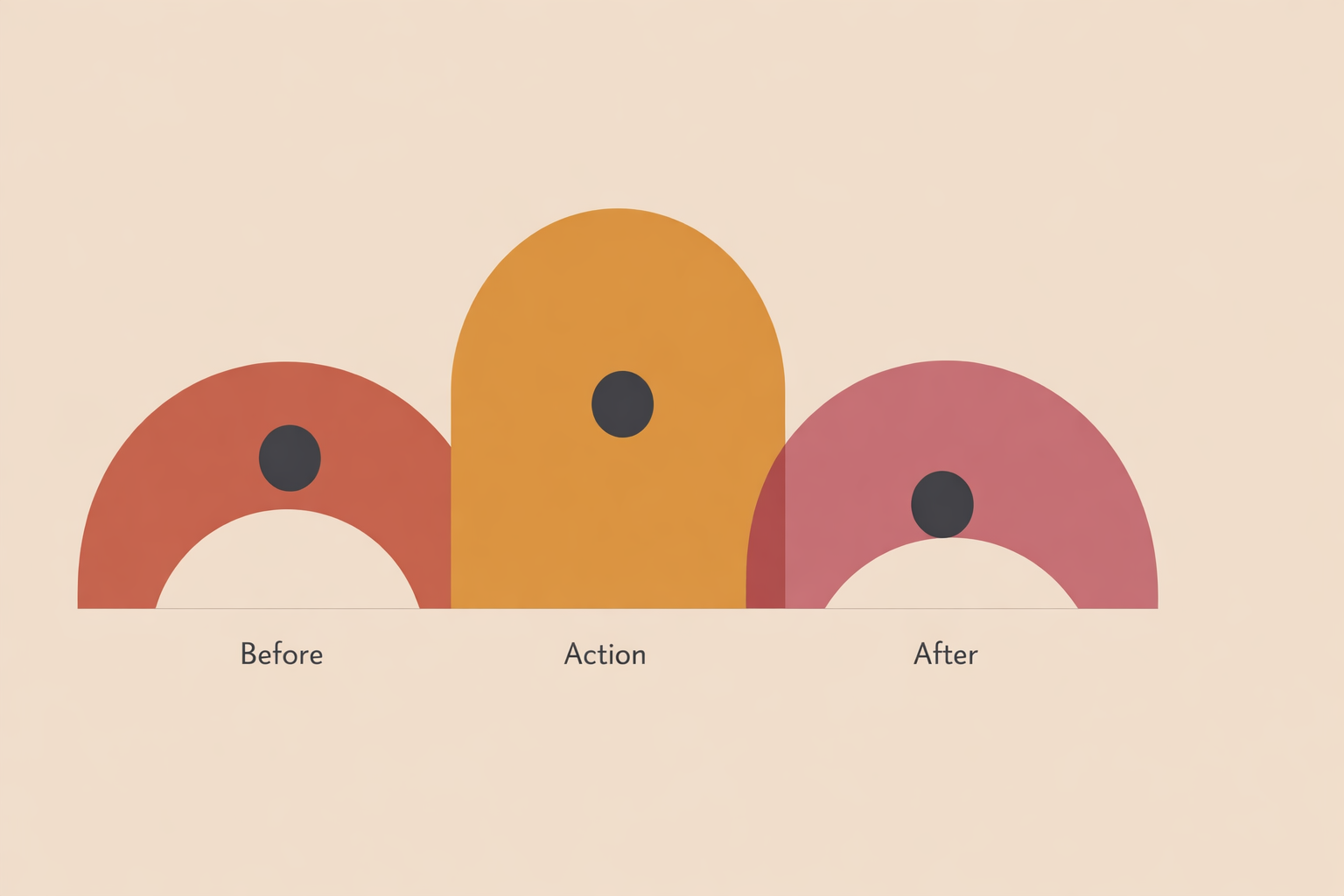
“Deep inner work” is easy to promise and much harder to frame clearly. Without a visible structure, discovery calls drift, clients with very different capacities enter the same offer, and sessions can swing between mapping, overwhelm, and premature integration. A simpler structure helps: three consent-led pathways for parts-based work—Map & Understand, Regulate & Re-relate, and Integrate & Lead.
Key Takeaway: Packaging parts-based coaching into three clear pathways helps clients choose work that fits their current readiness. Map builds language and orientation, Regulate supports steadiness and protector trust, and Integrate brings that awareness into choices, relationships, and leadership. Across all three, clear consent, scope, pacing, and referral boundaries keep the work grounded and useful.
How to turn a rich parts model into usable client offers
Build pathways, not rigid protocols. Your sessions can stay nuanced while the offer becomes easier to understand and easier to choose.
Match clients by readiness, not by emotional intensity. A highly emotional client might still be ready to map. A calm, articulate client might still need regulation skills before integration work will land.
Capacity is the real guide: can the client stay oriented, notice inner experience without flooding, and relate to parts with at least a little curiosity?
To keep each pathway clean and client-friendly, answer five practical questions in your materials:
- Who is this for?
- What will we focus on?
- What might you practice between sessions?
- What does progress look like in daily life?
- When is another form of support more appropriate?
This keeps your messaging outcome-led. Rather than selling catharsis, you’re naming observable capacities: clearer inner maps, less inner conflict, steadier choices, cleaner boundaries, and more warmth toward protective patterns.
Pathway 1: Map & Understand
This pathway fits clients who are functional on the outside but confused, conflicted, or harsh with themselves on the inside. The promise is clarity: understanding who’s “in the room” internally and how those dynamics operate.
Early mapping often works best when you begin with a handful of parts—enough to create a useful first map without turning the process into endless categorizing.
A simple map might include:
- name or image of the part
- where it shows up in the body
- its emotions, beliefs, and impulses
- what it seems to fear
- what it is trying to prevent
- how it relates to other parts
Keep the map provisional. A part that looks critical at work may be protective in family life. A part that seems avoidant may actually be exhausted. Calling it “a living draft” keeps the client from turning a useful model into a fixed identity.
Normalize blending early. When a part takes over, its perspective can feel absolute. Tracking cues like all-or-nothing language, faster speech, and reduced nuance helps clients spot blending in real time, so urgent inner voices stop being mistaken for “the whole truth.”
A helpful between-session script stays simple: “A part of me is scared, angry, or pushing hard. I’m here with you.” The tone often shifts immediately. Progress tends to accelerate when clients stop trying to eliminate parts and start listening.
Pathway 2: Regulate & Re-relate
This pathway is for clients who can identify parts but still get derailed by intensity, shutdown, or inner conflict. Insight is present, yet steadiness isn’t consistent.
Pacing is central here. Trauma-informed guidance warns that moving too quickly can overwhelm people who already struggle to stay oriented.
The focus shifts from understanding the system to staying in relationship with it. Protector-focused work is often pivotal. When a protective part is treated as predicting danger (rather than “being difficult”), cooperation becomes much more likely.
You might ask:
- What is this protector trying to prevent?
- What does it fear would happen if it softened?
- What conditions would help it trust the pace more?
Practical pacing can look like eyes open, attention partly on the room, brief contact with intense material, and frequent permission to pause. The client stays connected to the present while building tolerance.
Containment helps, too. Some clients do best when intense material has a clear boundary: it belongs in session, in a journal at a chosen time, or inside a short agreed ritual. That boundary gives intensity somewhere to live without running the whole week.
Regulation tools land best as experiments, guided by consent and real-time response. Trauma-informed guidance emphasizes client feedback, so what you use and when should be shaped together, not imposed.
Progress often comes through “small loop repairs.” If a client can interrupt one familiar sequence—criticism, shame spike, pushing, then numb shutdown—the whole system starts to reorganize toward cooperation over time.
Pathway 3: Integrate & Lead
Integration begins when a client can unblend with some reliability and bring grounded presence into everyday life. The aim is steadier choices and cleaner repair in real relationships.
Clients here often say, “I can tell when the anxious part is here, but it is not all of me,” or “I still get pulled, but I recover faster.” Many describe Core Self using the familiar “8 Cs” language: curiosity, compassion, calm, clarity, connectedness, courage, creativity, and confidence.
Integration becomes tangible in ordinary moments:
- pausing before sending the reactive message
- asking for help sooner
- setting a cleaner boundary
- repairing after conflict with less defensiveness
- choosing rest without self-attack
- making values-led decisions under pressure
A predictable session arc can support this: arrival, goal, parts check-in, pacing, exploration, integration, and closure. It doesn’t need to be mechanical; it simply helps the client stay oriented while life-based application deepens.
One subtle risk to watch is protector mimicry: a protector sounding calm and highly articulate while lacking warmth. Composure matters, but compassion for more vulnerable parts matters more.
This pathway often shines in leadership, business, creativity, and relationships. A founder can hear the Visionary, the Skeptic, and the People-Pleaser without letting any single voice run the decision. A partner can notice defensiveness sooner and return with more clarity. A creator can work with the inner critic without granting it total authority.
Working with ancestral wisdom without appropriation
Modern parts language is one way to describe inner multiplicity, but it’s far from the first. Many lineages have long practiced inner listening through ritual, rhythm, song, silence, prayer, story, and communal witnessing. The three pathways can sit alongside those roots with respect.
Map often resonates with naming and story. Regulate connects naturally with rhythm, breath, repetition, and grounded ritual. Integrate asks how inner awareness becomes daily conduct, responsibility, and care within community.
The key is cultural humility. Don’t treat all traditional practices as interchangeable with a parts framework, and don’t borrow spiritual or cultural forms as aesthetic add-ons. Share practices from your own background transparently. If you know a practice’s lineage, name it accurately; if you don’t, keep language modest and invite client choice.
This is especially important in groups. People may not want to share personal history across cultural or power differences, so protecting choice and privacy is essential. Group guidance emphasizes privacy, autonomy, and awareness of power differences, which can look like opt-in sharing, silent reflection, generalized examples, and no pressure to disclose.
Group spaces can still be deeply supportive. Broader psychology reporting suggests group formats can be highly effective for building insight, connection, and new relational patterns.
Whatever the setting, keep the map flexible. A parts map is a map, not a fixed category system.
Consent, scope, and referral across all three pathways
Clear consent and scope keep parts-based work grounded. They also help clients settle because they know what the space is for, how pacing works, and what happens if intensity rises beyond what coaching can hold.
Start with plain language. Explain that your work supports self-awareness, regulation, reflection, values-led action, and a healthier relationship with inner patterns. Be equally clear about what sits outside your role.
Revisit consent as the work unfolds. Consent often needs renewing when intensity changes, when you introduce a new exercise, or when a client realizes they want a slower pace. Trauma-informed guidance supports repeatedly discussing pacing rather than assuming one early “yes” covers every stage.
A simple color check-in can help: Green, Yellow, Red. If the client shifts into yellow or red, pause and renegotiate.
It’s also important to know when to pause coaching and refer onward. Ongoing inability to stay oriented, severe dissociation, active suicidal thoughts, ongoing abuse or coercive control, major functional collapse, or a need for specialized support are all signs that a different level or form of care is more appropriate. SAMHSA highlights suicidal thoughts, dissociation, and overwhelming activation as strong reasons to slow down and seek more specialized support.
Keep your emergency policy visible, and repeat it verbally as well as in writing. That reduces confusion if someone needs immediate help outside your scope.
Finally, protect your neutrality. Taking sides inside a client’s inner polarization usually intensifies the conflict. A steadier stance is to help each side feel heard without appointing a villain, which models the inner diplomacy the client is learning to build.
Bring the three-pathway offer to life
You don’t need one vague, all-purpose “deep inner work” package. A three-pathway structure makes your work easier to choose, easier to describe, and easier to hold with integrity. Map offers a compass. Regulate builds steadiness and trust. Integrate brings inner work into lived choices.
To implement it, start small. Update one client-facing page around the three pathways, add one between-session practice to each, and spell out what progress looks like in daily life. Make your “not a fit when” language visible, and keep pacing collaborative.
Let the structure serve the relationship rather than replace it. Clarity supports depth, because it helps clients engage at the pace their system can genuinely use.
Train in parts integration
Deepen these three pathways with the Inner Parts Integration Coach Certification.
Explore Inner Parts Integration →