Retreat founders and designers often meet the same friction point: the vision is felt through comfort, quiet, beauty, and belonging, while the budget demands rates, loads, phasing, and payback. In remote settings, that tension is sharper—contractor capacity is thinner, and every maintenance choice echoes for years. The good news is that biomimicry doesn’t have to stay a poetic idea. It becomes priceable when you translate experience into building performance, lifecycle thinking, and clear revenue logic.
The most useful shift is straightforward: stop pricing isolated features and start pricing the retreat as an ecosystem. When form, orientation, envelope, ventilation, water, upkeep, guest comfort, and room value are considered together, decisions get easier to defend. You’re no longer debating whether one gesture is “worth it.” You’re choosing how the whole place performs, feels, and endures.
Key Takeaway: Biomimicry becomes priceable when you treat the retreat as a whole system and connect nature-led decisions to measurable performance, maintenance demands, and guest comfort. Compare options across lifecycle costs and revenue logic, then choose a level of biomimicry that matches the climate, site realities, and operational capacity.
Why pricing biomimicry in retreat design feels difficult
Pricing feels hard because retreat value is often sensed before it’s measured. Founders can tell when a place feels alive, settled, and aligned with the land—and guests respond to that quality quickly. But spreadsheets don’t naturally capture stillness, deeper rest, or a sense of belonging.
The bridge is translation. Sensory benefits need to be expressed as outcomes stakeholders already understand: lower energy demand, smaller systems, fewer maintenance headaches, resilient phasing, stronger distinctiveness, and better pricing discipline. Once that’s done, biomimicry stops looking like an aesthetic premium and starts reading as strategic design.
Design quality shapes operations and perception at the same time. Quiet rooms, stable temperatures, good air movement, thoughtful daylight, and a strong sense of place all support the guest experience—and, in retreat settings, that experience becomes part of the story guests remember and share.
“Every building, no matter how large or small, is part of the urban design.”
Paul Rudolph’s line applies just as well to retreat landscapes. A retreat is never just a set of rooms; it sits inside a wider ecological, cultural, and emotional field, and people feel that immediately.
What biomimicry changes beyond visual nature cues
Biomimicry isn’t simply adding greenery or creating a “natural” mood. It’s a way of solving design problems by learning from living systems—so it changes how a place shades itself, moves air, handles water, responds to climate, and ages over time.
In that sense, biomimicry often goes further than biophilic design. Biophilic design supports connection and atmosphere, while biomimicry uses functional strategies—like ventilation, shading, and water management—drawn from nature’s patterns.
Practically, biomimicry can show up at multiple scales: the form of a structure, the way it behaves in heat and wind, or how the whole site operates as a nested system. Think of it like a grove: separate cabins can act as a cluster, not isolated objects. A roof can behave like a water-harvesting surface. A wall assembly can buffer heat the way an organism protects itself from extremes.
For retreat work, ancestral building wisdom belongs at the center of this conversation. Orientation, shaded thresholds, cross-ventilation, careful siting, rain handling, and compact forms aren’t trends—they’re long-tested responses to land and climate. Biomimicry simply gives contemporary language to something traditional builders have understood for generations: buildings thrive when they collaborate with their environment.
“Bio‑Architecture is one of the most interesting expressions of organic architecture.”
Javier Senosiain’s framing is a helpful anchor. The point isn’t to imitate nature’s appearance; it’s to work from living principles that improve performance and deepen coherence.
Price the retreat as an ecosystem, not as a list of features
The strongest pricing decisions come from ecosystem thinking. Instead of isolating the cost of one façade, roof, or ventilation strategy, look at how that choice changes other costs and opportunities across the project.
This means considering:
- initial build cost
- energy and water demand
- system size and complexity
- maintenance frequency
- replacement cycles
- guest comfort and distinctiveness
- rate confidence and long-term revenue
This approach also matches how many retreats are actually built: in phases. Cabins or small units often come first, with the communal heart added or expanded over time. Ecosystem pricing makes it easier to invest early in the moves that quietly deliver the most dependable value—orientation, envelope quality, shaded outdoor transitions, passive airflow, and resilient water logic.
Seen this way, biomimicry isn’t one line item. It’s a pattern of decisions that can reduce operational complexity while strengthening the atmosphere guests are paying for.
“The ultimate aspiration of bioarchitecture is integration of living systems with the built environment.”
A practical 5-step method to price biomimicry
If you want a clear way to move from inspiration to numbers, a simple five-step process helps. It keeps the soul of the project intact while making decisions easier to explain.
1. Set nature-benchmarked goals.
Start with performance, not form. Decide what the place needs to do: steadier temperatures, softer daylight, quieter rooms, better water retention, lower cooling demand, or a stronger sense of shelter. Use nature as the benchmark for outcomes, not as a styling reference.
2. Read the land in plan.
Map sun, wind, slope, runoff, views, access, vegetation, and exposure. This is where many of the best low-cost moves appear. Early choices around orientation, spacing, shade, and drainage tend to shape everything that follows.
3. Develop form in three dimensions.
Once the land is understood, test massing and geometry with a clear biomimicry logic. Aim for forms that solve problems simply: buildable, coherent, and maintainable without strain.
4. Compare lifecycle implications.
Place a conventional option beside the biomimetic one over a multi-year horizon. Track energy, water, upkeep, replacement cycles, system complexity, and operational friction. Here’s why that matters: in remote settings, every repair tends to cost more—in time, logistics, and disruption—than it looks on paper.
5. Translate performance into guest value.
The final step is language. Steady temperatures become better sleep. Passive airflow becomes quiet. Dappled light becomes a softer morning rhythm. Water-wise landscapes become beauty with less strain. That’s how technical performance becomes a pricing story with integrity.
Architecture is the “learned game” of forms and light.
Le Corbusier’s line is a useful reminder: this is a practice. You refine it by observing, modeling, pricing, and learning from each site.
Choosing the right dose of biomimicry
Not every retreat needs a dramatic bio-inspired structure. Some of the most durable value comes from modest, place-true moves. A helpful way to scope the work is to think in three levels: light, medium, and deep biomimicry.
Light biomimicry
Often the best starting point. It includes orientation, passive shading, envelope tuning, compact footprints, rain-sensitive landscape design, and simple ventilation logic. These measures tend to phase well, maintain well, and justify well.
Medium biomimicry
Here, strategies become more integrated. You might combine passive airflow, daylight control, water harvesting logic, thermal buffering, and site planning into one coherent performance package—often improving comfort and operating efficiency without introducing unnecessary complexity.
Deep biomimicry
This includes highly specialized façades, custom bio-inspired structures, kinetic components, or unusual envelope systems. These can create powerful identity and storytelling, but they also demand a mature team, precise detailing, and a realistic maintenance culture—especially in remote settings.
Across most cabin-plus-commons retreat patterns, the most reliable long-term value usually comes from high-performance envelopes, passive shade and airflow, durable materials, and resilient water systems. Put simply: simpler systems often age more gracefully and ask less from the site team.
Why climate and remoteness should lead the design
Biomimicry works best when the biological model fits the local biome. A strategy that performs beautifully in one climate can become expensive—or simply disappointing—in another.
This is amplified in retreat projects because many are intentionally remote. Remoteness magnifies weaknesses: skilled labor may be harder to source, replacement parts may take longer to arrive, and maintenance routines need to be realistic rather than idealized.
That’s why ancestral and passive strategies are often the strongest foundation. Orientation, shading, ventilation, thermal mass, protected outdoor thresholds, water harvesting, and landscape hydrology can reduce operational complexity compared with more mechanical approaches. Essentially, the intelligence sits in the form itself.
Climate fit matters at every scale. A stack-ventilation concept that feels elegant in hot-dry regions may underperform in hot-humid conditions. Self-shading elements that help in desert sun may block welcome warmth in temperate seasons. Fog-harvesting can be captivating, but it only makes practical sense where microclimate conditions reliably support it.
The same is true for low-upkeep surface strategies. Lotus-inspired self-cleaning finishes can be useful, but real-world abrasion, weathering, and site conditions shape how well they hold up over time.
The broader lesson is simple: avoid forcing a biological metaphor onto a place where it doesn’t belong. Biomimicry is strongest when it grows from local conditions rather than being imported as a visual concept.
Turning building performance into retreat value
Guests don’t book energy models. They book the feeling of being held by a place. So the final layer of pricing is experiential: expressing what the design allows people to feel, day after day.
Biophilic research offers a useful bridge. A visual connection with nature, along with non‑visual sensory qualities like sound, texture, and scent, can shape how restorative a space feels—often as much as amenities or floor area.
This helps explain why sleep tourism and restorative travel are drawing attention, particularly among self-paying midlife women. For this audience, quiet, light quality, air movement, and a genuine sense of refuge aren’t decorative extras; they’re central to the value of the stay.
One simple way to translate biomimicry into guest-facing language:
- Comfort: cabins oriented for shade and airflow, helping the atmosphere stay more even and restful
- Light: filtered daylight inspired by woodland patterns, supporting calm mornings and softer transitions through the day
- Quiet: less dependence on humming systems, allowing silence to become part of the experience
- Water and landscape: land-shaped drainage and planting that create beauty, resilience, and a stronger sense of place
When expressed clearly, this becomes a credible pricing story: the retreat costs more because it offers a rarer quality of comfort, coherence, and connection—while being designed to operate intelligently over time.
As Terrapin notes, biophilic design is not about decoration. In retreat architecture, the same principle applies to biomimicry: the value isn’t surface-level nature styling, but how the whole place performs—and how people feel inside it.
Build from grounded principles, then deepen over time
You don’t need an extravagant concept to begin. In most retreat projects, one or two well-chosen strategies can shift the whole direction: better orientation, stronger shading, quieter ventilation, a more climate-wise envelope, or a more intelligent water landscape.
Start there. Observe what the site is already teaching you. Price the choice across capital cost, operational ease, upkeep, and guest value—then deepen only where the next layer is truly supported by the climate, the team, and the long-term vision.
That’s often the most faithful expression of bio-architecture: fit over spectacle, and living logic over copied shapes.
The aim is the integration of living systems with the built environment.
Priced this way, biomimicry protects both the land and the business model. The retreat becomes more coherent, easier to explain, and more likely to endure.
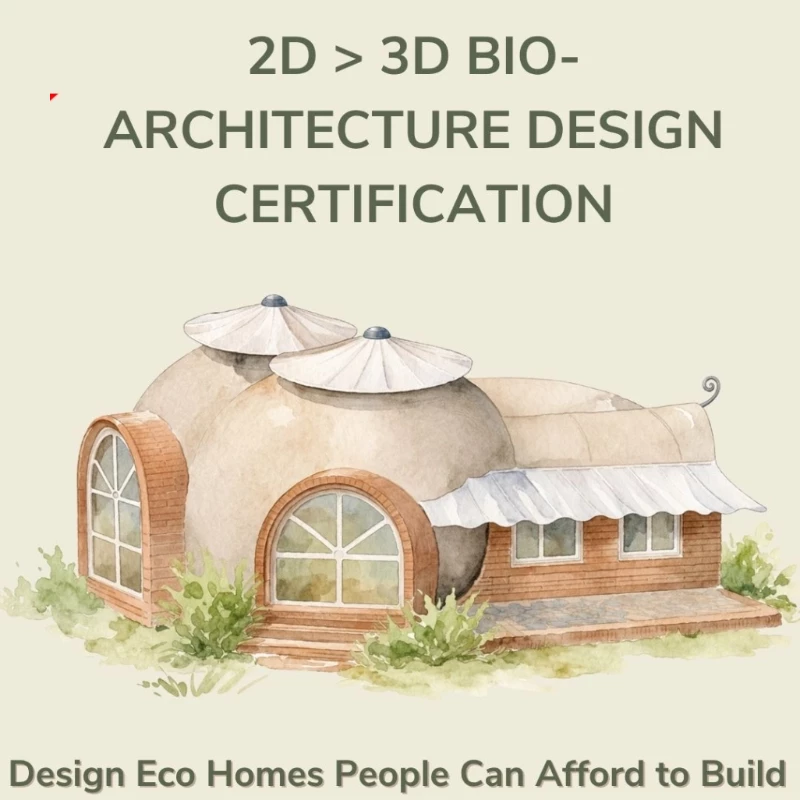
Master Bio-Architecture Design
Apply ecosystem pricing and climate-fit biomimicry with the 2D-3D Bio-architecture Design Certification.
Explore the Certification →