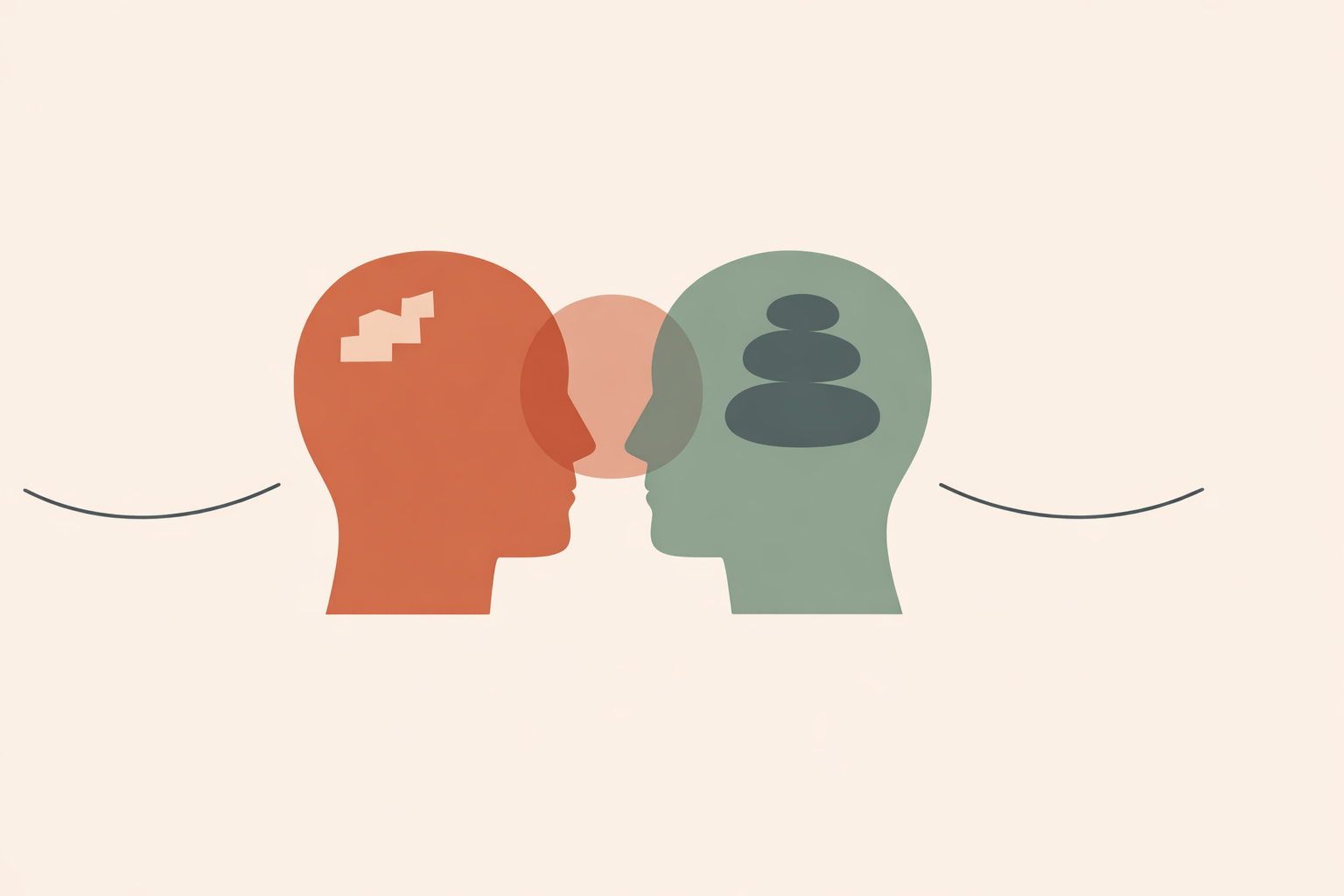
When a client’s body tightens or their words fall away, many practitioners instinctively talk more: What are you feeling? What just happened? Can you tell me why? With autistic clients, that can add strain rather than reduce it. The issue is rarely willingness. More often, the person is already managing too much input on a tired system. In those moments, the kinder move is to change the conditions first and coach second.
Key Takeaway: Effective support in moments of rising distress follows a practical sequence: check Input, then Capacity, then Control. Start by scanning the environment for sensory stressors and reducing what is adjustable. Next, look at cumulative load across the day, including transitions, masking, executive demand, and body basics. Finally, if overload tips into meltdown or shutdown, lower demands, widen communication options, and support choice in the simplest form available.
Quick Check 1 – Input: Start With the Environment
Start with the room, not the person. If a client suddenly tenses, withdraws, goes quiet, or stims more intensely, ask: what just got louder, brighter, closer, faster, itchier, or more socially demanding?
For many autistic people, sensory overload is what happens when too much sensory information arrives at once. The stressors can be small and cumulative: a humming projector, flickering lights, overlapping conversations, perfume, an irritating fabric, or a room that feels too warm. Sometimes it’s one sharp change, like a loud announcement or a blender starting nearby.
The first intervention is often immediate: lower the light, reduce noise, create space, slow the pace, or offer a quieter spot to regroup. Reach for what is adjustable before you reach for interpretation.
In practice, that might sound like: “I’m going to switch off these lights and move us to the lamp. Would headphones help?” Keep the tone collaborative, not corrective.
A quick sensory audit can help:
- What changed in the last minute?
- Is the strain coming from light, sound, smell, temperature, touch, visual clutter, movement, or social demand?
- What can we reduce right now?
Many clients also use stimming as a regulation tool or a way to communicate need. Repetitive movements such as hand-flapping, rocking, humming, or finger-flicking are often supportive rather than disruptive. Unless a behavior is causing harm, it’s usually more respectful to treat it as useful information than as something to stop.
Helpful adjustments might include quieter routes, lower lighting, permission to step out, predictable seating, reduced visual clutter, scheduled pauses, or a simple “pause/too much” signal card. Small changes can prevent a great deal of strain.
It can also help to capture patterns for later: “11:05, open-plan office; lights switched on; overlapping voices increased; client covered ears and speech slowed; moved to quiet room with dimmer light; returned calmer after a break.” Over time, notes like this become a practical map of what supports the person best.
Quick Check 2 – Capacity: Look Beyond the Final Trigger
The last trigger is not always the full story. Often, a visible moment of overwhelm arrives at the end of hours of accumulated demand. The final push may look small, but the build-up is doing the real work.
Many practitioners think of capacity like a shared battery: transitions, social effort, decision-making, sensory discomfort, hunger, commuting, pain, and unexpected changes all draw from the same limited pool. This lens explains why a day that looked “fine” on paper can still end in overload.
Masking adds a major layer. Suppressing stimming, imitating expected social behavior, enduring discomfort, and constantly predicting other people’s reactions can use up a lot of energy. Someone can appear composed while running close to empty.
So alongside “What set this off?” ask, “What was already using your energy before this moment?”
Walk back through the day with concrete prompts:
- Transitions: How many times did you have to switch tasks, rooms, or roles?
- Social effort: How many interactions needed close listening, small talk, or guesswork?
- Executive demand: How much planning, initiating, sequencing, or time pressure was involved?
- Sensory discomfort: Was there ongoing strain from noise, light, smell, texture, or heat?
- Basics: How was sleep, hydration, hunger, body tension, or general physical comfort?
This is also where a spiky profile helps you coach with accuracy. A client may show strong skill in one area and need considerable support in another. Someone might write beautifully and solve complex problems, yet have very little capacity left for a crowded event or a fast-moving group conversation.
Interoception can add another layer. Broad questions like “How do you feel?” can be too vague when someone is already strained. Concrete prompts tend to land better: “Does your body feel hot, shaky, tight, heavy, numb, or restless?” A short body scan can be more accessible than an abstract emotional check-in and fits well within neurodiversity and learning differences practice.
From there, planning becomes kinder and more realistic. If the value is connection, the plan doesn’t have to be “stay for the whole event.” It can be “arrive early, stay twenty minutes, step outside twice, and leave before the room gets too loud.” The aim is participation that still leaves enough energy for recovery.
Two practical tools can help:
- Capacity check-in card: battery 0–5, social effort 0–5, task-switching load 0–5, body comfort 0–5.
- Session note: “Arrived at 2/5 battery after several transitions and two noisy meetings; plan scaled to one priority task, headphones on, clear stop time, and regular breaks.”
When capacity is respected, the client feels met where they are. When it’s ignored, even a helpful suggestion can land as extra pressure.
Quick Check 3 – Control: Responding When Overload Becomes Meltdown or Shutdown
When input is high and capacity is low, the next question is simple: how much choice is still available right now? That answer guides you toward support that reduces demand instead of adding to it.
For many autistic people, a meltdown is an involuntary response linked to overwhelm, not a deliberate attempt to control a situation. Loss of control over speech, movement, or immediate self-management can be part of that picture. A shutdown may look quiet from the outside while still feeling intense internally.
Signs vary. Some presentations are loud and active (crying, shouting, pacing, running, hitting objects, self-injury, vocalizing, increased rocking). Others are quiet (going mute, freezing, becoming very still, or growing much less responsive). Some people move between overload, meltdown, and shutdown quickly.
In this phase, more language often becomes more demand. A low-arousal approach is usually the most supportive: fewer words, slower movement, literal phrasing, extra processing time, and minimal social pressure. Guidance recommends a quiet environment and keeping speech to a minimum when someone is overwhelmed.
A simple control check can keep you oriented:
- Choose: can they choose between A and B?
- Communicate: can they signal yes or no by nodding, pointing, tapping, typing, or using a card?
- Pause: can they slow or stop briefly with support?
If choice and communication are still available, keep support very simple and offer one decision at a time. If speech is difficult, widen the channel. Picture-based communication, writing, typing, gesture, pointing, or pre-agreed signals can all work well here.
You might say: “You’re safe. No need to talk. Outside or here?” Then wait. Or you might place headphones within reach, point to the exit, or hold up two color cards and allow time for a response.
The immediate priority is to lower both sensory load and demand. In moments of overload or meltdown, time and space are often more helpful than explanation. Reduce input, offer a safe place, lower social pressure, and allow regulation in whatever form is accessible.
A one-minute protocol can keep you grounded:
- Reduce: lower lights, lower noise, create space, remove unnecessary demands.
- Offer one choice: “Outside or stay here?”
- Support regulation: headphones, movement, pressure item, cool water, pacing, or stimming.
- Leave analysis for later.
When control begins to return, it often shows up in small signs first: slower breathing, softer shoulders, less scanning, more available attention. That’s when choice can widen again.
Conclusion – A Practical Sequence for Supporting Overload, Meltdown, and Shutdown
The sequence is straightforward: check input, check capacity, check control. Change the room before you ask for explanation. Respect the day’s accumulated load before setting expectations. Match your asks to the level of choice available in the moment.
These experiences can blur into one moving process, so there’s no need to debate vocabulary before offering support. Start with relief: reduce sensory input, lower demand, and make the environment easier to bear.
When calm returns, debrief only with consent and only if the person has the energy for it. Keep the focus on accessibility rather than analysis. Ask what helped, what made things harder, and what should change next time.
Simple debrief prompts often work well:
- What helped most?
- What should we change or remove next time?
- What would help you notice the drop in capacity earlier?
- What accommodation would make this setting easier?
Over time, these conversations create a pattern map: which environments drain fastest, which supports genuinely help, which transitions are costly, and which forms of communication stay accessible under strain. That kind of record makes future sessions more humane and more precise.
Keep plans individual. What soothes one person may overwhelm another. Test strategies gradually, with consent, and without assumptions. Dignity stays central.
It’s also important to know when to widen the circle of support. If distress escalates into self-injury, dangerous flight, or a prolonged inability to recover, additional support may be needed, and for coaches working in autism coaching clear scope matters.
Used consistently, these three quick checks turn a confusing moment into a grounded response. Instead of guessing, you reduce input, respect capacity, and support the person in the most accessible way available. That is neurodiversity-affirming coaching in practice: compassionate, concrete, and led by the person in front of you.
Explore Autism Coach Certification
Build on these input-capacity-control checks with the Autism Coach Certification for neurodiversity-affirming coaching skills.
Explore Autism Coach Certification →