Every equine practitioner eventually meets the same stall: felt sense disappears or spikes, the client reports “nothing” or goes foggy, and the horse drifts off or braces. The instinct is to ask better questions or move closer to re-engage. In practice, that often tightens both systems and erodes trust.
What looks like “resistance” is often a mismatch in activation that needs less demand, not more. Shallow breathing, narrowed vision, sped-up speech, or blankness in the client often appears alongside pinned ears, distance, or abrupt stillness in the horse. If you escalate tasks or proximity here, you often amplify threat rather than connection.
Key Takeaway: Somatic awareness in equine sessions often returns when you do three things in order: ground the body, right-size distance and demand, and use the horse’s feedback to name the pattern in simple language. The sequence is practical, repeatable, and helps protect trust, choice, and equine welfare.
Move 1: Ground the Body Before Going Deeper
When a session suddenly goes flat or chaotic, start by assuming the system is protecting itself. It’s usually more useful to read the shift as a nervous mismatch than as “resistance.” The body has lost its footing and is asking for less.
That’s why pressing harder rarely helps. Escalating tasks or moving closer when the client or horse is already over threshold can lead to shutdown, defensive responses, or a deeper loss of contact.
Across ancestral horse cultures, skilled handlers have long begun by arriving with settled breath, soft eyes, and a body that doesn’t add extra demand. Modern somatic language puts names to these shifts, but the principle is old: regulate yourself first, then ask for relationship.
Often, once the facilitator settles, the client follows. A little breath, orientation, and gentle pacing can invite insight back without pushing for meaning.
Composite scenario: Your client, Maya, stares past the gelding at liberty and says, “I don’t feel anything.” Her jaw is set, her breath is shallow, and the gelding’s ears oscillate before he steps away to graze. Rather than exploring story, you name the moment: “I’m noticing your breath got small. Let’s pause and get our feet under us first.”
Use plain, low-demand anchors:
- Feet first: feel weight in the left heel, then the right.
- Orienting: name three steady things you can see and one sound you can hear.
- Breath: two easy sips in, one longer sigh out.
- Posture: soften the jaw, widen the gaze, loosen the hands.
Keep your own pacing unhurried. Use language that preserves choice: “Could we try…” “Would it help to…” “We can stop here.” In equine therapy, tone and posture shape the whole field.
One-minute reset script: “Before we go further, let’s do a quick check. Feel your heels for two breaths. Name three colors around you. Let your eyes go soft. One more long exhale. If anything eases even one percent, we’ll stay right here.”
Move 2: Right-Size Distance and Demand
When the field feels strained, change dosage before changing content. In equine work, distance is one of the clearest dosage tools you have.
If the client wants closeness and the horse wants space, forcing proximity often freezes the human and frays the horse. By contrast, adjusting distance and reducing demand gives both systems room to find each other again.
This is why many practitioners start farther away or at liberty. Greater distance commonly allows relational engagement without overwhelm, especially with sensitive horses or activated clients.
Distance is dosage. Proximity works like a dimmer switch, and the skill is finding the setting where contact stays genuine.
Try a simple distance-and-demand ladder:
- Observe from across the fence and track one behavior for 60 seconds.
- Walk parallel at a comfortable distance while the horse grazes or meanders.
- Use approach-retreat in small increments, coordinated with exhale.
- If appropriate, work on a loose lead with minimal pressure and frequent pauses.
If you’re seeing strain, add titration and micro-breaks. Working at liberty, slowing pace, and allowing space often support steadier engagement than trying to hold connection through pressure alone.
On the human side, shrinking peripheral vision, a set jaw, sped-up speech, or a glazed stare usually means the process needs to get smaller. On the equine side, moving away, stiffening, head tossing, pinned ears, or abrupt stillness are feedback worth respecting.
If the client spikes into mobilization, reduce the task. If they drift toward collapse, gentle rhythmic motion such as swaying or slow walking can support re-engagement.
Micro-adjustment in action: During approach-retreat, the mare lifts her head and holds her breath as the client steps in. You say, “Let’s try two slow steps back.” The mare lowers her head and blinks. You stay there. The point is to restore contact.
Move 3: Center Equine Consent and Read the Feedback Clearly
Consent in equine work is practical. It shows up in distance, orientation, movement, and willingness to stay in contact.
Misreading avoidance as disobedience can hide aversive signals in the horse and can also recreate boundary pressure for the human. What gets labeled a “behavior problem” can be a clear no.
Equine consent and human safety belong together. When the horse says no through posture, movement, or withdrawal, the session does best when it asks for less.
Build choice into the structure:
- Offer the horse a real exit or the option to stay at liberty.
- Use short invitations, then full pauses with no asks.
- Let the client choose between standing, walking, observing, or pausing.
- Revise the plan whenever either body stops feeling available.
Practitioners in many ancestral and Indigenous horse traditions have long treated circling, pausing, and offering space as expressions of respect. Contemporary facilitation can learn from that orientation while staying mindful not to flatten living traditions into technique.
When distance and demand are right-sized, somatic awareness often returns as safety increases. It doesn’t need to be forced.
Move 4: Use the Horse’s Mirror to Name the Somatic Pattern
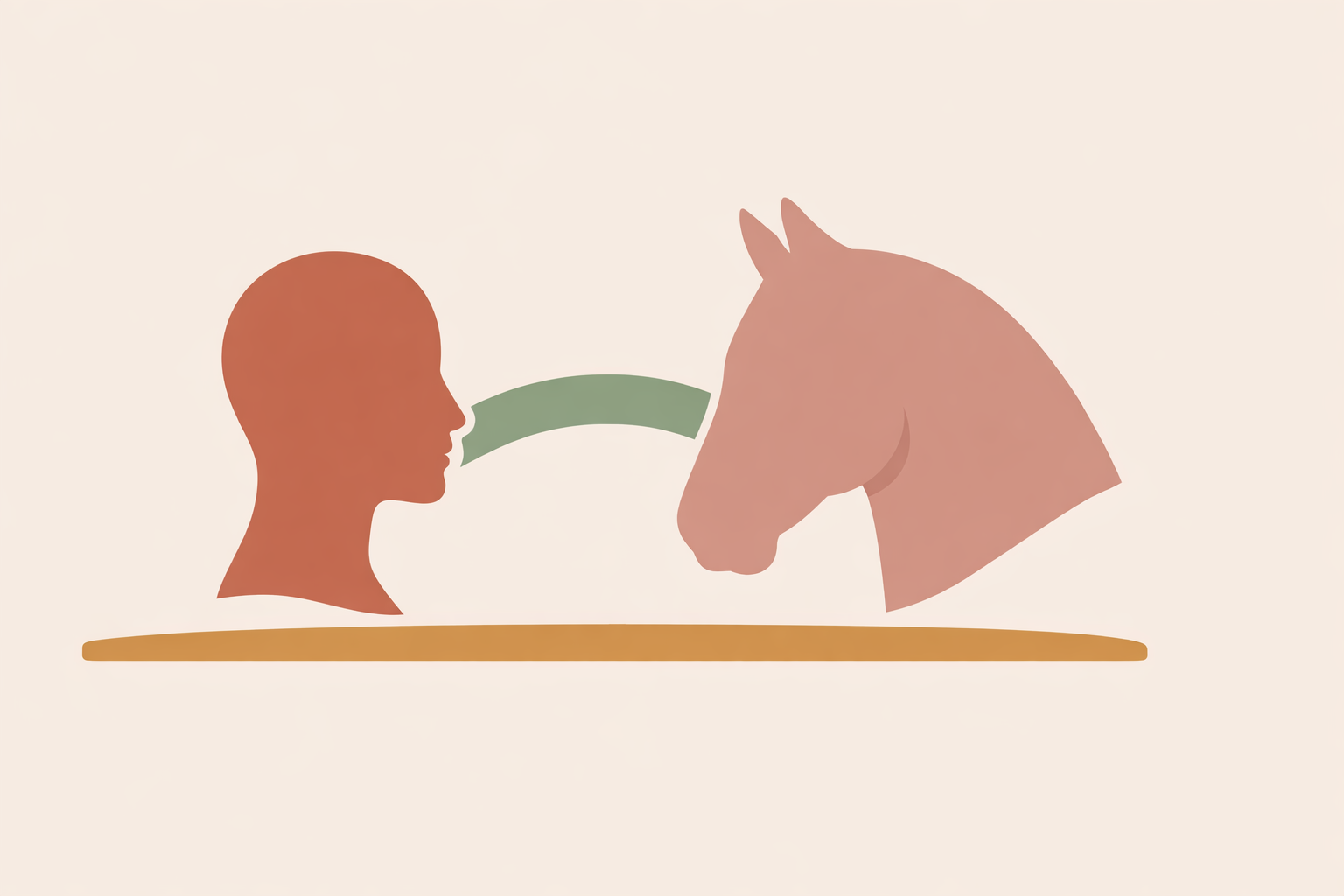
Once both bodies are steadier, the horse’s response can help put language to what’s happening. Horses often detect emotions in observable ways, which can help clients reconnect sensation, emotion, and relationship.
Calmer, more open humans tend to elicit affiliation such as approach, softer expression, or easier pacing. More defended or tense states can trigger avoidance or defensive responses. Used carefully, this offers immediate, nonverbal feedback.
Stay honest about what you’re seeing. If tension or avoidance shows up, address it first as a welfare concern rather than a symbol.
Keep language concrete. Simple sensation words help clients link experience to meaning without overload:
- tight / loose
- fast / slow
- open / closed
- near / far
- braced / easy
Some practitioners describe the horse as a biological mirror of autonomic shifts, including moments when a client appears outwardly fine. Noticing that kind of congruence can make honesty feel safer.
Pattern-naming script: “When your shoulders softened and your exhale got longer, Jasper stepped in and matched your pace. When your breath got smaller, he turned away. Which of those feels more supportive to your body right now?”
You can also use a simple four-part map:
- Tight + fast: stressed and bracing
- Tight + slow: holding and getting small
- Loose + fast: energized and available
- Loose + slow: settled and connected
Composite moment from practice: Amir keeps his chin tucked and feet planted as the mare circles wide. You say, “I see tight-and-slow in your shoulders, and she’s choosing distance. Would it be okay to try loose-and-slow by softening your gaze and letting your shoulders roll once?” Ten seconds later, the mare arcs closer and stands parallel. The feedback is immediate, and the language stays simple.
When the Session Goes Still or Spinny, Return to the Sequence
When equine-assisted practice becomes still or spinny, the answer is rarely more pressure. Return to the same order: ground the body, right-size distance and demand, then name what the horse is showing in plain language.
This sequence supports reflective work because embodied safety cues come first. From there, equine-assisted approaches show promise for emotion regulation, self-awareness, and physiological calming, especially when pacing is tailored to the pair.
It also helps to stay modest about co-regulation. Co-regulation varies with context, relationship, and timing, so it’s best held as a dialogue you build rather than an automatic outcome.
Across generations, horse cultures have emphasized presence before proximity, space before demand, and respect before request. That wisdom still holds: the horse gives clear feedback when the approach is working, and the client’s body usually answers back as well.
To close, keep the basics strong: prioritize equine choice, keep requests small when activation rises, and reset sooner than you think you need to. This work benefits from good boundaries, thoughtful supervision, and clear animal wellness facility safety practices, especially when sessions involve heightened emotion or unpredictable equine behavior.
Train in Equine Therapy
Build safer, clearer sessions with the Equine Therapy Certification and learn structured, consent-centered facilitation.
Explore Equine Therapy Certification →