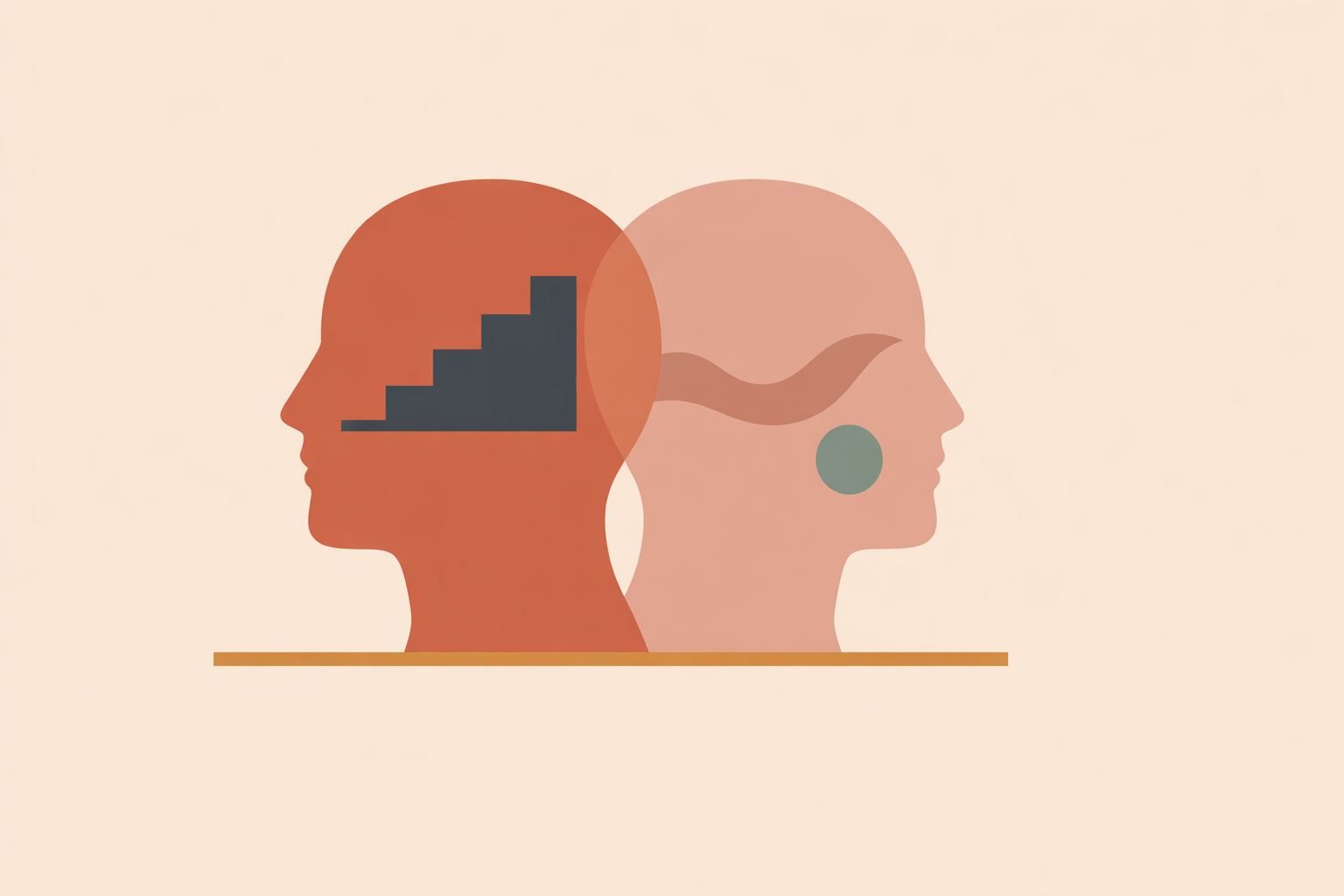
When sessions stall, it’s often because interpretation is moving faster than observation. The story gets sharper, but the moment stays closed. The opposite can happen too: assuming a body cue has one obvious meaning. A more useful move is to notice whether a fresh signal has arrived or whether an older expectation is steering, then respond from there.
That distinction keeps the work anchored in what is actually happening in the room. Some moments need space for a new sensation, pause, tonal shift, or detail to be described before anyone explains it. Other moments call for slowing meaning-making so assumptions can be named and checked. The craft is letting sensation and interpretation inform each other without either one taking over.
Key Takeaway: Sessions often gain traction when you can tell whether bottom-up signals or top-down expectations are leading and then work with both deliberately. New cues usually need description before interpretation, while strong narratives often need to be slowed down and tested against what was actually seen, heard, or felt. Cultural humility matters throughout, because silence, eye contact, tone, and emotional expression do not mean the same thing in every context.
Why this distinction changes a stuck session
A familiar moment: someone retells the same conflict, the room feels heavy, and nothing new moves. Then a small detail appears—“My chest tightened when she smiled”—and the whole conversation shifts. That’s often the difference between a repeated narrative and a fresh signal.
In lived experience, perception isn’t split into neat compartments. Expectations, attention, and incoming signals work reciprocally. When expectation gets ahead of sensation, the conversation narrows and ambiguous cues get absorbed into a familiar story. When sensation leads, experience can feel raw or surprising, and that’s often where learning begins.
This is why sessions tend to open when you can sense which stream is leading. A top-down tilt often sounds like certainty arriving before description. A bottom-up tilt often sounds like someone noticing a shift before they know what to make of it. Each calls for a different next step.
Cultural humility is part of the same skill. Norms around silence, eye contact, pacing, and emotional expression vary, and cultural variation can change what a cue means in context. Overconfidence here is easy and costly.
A practical pivot is often enough: ask, “What is the newest thing that happened just now?” Then spend a minute describing it before explaining it.
Bottom-up and top-down: a simple working map
Bottom-up and top-down are labels for two directions of sense-making. Bottom-up starts with what appears first: sensation, sound, posture, pace, facial shift, or something concrete in the environment. Top-down starts with expectation, memory, learned pattern, or a goal that shapes how the moment is read.
Most traditions of close observation already work with this distinction, even when they use different language. Contemporary interoception research also separates bodily signals from the conscious perception and interpretation built around them, showing that sensation and interpretation are not the same thing.
Practically, a bottom-up lens asks:
- What changed first?
- What was seen, heard, or felt?
- What in the room or body is new?
A top-down lens asks:
- What was expected?
- What meaning was assigned immediately?
- What older pattern may be organizing attention?
The point is not to force a moment into one category. It’s to notice which side is leading, so your next question matches the moment.
How attention keeps both streams connected
In real sessions, bottom-up and top-down processes rarely appear alone. Attention keeps braiding them together: what stands out in the environment competes with what feels familiar, urgent, or socially charged.
Bottom-up moments are often marked by novelty, intensity, or a concrete shift before clear meaning forms. This fits the broad understanding of stimulus-driven processing, where incoming signals capture attention because something in the moment stands out.
Top-down influence enters through expectation, memory, goals, and prior learning. Under pressure, people lean on familiar frames, which can create quick certainty about what a pause, glance, or phrase “must” mean.
That is why good observation sounds like sequencing: “I noticed your voice change when you said that. Let’s stay with the change first, then we can explore what you made of it.”
Recognizing bottom-up cues in the room
When body or environment leads, slow down. Bottom-up moments usually arrive before the person has a tidy explanation.
Common signs include:
- Sudden shifts: a voice drop, flushed face, startle, frozen posture, sharp exhale, or abrupt pause.
- Strong sensations: tightness, heat, tingling, heaviness, nausea, or a felt jolt with no immediate story.
- Concrete changes: a new message, a sound in the room, a change in another person’s behavior, or a previously unspoken fact.
In stress-laden stories, people can orient rapidly to possible threat with very little conscious deliberation. Research on threat perception describes facilitated threat detection as something that can begin very quickly, before a person has fully reflected on what they are perceiving.
That does not mean the moment is dangerous. It means the signal deserves attention before interpretation hardens around it.
A useful response might be:
- “Let’s mark what just changed.”
- “Where do you feel that most clearly?”
- “What happened immediately before it?”
This helps sensation come into focus without forcing a premature explanation.
Recognizing top-down patterns when story gets ahead of observation
At other times, the signal is small but the meaning arrives fully formed. A neutral email becomes proof of rejection. A brief glance at a phone becomes disrespect. Here, top-down expectation is leading.
Top-down processing describes how attention, memory, and expectation shape interpretation. In that sense, top-down processing is a normal human strength. Trouble starts when an old template becomes so dominant that every ambiguous cue gets made to fit it.
In sessions, watch for patterns like these:
- Meaning first, evidence second: the conclusion appears before the person can say what they actually noticed.
- Fast certainty: one small cue becomes a sweeping judgment.
- Selective attention: supporting details are vivid, while complicating details fade away.
In these moments, splitting observation from meaning helps: “What did you actually see or hear?” followed by “What did you make it mean?” That separation often loosens a rigid interpretation.
It also helps to remember that when sensation gets ahead of expectation, the experience can feel disruptive or startling at first. That disruption can still be a doorway to something genuinely new.
A three-step habit: describe, explore, check
To keep sensation and interpretation in balance, build one small habit into your sessions: describe, explore, then check.
1. Describe
- Name what happened in plain observational language.
- Stay close to pace, posture, breath, tone, expression, timing, and environmental shifts.
- Example: “When you said ‘Friday,’ your jaw tightened and you paused.”
2. Explore
- Open possibilities without locking into one reading.
- Invite first-person description before broader meaning.
- Example: “What was happening inside right there?”
3. Check
- Make your interpretation transparent and collaborative.
- Distinguish what you observed from what you inferred.
- Example: “I noticed tension, and I’m wondering if there was pressure there. Does that fit?”
This habit matters because strong sensation can tell you something significant is happening, but bodily signals alone do not identify the cause. Meaning still has to be explored in context.
A simple script can help:
- What did you notice first?
- What did you expect in that moment?
- What meaning did you give it?
- What else might also be true?
Working with body signals without over-reading them
Many practitioners learn, through experience, that the body often registers change before language catches up. Traditional lineages of close listening have valued this for generations. The skill becomes less useful when body cues are treated as universal codes.
Across thoughtful traditions and modern models, one practical principle holds: sensation is real, and meaning is built over time. Interoception research also distinguishes incoming bodily information from the broader conscious process that shapes felt perception.
So rather than assuming a cue tells the whole story, stay with inquiry:
- Sensation: What exactly is being felt?
- Appraisal: What meaning is being made of it?
- Context: What was happening just before it appeared?
This preserves the value of body awareness while keeping your conclusions appropriately grounded.
Why multimodal and culture-aware listening matters
People don’t communicate through words alone, and they don’t communicate through body cues alone either. Meaning emerges across channels at once.
When words, tone, facial expression, and context pull in different directions, people naturally combine these streams rather than relying on one fixed source of truth. Research on emotion comprehension describes multimodal meaning as something shaped by several cues at once.
This matters in practice. A pause might reflect care, restraint, translation, uncertainty, respect, or discomfort. Eye contact can signal engagement in one setting and disrespect in another. Volume and physical distance also vary by culture and community, and communication norms are not universal.
So when a cue catches your attention, ask before you assume:
- “I noticed a long pause. What was happening for you there?”
- “When your tone changed, what did that shift mean from your side?”
- “How is that kind of pause or eye contact usually understood in your world?”
This keeps your reading respectful and far less likely to drift into projection.
Using top-down and bottom-up skillfully
The practical lesson is straightforward: follow the signal, surface the expectation, and shape meaning collaboratively. A session often opens when you can tell whether the moment needs more observation or a slower look at the story already forming.
Used well, this approach brings steadiness to emotionally charged conversations. It reduces mind-reading, honors cultural context, and keeps you close to what is actually unfolding. Over time, it also strengthens your discipline around how you know what you know, a skill sharpened by emotion and the brain work and neuroscience and brain health study.
In closing, use this language with care. Terms like bottom-up and top-down should clarify your listening, not inflate certainty. Body cues and cultural signals are always contextual, and it’s wise to check assumptions, stay collaborative, and refer out when a concern clearly sits outside the scope of coaching or well-being support.
Go Deeper in Cognitive Neuroscience
Build sharper observation and interpretation skills in the Cognitive Neuroscience Certification.
Explore Cognitive Neuroscience →