


Many coaches treat documentation like a simple trade-off: write everything down so nothing gets missed, lean on familiar phrases, and move on. That approach can unravel when a neurodivergent client reads their record and sees language that echoes years of being misunderstood. Notes can either reinforce powerlessness or strengthen autonomy.
Key Takeaway: Neurodiversity-affirming coaching notes should be trauma-informed by default: present-focused, consent-visible, and limited to what supports continuity, access, and client choice. Trauma-focused notes belong only in a clearly appropriate container and with explicit scope clarity. In practice, this means replacing judgment with observation, recording adaptations instead of assumptions, and documenting body-based or ancestral practices with purpose, options, and client-reported experience rather than big claims.
Trauma-Informed vs Trauma-Focused Notes
These are different, and your notes should show that difference.
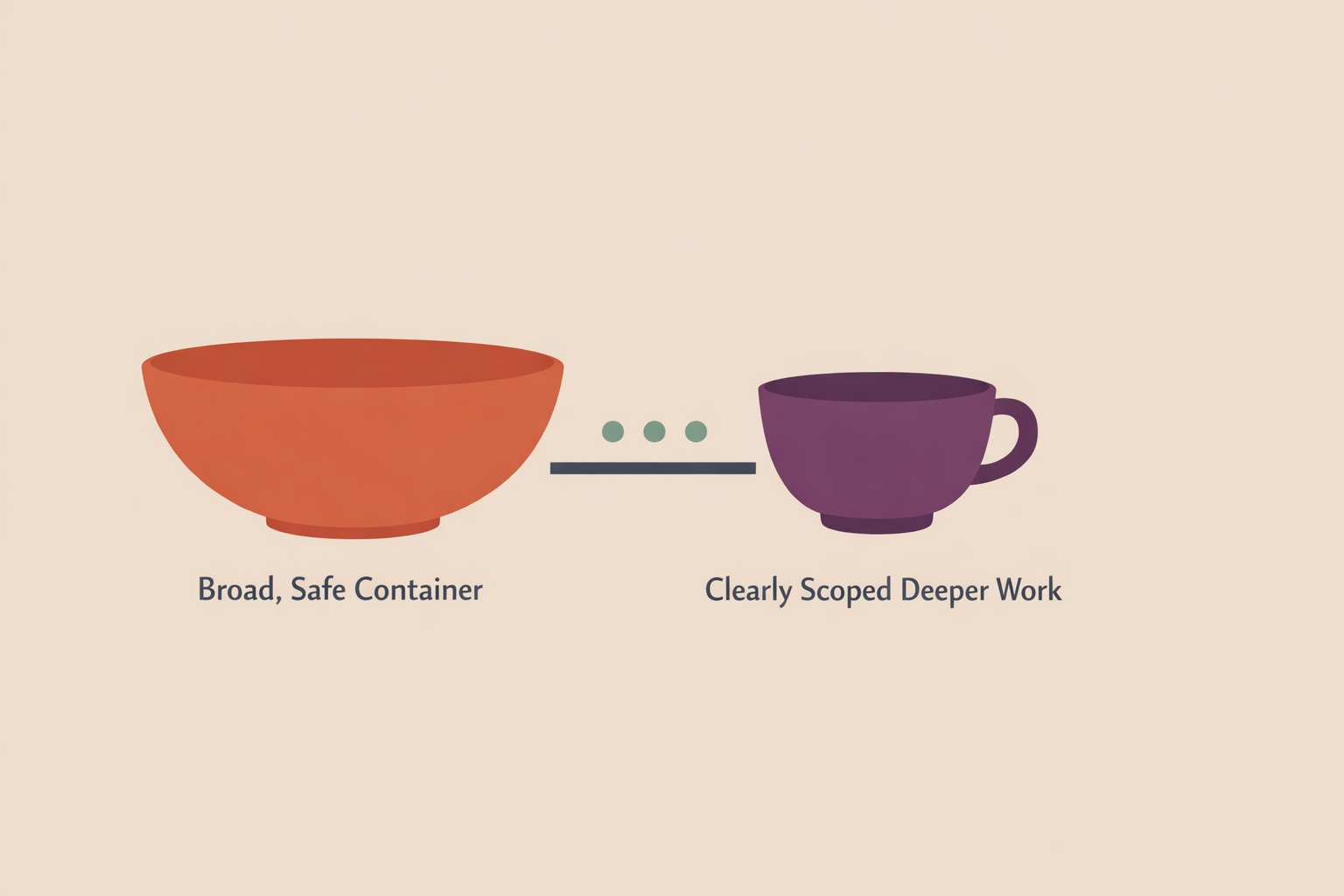
Trauma-informed practice is a broad, safety-oriented stance. Trauma-focused work is a more specific depth, centered on directly engaging traumatic experiences. As a practical reminder, trauma-informed care and trauma-focused work are not the same.
For coaching documentation, the split is straightforward:
- Trauma-informed notes: safety, consent, preferences, adaptations, and present-day goals.
- Trauma-focused notes: deeper exploration only when that depth is clearly named, fits the container, and connects to the client’s aims.
Most coaching notes belong in the first category. You can support executive functioning, communication preferences, sensory needs, and daily structure without capturing extensive personal history. Often, less documentation serves the client better.
A trauma-informed note might read: “Client identified school-morning bottlenecks; session focused on visual sequencing and transition prompts; consented to try a 3-step board.” Clear, useful, and sufficient.
A simple scope line can keep the record grounded: “Today’s session addressed present-day routines and options; we did not explore past experiences.”
What Trauma-Informed Notes Look Like in Neurodiversity-Affirming Coaching
The goal is minimum necessary documentation: enough for continuity, consent, and clarity, without turning notes into a personal archive.
Keep writing present-focused and concrete. Describe what mattered for support today, not a storyline about why it’s true. For example: “Client reports unexpected schedule changes can lead to shutdown and difficulty restarting tasks.” That’s actionable without pulling in backstory.
Make consent visible in the note itself. When sensitive material comes up, ask how the client wants it documented—or whether they want it documented at all.
- “Would you like any part of what you shared today included in the notes?”
- “If yes, how would you like it worded?”
- “Would you prefer I note the support need without the surrounding story?”
Neurodiversity-affirming coaching notes lean toward support needs rather than deficits. Practical items worth recording include:
- visual sequencing
- plain-language prompts
- extra processing time
- movement breaks
- transition warnings
- lower-stimulation settings
- communication preferences such as text-first or written follow-up
A simple structure keeps notes light and easy to use next session:
- client-defined goal
- consent and boundaries
- access and communication preferences
- relevant observations
- client language
- agreed actions and adaptations
- scope limits or referrals
- next-step choices
Example: “Goal: ‘Make meetings less exhausting.’ Consent: client approved documenting sensory preferences, not personal history. Observed: client became quieter in fluorescent lighting and said the glare felt ‘spiky.’ Adaptation: offered tinted overlay and agenda preview; client selected both. Plan: try 10-minute movement break before meetings; review next week.”
When a Session Turns Trauma-Focused
Sometimes deeper material becomes central. When it does, the note should communicate care, boundaries, and clarity about scope.
You don’t need to explain everything. You do need enough to show what the focus became, what stayed within coaching scope, and what choices were offered next.
A grounded phrasing might be: “Client reports becoming overwhelmed during conflict and would like to explore communication boundaries. We identified that deeper trauma-focused work is outside this coaching scope; client requested pacing options for current relationships.”
If a referral or additional support pathway fits, document it plainly: “Client’s requested depth of exploration exceeds this scope; client asked for qualified referral options and selected three to consider.”
This is where “the right container” matters. Traditional approaches often recognize that not every story belongs in every space. Naming a limit is part of ethical holding.
A short handoff-style note might look like this: “Content: conflict scenarios; client named freeze responses. Within coaching scope, practiced boundary scripts and sensory regulation options. Client chose to pause deeper exploration and requested referral options. Follow-up: send names by Friday; schedule shorter, skills-focused session next week.”
Language Shifts That Protect Dignity
One of the most effective upgrades you can make is swapping judgment for observable detail, client meaning, and client choice.
Use this pattern:
- What you observed
- What the client said it meant or felt like
- What the client chose next
That structure keeps interpretation in check and preserves autonomy.
- Before: “Client refused breathing exercise.” After: “Client declined breathing practice and selected a grounding object instead.”
- Before: “Client was triggered and dissociated.” After: “Client became quieter and looked away; after a pause, client said the room felt overwhelming and requested lights-off.”
- Before: “Client is avoidant and unable to follow through.” After: “Client postponed the task after an ambiguous instruction; client reported overwhelm and selected a three-step visual sequence.”
- Before: “Client perseverated on special interest.” After: “Client engaged in focused talk about trains; we used this interest to co-create a visual schedule that felt motivating.”
- Before: “Client refused eye contact.” After: “Client preferred no direct gaze; comprehension improved with side-by-side seating and written prompts.”
That last example highlights a practical truth: specific supports like side-by-side seating and written prompts can change how accessible communication feels. This kind of practice wisdom belongs in notes because it helps future-you (and the client) repeat what worked.
A helpful script in the moment is: “I want to record this in a way that feels right to you. How would you like me to describe what was helpful, or not helpful, about that activity?”
Documenting Body-Based, Breath, and Ancestral Practices Without Overclaiming
Body-based and ancestral practices can be powerful, and they deserve careful documentation. Record what was offered, how consent was handled, what the client chose, and what they reported afterward—without inflating outcomes.
Write modestly and concretely. For example: “Client said the slow rocking felt grounding and chose to continue for two minutes.” That honors the experience without turning it into a claim.
Some somatic practices are more activating than others, especially those that intensify body focus. Current discussion suggests interoceptive exposure can move people toward increasingly uncomfortable bodily sensations, which is one reason pacing and options matter. In practice, that can include closed eyes, intense internal focus, breath holds, touch, close proximity, evocative imagery, or long unstructured silence.
For that reason, capture three things clearly: purpose, options, and exits.
- Purpose shared: “This practice is for settling attention, not for exploring past experiences.”
- Options offered: “Eyes open or closed; seated or standing; 30 seconds or skip.”
- Stop signal agreed: “Hand raise to pause anytime.”
- Duration and monitoring: “Client chose 45 seconds; pace slowed during practice.”
- Client-reported experience: “Client said, ‘More settled; mild chest tightness, preferred eyes open.’”
Example note line: “Client selected standing sways, eyes open, 60 seconds; paused once using agreed signal; reported ‘neutral-to-calm’ afterward; no deeper personal history discussed.”
Even brief preparation helps. A sentence of orientation before inviting a breath, pause, or sensory practice reduces surprise and supports choice.
A Simple Notes Template for Everyday Use
When your days are full, consistency matters more than perfection. A repeatable structure makes trauma-informed documentation easier to sustain.
- Client Goal: “Finish one priority task daily without the panic spiral.”
- Consent and Boundaries: “Client approves documenting sensory preferences; prefers not to include personal stories.”
- Access and Communication: “Plain language, visual options, extra processing time, text-first follow-ups.”
- What Helped / Didn’t: “Helped: agenda preview, 3-step task chunk. Didn’t: open-ended brainstorming.”
- Options Offered and Client Choice: “Timer + body double + music; client selected body double with silent music.”
- Observations: “Client fidgeted with ring, voice softer in bright light; said the glare was ‘scratchy.’”
- Client-Reported Experience: “‘Felt calmer with five-minute warning; overwhelmed by rapid questions.’”
- Synthesis: “Predictability and low-stim cues support task start; fewer choices reduce freeze.”
- Plan: “Use visual planning board, 10-minute body double, one-song starter; review next week. If conflict scenarios reappear, discuss referral options.”
If you already use a familiar format, adapt it rather than starting over.
- SOAP, coaching-adapted: Subjective (client words and preferences), Objective (observable details), Assessment/Synthesis (what supports the client-defined goal), Plan (client-chosen next steps, adaptations, scope markers).
- DAP: Data (reports and observations), Assessment (implications for today’s goal), Plan (options, client choice, experiment, review point, referrals if needed).
A quick quality check prevents most note problems:
- Is the client’s voice visible?
- Is consent recorded, especially for sensitive topics or body-based practices?
- Are observations separated from interpretations?
- Are strengths and adaptations specific?
- Is scope clear?
- Could the client read this without shame or surprise?
Here is a concise example: “Goal: ‘Send one email without dread.’ Consent: document strategies, not personal stories. Preferences: text follow-up, dim light, 5-minute transition warning. Observed: increased fidgeting with overhead light; client said it felt ‘buzzing.’ Adaptations: lamps only; agenda preview. Options: body double, template reply, calendar block; client chose template plus five-sentence limit. Practice: drafted together using visual board. Reported experience: ‘Manageable with the template; panic rose when I saw 28 unread messages, so the five-sentence limit helped.’ Synthesis: predictability and reduced decision load enable start; visual sequencing maintains momentum. Plan: use template Monday and Wednesday at 10:00 with one-song starter; check in by text Friday. Scope: no deeper trauma processing; if distress escalates, discuss referral options at client’s pace.”
This structure stays light enough to protect privacy while still supporting ethical continuity.
Conclusion: Write Notes That Preserve Dignity
Good coaching notes don’t need to be long. They need to be respectful, clear, and genuinely useful.
Trauma-informed documentation centers safety, consent, present focus, and client choice. Trauma-focused notes belong only when that depth becomes central and the container is right. Across both, the guiding principle is steady: write enough to support continuity, but not so much that the record becomes invasive.
Because client access to records is now common, tone and wording matter as much as content. Detail matters, and what you leave out matters too.
From ancestral story-keeping to modern digital records, the same ethic remains worth protecting: safeguard what is shared, name only what serves the work, and let the page reflect the same care you bring to the session. In neurodiversity and learning differences work, that same care also includes respecting communication fit, scope, and client autonomy. When you do that, the notes become another form of support.
Train in Neurodiversity Coaching
Deepen these documentation and consent practices in the Neurodiversity Coach Certification.
Explore Neurodiversity Coach Certification →










