Urban growers often meet drying beds and heat spikes with the same response: run irrigation longer, add a timer, and hope the schedule survives summer. The pattern is familiar. Water bills climb, planters still swing from soggy to parched, and volunteers are left unsure whether to skip or soak.
Rooftops make it harder. Shallow boxes drain fast, heat builds quickly, and wind strips moisture. Shared gardens face hose bans and narrow watering windows right when crops need consistency. Even controlled environments can drift when small leaks or unmanaged evaporation quietly raise top-up volumes.
The issue is rarely effort. The issue is design that lets water leave faster than it is held.
The practical shift is to build for retention and recirculation, not just delivery.
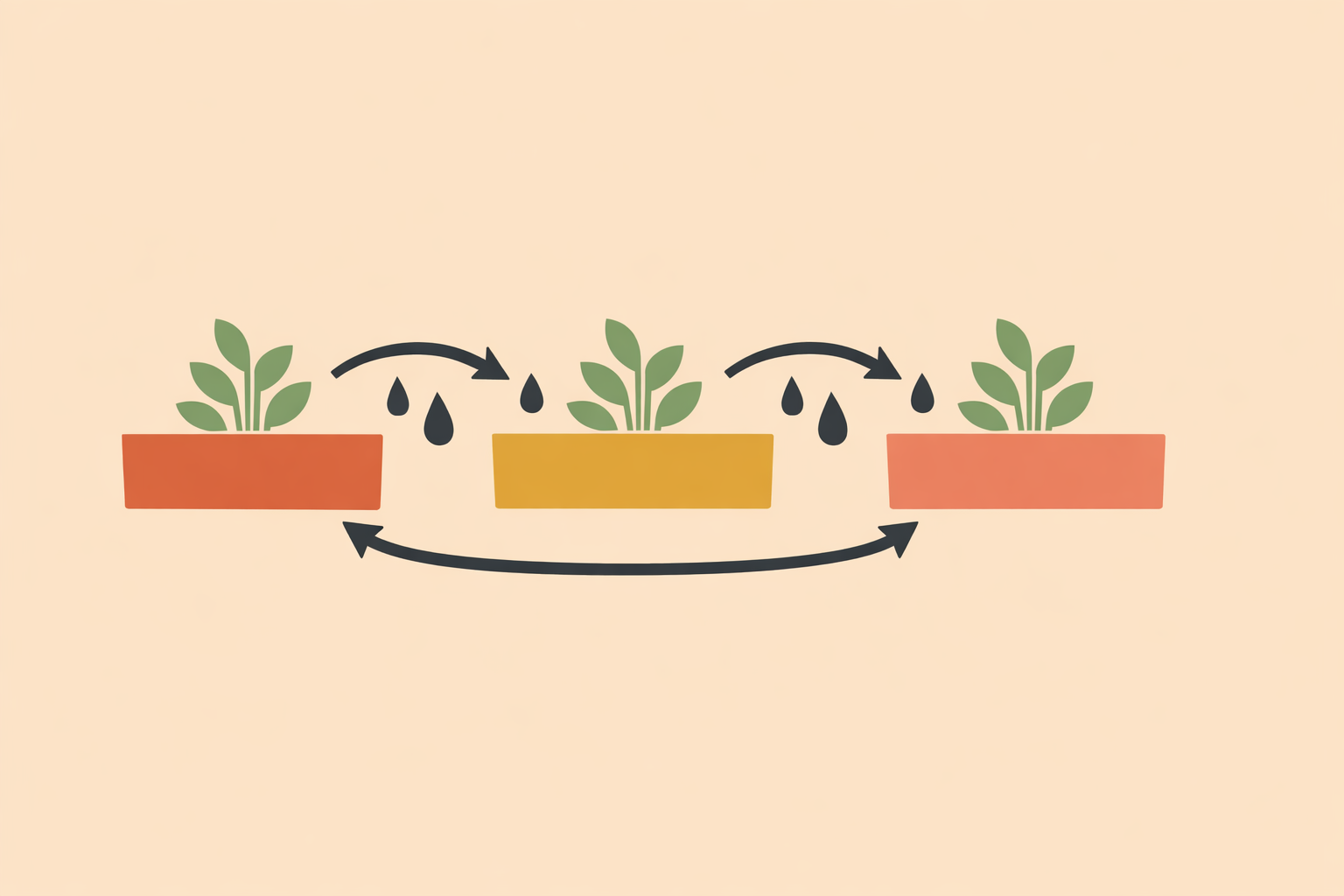
Key Takeaway: Water-smart city growing starts by keeping water in the loop. In soil and rooftop beds, deeper growing media, mulch, and slow drip help stabilize moisture and reduce waste. In hydroponics, closed recirculating systems return most water to the reservoir, with remaining losses driven mainly by plant transpiration. In aquaponics, rain capture and simple wetland-style conditioning can tighten the cycle further and reduce dependence on mains water. The best system is the one your site can maintain well, measure clearly, and expand steadily.
Water-Smart Soil Gardens and Rooftop Beds
For many city growers, the biggest gains start in soil. Thoughtfully built beds and rooftop planters can reduce water use dramatically when they’re designed to hold moisture instead of shedding it. The core moves stay simple: deepen the root zone, cover the surface, and water slowly enough for the bed to absorb what you apply.
Rooftops magnify every mistake because shallow growing areas lose water quickly through drainage, heat, and wind. Increasing bed depth gives roots a larger, steadier reserve and sends less water straight to roof drains. Pair that with slow water delivery and a covered surface, and the day-to-day moisture pattern becomes far easier to manage.
Traditional growing cultures arrived at this long ago: protect the soil surface, slow the water, and let the earth act as storage. In city beds, that wisdom shows up as drip lines, mulch, and well-shaped bed profiles that keep water where plants can use it.
Concrete setup for a rooftop bed: Build a 3 m × 1 m box at 30 cm depth and fill it with a balanced mix such as 40% screened topsoil, 40% composted fines, and 20% coarse sand or pumice. Run one 16 mm drip line down the center with 2 L/h emitters spaced every 30 cm. Then cover the surface with 5–7 cm of shredded leaves or straw-rich mulch. This creates a bed that behaves more like a reservoir than a sieve.
If the roof can collect rain, add storage. Rainwater storage can meaningfully reduce dependence on municipal supply and smooth out dry spells that would otherwise force rushed watering decisions.
Mulch does much of the quiet work. Many growers source shredded leaves through neighborhood cleanups or seasonal collections, turning an urban waste stream into moisture protection that lasts through heatwaves.
To keep watering responsive, use observation before automation. Slide two fingers under the mulch. If the soil beneath is still cool and faintly damp, waiting is often the best choice. A low-cost moisture meter can help newer growers build confidence, but the main skill is attentive growing.
- For leafy greens, aim for 20–30 cm depth.
- For larger fruiting crops on roofs, 30–40 cm gives a more forgiving root zone.
- Keep mulch on the surface through the hottest months.
- Use drip in short, slow cycles so water enters the bed instead of escaping around it.
As a soil-first retention approach settles in, water use becomes more stable. The bed holds moisture more evenly, runoff slows, and the overall growing rhythm feels calmer for everyone involved.
Closed-Loop Hydroponics and Vertical Farms
Hydroponics saves water when the loop is genuinely closed. In a well-maintained recirculating setup, nearly all water either returns to the reservoir or moves through the plant itself. The advantage is control that you can measure and maintain.
In these systems, most water losses come from plant transpiration rather than wasteful discharge. That’s why closed-loop hydroponics fits dense urban settings where water costs, access, and consistency matter as much as floor space.
Concrete setup for a compact vertical array: A 12-tower, 3-tier system in a 12 m² room can run from a single covered reservoir. Basil, salad greens, and microgreens are often the easiest starting crops because demand stays relatively steady and the cycle is forgiving. Prioritize covered tanks, secure fittings, clean filters, and reliable return flow every cycle.
The discipline that keeps hydroponics water-smart is leak prevention. A system only stays closed when fittings stay tight, reservoirs stay covered, and overflow is noticed quickly. A float switch for unexpected drops, a visible overflow jug, and a simple connection-check routine usually outperform complicated monitoring.
Crop choice shapes how hard the loop has to work. Leafy greens and herbs generally match the format well. Fruiting crops can thrive too, but they typically transpire more, so top-ups come faster and management needs to be sharper.
In controlled-environment growing, condensate capture can tighten the loop further by returning recovered moisture back into use where it makes sense to implement.
When recirculating practice is strong, water footprint per kilogram can be a small fraction of conventional field production. That’s not a universal verdict on growing styles; it’s a clear sign that careful loop management can deliver serious efficiency in the right city context.
- Cover reservoirs to reduce evaporation and contamination.
- Check filters weekly so clogs don’t trigger overflow.
- Use one simple level or flow alert.
- Start with greens and herbs before moving into thirstier crops.
Although the tools look modern, the guiding principle is familiar from traditional water-wise cultivation: guide water carefully, return what can be returned, and keep conditions steady.
Aquaponics and Integrated Rooftop Water Ecosystems
Aquaponics adds another layer of water stewardship by bringing fish, plants, and microbial life into one shared cycle. On rooftops and courtyards, it can stack functions in a small footprint: food production, rain capture, nutrient cycling, and on-site reuse.
When paired with rain harvesting and basic conditioning steps, aquaponic systems can reduce reliance on municipal water. Growers who think in systems appreciate that the water does more work before it ever leaves the site.
A small wetland-style cell can strengthen that approach. Constructed wetlands can condition stored rainwater or lightly used wash water so it re-enters a growing loop more cleanly. On rooftops, hybrid rooftop systems have been explored to treat water on-site and return it to planted areas for irrigation.
Concrete setup for an integrated rooftop system: A 1,000 L fish tank can feed two media beds and a small NFT run, while a separate rain tank captures roof runoff through a first-flush diverter. Overflow can move through a planted gravel trough before returning to the sump. The strength here is that one water body serves several living processes before leaving the site.
Aquaponics rewards rhythm and observation. Pumps, biofilters, beds, and fish need regular care, but it can be straightforward: clear water movement, steady oxygenation, routine debris checks, and seasonal pruning of wetland plants. Like many traditional integrated landscapes, it works best when someone is listening to the system consistently.
Some teams also pair these systems with on-site solar for pumps and controls. Site specifics vary, yet the design principle holds: when water and energy are considered together, rooftops become far more functional spaces.
- Keep fish stocking modest while the system matures.
- Use planted gravel or wetland edges to support water conditioning.
- Log top-ups, odors, clarity, and plant vigor each week.
- Stagger harvests so nutrients are drawn down steadily.
In many traditional landscapes, fish, water channels, and edible planting have long shared the same edges. Aquaponics brings that relational thinking into the city, with benefits that go beyond efficiency and into everyday stewardship.
Choosing the Right Water-Saving System for Your City Farm
All three pathways work best when water stays in circulation as long as possible. The right choice depends on your site, your team capacity, and the kind of growing culture you want to build.
If the quickest opportunity is improving what you already have, start with soil beds and rooftop planters. Depth, mulch, drip, and rain capture are dependable wins. If space is tight and you need high output from a compact footprint, closed-loop hydroponics often fits better. If your project is community-led and thrives on visible ecological relationships, aquaponics can become both a production system and a hands-on learning space.
Whatever you choose, begin with one manageable loop and learn it deeply. A pilot bed, a compact recirculating rack, or a modest fish-and-plant system will quickly reveal where your real gains and losses live. Next comes scaling with clarity instead of guesswork.
- Pick one system before layering others on top.
- Track one clear metric, such as liters per square meter or liters per kilogram.
- Teach water care as part of volunteer and team orientation.
- Review the loop monthly and refine it season by season.
Water-smart urban growing comes from designing beds, reservoirs, and living cycles that hold more of what already arrives. With steady care, clear measurement, and respect for both traditional growing wisdom and modern city constraints, self-sufficiency and sustainability practices can help urban farms become more consistent and resilient over time.
To close well, keep safeguards in place: use rain and reused water with transparency and good judgment, follow local rules, and keep records that make the system easy to manage as people come and go. Honor the cultural roots of the practices you borrow, share what works, and keep improving the loop.
Explore Urban Agriculture Certification
Build practical systems like these in the Urban Agriculture Certification, from water-smart beds to closed-loop growing.
Explore Urban Agriculture →