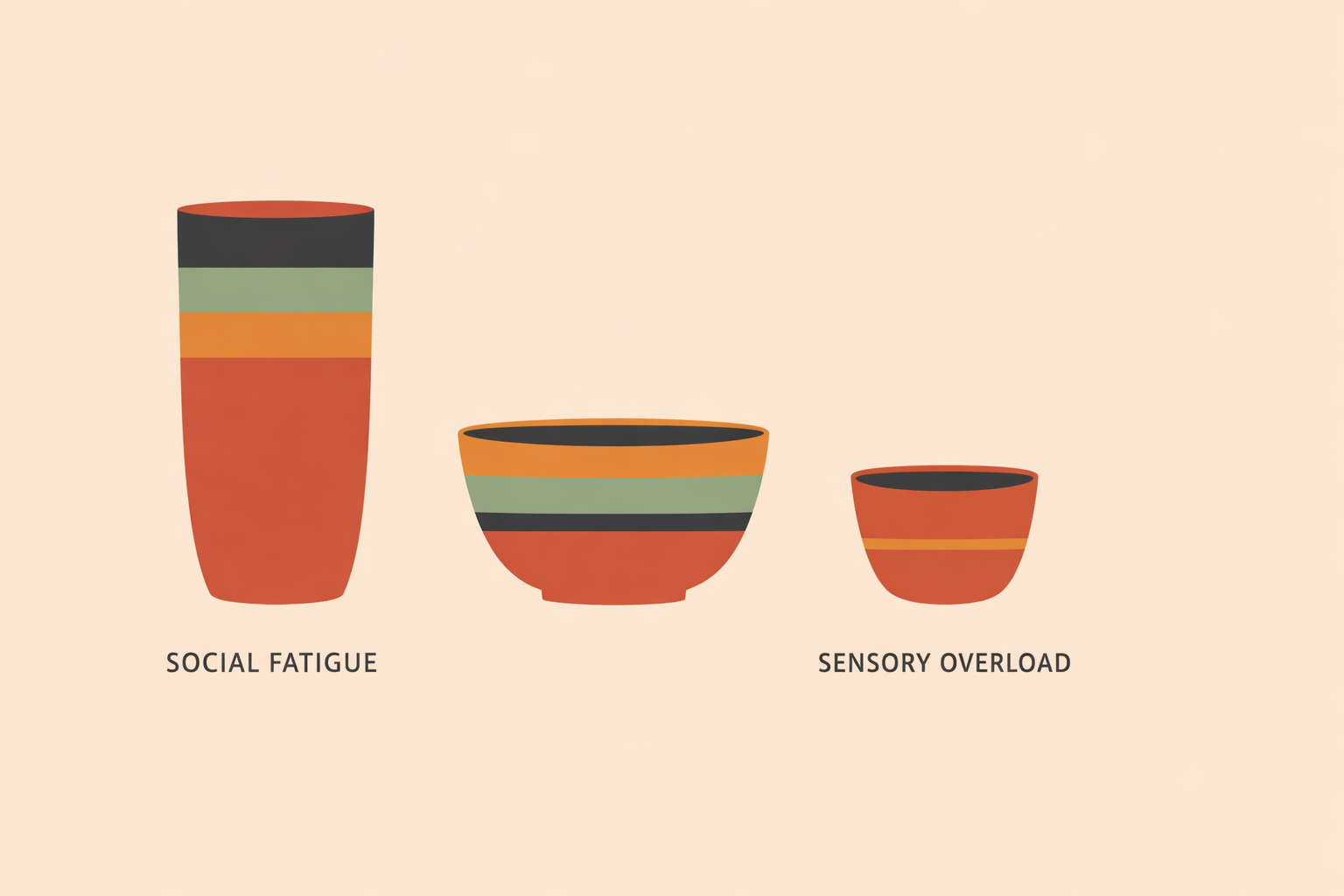
Most intake conversations start with identity labels: “Are you an introvert? Are you highly sensitive?” Labels can be comforting, but they rarely give you enough detail to support someone well. One client loves people yet leaves a bright, noisy room completely depleted. Another avoids groups but feels fine in quiet settings. A third manages the event itself, then replays every exchange for hours afterward.
A more useful approach is to map what actually drains, overloads, and restores the person in front of you. When you separate social energy from sensory load, emotional resonance, and processing depth, your notes become practical. You can shape pacing, environment, boundaries, and recovery in a way that fits the client rather than the label.
Key Takeaway: Effective intake for sensitive clients works best as a capacity map, not a personality shortcut. The six questions below help you distinguish social fatigue from sensory and emotional overload, spot what happens when demands stack, separate depth of processing from unhelpful mental looping, clarify empathy versus over-identification, surface subtle-cue sensitivity without drifting into assumptions, and build recovery rhythms the client can actually use.
1. After Social Interaction, What Actually Tires You?
Start here, because “people drain me” can mean very different things. Ask for a recent example—a meeting, a family meal, a coffee catch-up. Then ask what did the draining: the amount of interaction, the noise or lighting, the emotional tone, or how long their mind kept working afterward.
This distinction matters. Introversion is about social dose. Sensory-processing sensitivity (SPS) is about how deeply and intensely someone processes inner and outer input. In research, SPS is understood as an individual-difference trait. It overlaps with introversion, but it is not the same thing, and estimates often suggest about 30% extroverts among highly sensitive people.
In practice, the drain signatures often sound different:
- Introversion-leaning: “I was fine at first, but that much conversation wore me out.”
- Sensitivity-leaning: “I liked the people, but the glare, noise, and tension were too much.”
- Combined: “The dinner was lovely, but the cross-talk, bright room, and emotional intensity stayed with me all night.”
A quick follow-up usually clarifies things: “What would have helped you recover—less interaction, less stimulation, emotional decompression, or time to integrate?” Your notes then become coaching-ready: “Fatigue linked more to lighting and conflict than to one-to-one connection. Explore sensory adjustments and post-event integration.”
2. What Happens When Several Demands Arrive at Once?
This is often where overstimulation becomes unmistakable. Many sensitive clients can handle one stream of demand well; the tipping point comes when inputs stack—messages, background noise, another person’s urgency, a decision that needs making, and their own internal activation.
Ask them to walk you through a recent moment in sequence. What arrived first? What came next? What changed in the body, mood, or thinking as the load increased?
SPS research recognizes susceptibility to overstimulation as a core part of the trait. In real life, it often shows up as cognitive saturation, irritability, tears close to the surface, sudden indecision, mental fog, or an urgent need to leave. Capacity gets exceeded, even when the person is socially confident.
Overload also doesn’t always end when the room goes quiet. Some people stay activated because the space is still harsh, visually busy, or their inner system hasn’t settled yet.
A helpful in-session experiment is to ask, “If that moment happened again, where would you notice it first?” Then design a brief interruption the client can actually use: look away from the screen, drop the shoulders, soften the jaw, take one slower exhale, or name a single next action.
These small pauses are not dramatic, but they are reliable. They often prevent a manageable rise in activation from turning into a full-day spiral.
3. How Deeply Do You Process Decisions, Conversations, and Experiences?
Now move from outer load to inner processing. Ask, “After something important happens, what does your mind do over the next few hours?” Many sensitive clients describe careful reviewing, noticing layers of meaning, tracking consequences, and wanting time before responding.
That depth can be a strength. It becomes costly when reflection turns into repetitive looping with no movement, so the goal is to separate useful processing from being stuck.
This question tends to land well: “Did this thinking lead to clarity or action, or did it keep you in the same emotional place?”
A simple two-column debrief also helps:
- Column one: facts and observations.
- Column two: meanings, interpretations, and predictions.
For example:
- Observation: “My manager asked for revisions. Their tone was brief. The room felt hot.”
- Interpretation: “They are disappointed in me. I have already fallen behind.”
Then ask for one grounded next step, such as “Send a clarifying message before noon,” or “Review the brief once more and confirm the scope.” This gives depth of processing somewhere constructive to go and reduces unhelpful mind-reading without dismissing the client’s sensitivity.
4. How Strongly Do Emotions Affect You—Your Own and Other People’s?
Many sensitive clients are deeply receptive to emotional atmosphere. They may notice tension before anyone names it, feel moved by another person’s distress, or carry the residue of a difficult exchange long after it ends.
Ask concretely: “What happens in your body when someone near you is upset?” “Do you feel responsible for stabilizing the room?” “Do you notice other people’s emotions before they say anything?”
At this stage, separate empathy from over-identification. Empathy says, “I can feel that this matters.” Over-identification says, “This is mine to carry or fix.” That distinction protects the client’s energy and their relationships.
Boundary language turns insight into action. Invite the client to practice phrases like these, especially if you work in HSP coaching:
- “I care, and I can give this fuller attention tomorrow.”
- “Is this a good time for something heavy?”
- “I can listen for a few minutes, but I do not have the bandwidth to hold the whole conversation right now.”
These responses do not reduce kindness. They make kindness more sustainable.
If a client says, “I go home carrying everyone,” map responsibility together. What is truly theirs? What belongs to the other person? What belongs to the group dynamic? Even this simple sorting often reduces emotional residue.
5. Which Small Changes in the Environment Do You Notice First?
Sensitive clients often register subtle shifts before others do: a sharper tone, a brighter light, a synthetic scent, a draft from the vent, a crowded visual field, a small change in someone’s facial expression. This level of noticing can be a real strength when it supports good timing and thoughtful adjustments.
Research on SPS includes sensitivity to sensory and internal stimuli, but the most useful intake question stays grounded: “What do you notice first that other people tend to miss?” Then ask, “What meaning do you usually make from that?”
Keeping observation separate from interpretation builds accuracy. A client may correctly notice clipped speech, for example, and still jump too quickly to “They’re upset with me.” Your job is to protect their gift for perception from turning into constant self-referencing.
A quick strengths-and-limits scan works well:
- First cues noticed: brighter light, temperature change, clipped tone, visual clutter.
- Helpful uses: catching tension early, adjusting the room, noticing when a conversation needs slowing down.
- Energy cost: vigilance in busy spaces, difficulty ignoring repeated low-level input.
- Boundaries: observe first, check meaning second, avoid turning every signal into a personal story.
Small environmental shifts often bring disproportionate relief: softer lighting, fewer open tabs, a seat facing away from foot traffic, reduced visual clutter, or a quieter transition space before a demanding conversation. Sensitive people do better when the environment stops asking them to process unnecessary input.
6. What Helps You Recover—and How Do You Know You’re Ready to Re-Engage?
Once you understand a client’s patterns, recovery becomes much easier to design. Overstimulation in highly sensitive people often reflects sensory, social, cognitive, and emotional input accumulating faster than it can be integrated. Recovery works best as a rhythm the client can repeat.
It helps to separate two overlapping needs. Recovery linked to introversion often centers on reduced social demand. Recovery linked to high sensitivity typically needs a broader downshift: less noise, dimmer light, fewer decisions, less visual traffic, and time for the inner system to settle.
Fatigue matters. Daily-life research suggests fatigue amplifies overstimulation in highly sensitive people. The same study found that pleasant stimulation such as supportive sounds or visuals may ease the load, especially when exhaustion is not already high.
A “recovery ladder” gives clients something concrete:
- 60-second pause: look away from screens, lengthen the exhale, soften the gaze, orient to a few neutral objects.
- 5-minute reset: dim the lights, step outside or to a window, sip water, walk slowly.
- 20-minute decompression: no decisions, no messaging, light food if needed, gentle stretching, quiet or soothing sound.
- Longer restoration block: deep rest, time outdoors, journaling, low-pressure creativity, or device-free quiet.
Then define re-engagement cues: “How will you know you are back in yourself enough to return?” Clients often name clear markers—warmer hands, less squinting, steadier breath, clearer thinking, softer inner language, or the ability to choose one next step without dread.
Another useful lens is differential susceptibility. Sensitive people are often affected more strongly by both strain and support, so small adjustments can shift the whole day. A rushed, noisy transition can tip things off balance; a protected 10-minute buffer can restore steadiness quickly.
Finally, build recovery into the week, not only into crisis moments. A steadier rhythm of effort, transition, and restoration serves sensitive clients better than pushing until they crash and trying to recover all at once.
Build a Living Capacity Map, Not a Better Label
These six questions give you something more useful than a yes-or-no identity label. They show how a client responds to social contact, sensory input, emotional atmosphere, internal processing, and recovery. That’s the level where coaching choices become precise.
A simple structure is enough for most intakes: social energy, sensory load, emotional resonance, processing style, and recovery rhythm. Revisit the map as roles, seasons, and environments change. What overwhelms someone in one context may be manageable in another, and what restores them in winter may not be the same in summer.
It’s also worth remembering that finely tuned temperaments have long been recognized across cultures. Sensitivity has often been linked with careful perception, pattern awareness, relational attunement, and thoughtful stewardship. The point is to respect it and work with it skillfully so strengths have space to come forward.
For a final note of care: if a client’s overwhelm feels constant, severe, or paired with persistent sleep disruption or shutdown, widen the support plan and keep the focus on steadier routines, simpler environments, and realistic boundaries. The capacity map still applies; it just needs to be paced gently and revisited often.
Train as an HSP Coach
Apply these intake questions in practice with the Highly Sensitive Person (HSP) Coach course.
Explore the HSP Coach →