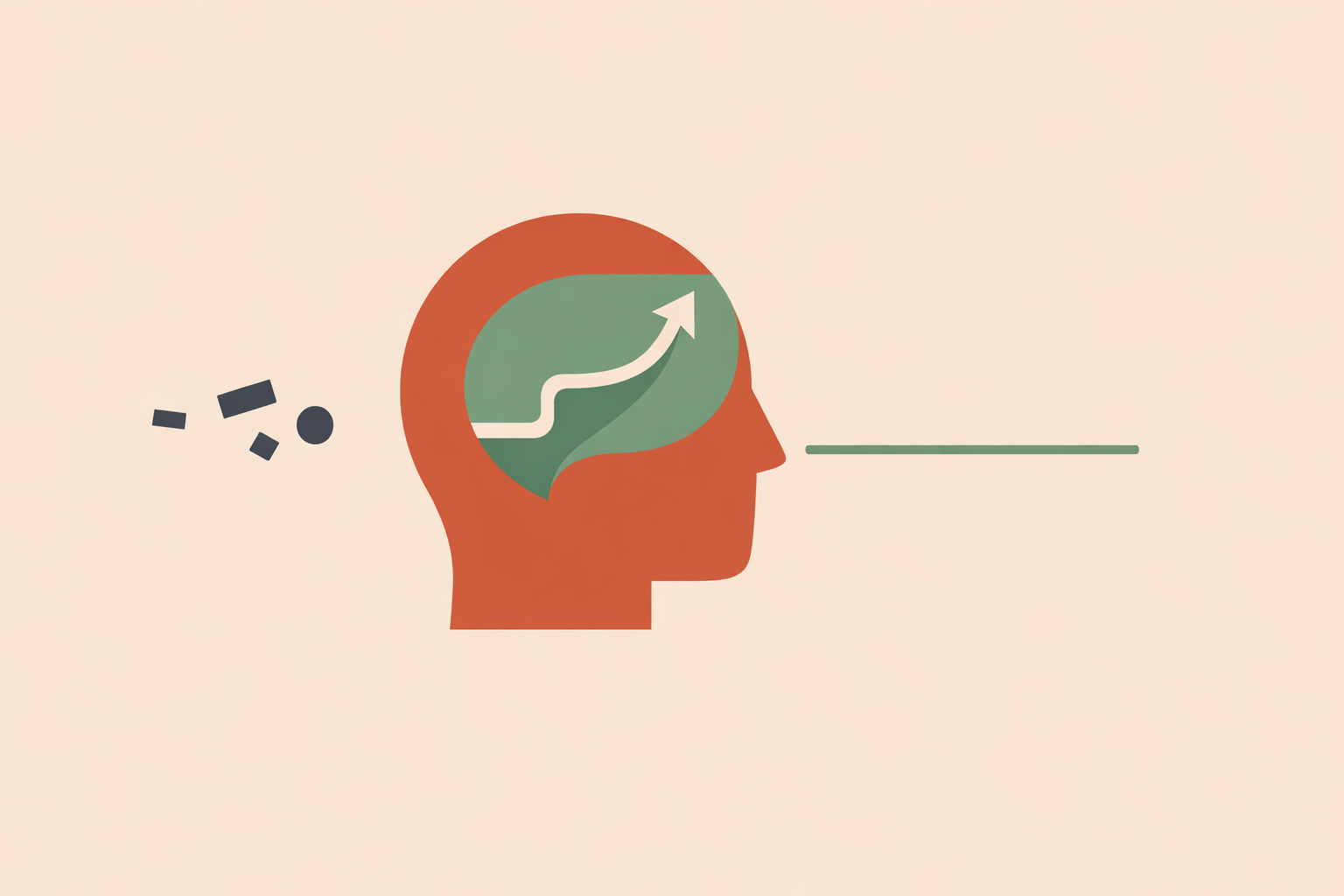
When a project slips, many practitioners reach for more structure: a tighter calendar, a new app, another attempt at focus. Often the turning point comes earlier, with one quiet sentence that redirects attention before any tool can help. “I always get stuck on the outline.” “If I can’t do an hour, it isn’t worth starting.” In real practice, wording like this can shrink what a person sees as possible and make distraction feel oddly reasonable.
Key Takeaway: Language can either tighten or reopen a person’s options in the middle of a goal. When you catch the exact phrase that is steering attention, you can replace it with wording that is more accurate, more grounded, and more useful. A simple reset is to identify the sentence, separate facts from interpretation, rephrase it into a workable next step, and continue before overthinking.
How self-talk derails a good plan
A solid plan can still unravel when the inner wording around it turns absolute, shaming, or defeatist. A person sits down to work, thinks “I always get stuck here,” and the task feels heavier than it did two minutes earlier. The plan may be fine; the sentence is what changed the felt path forward.
This is why language matters so much in coaching and personal practice. It’s not about magic words or pretending constraints don’t exist. It’s about how phrasing organizes attention. A moderate view of linguistic relativity suggests that words bias what the mind notices and how experience gets sorted.
Once someone keeps calling a task “impossible” or themselves “hopeless,” they become quicker at spotting friction than spotting openings. The wording becomes part of the atmosphere around the work.
A useful place to intervene is the exact line that shows up right before someone abandons a study block, a writing session, or a difficult conversation. Not the story they tell later, but the sentence that pushed them off course.
Language is a lens, not a life sentence
Language is a lens. It shapes what comes into focus first, but it never captures the whole reality. In supportive work, that distinction protects agency while keeping things honest.
Framing effects show that different wording can tilt decisions even when the situation stays the same. The same principle shows up in self-talk. “I have to do this” tends to bring pressure. “I am choosing this because it supports my priorities” tends to bring ownership.
Of course, context matters too. Capacity, time, resources, stress, and environment all shape follow-through. Still, language is one of the fastest levers available because it changes the felt relationship to the next action.
As practitioners, the target is steady, truthful phrasing that stays specific and workable. Not inflated positivity. Not denial. Just words that support the next clean step.
How to spot derailment phrases quickly
Most people can feel themselves sliding off track before they can explain why. The first skill is catching the exact wording that appears in that moment.
For one week, write down the literal sentence that shows up when motivation drops or avoidance begins. Common patterns include:
- Global predictions: “This will never work.”
- Fixed labels: “I’m a procrastinator.”
- Catastrophic conclusions: “If I miss today, everything is ruined.”
- Rigid rules: “I should already know this.”
- Mind-reading: “They’ll think I’m incompetent.”
This looks simple, but it’s often the moment everything becomes workable. Once the sentence is visible, you can respond to it rather than unconsciously obey it.
A quick way to track it in a journal or planner:
- Goal: 20 minutes of practice
- Exact sentence: “If I can’t do an hour, it doesn’t count.”
- Impact: skipped the session
- Reframe: “Twenty minutes still moves this forward.”
That level of precision makes language less slippery and helps separate the person from the phrase.
Shift from self-attack to constructive guidance
A common derailment is collapsing an event into an identity. “I missed today’s practice” becomes “I am weak.” “This section is difficult” becomes “I’m terrible at this.” Now the person is no longer responding to a moment; they’re reacting to a story about who they are.
Constructive self-guidance works better because inner speech helps organize action. Reviews of inner speech describe its role in planning, attention, and emotion regulation.
A simple three-part script helps:
- Name the fact: “I missed today’s session.”
- Name the feeling: “I feel frustrated and tense.”
- Name the next action: “I will review the first page for five minutes.”
This keeps things honest without turning a setback into a personal label. It also brings the focus back to behavior, which is usually where momentum returns.
Process-focused language is especially helpful here. Instead of “I’m not a math person,” try “I need more examples and more repetition.” Instead of “I’m terrible at listening,” try “Fast audio overwhelms me, so I’ll slow it down and work in short passes.” The second version gives a clear direction.
Turn harsh predictions into experiments
Absolute predictions often function like exit ramps: “This will never work.” “I always quit.” “There’s no point.” Even when they sound realistic, they shut down experimentation before it starts.
Shift the prediction into a test. Instead of “This is impossible,” try “I’ll test one approach for ten minutes.” Instead of “I always lose focus,” try “I’ll see what happens if I remove distractions for one block,” a small move that fits focus and memory work.
This reduces emotional weight and moves attention toward observation and action.
You can strengthen it with an if–then cue. Implementation intentions suggest that simple if–then plans can support follow-through. For example:
- If it is 8:30 and my laptop is open, then I set a 10-minute timer and write one sentence.
- If I feel the urge to check messages, then I finish the paragraph first.
- If I feel overwhelmed, then I reduce the task to the smallest visible step.
The aim isn’t perfect discipline. The aim is an easier entry into the next move.
Use distance and questions when emotions run high
When emotions surge, direct self-instruction can feel like it bounces off. A little distance in language can bring steadiness back online.
One option is distanced self-talk. Using your name or “you” instead of “I” can create more stability in the moment. There is emerging evidence linking this approach with momentary affect and more workable self-regulation.
In practice, it can sound like:
- “Why is Jordan feeling pressure right now?”
- “What would help Jordan take one clean next step?”
Questions can also beat declarations when fear or confusion is the real barrier. A good question invites movement without demanding certainty.
- “What is one reversible step?”
- “What would make this easier to begin?”
- “What part of this is actually mine to do today?”
When the emotional charge drops, return to direct action language: open the document, send the message, set the timer, begin the first line.
Traditional word practices can support steadiness
Many people already use traditional language practices like mantra, prayer, song, blessing, or proverb to steady themselves before focused work or meaningful conversations. In many lineages, these aren’t decorative rituals. They orient attention, reinforce intention, and reconnect a person with values that run deeper than today’s task.
That inheritance deserves respect. A review of chanting practices describes chanting as an ancient, widespread human practice linked with attention and emotional regulation. Research also suggests mantra-based meditation may support calm and steadiness, which can be especially useful before a work or learning block.
In lived practice, the best phrase is often the one that already carries real meaning. A proverb from a grandparent, a blessing from home, or a familiar prayer in one’s first language can land more deeply than generic productivity language.
This is also where integrity matters. Traditional practices should be approached with respect for their roots, not flattened into trendy “hacks.” It’s wiser to invite people to draw from their own lineages, communities, and sincere practices than to borrow carelessly from traditions they don’t understand.
A grounded example: before a difficult conversation, someone quietly repeats a brief blessing they know well, then names their practical intention for the exchange. The traditional phrase steadies the heart. The next sentence guides the action.
A simple 5-step reset when language starts pulling you off course
When you notice your wording tightening around a goal, use this reset:
- Catch: Write the exact sentence you just thought or said.
- Check: Separate facts from interpretations, labels, and predictions.
- Clarify: Name the real feeling or obstacle.
- Change: Rephrase the sentence toward accuracy, steadiness, and one specific next step.
- Continue: Take the smallest meaningful action before judging whether the reframe worked.
For example, “I have already ruined this project” can become “The draft missed two requirements, and I can address them one at a time for fifteen minutes.” The reality stays intact, and the paralysis eases.
Deliberate word choice won’t remove every real-world pressure, and it should never be used to deny genuine limits. Still, it reliably helps people regulate attention, reconnect with values, and choose the next workable action. Over time, this becomes a quiet discipline within neuroscience and brain health work: speaking in ways that support the life and work you’re actually building.
Train Your Coaching Brain
Build practical self-regulation tools in the Neuroscience Coach Certification to support clients when language and attention spiral.
Explore Neuroscience Coach Certification →