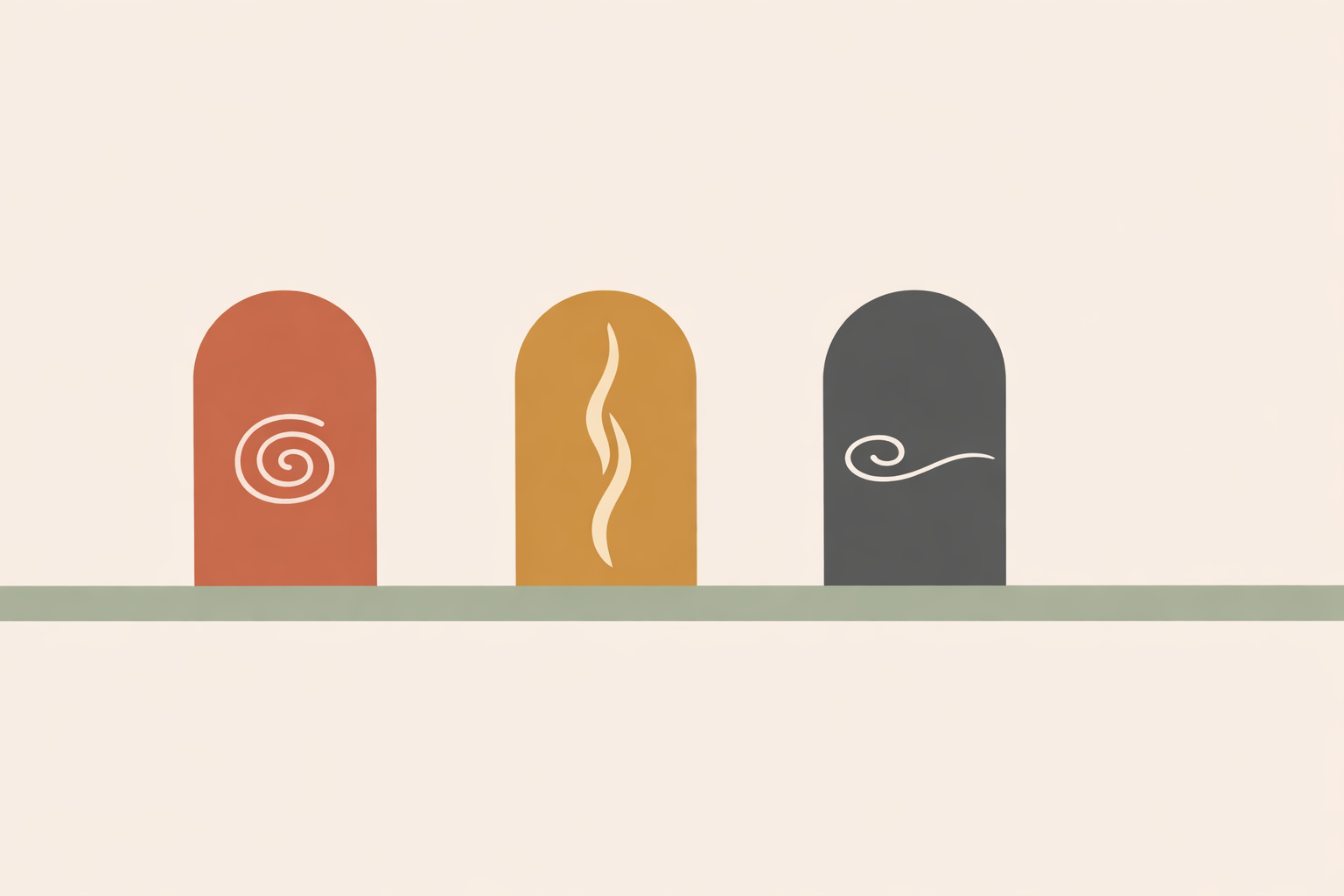
Practitioners often hit the same snag after a second class or a new teacher: the symbols don’t match what they learned first. Cho Ku Rei is drawn with a different spiral, Sei He Ki shifts from “emotional balance” to “mental clarity,” and Hon Sha Ze Sho Nen is chanted aloud instead of visualized. The instinct is to pick a winner so practice feels consistent. Usually that creates more tension, because you end up defending one version instead of practicing with ease.
It helps to see variation as a sign of a living lineage. Reiki moved through places, languages, and teaching cultures, and the symbols traveled with it. What often changes is not the heart of the practice, but how a lineage names, frames, draws, and applies what it has received.
Key Takeaway: Lineage differences shape how Reiki symbols are named, taught, and used. A simple five-part lens—identity, meaning, function, ritual, and authority—helps you compare versions without losing your footing. When you understand how teachings moved from Usui through later lineages, the differences around the core symbols, master-level additions, and Tibetan-influenced elements become easier to place with clarity and respect.
How Reiki Symbols Spread Through Lineage
What is commonly called Usui Reiki began in early twentieth-century Japan with Mikao Usui. From there, teachings were carried forward by students, adapted in real practice, and gradually shared beyond Japan.
Many practitioners describe the early core as relatively streamlined: guiding ideals, an initiation process, hand placements, and a focused symbolic framework. In many lineages, that older core is remembered as more concise than some later curricula.
From Usui, the teachings moved through Chujiro Hayashi, whose work in Tokyo helped shape practical instruction and systematize how sessions were taught. This is one reason session structure can feel fairly consistent even when symbol interpretations vary.
When Hawayo Takata brought Reiki into Hawai'i and North America, another layer of adaptation emerged. Scholarly accounts describe her major role in Reiki’s Western transmission, including how teaching culture around symbols developed in English-speaking settings. Takata’s role in adapting Reiki helps explain why many lineages still carry a particular classroom feel around privacy, reverence, and symbolic form.
Even with careful transmission, variation happens. Handwriting, memory, calligraphy, and oral repetition become lineage fingerprints over time. A small chalkboard difference can be repeated for decades until it feels like a major divide.
You’ll also hear origin stories that reach back to Tibetan or scriptural sources. Some lineages hold these stories dearly, even when they’re hard to verify historically. A respectful stance is to honor a lineage’s tradition while staying clear about what is lineage story, what is documented history, and what remains uncertain.
Five Ways Reiki Symbols Change Across Lineages
Most confusion eases when you sort variation into a few clear layers. Then you can compare teachings without arguing about everything at once.
- Identity: the name and visual form. “Cho Ku Rei” and “Choku Rei” can be spelling choices rather than a different symbol.
- Meaning: the qualities emphasized, such as grounding, focus, or amplification.
- Function: how the symbol is used in sessions, self-practice, or distance practice.
- Ritual: whether it’s traced, visualized, chanted, whispered, or held inwardly.
- Authority: who transmits it, how lineage is described, and how tightly “correctness” is defined.
This turns a tense comparison into a useful conversation. Instead of “Which version is right?” ask “What does your lineage call this, what does it mean by it, and how is it used?”
A practical example: a new client, Sam, trained in a school that chants Hon Sha Ze Sho Nen aloud. You normally work silently. Rather than treating that as a contradiction, you can name the ritual difference while recognizing the function is similar: both approaches use the symbol to support connection in distance practice.
Spelling differences are often the least important piece. Romanization varies, and not every lineage standardizes transliteration the same way. It helps to hear these differences as accents within a shared language.
The Three Core Reiki Symbols Across Styles
For many practitioners, the clearest place to notice lineage differences is in the three symbols commonly introduced first for deeper symbolic work: Cho Ku Rei, Sei He Ki, and Hon Sha Ze Sho Nen. The symbols are familiar, but the doorway each lineage opens through them can differ.
Cho Ku Rei. Many schools teach Cho Ku Rei as focus, concentration, or gathering. Some practitioners experience it as grounding at the start of a session, while others use it to emphasize an area or mark transitions. The shift is usually one of emphasis.
Sei He Ki. Sei He Ki is often associated with emotional harmony, mental clarity, or both together. One teacher may place it over the heart, another over the head, and another may use it in breath-centered meditation. These are often different ritual expressions aimed at a similar intention.
Hon Sha Ze Sho Nen. Across many lineages, this symbol carries the theme of connection beyond immediate physical proximity. Some practitioners draw it, others visualize it, and some chant it quietly while holding the recipient in awareness. Consent and clear intention are central, especially in distance practice.
Many curricula teach three symbols at Level II, with additional symbols reserved for Level III or master-level study. That structure shows up widely, even when interpretations differ.
For day-to-day work, speak plainly and locally. “In my lineage, this symbol is used to support focus,” or “In my training, this one is used during distance sessions,” is both accurate and respectful.
When Additional Symbols Enter the Lineage
As practitioners continue beyond the foundational symbols, they often meet a broader symbolic vocabulary. Confusion tends to deepen when later additions are presented as though they were always part of the earliest form.
Dai Ko Myo. In many schools, Dai Ko Myo is associated with illumination, advanced practice, and teaching transmission. It’s often held with special reverence in master-level work and may be used during initiation rituals or contemplative practice. Many practitioners and historians also note that earlier Usui-based teaching appears to have been more compact, with some lineages expanding the symbolic framework over time.
Raku. Raku appears mainly in Tibetan-influenced or hybrid Reiki teachings and is often described in grounding or completion-oriented terms. Not every lineage uses it, and its presence usually reflects a school’s development path.
Usui/Tibetan and later systems. Some approaches blend Usui Reiki with added symbols, ritual elements, and initiation structures. Later systems such as Karuna Reiki and Holy Fire also grew from Western Reiki roots while developing their own frameworks and teaching methods. These developments are part of Reiki’s ongoing evolution, even when they don’t match early Japanese forms.
The most respectful way to speak about additions is to name them clearly. If a symbol is a later lineage development, say so. If a school blends Usui teachings with Tibetan-influenced elements, say so. Clear naming protects tradition and keeps your communication honest.
What Actually Changes When Symbol Meanings Shift
When symbol meanings differ across lineages, the usual changes are interpretation, ritual method, and teaching language. The underlying practice often remains recognizably Reiki.
Holding three layers at once keeps things clear:
- Historical layer: what can be traced through teachers, lineages, and written accounts.
- Lineage layer: what your school teaches about meaning, use, and transmission.
- Experiential layer: what practitioners and recipients actually notice in practice.
These layers support each other, but they aren’t interchangeable. A lineage teaching isn’t automatically a historical fact, and a meaningful experience doesn’t need to become a universal rule.
It also helps to be evidence-informed. Modern research tends to evaluate Reiki as an overall practice rather than testing symbols one by one, and national health summaries describe mixed results. That leaves symbol-specific nuance largely in the hands of lineage transmission and careful observation.
That’s a strong foundation when it’s handled with integrity. Many people relate to Reiki as a structured contemplative and relational practice, shaped by stillness, attention, ritual meaning, expectation, reflective space, and the quality of presence between practitioner and recipient.
Practising With Integrity Across Different Reiki Teachings
Your most reliable compass is straightforward: be clear about what you do, where it comes from, and how you talk about it.
When you encounter an unfamiliar symbol teaching, ask:
- Which lineage does this come from?
- What meaning does that lineage give it?
- How is it used in practice?
- How is it ritually invoked or transmitted?
- Does this fit what I am prepared to practice responsibly?
A short lineage statement prevents a lot of confusion. For example: “I practice Usui Reiki in a lineage that uses Cho Ku Rei, Sei He Ki, and Hon Sha Ze Sho Nen at Level II.” It tells people what they need to know without grand claims.
Clarity matters especially when working with clients. Let people know if your approach includes symbols, visualization, chanting, chakra-based language, prayer-like elements, or silent distance practice. Choice supports trust, and a client’s preference for a simpler approach can be respected.
For remote sessions, keep boundaries plain and consent specific. You might say, “At 8 pm I will sit for 20 minutes and use the distance symbol from my lineage with a simple intention for rest. You do not need to do anything, and you can let me know if you prefer a silent approach.”
It also helps to remember that Reiki has never been one perfectly fixed thing everywhere. You can honor your lineage deeply while meeting other lineages with curiosity and discernment.
Choosing Your Reiki Symbol Path With Clarity
Across the decades, Reiki symbol meanings have shifted in name, emphasis, and ritual use because lineages carry wisdom in different dialects. When you compare identity, meaning, function, ritual, and authority, the noise settles and what looked like contradiction often becomes lineage texture.
As you continue your study, look for teaching that names its lineage clearly, distinguishes older forms from later additions, and explains how symbols are shared and understood. Strong teaching builds depth through practice, ethics, cultural respect, and honest transmission within energy healing.
More symbols don’t automatically mean deeper practice. Some lineages stay close to simplicity, principles, meditation, and steady hands-on work. Others explore a wider symbolic vocabulary with care. The strongest path is the one that’s transparent about what it is and how it supports real client work.
In closing, a few steady guardrails keep your practice clean: avoid making universal promises, get clear consent (especially for distance sessions), and don’t blur lineage tradition into provable history when it isn’t. With that in place, the symbols can do what they’ve always done best—serve as living supports for practice, rather than objects of confusion.
Advance with Reiki Master Certification
Deepen your symbol work and lineage clarity with the Reiki Master Certification.
Explore Reiki Master Certification →