Getting an organic-looking form is rarely the hard part of bio-inspired design. The real test comes later—when the concept has to be explained in functional terms, defended under budget pressure, and traced back to decisions a client can follow. That’s where many promising ideas lose momentum.
A steadier approach is to treat nature as a source of functions and rules—not just imagery. With a lean, traceable workflow, bio-inspired design becomes easier to model, test, coordinate, and communicate.
Key Takeaway: Bio-inspired design holds up best when you start with performance goals, translate biology into explicit rules, and encode them in a single parametric 3D model. Pair those rules with early simulation and clear documentation so the concept remains testable, explainable, and buildable.
Shift 2: Translate the brief into biological language
Once the function is clear, the next move is to “biologize” it—turning a design need into a question nature can answer.
“Make the roof cooler” becomes “how do living systems reduce heat gain or release stored heat?” “Make it quieter” becomes “how do natural systems absorb, diffuse, or break up sound?” Think of it like changing the search term: you stop hunting for a look and start hunting for a working strategy.
Translation-led approaches often create stronger matches. Research points to better fits when teams begin from function rather than analogy.
In practice, structured biology libraries and function-based search tools can reduce overwhelm in the early phase. When databases are indexed by function and mechanism, it’s easier to move from brief to biological strategy without getting pulled into surface-level imagery.
Some teams also use knowledge graphs that connect functions, organisms, mechanisms, and contexts. Here’s why that matters: it often reveals multiple viable pathways to the same goal—useful when climate, craft, budget, and buildability all need to stay in view.
“On graph paper we map the relationships that make the place feel alive… then in 3D we stress‑test those relationships against seasons, shade, and real human movement.”
A practical micro-sequence can look like this:
- Problem: overheating
- Function: dissipate heat
- Biology: reflective skins, ventilated ribs, evaporative surfaces
- Rule: increase reflection and airflow while limiting direct solar exposure
- Parameter: spacing, depth, porosity, reflectance
This is the moment the design stops being decorative and starts becoming operational.
Shift 3: Use 3D parametric tools to encode living rules
Bio-inspired design becomes far more workable when nature’s logic is built into the geometry. Instead of redrawing forms again and again, you define relationships—and let the model update as those relationships change.
This is why parametric and implicit modeling have become central for bio-inspired work. Industry research notes organic geometries are better handled through these approaches than through static drafting alone.
With a node-based workflow, you can encode rules for branching, porosity, curvature, rib depth, shell thickness, or gradients. Change one relationship and the whole system responds. What this means is you can work with nature’s logic as a set of dependencies, not a frozen shape.
This is especially useful for recurring geometry families in bio-inspired design: lattices, shells, branching systems, folds, and graded structures. They’re versatile enough to serve different environmental and spatial intentions without endless manual revision.
There’s also a coordination advantage. Using one 3D model as the source for drawings improves consistency and reduces coordination errors compared with fragmented 2D workflows.
“This 12‑week guided training teaches the principles and practice of Bio‑Architecture so you can design, visualize, and draft your own eco‑home—even if your current experience is mostly 2D floor plans.”
And for communication, 3D reduces guesswork. As K. V. Sharma puts it, “A 3D floor plan is far more visual… the virtual model removes much of the interpretation gap.”
That matters because bio-inspired work often fails not in the concept, but in the handoff between idea, geometry, and shared understanding.
Shift 4: Pair geometry with feedback early
Once the rules are in the model, they need feedback. Otherwise, a design can look bio-inspired while performing like any other shape.
For structural logic, topology optimization distributes material in ways analogous to bone—more where loads concentrate, less where it’s not needed. The result can be lighter, more efficient structures without losing strength.
More broadly, lightweighting can reduce mass while maintaining performance, especially in cellular, lattice, and plant-inspired systems.
Environmental feedback is just as important. Linking parametric geometry to simulation supports rapid feedback on sun and airflow as you refine the model. And early energy modeling helps passive strategies stay visible before big decisions lock in.
“By the fourth module I’d stopped drawing houses and started modeling micro‑climates; 3D became my way to prototype passive heating and cooling before committing to a single brick,” Carlos R. shared.
That’s the real upgrade: the model stops being a picture of a building and becomes a way to understand how a place behaves.
A simple early feedback routine can include:
- Sun and shade: where exposure accumulates across day and season
- Air movement: likely cross-ventilation paths and pressure differences
- Structural logic: where material is working hard and where it is not
If a bio-inspired rule holds up under those three checks, it’s usually worth developing further.
Shift 5: Make documentation the nervous system of the project
Bio-inspired projects often lose clarity not because the idea was weak, but because the reasoning gets scattered across sketches, scripts, screenshots, and half-remembered conversations. Documentation keeps one continuous thread—from organism to mechanism to design decision.
This is where lightweight knowledge systems earn their keep. Reviews of biomimetic workflows highlight a recurring challenge: engineering parameters can be hard to maintain as the work advances, and traceability gets lost.
A simple canvas, decision log, or relationship map prevents that drift. The goal isn’t bureaucracy—it’s continuity of thought, so the project stays teachable to your future self and legible to collaborators.
When the reasoning stays visible, iteration fatigue drops. Instead of re-litigating the same conceptual questions, the team can see what was chosen, why, and which parameter expresses that choice in the model.
“Rendering is not about ‘nice visuals’—it is about communicating light, texture, and mood so collaborators can feel the bio‑space.”
Useful documentation habits include:
- Biology-to-rule card: Function → Organism → Mechanism → Design Rule → Parametric Variable
- Decision log: date, question, options considered, chosen direction, contextual reason
- Model tags: name systems by function, such as Shade_, Vent_, Structure_
When someone asks, “Why this branching density?” or “Why does the shell thicken here?” the answer is already stored in the project’s memory.
Shift 6: Keep the toolchain minimal and fluent
One of the fastest ways to make bio-inspired design feel frustrating is tool sprawl: too many platforms, too many handoffs, and too many places where the reasoning can break.
A calmer approach is a minimum effective stack: one biology source, one process framework, and one parametric environment. When the thinking is clear and the habits are consistent, that’s enough to make meaningful progress.
For beginners and solo designers, guided translation methods and a small tool stack often beat complex optimization suites. Early bottlenecks are usually cognitive load, not missing features.
A steady cadence matters more than accumulating software. Two focused weekly sessions can be enough:
- Sprint 1: Brief → Function → Biological strategy
- Sprint 2: Biological strategy → Rule → Parameter → Quick feedback
It also helps to know that a relatively small set of geometry families covers a surprising amount of bio-inspired work. Lattices, shells, branching, and graded structures return again and again because they scale well and adapt to many contexts.
“I came in thinking in flat elevations; I left the course thinking in whole ecosystems—walls, plants, water, and wind as one integrated organism in my 3D model,” Katja M. reflected.
A simple working triad looks like this:
- Biology: one function-indexed source you trust
- Process: one canvas or checklist you will actually use
- Parametric tool: one node-based environment where relationships can stay editable
Depth of fluency usually takes you further than breadth of software.
Conclusion: A calmer, stronger bio-inspired workflow
Bio-inspired parametric design becomes coherent when each step naturally feeds the next: define the function, translate it into biological language, turn the mechanism into rules, encode those rules in 3D, gather feedback early, and document the reasoning clearly.
This is also where 3D shifts from representation to decision-making. Research on BIM adoption suggests better decisions become possible when structural, environmental, and spatial information can be explored inside one coherent model.
Here’s why that matters: structure, climate response, and life-supporting patterns can be shaped together instead of in fragments. When the same model supports drawings, coordination, and simulation, nature-inspired choices become easier to explain—and easier to protect as the project evolves.
The practical lesson is simple: don’t ask your tools to create meaning. Ask them to hold and clarify meaning that begins with function.
Master 3D Bio-Architecture Design
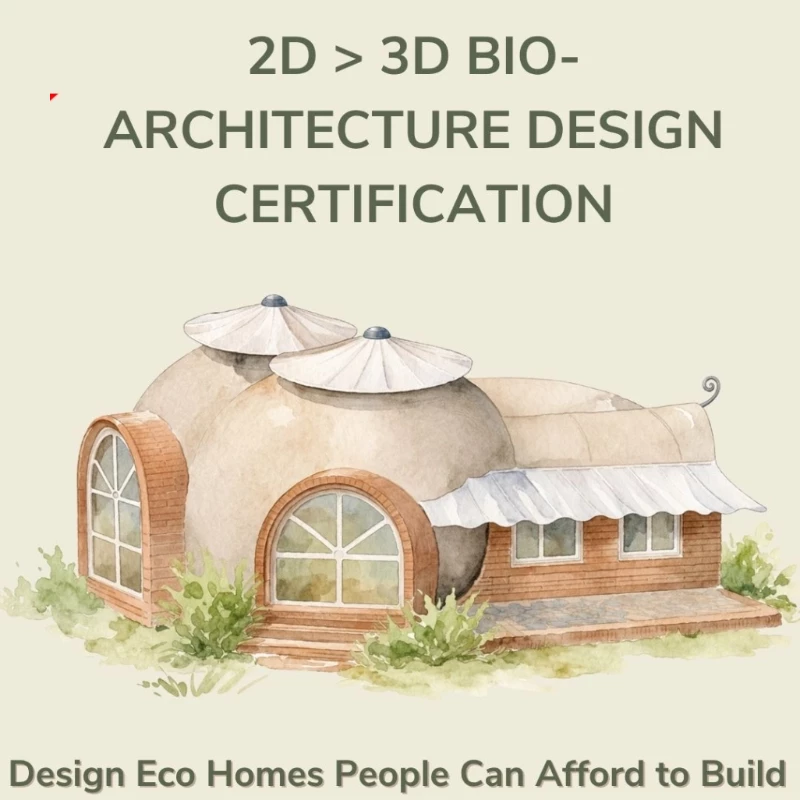
Apply this function-first workflow in the 2D-3D Bio-architecture Design Certification.
Explore the Certification →