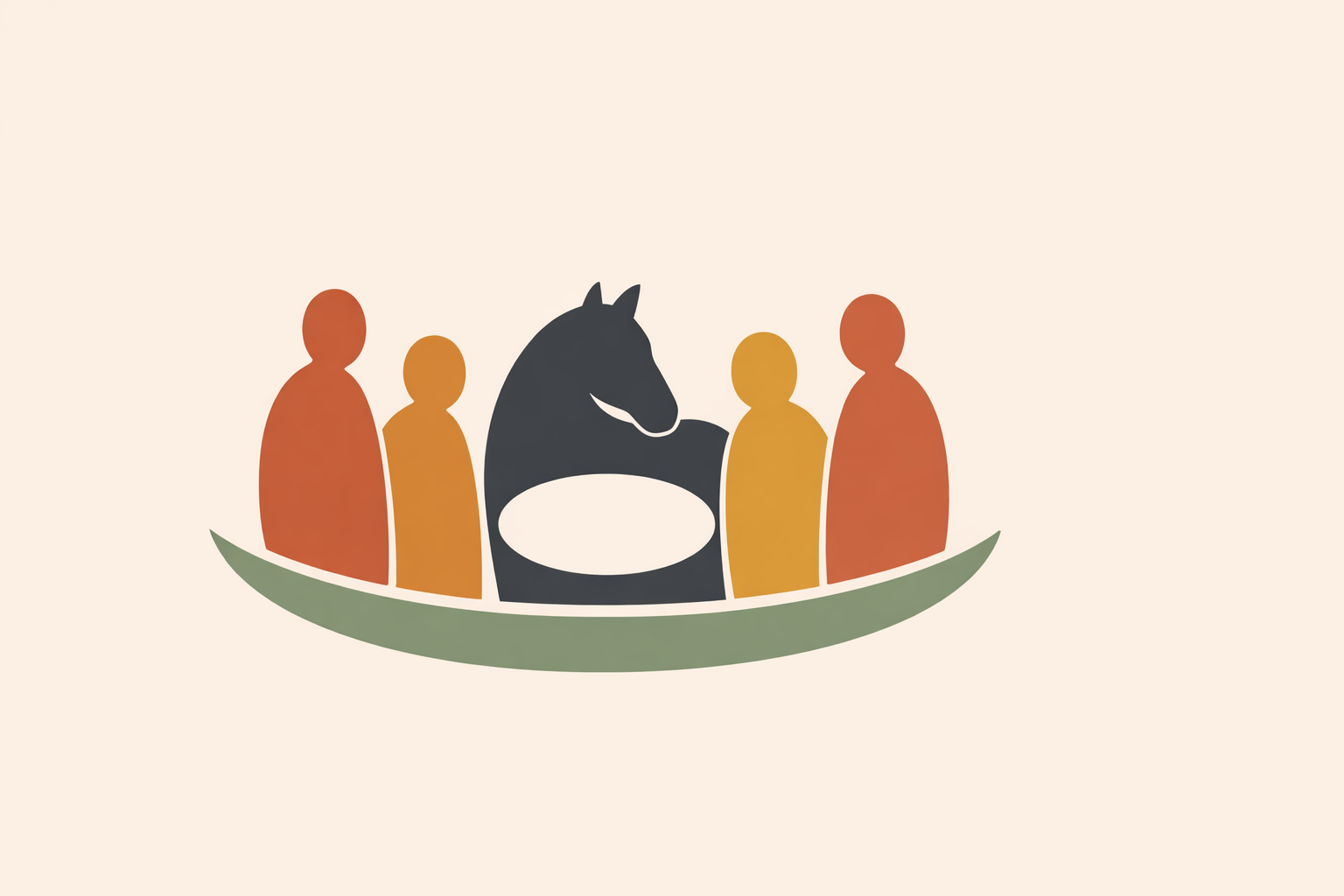
Equine‑facilitated work is a true team endeavor: horses, humans, and clear agreements moving together to support growth. At its heart is experiential partnership—hands‑on, reflective time with horses that invites people to notice, feel, and shift in real time.
Across many cultures, horses have long been companions in learning, livelihood, and spiritual life. Today’s programs carry that lineage forward through structured, mostly ground‑based experiences and guided reflection, using groundwork to build trust and clear communication. The focus stays on relationship rather than riding technique—presence, boundaries, and emotional skill-building in a dedicated, non‑riding space.
In that space, horses respond to breath, posture, and congruence, and people learn by being with them—not just by talking about change. The real question isn’t only how to build an offering; it’s who belongs on your equine‑facilitated team so the work stays ethical, effective, and sustainable. It starts with the partners who make everything else possible: the horses.
Key Takeaway: Build your equine‑facilitated team around clear roles that protect horse welfare and support human integration. When horses are treated as core partners and the equine specialist, facilitator, and (when needed) well‑being support work in alignment, sessions become safer, more ethical, and more effective.
Role 1: Horses as core partners on your equine‑facilitated team
Horses are not props. They’re sentient team members, and their sensitivity and choices shape every moment. When they’re treated as partners, their responses become living feedback—clear, immediate, and surprisingly precise.
Many approaches describe horses as co‑facilitators because their behavior reflects what’s happening in the human body and nervous system. Horses are exquisitely tuned to nonverbal signals, and groundwork intentionally works with nonverbal cues to build mutual understanding.
As one research‑informed summary notes, horses can detect when outward calm doesn’t match inner experience. Many facilitators have seen a horse respond instantly to a clipped “I’m fine,” then soften the moment someone exhales and tells the truth. Think of it like a relational mirror that doesn’t argue—just responds.
People often call it “instant feedback.” And as equine educator Linda Kohanov puts it, horses help us learn about ourselves and move through limits. Some programs also note that time with horses has been linked with increased calm; in practice, many teams simply recognize the groundedness people reliably report after being with the herd.
The takeaway: design the team around the horses’ welfare, consent, and individuality. Their feedback is the compass for every other role you add.
Role 2: The equine specialist – guardian and translator for the herd
Every strong equine‑facilitated team benefits from someone whose primary loyalty is to the horses’ well‑being. The equine specialist holds that line—protecting welfare, reading subtle communication, and ensuring sessions serve the herd as much as the humans.
Practically, this means steady oversight of the horses’ day‑to‑day needs and readiness. In many programs, equine specialists oversee welfare and also support ground‑based activities like grooming, leading, and obstacle work—often chosen because it strengthens the bond between humans and horses.
In the session itself, the equine specialist becomes the herd’s translator: tracking thresholds through ears, eyes, breath, weight shifts, and distance. Put simply, they help the team know whether a horse is curious, setting a boundary, or getting overloaded. Attuned handling starts with understanding equine body language, and this role is all about timing and nuance.
Many teams also practice consent-based interaction—allowing horses to approach, step away, or pause. Equine specialists help shape consent‑based experiences and keep safety norms clear. Strong programs also benefit from clear accountability, supported by role boundaries that define who holds what responsibility in the moment.
The bottom line: a skilled equine specialist keeps the herd safe and seen—and that makes every learning moment more authentic.
Role 3: The human facilitator or coach – turning herd moments into insight
Horses surface the wisdom; the facilitator or coach helps people harvest it. This role turns real‑time equine feedback into insight, then into practical experiments participants can use in everyday life.
Facilitators shape experiences to fit the person or group—boundary explorations, trust-building, communication challenges, and relational tasks that echo real-world dynamics. Many start with low‑challenge, consent‑based groundwork and build complexity as confidence grows, using nonverbal cues to support connection while keeping safety and relationship central.
The real craft is meaning‑making. The facilitator helps someone notice breath and posture, watch what shifts in the horse, and name the pattern underneath—then translate that into something usable. A horse stepping away can become a clear lesson in boundaries at work. A shared stillness can become a felt sense of safety someone practices at home.
This is why organizations often seek the work for team building and leadership presence. Common outcomes include stronger self‑awareness, clearer communication, and steadier self‑regulation—benefits practitioners frequently see when clients integrate arena learning into daily life, aligning with how groundwork can enhance communication skills in human‑horse partnership.
In short: the facilitator designs the arc and holds the reflective container so “what happened with the horse” becomes “what changes next.”
Role 4: The well‑being professional – safely holding emotional depth
When equine‑facilitated work touches grief, trauma, or major transitions, an additional well‑being professional can make the difference between overwhelm and integration. Their presence helps keep exploration paced, resourced, and steady.
In many programs, this person works closely with the equine specialist. They focus on emotional regulation, relationship patterns, and supportive processing when the horse’s feedback brings big material to the surface. Essentially, they help the team keep the experience within a window where learning can land.
Some summaries of equine‑facilitated approaches describe benefits that include stronger coping and emotional regulation, which matches what many experienced teams observe over time.
One participant shared arriving with “ptsd, depression, anxiety, and low self esteem,” and noticing not just personal shifts but relationship changes afterward—an echo of how profound, relational learning with horses often extends beyond the arena testimonials.
Collaborative models often include a simple intake, shared goals, active observation during horse time, and a gentle integration process afterward. EAGALA helped popularize this kind of collaborative structure, and many coaching-forward teams use a similar duo or triad approach when emotions run high.
Guiding question: Does the depth you’re inviting require an extra layer of emotional stewardship? If yes, build that into the team early.
Role 5: The program director or practice builder – creating a safe container
Strong equine‑facilitated work doesn’t happen by accident. It needs someone behind the scenes weaving ethics, logistics, and quality into an offering participants can trust.
The program director (often the founder) coordinates scheduling, facilities, herd support, and team communication. They translate values into daily practice—clear role boundaries, species-respectful protocols, and a scope that matches training and intent (coaching, education, or community well‑being). They also guide evaluation: tracking goals, noticing patterns, and refining based on what the horses and participants consistently show.
When this role is done well, the whole environment becomes steadier. One veteran described the combined effect of “patient and tolerant horses and staff” as a setting that helped him meet ongoing challenges—proof of what a coordinated relational environment can offer. Directors also protect ethics as programs grow in popularity, keeping horse welfare and participant clarity firmly in the foreground.
Think of this role as the container builder: when the structure is aligned, everyone relaxes into the work—horses included.
Role 6: Supporting animals and holistic practitioners – widening the circle with care
Some teams widen the circle beyond horses. When it’s done thoughtfully, other animals and holistic collaborators can support regulation, engagement, and accessibility—without diluting the primacy of the herd.
Multi‑species formats may include calm dogs, goats, or rabbits alongside equine sessions. For some anxious participants, a few minutes sitting with a relaxed dog before meeting a 1,200‑pound horse can help the body settle. More broadly, animal contact has been associated with increased oxytocin, a shift many people simply experience as warmth and ease.
Smaller animals can also lower the entry threshold—inviting play, curiosity, and gentle care, especially for youth or anyone intimidated by a horse’s size. The key is intentional design: other species join because it serves the learning arc and respects the animals themselves.
Some teams also collaborate with holistic practitioners—breathwork, somatic education, and nature-based ritual can frame or integrate arena time. The shared ethic matters most: animals are partners, not instruments, and sessions are built around relationship and consent‑based interaction. While groundwork may also support physical skills like coordination, the north star remains emotional safety and authentic connection.
Use this role wisely: widen the circle to meet participants where they are—and only as fast as your horses, your team, and your scope can truly hold.
Role 7: You, your lineage, and your community – the evolving heart of the herd
Teams don’t exist in a vacuum. Your values, your teachers, and your community agreements shape how horses and humans meet on your land. You are part of the lineage you carry forward.
Many practitioners find that close work with horses makes them more present, more open, and less judgmental in daily life. Horses invite humility and honesty; they nudge us to refine our boundaries, our timing, and our inner steadiness. Participants feel that difference immediately.
As one participant shared, “I am a new woman…lighter and free,” crediting the team’s companioning and “the gracious healing the horses offer” client story.
Skill-building is ongoing: equine fluency, facilitation craft, and an ethical backbone that stays strong under real-world pressure. At Naturalistico, learning paths are designed to combine practice, community, and ongoing evolution—so what you study can be applied in real sessions, supported by peers and mentorship.
Whatever your training route, hold your roots with respect. Learn from elders and horse-centered communities with humility, name your influences clearly, and avoid appropriation. Then keep refining—because your presence shapes the whole field of the work.
Remember: your presence is part of the medicine of your herd. Grow it with care.
Conclusion: Sketching your first equine‑facilitated team
Start simple, start ethical, and let the herd show you what to build next. A focused, well-coordinated team can do more—safely—than a crowded one with unclear roles.
For many new programs, a strong foundation is a duo: an equine specialist plus a facilitator or well‑being partner, especially when your sessions invite emotional complexity. This duo model helps ensure horses are advocated for and humans are well-supported while you refine structure.
- Clarify your scope: Name whether your offering centers coaching, education, or community well‑being, and align activities with that scope and your training.
- Keep it ground‑based: Groundwork supports accessibility and partnership, and it can also help stabilize musculature, which is one reason many teams stay on the ground.
- Write the basics: Document safety protocols, consent practices, and role boundaries, then review them together each season.
- Plan evaluation: Use simple ways to track goals and change over time—brief self-checks, facilitator observations, and short integration notes.
- Grow by phase: Add roles and species only as your horses, space, and community can truly support them.
- Invest in community: Seek mentorship, peer feedback, and ongoing learning designed for real client work; alignment matters more than size.
Your herd—equine and human—will evolve. Let the horses’ feedback lead, let structure protect what matters, and let community keep you accountable and inspired. A clear team with shared ethics is how this work stays sustainable for everyone involved—including the horses who choose to meet people at the gate.
Train as Equine Therapy Practitioner
Apply these team roles in practice with the Equine Therapy Practitioner course.
Explore Equine Therapy Practitioner →