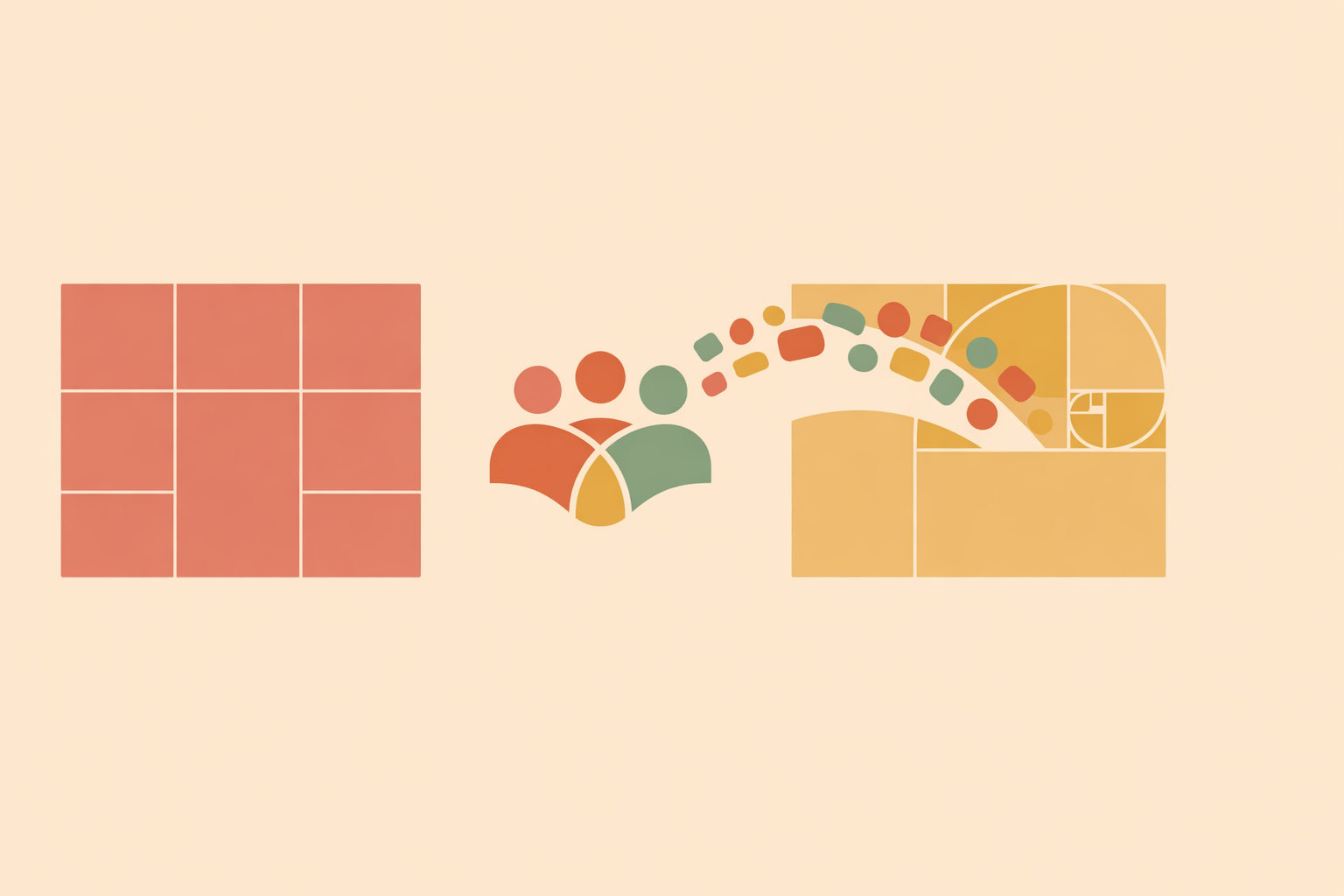
Workshops on sacred geometry can drift into abstraction fast. A slide deck on the golden ratio turns into a debate about science, myth, or symbolism, and the practical aim—helping people feel balance, rhythm, and flow on the page—gets buried. A steadier path is to use phi grids and spirals as working armatures: useful, observable, and open to multiple meanings without becoming doctrine.
This five-part sequence keeps everything grounded in making. It moves from quick image crops to spiral-led layouts, then into nature tracing, a collaborative emblem, and a mandala-style reflection space. The facilitator’s job stays consistent: name what’s structure and what’s meaning, invite opt-in rather than assumption, and help participants notice what changes when proportion shifts.
Key Takeaway: Use the golden ratio as a practical facilitation tool for exploring balance, visual flow, and reflective making—without overstating what it proves. These five exercises help participants compare compositional choices, guide attention, test patterns in nature with humility, co-create within ethical boundaries, and reflect through shared form.
Exercise 1: Phi-Grid Image Remix
Start with something familiar and low pressure: phone photos participants already have. The goal isn’t perfect composition; it’s noticing the felt difference between a standard thirds crop and a phi-based crop.
Set the tone early: “We’re comparing two guides and noticing what changes. There’s no right answer. You can join in, observe, or pass.”
In visual design education, the golden section is commonly taught as a proportion system for dividing space. That makes it a strong facilitation tool here: not “better,” just different.
Run the exercise in 15 minutes:
- Minute 0–3: In pairs, choose any photo. Make a crop using the rule of thirds. Save it as A.
- Minute 3–8: Re-crop the same image using a phi grid if available, or by moving the subject slightly closer to center than thirds would suggest. Save it as B.
- Minute 8–12: Compare A and B side by side. Ask: “Where does your eye settle?” “Which crop feels calmer, clearer, or more alive?”
- Minute 12–15: Share one brief observation per pair.
Keep the language relaxed: these are guides, not laws. Participants often notice small but meaningful shifts. A face moved a little inward can feel steadier, and a horizon nudged closer to center can soften tension without flattening the image.
If someone uses a coastal scene with a pier, the thirds crop may feel more dramatic, while the phi crop may feel more gathered and balanced. That contrast builds “hands-on” understanding before theory enters the room.
Exercise 2: Golden Spiral Storyboard
Once participants can feel balance, move into motion. The spiral supports conversation about sequence: where the eye begins, what it meets next, and where it finally lands.
A design resource notes that golden spirals can guide a viewer’s eye across a composition and create a strong sense of visual flow. The tight center of the spiral also tends to work well as a focal point.
Use that idea in a group storyboard. Imagine the task is a poster for a community concert.
- Step 1: Choose the spiral orientation. Ask which direction suits the feeling of the event.
- Step 2: Pick the landing point. Place the most important final detail—such as “Saturday 7 PM”—near the inner curl.
- Step 3: Add secondary elements along the spiral arm: headline, venue, image, short supporting text.
- Step 4: Trace the route with a finger and say aloud what the eye encounters.
This gives the group a shared language for hierarchy without getting overly theoretical. Primary elements sit near the curl; secondary elements unfold outward. When you shift an image closer to the spiral arm, most people can feel the emphasis change, even if they describe it differently.
A helpful bridge sentence here is: the grid helps you place, while the spiral helps you lead. That keeps this exercise connected to the first.
In remote or classroom settings, the same method works on slides. One slide can lead toward a key problem statement, the next toward your central idea, and the last toward two clear next steps.
Exercise 3: Nature Tracing with Phi
This is often where the room softens. Shifting from studio composition into shells, leaves, seed heads, branches, or waves invites proportion as observation, not argument.
Frame it carefully: “We’re looking for approximations, not trying to prove a universal pattern.” That one sentence keeps the work grounded.
Invite participants to bring or choose images from nature, then layer simple rectangles, arcs, or spirals over them. Ask:
- Where does the spiral fit closely?
- Where does it drift away?
- If it does not fit, what other pattern seems more useful here?
- What feels personally meaningful, and what is directly observable?
It helps to be honest about the bigger claims. Popular narratives around the golden ratio are often repeated too confidently, and modern reviews note those broader beauty claims are widely contested. Traditional practice still has value here: attentive tracing trains the eye, builds discernment, and invites respectful curiosity.
Use a two-column board:
- What we can measure
- What it means to me
That separation keeps the room clear. “This arc roughly follows the shell’s outer curve” goes in one column. “This spiral reminds me of renewal” goes in the other. Both can be true, and they stay distinct, much like responsible shape talk.
Participants also get permission to notice that not every pleasing form resolves into phi. Branching, packing, repetition, symmetry, and asymmetry all belong in the same conversation, and that humility usually makes people more curious.
A simple example: someone overlays a spiral on a storm image and finds the outer bands echo it well while the center breaks away. That “partial fit” teaches more than a forced perfect match.
Exercise 4: Collective Emblem on a Golden Grid
Now bring the work into co-creation. A shared emblem lets participants use proportion collaboratively while practicing ethical clarity around imagery and meaning.
Set up a visible armature on paper or a digital board:
- Create a golden rectangle and a few subdivisions.
- Add a light circle framework scaled from the same proportion.
- Choose a subject connected to place, shared purpose, or local ecology.
- Avoid copying living sacred symbols or culturally specific motifs without clear relationship and context.
Assign simple roles: outer shape, internal curves, spacing, color, final refinement. Two passes work well—first structure, then expression.
As a teaching point, name two parallel languages:
- Geometry notes: widths, radii, spacing, alignments
- Meaning notes: symbolism, color associations, group intention
This distinction supports honest collaboration. It also reflects a familiar design principle: proportion systems help organize space, and some research suggests golden-ratio forms may allow easier visual processing. Many makers also recognize, through experience, that these structures can “tune” spacing and curves in a satisfying way.
Run a short critique with three questions:
- Where is the grid helping?
- Where is it becoming too rigid?
- What could be simplified?
If the shape starts to feel forced, loosen the constraint. That flexibility is part of learning to use sacred geometry as craft rather than command, whether in group facilitation or broader spirituality and ritual practice.
For example, a group creating a bee emblem for a pollinator project might use phi-based wing proportions and a circular head shape, while separately naming the bee as a symbol of cooperation and the palette as a reference to local flowers. Structure and meaning stay in conversation without being confused as the same thing.
Exercise 5: Golden-Ratio Mandala Circle
End with a slower, more reflective exercise. A mandala-style circle offers a structured space for rhythm, pattern, and quiet attention.
Begin with clear consent language: “You choose your depth of engagement. Pattern-only is welcome. Personal meaning is optional. You may pause, step back, or simply observe at any time.”
Then build a shared framework:
- Draw a large circle.
- Place a golden rectangle within it.
- Add a spiral arc crossing the circle.
- Add four or eight radial lines for symmetry.
Invite different pathways from there. Some participants will work along the spiral for movement. Others will prefer the stillness of radial symmetry. Some will combine both.
There is modest support for mandala-based activities as containers for increased flow. Beyond research language, experienced facilitators recognize the effect: circles help hold attention, repetition settles the hand, and patterned making gives people a way to stay present without needing to explain themselves.
Helpful prompts include:
- What pattern feels good to repeat right now?
- Would you like to keep this abstract, or add meaning words later?
- If a motif comes from a specific tradition: how should it be named or adapted respectfully?
Close gently. Invite participants to share either a geometry reflection or a personal reflection, but not both unless they want to. One person may say the spiral helped space repeated shapes. Another may say leaving the center open felt important. Both are complete responses.
Bringing It All Together
These five exercises create a natural arc: compare crops, guide attention, test patterns in nature, co-design within an ethical frame, and finish in reflective making. Together they build fluency with proportion while modeling facilitation that is clear, respectful, and grounded.
It also helps to name the boundaries with confidence. The golden ratio can support a sense of harmony, and some people do experience golden-ratio compositions as more harmonious. At the same time, the stronger myths—that phi guarantees beauty, explains all pleasing form, or hides behind every meaningful pattern—don’t need to be carried into the room. Some critiques describe that hidden-perfection story as a 150-year-old scam.
The practical value stays straightforward. The grid offers one way to divide space. The spiral offers one way to guide attention. The circle offers one way to hold reflection. Used in that spirit, sacred geometry remains a living practice of seeing and making, with measurement where measurement helps and interpretation where meaning begins.
Explore Sacred Geometry Certification
Build facilitation-ready skills with proportion, grids, and reflective making in the Sacred Geometry Certification.
Explore Sacred Geometry →