Many programs approach fall prevention in the garden by coaching people to be careful, adding extra support, or installing a rail after a near-miss. Those steps can help, but they often arrive late. In practice, many stumbles start earlier: a narrow gate, a small threshold, a poorly defined edge, or a hose stretched across the main route.
Accessible layout is the foundation. When routes are obvious, surfaces feel steady, and tasks sit within easy reach, movement settles. Participation lasts longer because the space is doing some of the supporting.
Key Takeaway: Fall-safer therapeutic gardens begin with layout choices that reduce uncertainty and physical strain. Prioritize step-free, clearly edged paths; firm, slip-resistant surfaces; simple looped circulation; readable wayfinding; reachable planting areas; and frequent places to rest in shade. Small design changes often do more for safe participation than repeated reminders to slow down.
Make accessible layout your first fall-prevention tool
Build steadiness into the space itself. This is the heart of universal design: shaping environments so people with different abilities, energy levels, and ways of moving can take part without constant workaround.
In therapeutic gardens, uncertainty drains attention. If someone has to keep scanning for the route, second-guess a turn, or negotiate awkward obstacles, focus shifts away from plants and toward staying safe. A clear layout reduces that background effort.
Traditional courtyards and cloister gardens often got this right through simple loops, resting niches, nearby water, and planting kept close at hand. Those time-tested patterns still offer practical wisdom today, especially when paired with contemporary accessibility thinking.
Start with a quick site sketch and trace the main route someone should be able to follow without explanation. Then circle hesitation points: tight turns, sudden level changes, poor visibility, clutter, and awkward transitions. Fixing these usually does more for confidence than any decorative upgrade.
Design step-free, wide, clearly edged routes
The safest garden route is step-free, easy to read, and wide enough for unhurried movement. Pay extra attention near entrances, gates, and the first few metres from the building, where traffic bunches and attention is often divided.
Thresholds matter because threshold irregularities commonly cause trips and snags. Even a small lip can catch a wheel, walking aid, or shuffling toe. If a level change must stay, bevel or ramp it so the transition feels continuous.
Edges matter just as much. People drift toward beds, soft soil, or gravel shoulders without noticing, especially when they’re engaged in conversation or looking at plants. In dementia-support settings, guidance highlights clearly defined edges to keep routes visually legible for people with limited vision or confidence outdoors.
Keep the main route free of storage, hoses, pots, and wheelbarrows. Many stumbles happen at small pinch points where the body has to compensate quickly.
Concrete example: replace a door lip with a beveled ramp, widen the first section of path so two people can pass comfortably, and add continuous edging that also guides hoses away from the walking line.
- Main route: step-free wherever possible
- Edges: continuous and easy to see
- Storage: off the main path, near the work zone
- Transitions: ramped or softened, never abrupt
Choose stable surfaces and keep slopes gentle
Where a path goes matters, and how it feels underfoot matters just as much. Loose gravel, uneven stepping stones, polished pavers, and surfaces that hold water all demand extra effort to stay steady, and that effort accumulates over a session.
For most therapeutic gardens, choose firm, stable, low-glare surfaces with reliable traction in both dry and wet conditions. Wet weather deserves special attention because paths can turn slick after irrigation or rain.
Standing water also encourages the slippery organic film many practitioners recognize from real sites. When water lingers, surfaces become unpredictable.
Slope is equally important. Gentle grades are easier on balance and energy than steep ones, and dementia-support design repeatedly emphasizes even, non-slippery paths as the safer default. Where a slope can’t be avoided, keep it gentle and add level places to pause.
Concrete example: replace a loose path with a broom-finished surface, improve drainage so water clears quickly, and break a longer incline with small resting pads.
- Avoid shiny, loose, or shifting materials
- Watch for puddling after watering
- Inspect mossy or slimy sections after storms
- Add rest points on longer graded routes
Use looped circulation and simple wayfinding
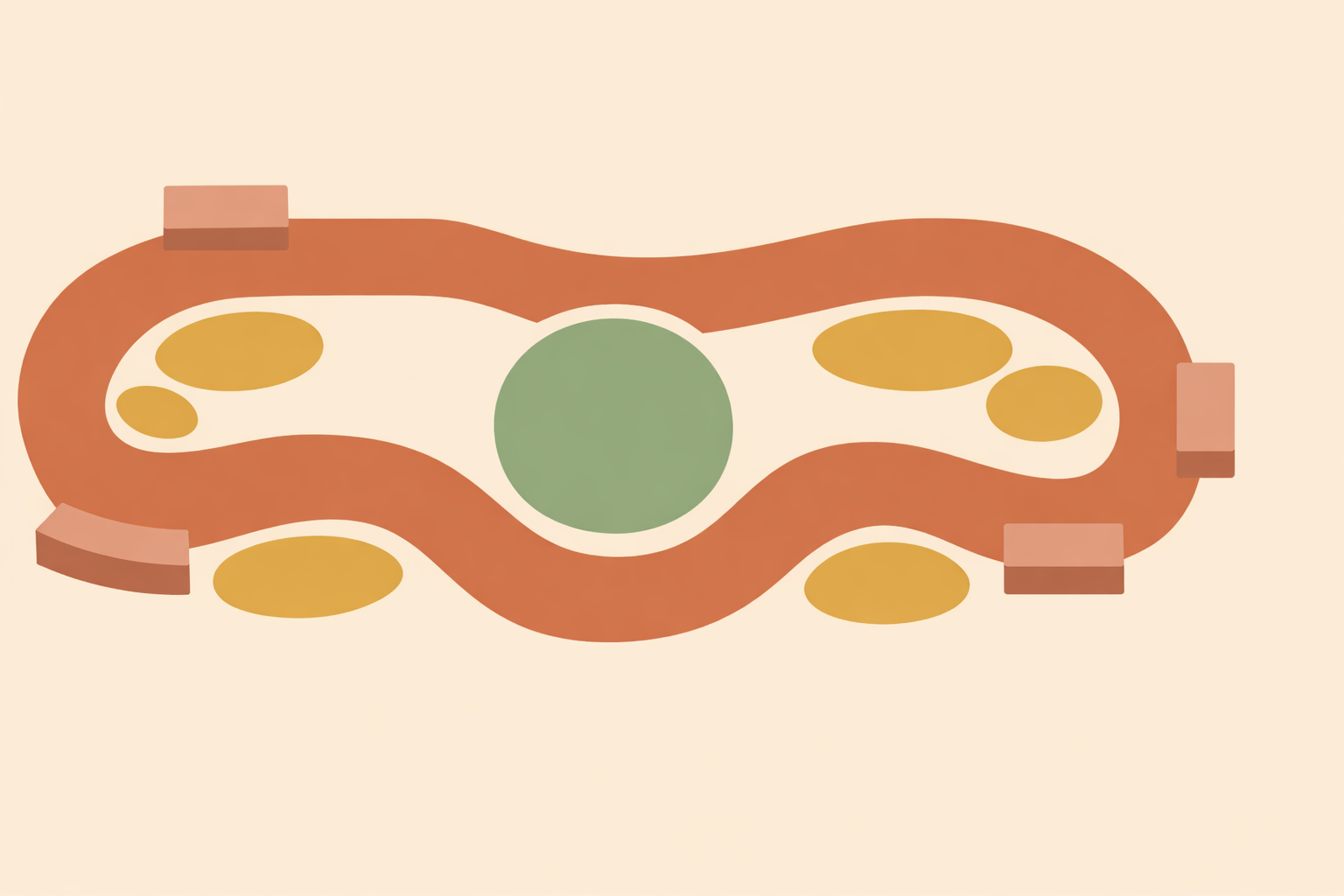
When people can move through a garden without getting stuck, they move more calmly. Looped circulation supports this by avoiding dead ends that force abrupt turnarounds.
In dementia-support settings, guidance recommends continuous loop paths with no dead ends. This supports steady walking and reduces confusion when a route suddenly stops.
Gentle curves often work better than sharp directional changes, especially for people using walkers or wheelchairs. Good wayfinding is less about placing signs everywhere and more about making the right path the obvious one, a principle that also supports session flow in therapeutic garden work.
Environmental complexity can increase hesitation. Research has linked wayfinding difficulties with anxiety, wandering, and falls, reinforcing a practical design lesson: reduce navigational uncertainty wherever possible.
Keep key destinations easy to spot, use one consistent sign style, and mark the loop entrance clearly. If the garden is used near dusk, maintain consistent lighting so edges and transitions remain visible.
Concrete example: place a simple loop map at the entrance with icons for seating, water, and washroom access, then repeat the same visual language throughout the site.
Bring plant work within easy reach
Bring the work closer to the body. Raised beds, reachable tools, and compact task zones help people stay steady while staying fully engaged with the plants.
Overreaching, twisting, carrying, and repeated bending commonly create wobble. Research on older gardeners has found lower back pain is especially common, and observational work links prolonged flexed postures with musculoskeletal strain.
Raised beds can reduce deep bending, limit awkward lifting, and support seated and standing participation. Keep bed widths narrow enough that the center is reachable, and consider U-shaped forms to bring more planting area into a compact range.
Tool placement matters too. If every trowel, can, or basket requires extra carrying or turning across traffic, the task becomes less stable than it needs to be. Store tools close to the task zone, at a comfortable height, and off the main route.
Concrete example: build a bed with seated access on one side, store tools beside it at an easy reach height, and use soaker irrigation so no one needs to drag a hose through the working area.
- Reduce deep bending where possible
- Keep the far edge within comfortable reach
- Store tools at the point of use
- Minimize carrying water and supplies
Add resting places, shade, and steady supports
Fatigue is a quiet contributor to falls. Someone may start strong, then become less steady as heat, exertion, or standing time builds. Good garden design respects that natural rhythm.
Resting places should feel like part of the route. In dementia garden guidance, seating along paths is recommended so people can pause and continue without overextending themselves.
Shade supports steadier participation as well. Outdoor guidance for dementia-friendly gardens recommends shaded areas to prevent overheating, and in everyday practice shade also helps people conserve energy in warmer months.
Where slopes remain or confidence is limited, a rail or stable touch point can add reassurance. Supports work best when the route is already clear and predictable.
Concrete example: place a shaded bench halfway around the main loop on a level pad, with enough room beside it for mobility aids and seated transfer.
- Place benches where pauses naturally make sense
- Keep seating just off the walking line, not inside it
- Prioritize shade at rest points and gathering zones
- Add rails only where they clearly support movement
Plan for real garden tasks, not ideal ones
A therapeutic garden works best when it’s designed around what truly happens there: watering, harvesting, pruning, potting, gathering, and quiet observation. When layout reflects real tasks, safer participation tends to follow.
Separate movement zones from work zones where possible, and walk through the practical questions early. Where will the hose live? Where does the wheelbarrow rest? Which routes get crossed when people carry baskets or watering cans? Many recurring hazards are workflow problems disguised as clumsiness.
Smarter irrigation helps by keeping hoses off the main route and bringing water access closer to the task area. Shared or partial participation helps too: one person can start a task, another can complete it, and everyone stays involved without pushing beyond their capacity.
There is also encouraging evidence that gardening can support steadier movement over time when participation is well supported. Among older adults, more gardening has been associated with lower future fall risk and better balance, and other community research found fewer falls among gardeners than nongardeners.
Thoughtful design lets the activity and the environment reinforce one another, which is central to both nature and outdoor therapy and horticultural therapy practice.
Concrete example: move the hose connection to a comfortable standing height near the beds, add a dedicated hook for storage, and create task stations so no one has to carry tools across the main loop.
Conclusion: Safer gardens feel calmer, clearer, and more usable
Fall-safer therapeutic gardens rarely come from one dramatic feature. They grow out of grounded choices: step-free entry, readable routes, stable surfaces, gentle grades, simple loops, reachable planting areas, frequent resting places, and practical workflow.
These choices reduce risk while also making the garden easier to understand and more enjoyable to return to. People spend less energy compensating and more energy connecting with the task, the season, and the living landscape around them.
Start small. Trace the main route, notice where hesitation repeats, and change the first few things with the biggest effect. As improvements settle in, keep reviewing surfaces, drainage, and clutter through the seasons, since outdoor conditions change and maintenance is part of safety.
Advance Horticultural Therapy Skills
Apply these fall-safer garden design principles in the Horticultural Therapy Certification.
Explore Horticultural Therapy Certification →