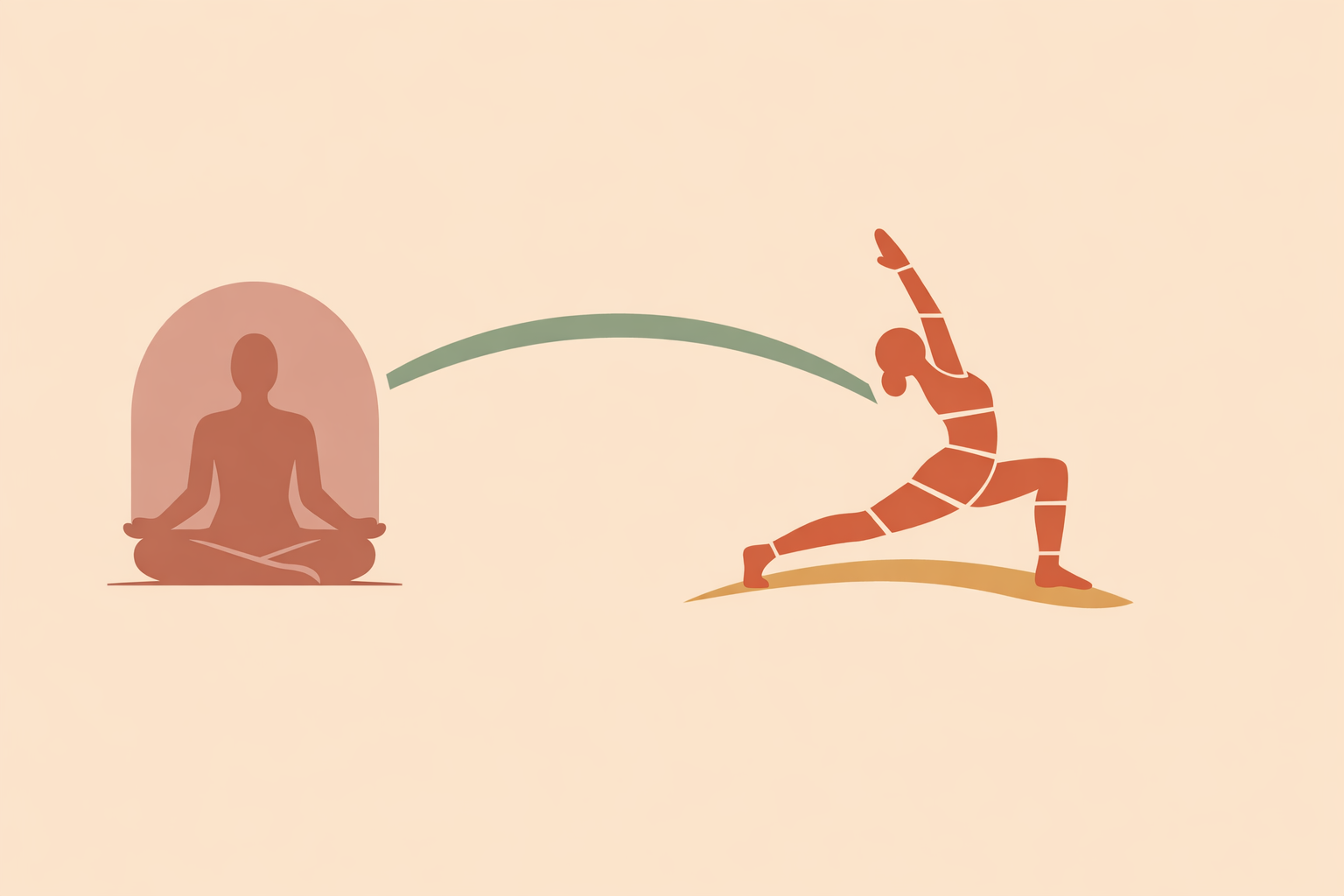
Most yoga teachers run into the same real-world puzzle: one room, many bodies, many moods, and only so much time. One student is cautious and new. Another is buzzing with energy. Someone else wants a stronger physical push. “Hatha” and “Vinyasa” can sound like fixed categories, but in day-to-day teaching they’re simply different ways of shaping pace, attention, and overall load.
Used skillfully, each has a clear place. Hatha often offers steadiness and time to feel what’s happening. Vinyasa often offers rhythm and momentum. The art isn’t picking a side—it’s choosing the right dose for the people in front of you.
Key Takeaway: Hatha and Vinyasa aren’t rigid categories—they’re practical tools for adjusting pace and overall load. Use Hatha to build clarity, grounding, and sustainable foundations, and use Vinyasa when students benefit from rhythm and dynamic effort, adjusting intensity to match stress levels, goals, and daily capacity.
2. For stress support, match the pace to the person
When someone arrives depleted, Hatha often helps them land. When someone arrives agitated, moderate Vinyasa can help them move through excess energy before stillness becomes possible. This is where practical teaching matters more than style loyalty.
Hatha’s steadiness supports downshifting partly through longer-held postures and breathing practices. Put simply, slower rhythm gives students time to soften tension and lengthen the breath.
For students who feel wired, a moderate flow can be a better doorway. Breath-linked movement can clear mental static, and the same pacing can still help you relax once restlessness has somewhere to go.
“Yoga … is a science of well-being,” writes Amit Ray.
What this means in the room: the “right” class is the one that meets the person honestly.
- For overwhelm or low energy: use Hatha, slower exhales, grounded standing postures, and a spacious close.
- For restless energy: use moderate Vinyasa with repeatable class structure, then taper into quieter floor work.
- For mixed states: begin with gentle movement, then shift into steadier holds and breath attention.
The aim isn’t intensity for its own sake. It’s regulation through wise pacing.
3. For strength, stamina, and mobility, the load is simply different
Both Hatha and Vinyasa can build strong, capable practitioners. They simply train strength through different kinds of effort.
Hatha develops endurance through time under tension. Longer holds ask muscles to organize and sustain effort, while giving students time to notice joint position, weight distribution, and subtle compensations. Think of it like slow, attentive craftsmanship: steadiness teaches structure.
Vinyasa builds strength through repetition and cumulative transitions. Because it often involves continuous movement, it typically creates more cardiovascular demand than Hatha. Repeated weight-bearing transitions—like plank-based sequences—also build upper-body and core strength over time.
This difference is useful for planning:
- Hatha bias: longer standing holds, slower lowering, steady balance work, and spacious recovery.
- Vinyasa bias: linked sequences, repeated transitions, moderate heat, and whole-body stamina.
- Shared ground: both can improve mobility when movement is mindful and intelligently progressed.
“Confidence through self-control,” Iyengar wrote.
That’s the heart of physical practice: not just depth or sweat, but steadier breath, cleaner transitions, and composure as effort rises.
4. For busy lives, choose the style that fits the day
A useful practice has to be realistic enough to keep happening. This is one reason Hatha remains such a dependable foundation: it compresses well. Even a short session can feel complete—center, a few key postures, a twist or fold, then rest.
Many teachers also find that 20-minute daily practices can create a real arc over time. Hatha fits beautifully here because it doesn’t require high intensity to feel meaningful.
Vinyasa shines when students want a lot in one sitting. A well-designed flow can combine mobility, strength, and moderate aerobic effort in a single continuous practice. It can also feel mentally clarifying—continuous attention becomes the focus tool.
One teacher put it simply: “Yoga has taken an important part in my life.”
That usually happens because practice fits life, not because life rearranges itself to fit practice.
- 10–15 minutes: Hatha often works best for a complete pause in the middle of the day.
- 25–35 minutes: Vinyasa can offer a compact, energizing full-body practice.
- 45–60 minutes: a hybrid approach often serves best, beginning with flow and deepening with steadier holds.
5. For long-term growth, build on Hatha and layer Vinyasa with intention
Over time, the most sustainable path is rarely “Hatha only” or “Vinyasa only.” Durable practice tends to grow from strong foundations, then expands into more dynamic expression as readiness develops.
Many training pathways start with Hatha-based fundamentals before adding more complex Vinyasa sequencing. It reflects a simple truth: before students can flow well, they need to know how to stand, breathe, transition, and observe.
Hatha is also broadly adaptable across ages and abilities when taught with options and props, making it a strong base for inclusive teaching. From there, Vinyasa becomes a creative language—gentler, stronger, simpler, or more layered depending on the moment.
Across both styles, contemporary spaces also increasingly emphasize trauma-informed, consent-based, and inclusive teaching. That focus supports better outcomes because it keeps dignity, choice, clarity, and respect for the roots of the practice at the center.
“Yoga transforms the person who sees,” Iyengar wrote.
Transformation usually arrives through consistency: a steady relationship with breath, effort, awareness, and self-study—not dramatic peaks.
- Early stage: emphasize Hatha for alignment, breath, and observation.
- Developing stage: add moderate Vinyasa to build rhythm, transitions, and dynamic strength.
- Mature stage: cycle and blend both according to season, energy, and personal focus.
With time, the question shifts from “Which style is better?” to “What support is most appropriate right now?”
Hatha vs Vinyasa: the practical choice
If the need is beginner clarity, Hatha is usually the wiser first step. If the need is momentum, dynamic effort, or an integrated full-body session, Vinyasa may fit better. If the need is stress support, let the student’s current state guide the pace—Hatha for grounding, moderate Vinyasa for organized discharge before settling.
For physical development, Hatha tends to emphasize steadiness, endurance, and structural awareness, while Vinyasa tends to emphasize continuity, stamina, and dynamic strength. For lifestyle fit, Hatha often wins on accessibility, while Vinyasa can feel more “complete” when time is limited and focus is available.
In the long run, the most skillful practitioners and teachers learn both languages. Tradition gives the roots, experience teaches application, and thoughtful teaching chooses with care rather than habit.
As Kareem Abdul-Jabbar put it, “Yoga is just good for you.” The real art is knowing which form of practice belongs to which moment.
Teach Yoga With Confidence
Build adaptable sequencing and cueing skills in Naturalistico’s Yoga Teacher Certification.
Explore Yoga Teacher Certification →