Project teams are facing rising uncertainty while also being asked to deliver lower capex, tighter energy targets, and firmer schedules. The familiar response is to add more: more structural tonnage, more façade layers, more mechanical complexity. Yet that approach often increases first cost, raises coordination risk, and leaves teams with buildings that are harder to deliver and run smoothly.
Biomimicry offers a steadier path when it’s used as a functional design language, not a visual style. Instead of guessing, teams study how organisms and ecosystems manage heat, light, air, water, and load with elegance and restraint. Think of it like borrowing nature’s “operating rules” for structure, skins, and site—so the building fits the climate and resource flows it will live within.
Key Takeaway: Used as a performance-based design language, biomimicry helps teams translate nature’s strategies into clear decisions for structure, envelope, airflow, and water. That clarity often simplifies assemblies, reduces coordination risk, and lowers both capital and operational costs without adding unnecessary complexity.
From ancestral building wisdom to modern biomimicry
Biomimicry is best understood as continuity, not rupture. Long before contemporary software and simulation, vernacular builders learned by watching place closely—sun, wind, rainfall, soil, and season—and shaping comfort and durability around those realities.
Courtyards, thermal mass, shading, porous screens, orientation, and planned airflow paths weren’t “features.” They were practical responses refined over generations, rooted in local conditions and craft.
Today, biomimicry formalizes traditional climate-responsive practices and brings them into modern workflows. That shared language helps interdisciplinary teams coordinate around what the building must do—rather than debating disconnected preferences.
When design begins with climate and flow conditions, teams often avoid overbuilt assemblies and unnecessary system complexity. Climate-responsive passive design can reduce system sizing and make delivery more predictable from the start.
As Frank Lloyd Wright liked to remind students, “Study nature… It will never fail you.”
Biomimicry vs biophilia vs bioclimatic design
These ideas overlap, but they’re not interchangeable—and that clarity is what keeps budgets focused on what actually performs.
Biophilia is about affinity and atmosphere: natural textures, vegetation, water, daylight, and views that help a space feel more alive and grounded. Bioclimatic design focuses on orientation, massing, shading, solar exposure, and airflow in direct response to climate. Biomimicry goes one step further by asking how living systems solve similar problems with minimal resources.
Nature’s functional strategies are the point—rather than copying appearance alone. A façade that merely looks organic may add cost. A façade that behaves more like a living skin—regulating heat, light, or airflow through a simple rule set—can become a serious performance tool.
Janine Benyus’ framing still helps teams stay precise: biomimicry can be applied at the level of form, process, and ecosystem. Form concerns geometry and load. Process concerns making, adapting, and operating. Ecosystem concerns relationships between parts, flows, and place. Once the “level” is defined, design decisions and cost trade-offs get much easier to manage.
As Louis Sullivan put it, “Form follows function.” Biomimicry simply asks designers to look more carefully at how nature defines function before deciding on form.
Nature’s core rules for lower cost and steadier outcomes
Nature tends to follow a few dependable patterns. When teams translate those patterns into design principles, cost control and project stability often improve together.
- Use resources precisely. Material goes where it truly needs to carry load or provide protection.
- Adapt instead of oversizing. Systems respond to changing conditions rather than being permanently designed for extremes.
- Keep flows circular. Waste from one process becomes input for another.
- Learn through feedback. Performance is sensed, adjusted, and refined over time.
Biomimicry work consistently links efficiency and feedback with stronger, more resilient outcomes. For building teams, that often shows up as fewer late changes, less redundancy without purpose, and more confidence that details will behave as intended.
Resource efficiency is the most immediate lever. In living systems, matter concentrates only where it’s needed. The same idea appears in structural optimization inspired by bone: load-path concentration can reduce weight while keeping performance.
Adaptability is next. When façades open, close, shade, or “breathe” in response to conditions, the building can stay useful longer without disruptive upgrades. Adaptable façades illustrate how responsive elements can support ongoing functionality.
Circularity follows naturally. Buildings conceived more like ecosystems can be assembled for reuse, repair, disassembly, and recovery. Disassembly and reuse can reduce waste and improve life-cycle outcomes.
Finally, feedback closes the loop. Strong biomimetic projects make room for learning through post-occupancy evaluation, so teams refine what works and stop repeating what doesn’t.
Le Corbusier called architecture a game “of forms assembled in the light.” Nature adds another layer: forms assembled through feedback, restraint, and adaptation.
Cutting capital cost with structures and skins that behave intelligently
One of biomimicry’s strongest contributions is how it reshapes structural and envelope thinking. When assemblies follow natural load paths and protective logic, projects often become lighter, simpler, and easier to build.
Following nature’s structural logic can reduce tonnage while maintaining performance. Instead of defaulting to uniform excess, teams place strength where loads actually travel—an insight echoed by bones, shells, ribs, and branching systems.
Shells, folded surfaces, ribbing, and honeycomb-like organization can also help roofs and façades do more with less. Nature-inspired modular patterns can enable prefabrication, which often reduces on-site labor and coordination complexity.
The practical lesson: biomimicry performs best when geometry is disciplined enough to repeat, fabricate, and coordinate, including in biomimicry-led 2D–3D workflows. Controlled variation usually delivers better value than endless bespoke parts.
Frank Gehry once said architecture should yearn for “timelessness.” Natural structures feel timeless partly because their logic is so economical.
Lowering operational costs through climate-adaptive design
Operational spending often falls when buildings adopt climate-adaptive strategies—reducing the need for constant mechanical compensation and letting the building do more of the work.
Passive design strategies such as natural ventilation and shading can significantly reduce operational energy costs. Biomimicry strengthens this by offering time-tested models for how these strategies can work together as a whole system.
A well-known example is termite-inspired ventilation. In Zimbabwe, a biomimetic office building using termite-based ventilation principles achieved 35% lower construction cost and dramatically lower energy use than comparable buildings. The lesson isn’t to copy a mound literally; it’s to study how pressure, airflow, thermal mass, and venting cooperate.
At the envelope scale, cactus-like shading, porous skins, and self-shading geometries appear again and again. Reviews highlight porous envelopes and self-shading as recurring strategies in strong examples.
At the landscape scale, ecosystem thinking supports better water management. Floodable ground, green-blue infrastructure, and cyclical water strategies can reduce disruption and strengthen long-term site performance. Green infrastructure can reduce flood risk and help teams avoid costly retrofits later.
As Wright reminded us, architecture is the “mother art.” Practically speaking, that long view includes how gracefully a building lives day after day.
Biomimicry as a risk management framework
Biomimicry isn’t only about efficiency. It can also steady projects by giving teams a shared reference point for decisions across disciplines.
Starting with a performance brief rooted in biology can reduce late-stage shifts. A brief like “manage heat the way a cactus does” or “distribute load the way bone does” isn’t poetry—it’s a practical target that structural, envelope, and environmental teams can align around.
That shared language improves integration. A common framework helps teams coordinate around locally tested natural strategies rather than disconnected assumptions.
When coordination calms down, costs often follow. Many teams find the biggest savings don’t come from one dramatic feature, but from fewer clashes, fewer reversals, and a clearer chain of decisions from concept through delivery.
As Bjarke Ingels says, architecture tries to make the world more like “our dreams.” The grounded version of that dream is a building that performs coherently because its logic was clear from the beginning.
Working digitally with nature: 2D–3D biomimicry workflows
Digital craft is where biomimetic ideas either become buildable—or drift into abstraction. The strongest workflows translate biological principles into explicit parameters early, then carry those parameters consistently through modeling, analysis, coordination, and fabrication.
Linking parametric biomimicry to BIM reduces clashes and can shorten coordination cycles. Put simply, biomimicry is often labeled “complex” when the real issue is that the design logic wasn’t made explicit enough to coordinate.
Branching systems are a good example. Procedural tools and topology optimization can generate distribution paths that install more smoothly than conventional layouts, and branching layouts can reduce routing conflicts.
In practice, effective workflows tend to follow a simple rhythm that echoes a strong 2D-to-3D sequence:
- Begin with a clear biological rule rather than a decorative image.
- Translate that rule into a manageable 2D diagram.
- Build parametric controls with clear limits based on code, tolerance, fabrication, and budget.
- Link analysis and coordination to the same model logic.
- Refine the geometry only as far as fabrication and operation can realistically support.
The goal isn’t digital spectacle. It’s clarity—faster iteration with less rework because everyone is working from the same underlying rules, and for many teams that means taking 2D plans into usable 3D early enough to test what matters.
In Juhani Pallasmaa’s words, architecture is a “reconciliation” with the world. Digital tools can help make that reconciliation precise enough to build.
Avoiding the common traps
Biomimicry is powerful, but not every nature-inspired move earns its place. Trouble usually appears when teams imitate appearance without respecting scale, context, and operational reality.
Highly irregular bespoke façades are a common trap. When too many parts are unique, fabrication intensity rises, coordination tightens, and budgets drift. Complexity isn’t “wrong,” but it should always pay for itself in performance or delivery benefits.
Material assumptions can also disappoint. In some polluted urban conditions, self-cleaning coatings degrade faster, which can erase expected life-cycle value.
Natural ventilation has its own realities. Underperformance can show up when windows are secured, controls are overridden, or operators aren’t prepared for the intended use pattern. Here’s why that matters: even the best concept depends on day-to-day behaviors and support.
Innovative systems tend to succeed when owners and building teams back them with training, clear responsibilities, and a culture of performance. They also land more smoothly when code pathways and contractor familiarity are handled early. Good biomimicry is not only clever; it’s communicable, maintainable, and context-aware.
Mies van der Rohe’s reminder that “God is in the details” still applies. Right-size complexity. Validate maintenance assumptions. Address buildability early.
Why biomimicry matters now
The field is advancing quickly. Bibliometric analyses show an upward trend in biomimicry and bioinspired design research over the last two decades, alongside more capable digital workflows and more mature built examples.
At the same time, the skills that support this work are becoming more valuable. Systems thinking and digital skills are increasingly in demand across emerging green roles, and biomimicry sits right at that intersection—environmental insight, design judgment, and technical fluency working together.
The deeper promise isn’t trend-based. It’s cultural and ecological. Biomimicry is strongest when it respects local ecosystems, honors vernacular intelligence, and avoids shallow visual borrowing. Used well, it helps teams build with more coherence and often with less waste.
As Louis Kahn said, architecture is “the reaching out for the truth.” In this case, the truth is simple: nature has already worked through many of the problems we’re still trying to solve.
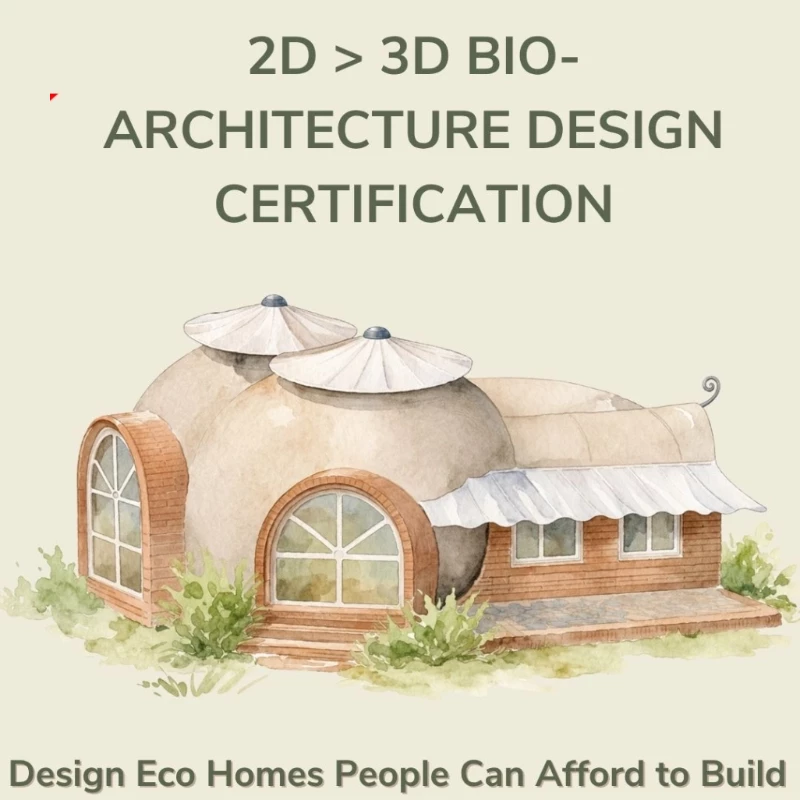
Master 2D–3D Biomimicry Workflows
Apply the article’s principles with the 2D-3D Bio-architecture Design Certification from concept through coordinated digital delivery.
Explore the Certification →