Geometry-forward portfolios often lean on ornate mandalas and dense lattices that look impressive, yet leave clients wondering how they translate into real deliverables. The questions tend to be practical: What does this shape do here? Where does it belong in a slide, worksheet, sign, or journal page? When captions stay purely symbolic and the process stays hidden, interest can turn into slower approvals and smaller scopes.
A more dependable approach is to translate geometric form into client language: name the function, show the construction, keep symbolism optional, and anchor the work in ethics. Geometry becomes easier to trust when people can see how it’s built, what it supports, and what it does not claim to do.
Key Takeaway: Geometry becomes client-ready when form is translated into function, process, and ethics. Start with clear client language and simple boundaries, build portfolio studies from durable shapes and labeled symmetry types, use separate formal and interpretive captions, show process and proportion systems, extend one form into multiple applications, and ground everything in cultural respect and consent-forward practice.
Step 2: Build portfolio studies from simple geometric forms
The most reliable portfolio studies start with durable basics: point, line, circle, triangle, square, rectangle, pentagon, hexagon, spiral, sphere, and cube. These forms stay readable and adapt well across many briefs.
The circle is especially versatile. It can frame a quote, hold a logo mark, organize a multi-step program, or structure a reflective prompt. You can show range by varying the role of the circle rather than constantly reinventing the form, especially in circle-based studies.
Try taking one circle and building three quick studies:
- a centered logo target
- a radial calendar or cycle map
- a spoke-based reflection template
Symmetry choices also help clients “read” what they’re seeing. Label the common types in plain language so the structure is immediately understandable.
- Reflection: mirrored balance across an axis
- Rotational: a form that repeats around a center
- Translational: a motif that repeats across a surface
- Glide reflection: a mirrored repeat that also shifts along a line
Natural pattern can be a generous teacher when handled with care. Branching, packing, and tiling offer practical models for flow, clustering, and continuity. A branching study, for instance, can make process maps and community maps feel intuitive because relationships are visible at a glance.
Step 3: Use two registers: formal geometry and optional symbolism
A portfolio habit that consistently improves trust is speaking in two registers. One is formal: shape, angle, symmetry, proportion, spacing, repetition. The other is interpretive: symbolism, personal meaning, cultural resonance, or contemplative association. Keeping them distinct gives the viewer clarity and choice.
One caption can hold both comfortably:
- Formal: “A hexagon field constructed from circle division with rotational symmetry and a vertical primary axis.”
- Interpretive: “The sixfold rhythm may suggest cooperation or shared structure.”
- Boundary: “Interpretation is optional; the piece also stands as pure geometry.”
This separation is useful partly because controlled evidence related to sacred-geometry-style practices remains limited. Traditional and practitioner knowledge still matters; it carries continuity, lived results, and cultural context. Clear labeling just helps your audience understand when you’re describing measurable structure, design convention, lineage, observation, or personal interpretation.
So if someone asks what a hexagon “means,” you can answer in layers: formally, it has six equal sides and tiles efficiently; interpretively, some people associate it with cooperation or hive-like order; and either reading is optional. That kind of language respects autonomy while honoring tradition, which is central to sharing symbolic meanings responsibly.
Step 4: Show process, not only the finished image
Geometry gains credibility when people can see how it was built. Process pages, construction diagrams, overlays, and short sequences make the work feel reliable and adaptable rather than decorative.
A strong process spread might show:
- center points and guide lines
- circle divisions and polygon construction
- the moment decoration begins
- one or two alternate layout tests
Even digitally, a few layer exports or snapshots communicate the underlying order without overwhelming anyone with technique.
Proportion systems can strengthen this section of your portfolio. The golden ratio is approximately 1.618, and Fibonacci sequences approach that ratio in ways that translate well into layout guides. Used well, these systems function as visual armatures for structuring space.
Consider showing a few comparisons:
- Rule of thirds: placing the focal point at a grid intersection
- Golden rectangle: using a proportion-based frame for a softer, more lyrical balance
- Spiral armature: guiding movement through a page or sequence
Small shifts in placement can meaningfully change the perceived balance of a layout. When clients see those adjustments, they also see your judgment, and they understand that the work can be revised, scaled, or repurposed without losing coherence.
Step 5: Extend one geometric form into multiple applications
One well-built form should lead to several usable outputs. This is an easy way to demonstrate value because it shows range and thoughtful reuse without demanding a whole new design each time.
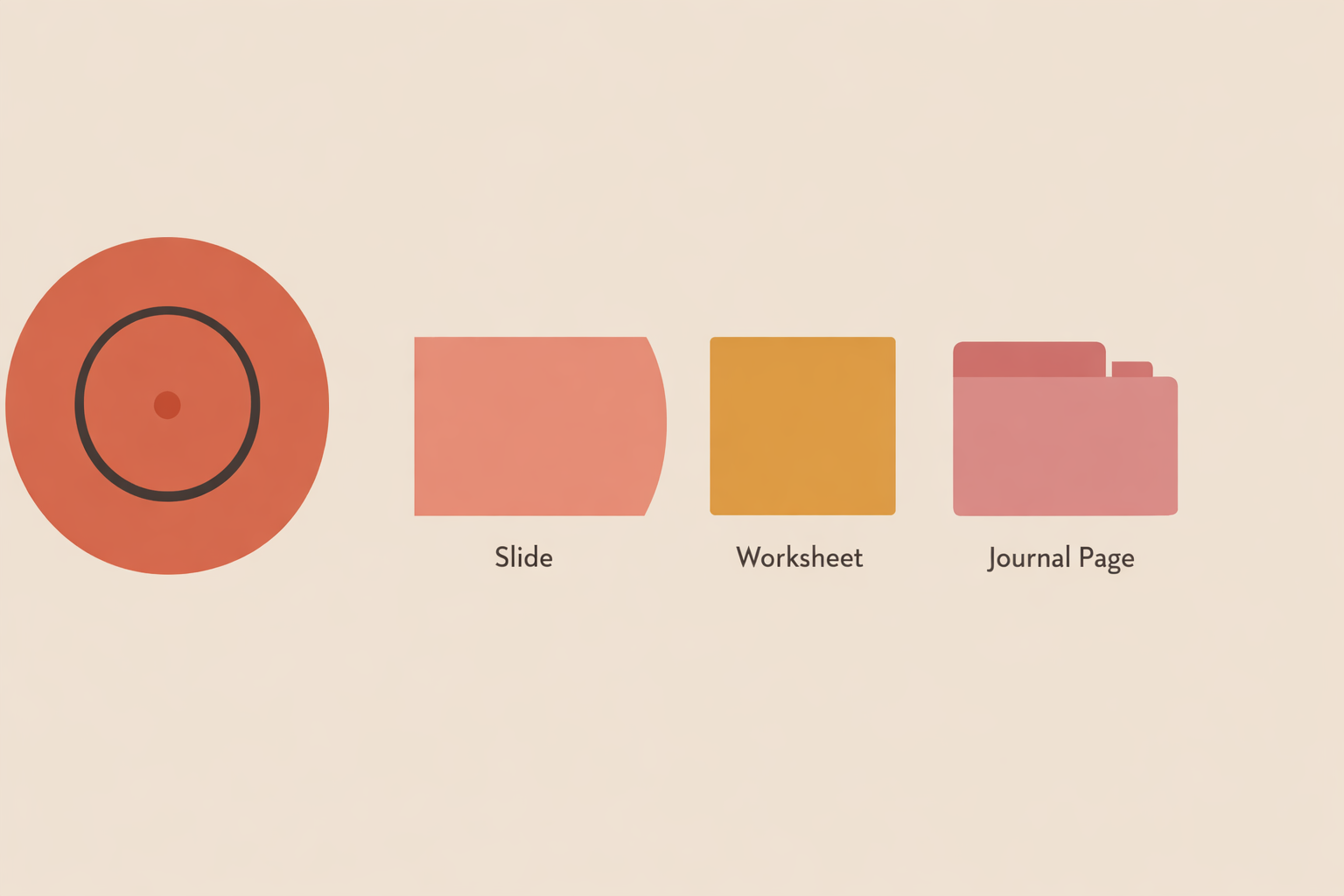
A single circle lattice, mandala, or hexagon study can become:
- Logo or submark: a simplified central motif
- Worksheet: spokes or cells turned into prompts
- Surface pattern: a border, repeat tile, or full background
- Slide deck system: a subtle grid or recurring framing device
- Reflective activity: a short, choice-based visual exercise
Clients immediately understand “one geometric seed becomes a coherent family.” Your portfolio starts to read as systems thinking, not just attractive images.
Branching patterns are especially useful for process diagrams, learning journeys, program maps, and community ecosystems. A trunk can carry the central purpose, larger branches can hold major pathways, and smaller branches can show actions, roles, or options. As long as it’s labeled clearly as a visual analogy, it stays evocative and grounded.
Tessellation is equally practical. One repeat unit can scale from a small border to a large-format backdrop with very little conceptual strain, which makes tiling systems excellent for client-facing design.
Step 6: Keep the work ethical, consent-forward, and culturally respectful
Geometry carries lineage as well as form. A strong portfolio needs more than technical skill; it also needs sourcing, boundaries, and cultural respect that you can state plainly.
This becomes especially important when drawing from traditional or Indigenous design languages. appropriation concerns are most relevant when cultural elements are used without authorization, acknowledgment, or benefit-sharing.
Many institutions also warn that sacred or culturally sensitive designs should not be reproduced casually. Indigenous materials protocols, for example, highlight sacred or sensitive materials and emphasize consent before reproduction or publication.
In day-to-day practice, permission matters more than visual similarity. If a pattern is recognizably rooted in a living tradition, respectful use depends on relationship, context, and consent.
Helpful guardrails to publish alongside your work include:
- what method you used
- where the source inspiration came from
- what is formally constructed versus traditionally derived
- whether adaptation, consultation, or permission was involved
If you facilitate reflective or group-based experiences with geometry, consent-forward language also keeps the space steady and participant-led, which also aligns naturally with spirituality and ritual practice:
- “Participation is optional, and you can pause or switch roles at any time.”
- “Symbolic meaning is personal; sharing is always a choice.”
- “We will move through the same steps each round so the structure stays predictable.”
Trauma-aware mandala-making protocols emphasize choice and predictable steps, along with the option to witness rather than join directly. These principles adapt well to workshops, classrooms, and contemplative spaces, while keeping claims grounded.
Accessibility belongs here too. Large-print templates, quiet space, and tactile options can make geometric work more invitational when appropriate. An access-oriented mindset also signals care, which clients notice.
Conclusion: Build one small, complete geometry project this week
Choose one seed form: a circle lattice, a hexagon field, a branching map, or a simple tessellation. Carry it through a compact arc: construction sketch, symmetry or proportion study, two-register caption, visible process spread, two to four practical applications, and a short ethics note.
Keep it specific. A 12-spoke circle can become a reflection card, a slide background, a repeating footer band, and a simple submark. As you build, label what is measured, what is interpretive, and what remains optional.
Over time, repeatedly sharing work that includes construction diagrams, mockups, facilitation notes, and source acknowledgments signals readiness for real briefs across branding, education, community, and contemplative contexts, including broader ritual design work.
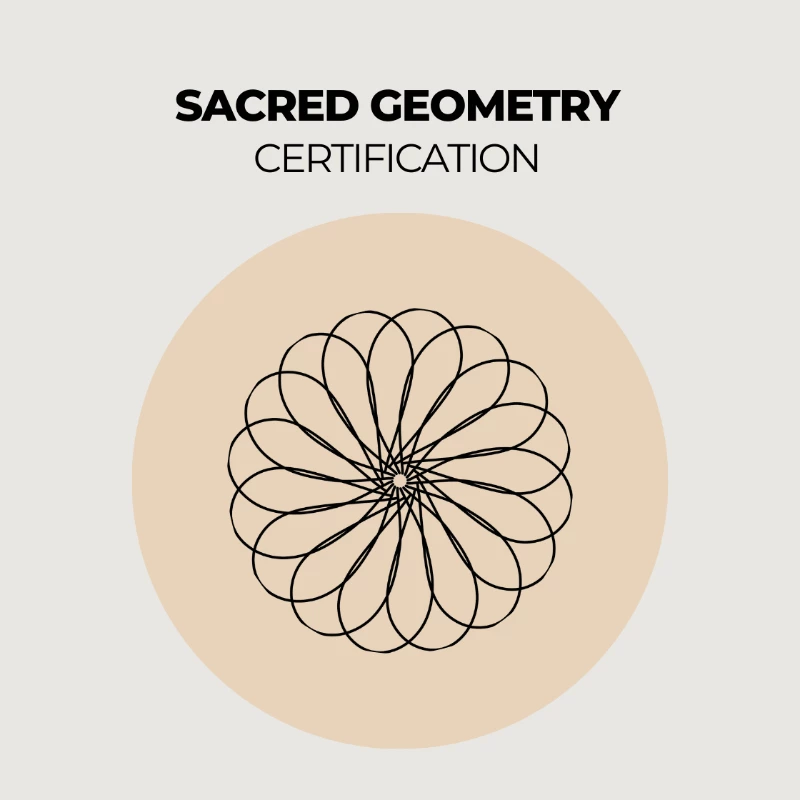
Let tradition inspire the work, let clear process steady it, and let ethics shape how it’s shared. That combination makes geometric practice dependable, whether you are refining a portfolio or pursuing sacred geometry certification.
Master Sacred Geometry Certification
Deepen your construction, captioning, and ethics practice with the Sacred Geometry Certification.
Explore Sacred Geometry →