The default move in preparedness is to buy more gear. It feels decisive, but it often skips the real question: what will actually work in your home, with your people, under ordinary pressure as well as during disruption?
Reliable resilience is usually quieter than that. It begins by lowering everyday demand, noticing what’s already around you, and practicing a few simple systems until they feel normal. A shaded west window can matter more than another device. Rotated water containers often beat an ambitious stockpile you never maintain. A neighbor who knows your rhythms can be more valuable than a shelf of unopened supplies.
Key Takeaway: Household resilience becomes steadier when you design for your actual place, reduce everyday needs, and practice together. Start with a simple map of risks, assets, and gaps; secure rotating water storage; grow food in manageable layers; make shelter cooler in heat and tighter in winter; cut energy demand before adding backup power; strengthen mutual aid; keep a small, well-used home apothecary; and build seasonal rhythms that make these skills second nature.
Start with a simple resilience map
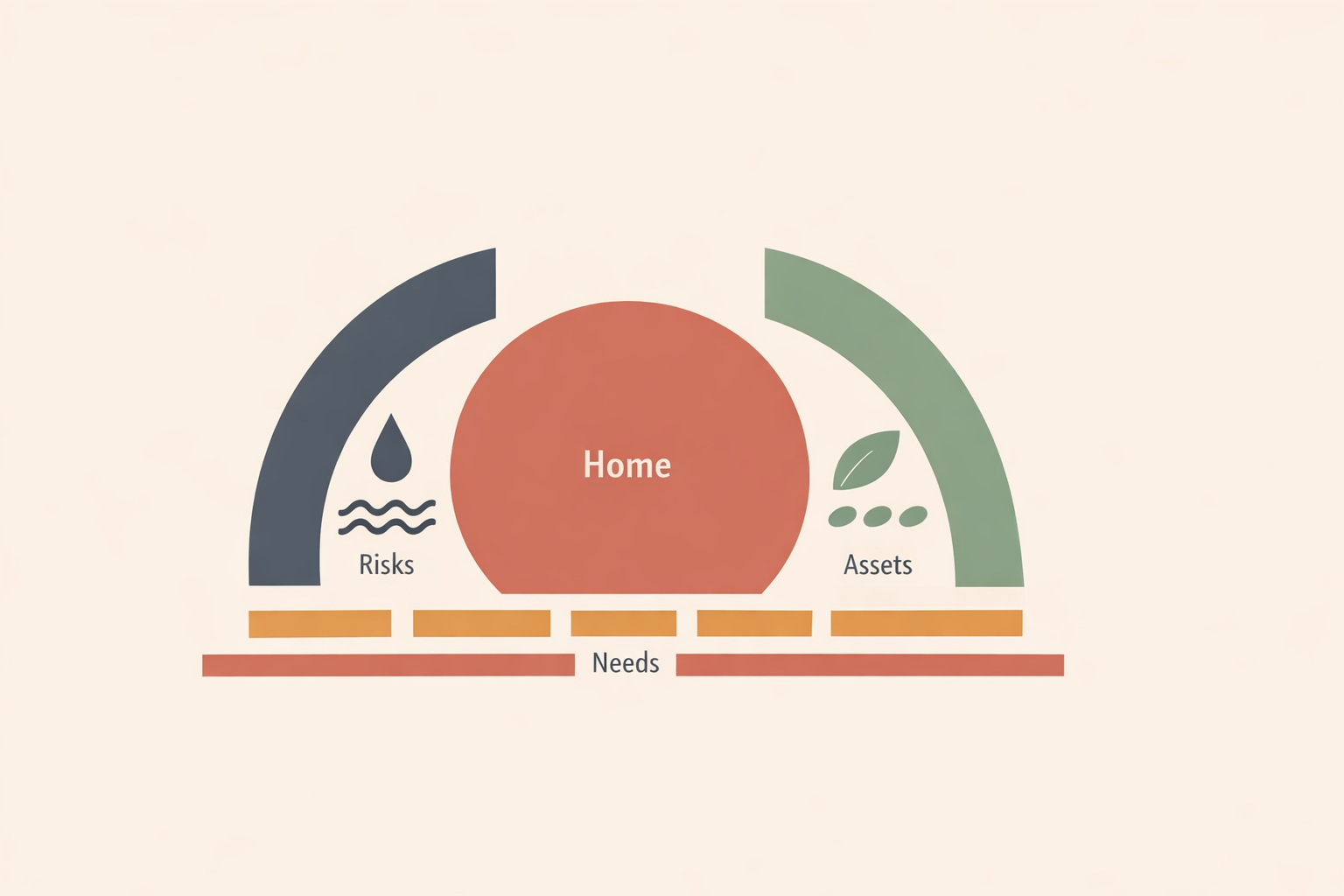
Before buying anything, sketch a one-page resilience map. It keeps decisions grounded in your real life, not a generic checklist.
Put your home or block in the center. Around it, write three short lists:
- Risks: heat waves, outages, water interruptions, supply delays, smoke, flooding
- Assets: balcony sun, a shared courtyard, useful tools, a capable neighbor, roof access, a community garden
- Gaps: no stored water, poor shade, no backup lighting, weak neighbor coordination
A small urban apartment might map like this: Risks—heat waves, water shutoff. Assets—roof access, friendly building chat, nearby market. Gaps—no water storage, no exterior shade. From there, the next steps are straightforward: store water and shade the hottest window.
Keep the map visible and alive. Tape it inside a cupboard and revise it monthly so your plan keeps pace with your circumstances.
Secure water first with storage and simple systems
Water comes first. A practical baseline is 20 L per person per day if supply is interrupted.
Choose storage you can actually rotate. Stackable food-grade jerry cans are easy to fill, carry, and empty. Label each one with the fill date, then once a month use the oldest water for household tasks and refill it.
To make the numbers tangible: for a family of three, a 200-liter rain barrel plus two 20-liter cans gives roughly five days at that baseline. It’s not extravagant, but it creates breathing room.
If rain capture is possible where you live, keep it simple and clean:
- screen the inlet
- keep lids secure
- divert the first dirty roof runoff
- watch for insects and debris
For most households, the real win is a system that runs smoothly month after month, not the biggest possible volume.
Grow food in small, steady layers
Most people do better with a steady trickle of useful food than with an oversized garden plan that collapses by midsummer.
If you only have a balcony, stoop, or windowsill, begin there. A 60 cm planter trough can support a satisfying rotation of greens, scallions regrown from kitchen scraps, and a compact tomato through warm months.
If you have ground space, think in layers rather than rows. Guild-style planting is especially useful because one bed can do several jobs at once. A dwarf fruit tree underplanted with chives, strawberries, and calendula offers food, ground cover, beauty, and habitat in a compact footprint.
These combinations are valued by growers because they make a space more cooperative and less bare. Chives are often used around other plants, strawberries knit over the soil, and calendula earns its place both in the garden and on the household shelf.
Urban growing also strengthens more than the dinner bowl. Even modest shared plots can improve access to fresh food while helping neighbors become more connected and resourceful together, and self-sufficiency and sustainability often start with exactly that kind of manageable growing practice.
Keep sowing rhythms light:
- radish every two weeks
- lettuce every month
- beans in spring
- garlic in autumn
Preserve overflow without turning it into a second job. A few trays of chopped greens, blanched and frozen each week in summer, can carry real value into winter soups and stews.
Make shelter cooler, tighter, and easier to live in
A resilient home stays comfortable with less effort.
In hot weather, start outside. Exterior shade on west-facing windows can make rooms noticeably cooler during hot spells. Shade cloth on a simple frame, exterior blinds, or another removable option can all work, as long as it suits your building.
Then work with airflow. Night ventilation and cross-breezes can make a home far more bearable after a day of stored heat. A small fan pulling in cooler night air is often a high-return choice.
Thermal mass also matters. Brick, earthen plaster, clay, and even dense furnishings can soften indoor temperature swings. In a rental, you may not change the structure, but you can still arrange spaces with this buffering effect in mind.
For winter comfort, chase drafts before chasing bigger systems. Weatherstripping, sealing an attic hatch, adding a door sweep, or hanging a heavy curtain can make an outsized difference.
Reduce energy demand before adding backup power
Energy resilience starts with restraint. The lighter your daily load, the easier every backup choice becomes.
Audit one ordinary day and one stressful day. Write down what you actually use, then sort it into three groups:
- Essential: lights, phone charging, communications, a fan
- Flexible: laundry, cooking appliances, device charging windows
- Optional: convenience items that can wait
Practice load shaping. Batch tasks, charge devices in windows of time, and avoid scattered energy use that keeps everything half-on.
Replace obvious waste first. Older refrigerators can draw far more power than efficient models, and better lighting quietly lowers demand every day. When a household cuts its daily baseline from 8 kWh to 4 kWh, it halves the burden any backup system must carry.
After that, backup generation is easier to size sensibly. In some homes, a single 200 W balcony panel paired with a small power station can cover lights, communications, and a fan through short outages.
Build mutual aid into everyday life
No household is fully self-contained, and it doesn’t need to be. Resilience grows faster when it’s shared.
Start with a practical invitation. A building chat or street message works well when it’s warm and specific: who can share water, tools, charging time, freezer space, child pickup, or a ride?
Then make it easy to participate:
- keep a simple “what we have / what we need” list
- host a small tool or seed swap
- agree how borrowed items are tracked and returned
- note who may need extra support in heat, outages, or transport disruptions
These structures are modest, but they change the tone of a block. Trust grows through repeated, ordinary usefulness, and that is the groundwork of mutual aid networks.
Shared infrastructure can become a real reserve: a neighborhood chest freezer, a grain co-op, a seed library, a communal dehydrator, or pooled storage jars.
Keep a small, well-used home apothecary
A home apothecary works best when it’s familiar, modest, and used regularly. It supports steadiness and reduces reliance on fragile supply chains.
Think in two layers: daily support and rough-day support.
- Daily support: mineral-rich herbal infusions, kitchen spices used generously, soothing teas, skin-support salves
- Rough-day support: steam herbs, simple saline, clean cloths, calming preparations already known to the household
The value is not in collecting many items. It comes from knowing how to prepare, store, and use a few trusted ones well, as traditional households have done for generations.
Embodied practices belong here too. A few minutes of self-massage, brief guided breathing, and a weekly foot soak can become anchoring rituals in demanding seasons.
For heat stress, basics still matter most: shade, cool cloths, rest, and small frequent sips. If you need a simple home rehydration approach, the WHO home recipe uses 1 litre of water, ½ teaspoon salt, and 6 teaspoons sugar. Keep the proportions clear and prepare it carefully.
Use tangible assets to create practical stability
In uncertain times, tangible usefulness has a calming quality. Durable goods, staple supplies, and practical tools often serve a household better than abstract plans alone.
Keep a modest amount of local cash on hand for moments when digital payments fail. Store it securely and note it on your resilience map so it’s remembered when needed.
Favor purchases that produce, preserve, repair, or extend value:
- hand tools
- water filters and spare elements
- storage jars and lids
- sewing supplies
- staple foods you already cook and enjoy
Buying slowly works well. A few sensible additions each month can build real capacity without drama.
At community scale, shared assets often offer the best return. A freezer, grain order, seed collection, or equipment library becomes practical wealth that can be maintained and circulated.
Adapt the plan for urban or rural life
The principles stay consistent across places, but the expression changes.
Urban households often do best by focusing on:
- water storage that fits tight spaces
- window shade and airflow
- container growing
- shared infrastructure with neighbors
- careful energy demand reduction
Rural households may focus more on:
- redundant water access
- diverse growing spaces
- weather protection and fire awareness
- livestock and pet evacuation practice
- outdoor or off-grid food preservation setups
In both settings, the strongest households are usually the ones whose systems have been tried, simplified, and woven into ordinary life.
Learn from Indigenous stewardship with respect
Many place-based resilience practices long predate modern preparedness language. Indigenous traditions hold deep knowledge about reciprocity, timing, restraint, and skilled relationship with land.
This knowledge deserves humility, consent, and close attention to local context. It is not a set of techniques to lift out of relationship.
Some households choose to weave in respectful practices such as gratitude before harvest, selective gathering, and returning part of the first harvest to the land or to community. These gestures can shape character as much as habit.
In fire-adapted landscapes, cultural burning is one example of stewardship that is increasingly recognized for its role in reducing risk and renewing relationship to place. The wider lesson is to listen deeply to those whose traditions are rooted where you live.
Make resilience a rhythm, not a one-time project
Preparedness becomes real when it enters the calendar.
A light rhythm is usually enough:
- Monthly: rotate water, check lights, review supplies, update neighbor contacts
- Quarterly: clean gutters, inventory staples, inspect weather seals, test small systems
- Seasonally: plant, preserve, shift shade or storm layers, rehearse an outage evening
Keep practice grounded and even enjoyable. Cook one simple meal with the least complicated setup you own. Spend an evening using less power than usual. Notice what works, what irritates, and what needs adjusting.
Track a few meaningful measures over time:
- liters of water on hand
- salads or herbs coming from home
- hours of restful sleep
- how often you use and replenish key supplies
These markers show whether your household is becoming more practiced, more comfortable, and less brittle.
Conclusion: resilience grows through practice, place, and relationship
Resilience is rarely built in one dramatic push. More often, it grows through ordinary repetition: water rotated on time, a shaded room that stays livable, greens cut from a planter, a lighter electrical load, a shelf of familiar herbs, a message sent to neighbors before it is urgent.
Old ways and modern tools both belong here when used with integrity. What matters most is that your systems are understandable, maintainable, and rooted in the life you actually live.
A final note: keep water storage clean and well-labeled, be thoughtful with any internal-use preparations in the home apothecary, and stay within what your household genuinely knows how to do under stress. Start small, keep going, and let the seasons teach the next step through self-sufficiency.
Explore Self-Sufficiency Skills
Build these home systems into lasting habits with the Self-Sufficiency Certification.
Explore Self-Sufficiency →