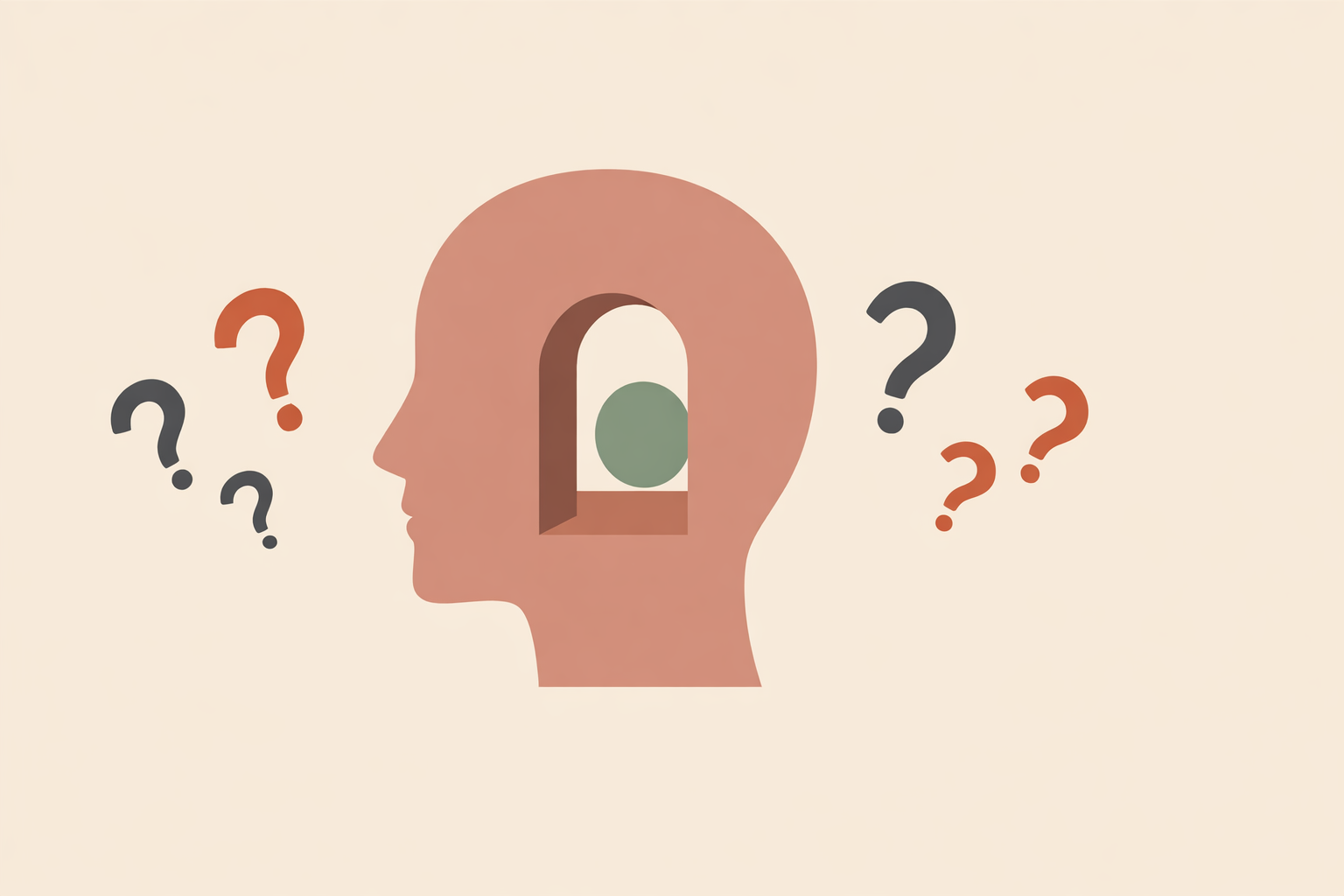
In OCD-informed coaching, one of the hardest moments can look completely ordinary: a client reaches for certainty, and you feel the pull to answer. “Did I say anything inappropriate?” “Are you sure the stove is off?” A quick response can soothe them for a moment, but the question usually returns—often tighter, sharper, and more urgent.
The same dynamic often shows up at home. Partners may confirm, re-check, or help someone avoid uncertainty because they care. Unfortunately, what feels supportive in the moment can strengthen the loop underneath.
Effective coaching takes a steadier path. The aim is to help clients function with uncertainty present: validate distress without confirming the feared content, build body-based steadiness, reduce reassurance habits, and guide attention back to values-led action.
Key Takeaway: Effective OCD-informed coaching helps clients live with uncertainty and avoids feeding reassurance loops. The work starts by understanding how intolerance of uncertainty drives repetitive checking, asking, and mental reviewing. From there, practitioners can map each client’s triggers and core beliefs, replace reassurance with supportive boundaries, use brief regulation practices as a bridge back to choice, and introduce low-intensity “delay, don’t debate” experiments. Observer-mind language and simple reframes can help loosen rumination, while values-based action keeps the coaching grounded in real life.
Intolerance of Uncertainty in OCD: Why Reassurance Backfires
At the heart of many obsessive-compulsive patterns sits a painful demand: “I must be sure.” Modern psychology describes intolerance of uncertainty as a key driver of the cycle. In lived experience, uncertainty doesn’t feel like a mild discomfort; it can register as immediate danger.
Here’s how the loop often unfolds: an intrusive thought lands, the body tightens, the mind scans for threat, and the urge to get certainty rises. Checking, reviewing, confessing, replaying, or repeatedly asking can all be attempts to settle doubt. The relief is genuine, but it fades quickly, which trains the mind to reach for the same strategy again.
Reassurance can function like a compulsion: it calms the system briefly, then strengthens the belief that certainty must be chased. Higher intolerance of uncertainty is linked with more frequent compulsive rituals, including checking and repeated asking.
So the coaching task isn’t to prove that nothing bad will happen. It’s to help clients stay steady and values-led when certainty is unavailable.
- Useful coaching line: “I hear how strong the doubt is. I’m not going to answer the content. Let’s notice the loop, settle the body, and choose the next small step.”
Map the Loop: Triggers, Rules, and Core Beliefs
Before a pattern can shift, it needs to be seen. Many clients gain traction when they can map their loop in plain language: intrusive thought, threat appraisal, body activation, compulsion or safety behavior, brief relief, then renewed doubt.
The map should stay simple enough to use in real life, especially in the moments that matter most.
Uncertainty triggers vary widely: relationships, contamination themes, harm fears, making mistakes at work, digital checking, morality, scrupulosity, and health-related fears. The goal isn’t a perfect theme label. The goal is recognition: “This is where uncertainty hooks me.”
Under the behavior there’s usually a rule that sounds sensible in the moment: “If I’m uncertain, I’m unsafe.” “If I make a mistake, I’m irresponsible.” “If I can’t be completely sure, I have to keep checking.” These rules are often shaped by core beliefs around responsibility, perfectionism, and control.
Once the rule is named, the client isn’t “overthinking.” They’re following an internal standard that treats uncertainty as unacceptable.
- Mini-map example: Trigger—partner does not text back. Thought—“What if they’re upset?” Rule—“If I don’t check, I’m being careless.” Body—tight chest, urgency. Compulsion—send another text and reread the thread. Relief—brief. Aftermath—more doubt later.
- Helpful note to write in-session: “Old rule: If I might be wrong, I must be certain. New practice: I can act by values while uncertainty is present.”
From Reassurance to Support: Boundaries That Help
When the loop is visible, boundaries become easier to explain without shame. Reassurance-seeking can look like repeated questioning, confessing, online searching, checking with others, or asking for certainty in spiritual or relational matters. The forms differ, but the aim is usually the same: get rid of doubt right now.
Support stays warm and connected, while refusing to become part of the ritual. That combination is often what clients most need to experience.
This matters in close relationships, too. When partners or family repeatedly answer, check, or help someone avoid uncertainty, accommodation can keep the cycle running and slowly shrink everyone’s freedom.
A steadier approach: validate the distress, name the loop, then redirect into a skill or a values-based next step. Care stays intact, and the “certainty machine” stops without falling into reassurance traps.
- Boundary statement for coaching agreements: “I will not answer repetitive certainty questions. I will help you recognize the loop, regulate your body, and choose supportive actions.”
- Partner script: “I care about you, and I’m not going to keep confirming this. Let’s pause, ground, and decide what would help the evening move forward.”
- Quick litmus test: if the relief is short and the urge quickly returns, reassurance is probably feeding the loop.
Body-Based Regulation: A Bridge Back to Presence
When uncertainty spikes, the body often reacts first. Agitation, scanning, shallow breathing, pressure in the chest, numbness, or fog can narrow a client’s options down to one: “fix the doubt.”
Traditional practices have long worked with breath, posture, grounding, orienting, and softening the jaw and shoulders to return to presence. Contemporary mindfulness literature also highlights awareness of breathing and body sensation as anchors for attention.
In OCD-informed coaching, these tools work best as a bridge back to choice. They’re there to lower the intensity enough for a person to respond intentionally.
If regulation becomes a requirement to feel “certain enough,” the loop stays alive. If it creates space, the client can move forward with the day.
- Two-minute practice: name the loop, feel the feet on the floor, relax the jaw and shoulders, orient to the room, and slow the exhale. Then choose one small next action.
- Helpful check-in: “Did I use this practice to create space, or to force certainty?”
Delay, Don’t Debate: Gentle Pattern Interruptions
Once a client can stay present through the first wave of activation, coaching can move into low-intensity uncertainty practice. The spirit is respectful and practical: interrupt the familiar response without turning it into a fight.
Rather than debating the content of the thought, the client delays the ritual.
This often looks very ordinary: sending an email after one review instead of five, leaving a harmless imperfection in place, delaying a reassurance question by two minutes, or resisting the urge to reread a message thread. Small steps matter because they’re repeatable, and repeatable steps build trust in one’s capacity.
Consistency beats intensity here. Modest experiments done steadily tend to change the pattern faster than occasional big pushes.
- Sticky-note plan: “Today I check the lock once. If the urge returns, I wait two minutes, breathe, and move to the next task.”
- Progression example:
- Week 1: delay one reassurance question by two minutes each day.
- Week 2: delay by three minutes, twice a day.
- Week 3: delay by five minutes in several everyday situations.
Observer Mind: Loosening Rumination and Mental Reviewing
Not all compulsions are visible. Rumination, replaying conversations, moral self-checking, and endless “what if” analysis can also operate as reassurance loops.
Clients often benefit from naming thoughts as thoughts. Shifting from “This thought means something” to “I’m noticing I’m having the thought that…” can create enough distance to reduce fusion with the fear.
This isn’t about positive thinking. It’s about relating to inner experience with more choice, so the client stops treating every thought as a task that must be completed.
Brief reframes can help when they lead back into living: “This is an uncertainty alarm, not an instruction.” “Maybe, maybe not.” “I do not need to solve this right now.”
- Observer-mind script: “I’m noticing the thought that I must be 100% sure. Maybe I can’t be. What is the next small action that fits who I want to be?”
- Reframe for scrupulosity themes: “This is a spike in uncertainty around faith, not a command to review everything again. I can practice sincerely without chasing perfect certainty.”
Values-Based Action: Living Well Without Waiting for Certainty
Every skill here points toward the same outcome: a life guided less by certainty-seeking and more by values. Clients don’t need to feel ready first. They build readiness by acting while uncertainty rides along.
Values provide direction when the mind won’t provide reassurance. A practical coaching question is: “If certainty were unavailable, what would matter most right now?”
That shift moves attention away from threat management and back toward participation in life. Relationships, meaningful work, creativity, spiritual practice, rest, honesty, and contribution become steady reference points again.
Small actions carry real weight when they express a chosen direction: reply once, then return to dinner. Submit the draft, then move to the next task. Offer a sincere prayer, then continue with the day without revisiting it again and again.
- Values ladder:
- Relationship: send one caring message, then stay present with the evening.
- Work: complete one review, submit, and move on.
- Spiritual life: practice sincerely, then allow uncertainty to remain without further checking.
- Closing phrase for sessions: “Uncertainty can come with me, but it does not get to lead.”
Conclusion: Warm, Boundaried, and Values-Led
OCD-informed coaching becomes stronger when it stops trying to remove uncertainty and starts helping clients live alongside it with more steadiness. The essential moves stay straightforward: notice the loop, refuse reassurance, regulate enough to regain choice, interrupt the ritual gently, and return to what matters.
That requires both kindness and clarity. A practitioner can validate distress without confirming feared content, and offer structure and presence rather than certainty, including knowing what to say when intrusive doubt shows up.
Scope matters as well. This work focuses on awareness, skills, pattern change, and values-based follow-through. It does not position the coach as an authority for certainty or as a substitute for other forms of support a client may choose to seek.
Done well, the results are often quietly powerful. Uncertainty still shows up, but it stops running the day—and that’s where lasting change starts.
Train in OCD Coach Certification
Deepen these skills with the OCD Coach Certification for warm boundaries, uncertainty practice, and values-led coaching.
Explore OCD Coach Certification →