Sacred geometry sessions land best when φ is taught as a usable proportion system rather than a promise about beauty. In practice, that shift changes the whole room: beginners stop worrying about getting a mystical formula “right,” and experienced makers can stay engaged because the work remains rooted in observation, structure, and choice.
Key Takeaway: Use the golden ratio as a flexible scaffold for proportion and composition, not as a universal law. Teach the geometry first, keep symbolism optional, build in clear choice points, and translate φ into simple, usable moves for mandalas, layouts, and free composition.
Why teach the golden ratio as a scaffold, not a rule
Facilitators often reach for φ because it’s associated with beauty. In a strong session, though, it’s presented as a practical design tool that participants can test, compare, and adapt.
The golden ratio is about 1:1.618. In art and photography, it’s commonly used to support horizons and focal points in a way that feels balanced without locking anyone into a single “correct” layout. One proportion becomes a shared scaffold for exploring placement, spacing, and emphasis.
Traditional geometry teaching also draws from what makers have always noticed in nature: spirals, branching, tiling, and repeating relationships. Nature offers observation and inspiration. It doesn’t need to be used as “proof” that one ratio explains everything.
This framing keeps facilitation grounded and lively. Invite the group to try a φ placement, then try a different grid, then try intuition alone. That comparison creates better learning, and usually better work, than any grand promise ever could.
Teach φ as geometry first, symbolism second
The cleanest approach is to separate what can be drawn and measured from what might feel meaningful.
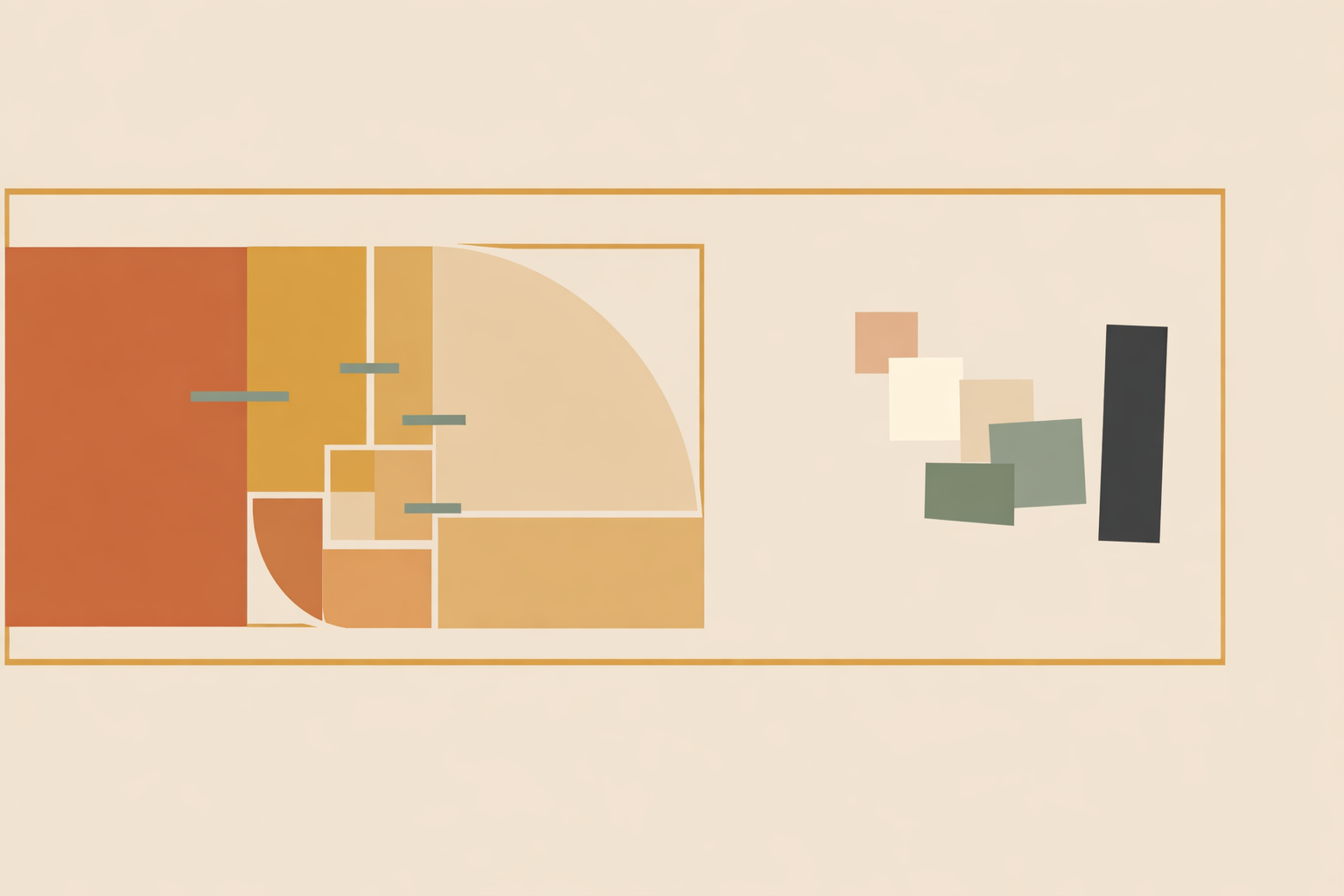
Start with plain form. Define φ through a line division, then construct a golden rectangle and show how subdivision repeats the proportion. Once participants can see the structure, they can use it for real compositional decisions, including horizons, centers, and focal details.
If the group is open to it, introduce symbolism as a second language. Some people experience spirals, radiating forms, and nested rectangles as resonant or contemplative. Others enjoy the clarity of the build and prefer to keep the experience purely visual. Both belong in the same room.
A simple script helps hold that boundary: “Geometry first: we are marking a proportional placement. Meaning, if any, is yours to explore or leave aside,” a stance that also supports responsible shape talk.
For a short session, this sequence is usually enough:
- Define φ on a line.
- Construct a golden rectangle.
- Subdivide once or twice.
- Mark a few possible focal points.
- Use the structure in a brief drawing or layout exercise.
Create a choice-rich, trauma-sensitive teaching space
With mixed-ability groups, the container matters as much as the content. A calm structure with real choice points helps people engage without pressure.
Trauma-informed arts practice is commonly organized around safety and choice, alongside trustworthiness, collaboration, empowerment, and cultural safety. In teaching terms, that looks like clear sequencing, predictable pacing, and language that leaves room for autonomy.
Ongoing consent is especially helpful in creative spaces. Make it explicit that people can choose participation, adjust the prompt, observe instead of making, or keep their work private at any point.
Useful lines to borrow:
- You can draw, adapt, or simply observe. All count as participation.
- If you want a simpler version, stay with the rectangle and skip the spiral.
- Sharing is optional. Private notes are also welcome.
- You are free to pause, rest, or change direction at any time.
Orientation also reduces pressure. A quick visual itinerary on the board (line, rectangle, subdivisions, optional spiral, then free patterning) helps the group settle into the process.
Keep the framing neutral and grounded. You are guiding a structured, proportion-based creative practice within spirituality and ritual, and that is already rich territory.
How to teach simple golden-ratio constructions step by step
Begin with a line, not a spiral. When participants can build and subdivide a golden rectangle, the rest becomes easier to trust and easier to apply.
A straightforward teaching sequence looks like this:
- Draw a line and divide it into golden proportion.
- Use the longer segment to construct a square.
- Extend the square into a golden rectangle.
- Subdivide the rectangle to reveal smaller related rectangles.
- Mark intersections as possible anchors for focal elements.
- Add a spiral only if time and interest are both there.
If exact construction feels too technical for the room, use a practical approximation. A 62/38 split is usually enough for live making when the goal is composition.
Many teachers also start with circles before introducing φ. A center point, one or two rings, and evenly spaced radial divisions give the hand something steady to follow and make patterning feel approachable.
Mandalas fit naturally here: center, repetition, rhythm. Keep it simple—establish the center, divide the circle, place rings, then repeat forms within each sector. Introduce φ as one option for choosing ring distances or areas of emphasis.
For mixed-level groups, a practical one-hour flow might be:
- 10 minutes: circle lattice
- 15 minutes: golden rectangle build
- 10 minutes: φ-based placements or ring distances
- 20 minutes: quiet patterning or composition
- 5 minutes: optional notes or sharing
This works well because it moves from stability to choice. Participants leave with a clear method and a personal outcome.
Use φ in composition for mandalas, layouts, and image flow
Once the scaffold is built, the goal is to compose rather than over-measure. φ shines when it supports movement and emphasis without flattening the piece.
In images and page layouts, a φ spiral can guide the viewer’s eye through the composition. Used lightly, it helps participants think about visual path, not just placement.
For mandalas, combine radial order with proportional spacing. Place a dominant ring, then echo it with inner or outer rings at related distances. Symmetry creates steadiness; small departures can add vitality.
Digital work benefits from the same mindset. Many editing tools include crop overlays to align key elements with proportional guides. Treat these as prompts for seeing, then decide what serves the piece.
Three quick drills work well in class:
- Move one focal element until it sits near a proportional intersection, then compare before and after.
- Place three echo marks along an implied spiral path: large, medium, small.
- Add one deliberate asymmetry and notice whether the composition feels more alive.
Art history can enrich this section when it’s shared with care. Some modern artists, including Salvador Dalí, are often discussed in relation to φ—offer it as an example of intentional compositional choice, not a requirement for great art.
Guide meaning and reflection without over-claiming
The strongest sacred geometry facilitation doesn’t force meaning. It makes room for meaning.
Hold a clear boundary between measured structure and personal interpretation. Geometry can show relationship, spacing, and recurrence. What someone feels in response belongs to their own experience, culture, and imagination.
This boundary matters because beauty claims around φ are often overstated. This proportion is useful, evocative, and clarifying for many people, and it still remains one option among many.
In reflection, invite language that supports agency:
- What felt steady as you worked?
- Where did you follow the scaffold, and where did you depart from it?
- Did this structure suggest any meaning for you, or was the experience mainly visual?
- If you used a motif with a specific lineage, how will you acknowledge that source?
Cultural care belongs here too. Sacred forms and motifs are connected to people and history. When you borrow, name origins where you can, distinguish interpretation from tradition, and avoid presenting living cultural forms as generic decoration.
A gentle close works well: a little time for looking, a little time for private note-making, then an optional invitation to share one choice that felt strong or true. That keeps the emphasis on observation, agency, and respectful making.
Conclusion
Teaching the golden ratio well is less about proving anything and more about offering a reliable creative scaffold. When you pair honest geometry with participant choice and careful cultural framing, φ becomes genuinely useful: a structure people can test, adapt, and make their own.
Start with what can be drawn. Build slowly. Let symbolism remain optional. Use proportion to support composition, not to dominate it. In that kind of session, sacred geometry feels grounded, spacious, and alive enough for real creative exploration.
Train in Sacred Geometry
Apply proportion, choice, and cultural care with confidence in the Sacred Geometry Certification.
Explore Sacred Geometry →