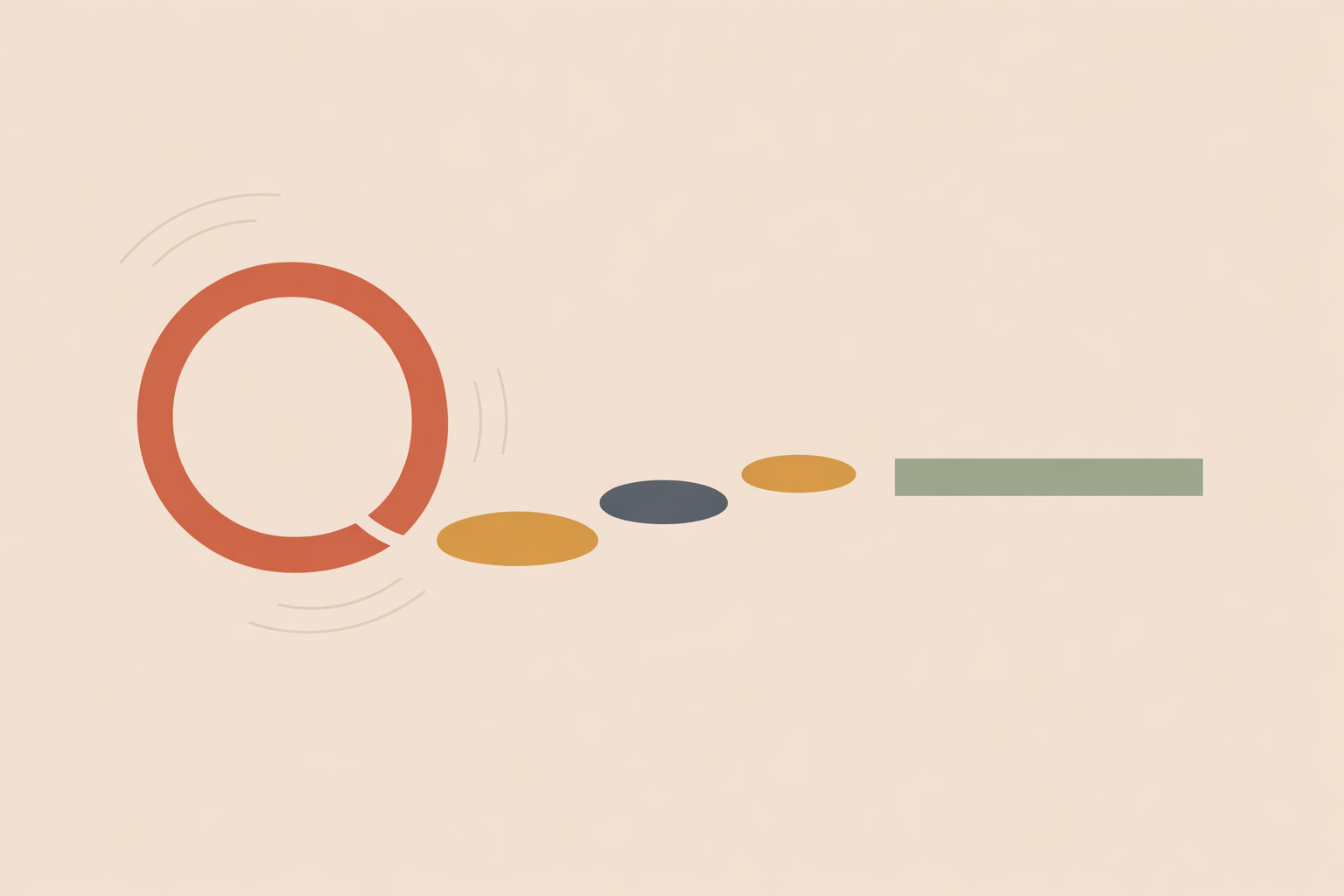
When a client’s work slows under “just one more check,” it’s tempting to reach for process: tighter templates, extra reviews, more reassurance. Those tools can support conscientious work, yet with OCD-related perfectionism they often strengthen the very loop you’re trying to soften. Each reread or confirmation brings a brief exhale of relief, and the mind learns to demand that relief again.
Key Takeaway: Loosening OCD-linked perfectionism at work means separating craftsmanship from compulsive certainty-seeking, then changing the loop at the point of action. The most useful coaching moves are to name the doubt loop, distinguish role-based quality checks from rituals, include mental rituals in the map, set clear stopping rules, reduce reassurance, practice small safe imperfections, and track behavior rather than feelings of certainty.
Step 2: Map the doubt cycle, including mental rituals
Once it has a name, map the cycle in plain, observable steps.
A client prepares a weekly update. The trigger is the Send button. The thought is, “What if I left out a number?” The meaning becomes, “If I’m wrong, I’ll let everyone down.” Tension rises. They reread, compare with last week, or ask someone to confirm. Relief arrives briefly, and the mind learns: checking worked, so repeat it next time.
That’s the loop: trigger, doubt, threat meaning, arousal, ritual, relief, reinforcement.
Include mental rituals, not only visible ones. Silent reviewing, internal debate, analyzing, replaying conversations, or praying for certainty can function just like repeated checking. They can look “quiet,” yet keep the loop fully powered.
A Core Belief Map can uncover the deeper rule driving the pattern:
- Trigger: preparing to send a routine email.
- Automatic meaning: “If I miss anything, I’m careless.”
- Core belief: “My worth depends on not making mistakes.”
- Rule: “I must be completely certain before I submit.”
- Ritual: reread repeatedly, compare drafts, ask “Is this OK?”
- Short-term payoff: brief relief.
- Long-term cost: delays, fatigue, less trust in one’s own judgment.
In this kind of cycle, compulsions bring temporary relief, but they also make future checking more likely. Over time, the person learns to trust the ritual more than their own capacity to tolerate uncertainty.
Keep the map visible: a sticky note, a notebook page, or beside the laptop. When the urge spikes, the client can relate to the pattern rather than disappear into it.
Step 3: Use Observer Mind without turning it into another check
Observer Mind helps the client notice the urge without following it. The shift is subtle: “I am noticing the thought that this must be perfect” lands differently from “This must be perfect.”
The goal is space for choice, not a guarantee of calm. Useful phrases include:
- “My mind is asking for one more check.”
- “I notice the urge to get certainty before I send.”
- “Doubt is here, and I can still follow the plan.”
Keep it grounded. Feel the feet on the floor, take a slower exhale, look at the stopping rule, then do the next planned step.
One thing to watch: self-awareness can become its own ritual. A client may start checking whether they are “observing correctly,” reviewing their mindset, or waiting for a perfect internal state before acting.
If that shows up, simplify. The aim is less automatic obedience to the loop, not perfect observing.
Step 4: Set proportionate standards and clear stopping rules
Write down the required checks, then stop when they’re done.
This is where many clients feel a real shift. Healthy quality control has a purpose and an endpoint. Compulsive checking keeps stretching toward certainty, so it can’t truly finish.
Ask three questions:
- What does the role or procedure actually require?
- What extra step is driven by doubt rather than policy?
- What tells you the task is complete besides a brief feeling of certainty?
Turn the answers into one-sentence stopping rules:
- “Read the email once for content and once for attachments, then send.”
- “Review the spreadsheet for formula errors using the tool, then upload by 3:00.”
- “Ask one clarifying question, record the answer, then proceed.”
Specific beats vague. Observable beats emotional. A strong rule tells the client what to do, not what to feel.
Digital workspaces make boundaries even more important. Draft folders, version histories, read receipts, and long chat threads make it easy to “check forever” while still feeling unfinished.
Build digital limits into the plan:
- scheduled inbox times
- one agreed review pass for low-stakes messages
- time-limited research windows
- notifications paused during focused work
- no post-send rereading unless a real issue emerges
As steadiness grows, add small, safe imperfections: leave one nonessential phrasing choice alone, or submit something solid without polishing it into exhaustion. The point is proportion, not lowered standards.
Step 5: Practice low-intensity interruptions that fit daily work
Big overhauls often create backlash. Small, repeatable interruptions fit real workdays and build confidence through repetition.
The approach is direct: begin the task, feel the urge, then change one small part of the usual loop. The training target is acting without full certainty.
Examples:
- Drop one extra check and send at the planned number of passes.
- Wait five minutes before asking for reassurance, while continuing the task.
- Limit research to a pre-agreed window, then decide with the information already gathered.
- Send a low-stakes email on time, even if it does not feel flawless.
- Close the laptop at the scheduled time instead of reopening the task at night.
These experiments work best inside a manageable range of activation. If the client is too agitated or shut down, support regulation first, then return to the plan.
This is also where traditional, everyday grounding practices fit naturally alongside modern coaching tools and broader mental health frameworks. A steady exhale, both feet on the floor, a brief walk outside, warm tea held with attention, or a simple end-of-day closing phrase can support steadiness without feeding certainty-seeking.
Keep each experiment modest and clear: “For this week, follow the two-pass rule for daily status emails, send by 9:15, notice post-send urges for 60 seconds, then move to the next task.” Review what happened in behavior, not how settled it felt.
Step 6: Replace reassurance-seeking with values-based action
Reassurance can look harmless at work: “Is this okay?” “Are you sure?” “Can you confirm one more time?” When it’s repeated mainly to lower distress, it often functions as part of the loop.
It calms things quickly, but it teaches dependence on outside certainty. The client learns to borrow confidence instead of building trust in their process.
Kind, clear boundaries help without feeding the pattern:
- “I can help you identify the agreed standard, but I won’t repeatedly certify that it is perfect.”
- “Let’s answer the work question once, write down the decision, and move forward.”
- “You get one ask on tone, then you act on the answer.”
Then shift the compass to values: “In the presence of uncertainty, what kind of colleague do you want to be?” Reliable, thoughtful, honest, collaborative, balanced, useful. Values give the client somewhere firm to stand when certainty doesn’t show up.
The goal changes accordingly. “Eliminate every possible error” becomes “Send the report on time and support the team.” “Prepare until no question could surprise me” becomes “Participate fully even with uncertainty present.”
A one-ask policy can support this: ask once, save the answer in a note, and use that note next time rather than seeking fresh reassurance. The aim is steadiness, much like avoiding reassurance traps in OCD-focused coaching.
Step 7: Track behavior, not certainty
Progress comes from doing, not from waiting to feel ready. Create a stopping plan that makes the action visible.
A useful plan includes:
- the task
- the required standard
- the maximum number of reviews
- the submission time
- likely urges
- the next action after stopping
For a routine update:
- Standard: facts verified, tone professional, correct recipient, attachment included.
- Max reviews: two passes.
- Stop time: 11:00.
- Likely urges: “Read it once more,” “Compare with last week,” “Ask Sam to confirm.”
- Plan: label the urge, exhale, send, move to the next calendar block.
Track function, not feelings. Practical signs of change include:
- fewer repeated checks
- faster recovery after small mistakes
- quicker transitions between tasks
- less reassurance-seeking
- more on-time submissions
- more energy left for meaningful work
Success doesn’t require perfect confidence. Ask instead: “Did I follow the agreed standard and act from my values while uncertainty was present?”
Keep tracking light. A tiny weekly scoreboard is often enough:
- Sent on time
- Stayed within max checks
- Used one-ask only
- Closed the workday cleanly
A simple check mark is enough. If tracking becomes exhaustive, it has turned into another ritual, so reduce it immediately.
Conclusion: Loosening OCD-related perfectionism through proportion and steadiness
This work is about restoring proportion while protecting pride in good craft.
When clients learn to name the doubt loop, map its mechanics (including mental rituals), use Observer Mind in a straightforward way, set stopping rules, practice small safe imperfections, reduce reassurance, and measure behavior instead of certainty, work starts moving again. Standards stay intact, and the compulsive grip loosens.
Within coaching, the role is grounded and practical: support daily follow-through, values-led choices, workable boundaries, and steadier routines within a broader mental health frameworks lens. Traditional grounding practices can complement this beautifully when used as supports rather than new certainty-seeking habits.
Over time, the change is clear: less time spent chasing perfect, more time available for contribution and meaningful work. For practitioners building depth in this area, OCD coach certification offers a more focused route into this kind of coaching work.
Explore OCD Coach Certification
Apply these stopping rules and uncertainty skills with deeper coaching structure in the OCD Coach Certification.
Explore OCD Coach Certification →