Many ocean-informed practitioners begin with a familiar instinct: get closer, get wetter, feel better. That works beautifully for some people—until it doesn’t. Different bodies arrive with different activation levels, attention bandwidth, and histories with the sea. The same shoreline can soften one person and tighten another.
When conditions set the pace instead of the person’s state, sessions can turn hurried. Breath gets shallow, attention narrows, and the experience becomes performative rather than restorative.
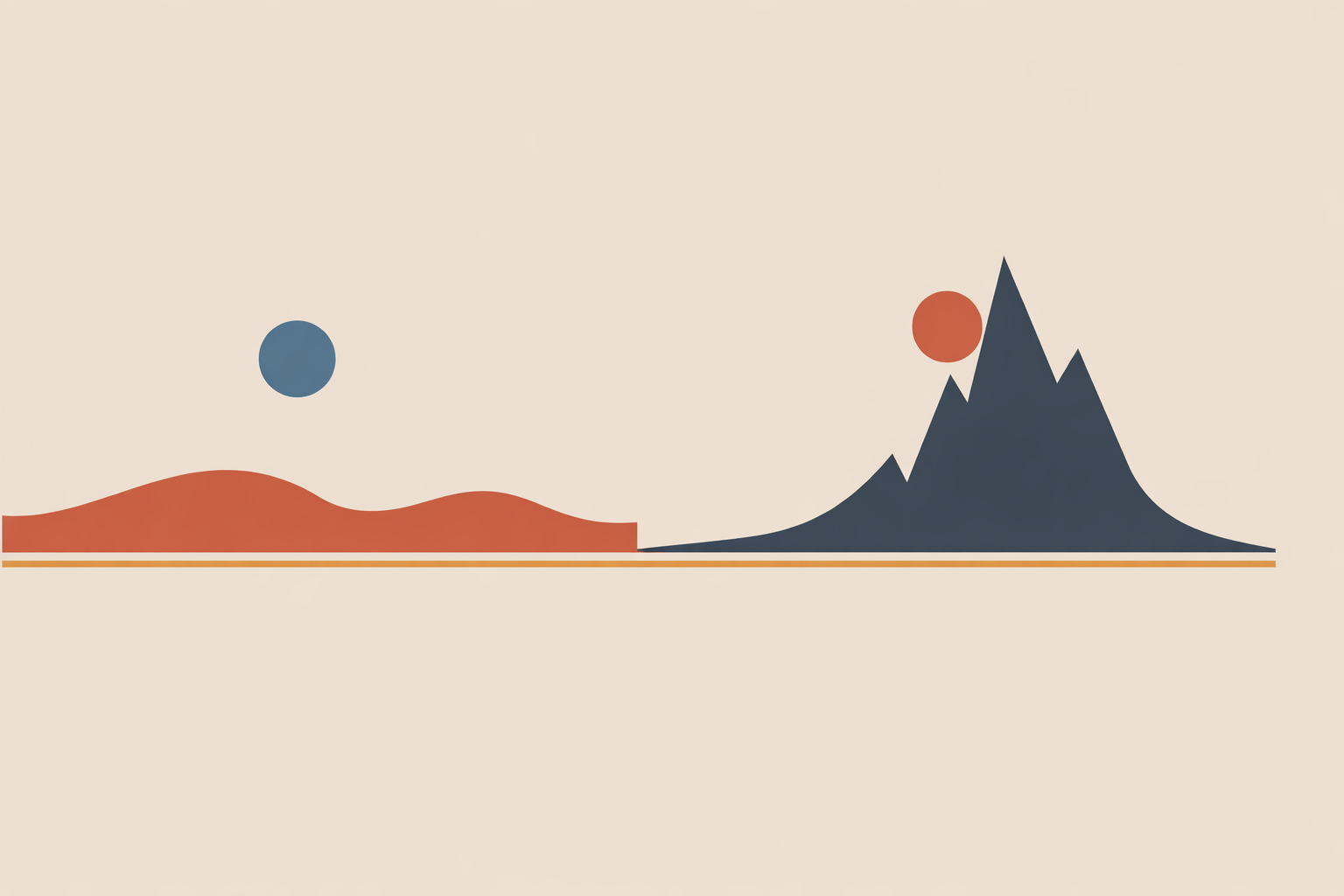
A steadier compass is simple: Blue Mind suggests readiness for gentle exploration, while Red Mind suggests simplification, steadier pacing, and restored choice. Used as shifting states rather than fixed labels, this lens helps you adjust intensity in real time, begin on land, move step by step, and step back without apology. That’s what makes sea-based work more ethical, responsive, and repeatable.
Key Takeaway: Use Blue Mind vs Red Mind as a pacing compass for sea sessions. Start on land, read state before intensity, progress through a clear ladder only when readiness is present, and step back as soon as the sea asks too much. Good pacing protects choice, supports integration, and keeps the experience restorative rather than dramatic.
Blue Mind and Red Mind are shifting states, not labels
Blue Mind and Red Mind work best as moment-to-moment states of attention and relationship, not identities. Treat them like weather: informative, changeable, and worth responding to.
Blue Mind often looks like slower speech, easier breathing, more flexible posture, and genuine curiosity. Red Mind commonly shows up as rushing, clipped responses, shallow breathing, narrowed attention, and pushing through. These cues are usually easy to spot when you stay with observable behavior rather than interpretations.
That keeps your language simple and respectful. You don’t need labels to do skilled work. You can say, “Your pace increased,” “Your shoulders lifted,” or “You keep checking the exit,” and then return choice to the person.
Here’s a composite example. Mid-session, Marco’s steps become quick and short. He stops tracking your voice and keeps glancing toward the car park. You say, “I’m noticing your pace picked up. Want more, less, or the same right now?” He chooses less. You both move up to dry sand, plant your feet, and orient to two landmarks. A minute later his breath lengthens and he says he can notice the waves again. Nothing was wrong; Red Mind just clarified what the session needed next.
Start on land before you start in water
Begin on land, even when the sea looks inviting. A brief check-in on shore often determines whether the rest of the session feels steady or scrambled.
A couple of minutes is usually enough. You’re not gathering life history. You’re locating the person on the Blue–Red continuum so intensity matches readiness.
Useful opening questions include:
- “On a scale of 0 to 10, how activated or settled do you feel?”
- “How easy is it to notice your breath right now?”
- “Do you want more stimulation, less, or about the same?”
- “What would make this feel more manageable?”
- “If you need a pause or exit, what’s your preferred signal?”
You can also note three quick before-and-after ratings: activation, felt steadiness, and capacity for choice. These guide pacing; they’re not a gate. Low activation can reflect calm readiness, or it can reflect depletion. Higher activation doesn’t rule out sea contact when you start with enough distance, orientation, and options.
It’s also realistic to expect many people to arrive somewhat activated. For many adults, a Red Mind baseline is part of modern life. That doesn’t block the session; it gives you a starting map.
A field note might read: “Pre: activation 6, steadiness 4, choice 5. Began in the lee of a dune. Five minutes of horizon-viewing, then hand contact with seawater from a bucket rather than shoreline approach. Post: activation 3, steadiness 7, choice 8.” The sea didn’t change. The container did.
A simple Blue Mind intensity ladder for sea sessions
Most rushed sessions stumble in the same place: the “big” moment arrives too early. A more reliable approach is to build an intensity ladder and climb only while attention stays settled and choice stays strong.
The sequence is regulate, explore, intensify if appropriate, then integrate. Presence comes first. The ocean can offer a lot, but only when the person can stay in relationship with what’s happening.
A practical intensity ladder might include:
- Land-based observation with exits visible
- Walking near the waterline on stable sand
- Hand contact with seawater, or a small bowl if surf is rough
- Sitting near shallow water with feet grounded
- Ankle-deep wading with stable support nearby
- Brief supported immersion if skills, conditions, and consent align
- Swimming or floating only when readiness is clear and support is in place
Each rung adds demand. Viewing water differs from touching it; wading differs from full-body immersion. Cold adds demand on top. Keep every step as a two-way door, where the way back is short, obvious, and openly welcomed.
You never need to force depth to create value. Many of the most meaningful sessions stay on the first few rungs. Rhythmic sound, wider vision, steady footing, and brief contact can be plenty when the pacing is right.
A simple exchange at the third rung might sound like: “Let’s try 30 seconds of hand contact, then check in. I’ll count down so the exit stays clear.” Afterwards, ask, “What changed? More, less, or the same?” If breathing stays easy and attention remains wide, you can consider one more step. If not, you stay put or step back.
What to do when Red Mind appears mid-session
When Red Mind starts to dominate, more intensity usually stops helping. That’s your cue to reduce demand and restore choice.
Signs are easy to miss if you’re attached to the original plan: breath shortens, posture hardens, speech becomes clipped, the eyes dart, the person stops taking in your voice, or they begin performing capability instead of staying present. When that shift appears, simplify quickly.
Helpful responses include:
- Increase distance from breaking waves, crowds, unstable rocks, or strong wind
- Move to steady footing or sit with back support if available
- Orient to two fixed landmarks and the exit route
- Offer warmth, shade, water, or a clothing adjustment
- Use short sentences and one instruction at a time
- Avoid forcing breath-focused practices if attention on breath feels overwhelming
- Ask, “More, less, or the same?” to restore immediate choice
It helps to track two variables: inner state and outer conditions. Blue Mind with gentle conditions may allow exploration. Blue Mind with challenging conditions often calls for land-based work. Red Mind with gentle conditions usually asks for orienting and reduced demand. Red Mind with challenging conditions is a clear sign to end the water component and move to secure ground.
Stepping down the ladder is not failure. It’s a core skill in ocean-informed practice, and it often creates the most honest sessions.
Picture a composite scene. Mid-wade, Jae freezes and lifts his shoulders toward his ears. You say, “Let’s step back three paces onto dry sand.” Once there, you ask him to find the pier and a white house on the cliff. A minute later his breathing lengthens. You both decide to end with shoreline observation rather than continue in the water. That choice isn’t a reduced session; it’s the session.
Pacing cold water and other high-demand practices
Cold is not the goal. Connection is. Cold immersion and deeper water are distinct practices with distinct loads, and they deserve their own pacing.
Even a calm-looking entry can place strong demand on the body. In cold water, rapid breathing in the first minute often reflects cold shock rather than emotional overwhelm. That points you toward orientation, shorter exposure, clear exits, and steady rewarming.
After exiting, afterdrop risk also deserves respect. People can continue cooling after they leave the water, which makes post-session warmth and monitoring as important as the entry.
For first-time or low-confidence participants, keep protocols short and straightforward. A brief supported dip can be enough. Chest-deep immersion for 30 to 60 seconds with a stable buddy, a fixed landmark, and a pre-agreed exit signal is often plenty. If the breath spikes, orient first. If the eyes glaze over, exit. If conditions are rough, don’t substitute courage for pacing.
It also helps to separate cold work from the wider promise of sea sessions. Some people genuinely thrive with cold; others get more from warmth, rhythm, sightlines, salt air, and gentle contact.
After the water, prioritize rewarming before reflection. Warm layers, sheltered walking, and enough time for the system to settle usually support stronger integration than immediate analysis.
Making the session portable beyond the beach
End by helping the person carry the pattern home. Blue Mind isn’t only a place; it’s a relationship with attention that can be rehearsed anywhere.
A simple integration arc works well: settle, orient, choose, experience, reflect, integrate. The last step is where sea-based work becomes everyday practice.
Portable options might include:
- Listening to rhythmic sound for two minutes as a wave-analogue
- Taking a slow walk with the eyes resting on a distant horizon line, rooftops, or treeline
- Using a four-sense inventory: one thing you can see, hear, feel, and smell
- Pausing before a response and asking internally, “More, less, or the same?”
It also helps to normalize variety in the hours after a session. Some people feel an immediate glow, others feel tired, and some notice changes later. Broad blue-space reviews support generally positive associations with well-being, while individual responses still vary with context, timing, weather, energy, and what the session asked of them.
Keep debrief questions practical: “What feels different now?” “What helped?” “What was too much?” “What will you carry into the week?” A useful answer might be, “When my workday becomes too sharp, I’ll take 90 seconds with a distant gaze and 10 slower steps.” That’s the ocean leaving the beach with them.
Conclusion: a steadier compass for ethical sea-based work
Use Blue Mind as a cue for gentle exploration. Use Red Mind as a cue to slow down, simplify, and restore choice. With that orientation, the sea serves the person’s rhythm rather than a prewritten plan.
Good ocean-informed practice asks for basics done well: begin on land, read state before intensity, keep exits visible, progress gradually, and treat stepping back as skill rather than compromise. When someone is settled, the sea can open. When someone is overloaded, reduce demand and protect relationship.
This approach also supports integrity. It respects consent, honours traditional pacing wisdom, and keeps the work within a clear scope of well-being and coaching support. It values responsiveness over drama and repeatability over spectacle.
Over time, this lens becomes second nature. The focus shifts from making the session bigger to making it more attuned. That’s usually where the deepest shifts happen—by rhythm, not force.
Train in Ocean Therapy
Deepen your pacing skills with the Ocean Therapy Practitioner Certification for safer, more responsive sea-based sessions.
Explore Ocean Therapy →