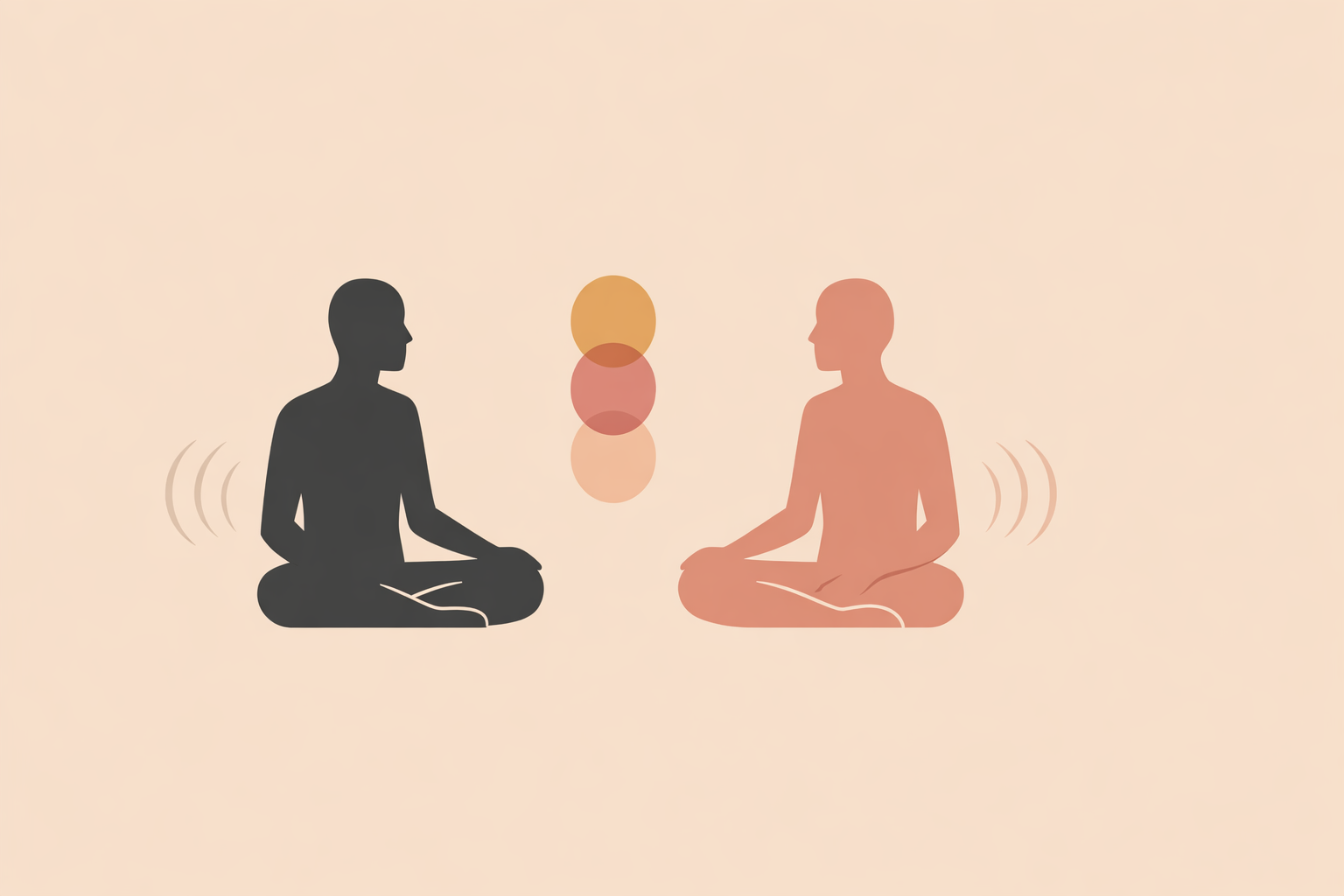
Meridian-informed sessions feel steadier when a practitioner begins with presence rather than rushing into technique. A client might arrive hoping for a “meridian reset” or a quick energetic shift, yet what holds the work together is often simpler: clear scope, real choice, and language that keeps meridians in their proper place as a reflective map.
With that foundation, the session becomes easier to trust. Consent stays active, boundaries stay visible, and intuitive material can be offered without taking authority away from the client.
Key Takeaway: Meridian-informed sessions work best when they are guided by clear scope, ongoing choice, and simple, grounded language. A strong session arc begins with role and scope, continues through consent and boundaries, uses check-ins to regulate pacing, offers reflections lightly, and stays ready to pause and ground when meridians are not the main need.
Script 1: Name Your Role and Scope Clearly
Start by naming what meridians mean in your work. That clarity helps the client choose the kind of support they want, and it keeps the session honest from the first minute.
A simple way to frame it is: “In my practice, meridians are a traditional map for noticing energy flow, balance, and resonance. We use them as a language for reflection and awareness.” That is often enough. You do not need to over-explain or defend the framework. Meridians tend to work best when they are held as a meaningful organizing map rather than as a statement of fixed physical fact.
You can also make the scope explicit: “My role is to support awareness, alignment, and choice. Your role is to notice your experience, set the pace, and let me know if you want to pause or change direction.” This shared structure often settles the room immediately.
Here is a four-part opening script you can adapt:
- “Traditional lineages use meridians as a way to organize energy work.”
- “In this session, I use that map as a reflective framework.”
- “Your experience matters more than any theory about it.”
- “We will go at your pace, and you can pause or redirect at any time.”
If a client asks for a fast fix, this kind of opening helps you stay steady. Rather than promising a result, you offer a clear container that supports collaboration.
Script 2: Make Consent Ongoing, Not One-Time
Consent works best as a living conversation. When it continues throughout the session, meridian work stays collaborative instead of automatic.
You might begin with: “Would you like to try a short meridian-informed practice? I’ll explain each step, and you can pause, change direction, or stop at any time.” The wording is simple, but the impact is real: the client chooses each step with you.
As the session unfolds, revisit that choice:
- “Would you like to continue here, or shift?”
- “Shall we stay with this for a moment, or move into grounding?”
- “Before we add anything new, does this still feel right?”
This matters most during transitions. A client can start out curious and become more cautious later, and good practice makes room for that change without friction.
In real sessions, small phrases do a lot of work: “Does that fit?” “Would you like to keep going?” “We can regroup.” Ordinary words, strong partnership.
Script 3: Set Boundaries Around Touch, Intuitive Input, and Distance Work
Clear boundaries prevent confusion and protect trust. If touch, intuitive input, or remote work could be part of your practice, name each option plainly and make it opt-in.
A useful script is: “We can work fully hands-off today. I won’t include touch, intuitive impressions, or distance work unless you want that and say so clearly.” This gives genuine choice without putting the client on the spot.
You can also break the options down one by one:
- “Today we can stay hands-off unless you request otherwise.”
- “If you would like intuitive reflections, I can offer them lightly, and you are free to say no.”
- “Distance work is by request only. We do not need to include it.”
When a client seems overwhelmed, highly activated, or detached, it’s usually wiser to keep things simple. Many practitioners choose hands-off support and basic settling practices such as breath, orientation, or imagery. Practitioner guidance also suggests grounding techniques such as breathing and guided imagery when someone is overwhelmed or dissociative.
Touch is never the default. It is a separate choice that deserves its own clear yes.
Script 4: Use Mid-Session Check-Ins to Regulate Pace
Once the session is underway, check-ins keep the process client-led. They prevent drift into intensity, interpretation, or pacing the client didn’t choose.
One reliable question is: “What are you noticing now, and would you like to continue, slow down, shift focus, or stop?” It is respectful, easy to repeat, and keeps the client as the reference point.
Frequent pacing conversations are consistent with trauma-informed guidance, which recommends discussing pacing regularly so the process does not move too fast for the person in front of you.
If a client becomes dizzy, numb, detached, or has trouble tracking the room, slow the session down. Step away from interpretation and return to basic settling. Trauma-informed guidance recommends grounding to support a return to the here and now.
A mid-session exchange might sound like this:
- Practitioner: “What stands out right now?”
- Client: “I feel tight in my chest and a bit spacey.”
- Practitioner: “Thank you. Would you like to stay with that for three breaths, shift to feet-on-floor grounding, or take a full pause?”
For your notes, one concise line is often enough: “Client chose to slow down and ground; reported feeling steadier afterward.” That records choice and pacing without imposing a story.
Script 5: Offer Meridian Reflections as Possibilities
When impressions arise, offer them lightly and keep the client’s experience central.
A helpful preface is: “I have a possible association, and it may not fit. Would you like to hear it, or would you prefer to stay with your own observations?” This keeps intuition in proportion and preserves the client’s authority.
If the client says yes, keep it brief and return the focus right back to them. For example: “As we stayed with that point, I had an image of a clear stream. Does that connect with anything for you?” Then pause and let them respond in their own language.
This approach is especially useful when clients ask broad symbolic questions, such as whether a particular meridian “means” a particular emotion. Some traditional lineages do make those associations, and they can be meaningful within practice. Still, it’s best not to force a label onto someone’s experience. You can say: “Some lineages connect this area with movement or emotion, but I’d rather hear what you notice first,” a client-led approach that also fits emotional-center mapping.
If your reflection does not land, repair simply: “Thank you for saying that. We can leave that aside.” Nothing more is needed.
Script 6: Pause and Ground When Meridians Are Not the Main Need
Sometimes the most skillful move is to set meridians aside. When someone needs steadiness more than interpretation, your role is to simplify.
You might say: “Let’s pause the meridian focus for a moment and come back to grounding.” That sentence alone can reset the session.
If the client is overwhelmed or detached, grounding is often more supportive than continuing with symbolic or intuitive material. Guidance describes grounding as particularly helpful when someone has dissociated or is experiencing intense feelings.
Keep your grounding options concrete:
- “Feel your feet or seat making contact with support.”
- “Look around and name three neutral objects.”
- “Notice your breath without trying to change it.”
- “Take a sip of water and notice temperature and weight.”
- “What small action would help you feel steadier after this session?”
Mid-session check-ins support this simplicity, because they reduce the chance of drifting into more intensity than the client wants. Trauma-informed guidance recommends frequent check-ins around pacing and timing for exactly this reason.
When you close, stay practical. Ask: “What are you taking from this in your own words?” and “What would help you feel steady as you return to your day?”
Conclusion: Let the Language Hold the Session
Meridian-informed work becomes more trustworthy when the language around it is clear. Name your role. Keep consent alive. Set boundaries around touch, intuition, and distance work. Check in often. Offer reflections as possibilities. When the moment calls for it, pause and ground.
Used together, these habits create a session rhythm that feels respectful, spacious, and dependable. Over time, that rhythm supports a mature practice within energy healing: one that honors tradition, stays collaborative, and keeps the client’s experience at the center.
Meridians can remain a helpful map while you keep the session grounded in choice, pacing, and clear agreements. That is where depth tends to unfold safely, whether you frame the work broadly through energy healing or more specifically through energy alignment.
Train in Energy Alignment
Deepen your meridian-informed sessions with the Spiritual Healing and Energy Alignment Certification.
Explore Spiritual Healing →