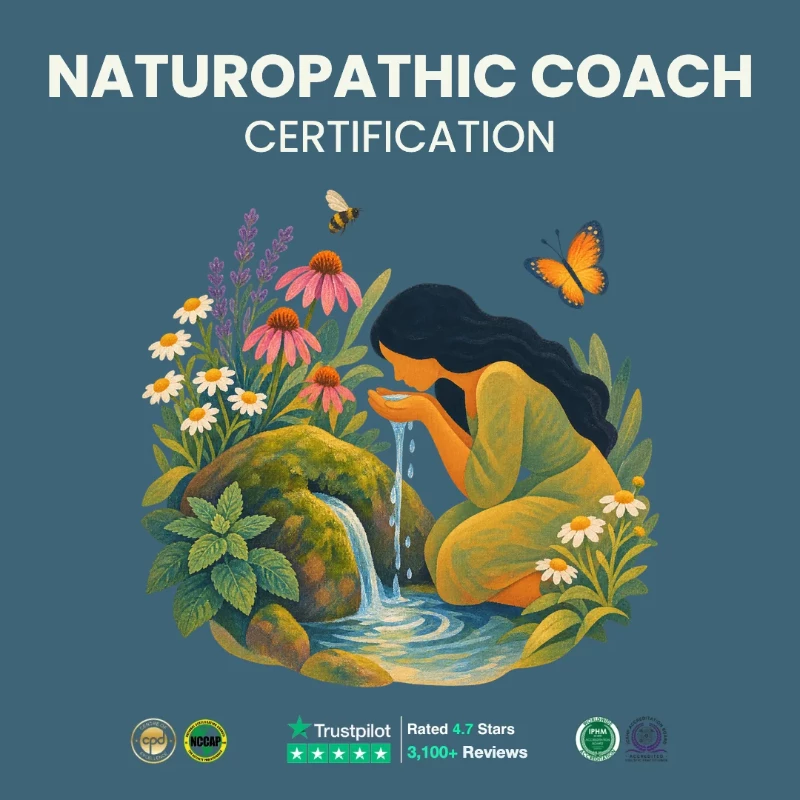
The Naturopathic Coach Certification on Naturalistico is a non-clinical training in the naturopathic view of health: the whole-person approach, nutrition and lifestyle, plant and nature-based traditions, and how to hold client conversations about them without stepping into medicine. Fully online and self-paced, 15 modules and about 12 hours 41 minutes of narrated audio, with 21 downloadable guides, quizzes, a final exam and a verifiable certificate. It currently costs $97 with a 30-day money-back guarantee, and 74 verified students rate it 4.86 out of 5.
One distinction decides whether this course is right for you, and it is worth getting straight before anything else. A licensed naturopathic doctor and a naturopathic coach are not the same thing, do not train the same way, and are not allowed to do the same work. This course trains the second, not the first.
Below: what that difference actually means, what the 15 modules cover, who the course suits, what students say including the criticism, what it costs, what the accreditation means, and the legal line you must check in your own country.
Key Takeaway: The Naturopathic Coach Certification is a non-clinical, self-paced course in naturopathic principles and lifestyle coaching. The article covers the difference between a licensed naturopathic doctor and a naturopathic coach, the 15 modules from the holistic approach through nutrition, supplements, plants, bodywork and light-based traditions, who the course fits, verified student ratings and their criticism, format and price, what IPHM, CMA and CPD accreditation means, why title rules vary by jurisdiction, and the questions asked before enrolling.
Naturopathic doctor or naturopathic coach: the distinction that matters
Start here, because most confusion in this field lives in one word. The National Center for Complementary and Integrative Health describes what naturopathy is and names three different kinds of practitioner. Licensed naturopathic physicians complete a four-year programme at a college accredited by the Council on Naturopathic Medical Education, pass board exams, and are licensed in some jurisdictions to diagnose and treat. Traditional naturopaths train through various non-accredited programmes and are not eligible for that licensing. Other health professionals sit somewhere between.
A state consumer guide makes the first category concrete: in California, naturopathic doctors are described as primary care doctors who must be licensed, and their scope includes diagnosing and treating, ordering diagnostic tests and dispensing supplements. That is an ND's scope, and this certificate does not grant any part of it.
What a naturopathic coach does instead is education and support: helping someone understand a whole-person view of health, work on daily habits around food, sleep, stress and movement, and stay in useful conversation with the clinicians actually treating them. That is real work and it is honest work, as long as the boundary is explicit. This piece on what a naturopath does is a good companion for explaining your role to clients.
On evidence, the honest position is narrow. A scoping review of whole-system naturopathic medicine research found studies across mostly chronic conditions that predominantly showed benefit, but every one of those studies evaluated care delivered by naturopathic clinicians, not by certificate-holding coaches. Separately, a meta-analysis of wellness coaching reported improvements in quality of life and self-efficacy while rating certainty in the evidence as low or very low. Neither result is a promise you can make to a client.
What the certification covers
Fifteen modules, about 12 hours 41 minutes of narrated audio, with 21 PDF guides and quizzes. The arc runs from philosophy to the body systems to the traditional modalities, closing with practice.
- Modules 1 to 3, foundations: Holistic approach to health, Relationships between body, mind and emotions, and Social relations and associations with the musculoskeletal, immune, blood and skin systems.
- Modules 4 to 6, the person: Self-esteem and money and love balance, Personal desires and communication, and Open-mindedness, spirituality, energy and relationships. These are conversation-level modules, not clinical ones.
- Modules 7 to 9, food and plants: Nutrition using the holistic approach, Health foods and supplements, and Detoxification, medicinal plants and aromatherapy.
- Modules 10 and 11, common complaints: the course names these modules around stress, sleep, brain, weight, fatigue, immunity, chronic pain, skin, digestion and asthma. Read them as topic areas a client will raise with you, not as conditions you are being trained to treat, because you are not.
- Modules 12 to 14, traditional modalities: Massage, reflexology, lithotherapy, relaxation and meditation; Bach flowers, gemmotherapy and hydrotherapy; and Iridology, light therapy, heliotherapy and chromotherapy. These are taught as traditions within naturopathy. Several have little or no supporting clinical evidence, and describing them accurately to clients is part of practising ethically.
- Module 15, Practical guide to naturopathy: the short closing module on putting it together.
Be clear-eyed about the shape of that curriculum. It is broad rather than deep, it is rooted in the naturopathic tradition rather than in clinical medicine, and its value is in giving you a coherent framework and vocabulary for lifestyle conversations. What it cannot do is qualify you to assess or treat any of the conditions its module names mention. If you want the boundary in operational terms, keep session notes that record education and habits rather than symptoms and outcomes.
Who it's for
- Health and wellness coaches who want a whole-person framework behind the habit work they already do.
- Herbalists, aromatherapists and bodyworkers looking for the wider naturopathic context their modality sits inside.
- Nutrition and lifestyle practitioners who want the traditional perspective alongside the modern one.
- People exploring the field before committing to a four-year naturopathic medical programme, for whom this is an inexpensive way to find out whether the philosophy fits.
- Practitioners in unregulated jurisdictions who intend to work strictly within education and coaching, and who will check local rules first.
It is not the right course if you want to become a naturopathic doctor, diagnose or treat anything, advise anyone on medication, or use a protected title. In some places that title is restricted: NCCIH notes there is no standardised national credentialing system for complementary practitioners, that states decide, and that some jurisdictions apply title licensure, meaning you need specific credentials before you can call yourself something. Washington State, for example, licenses naturopathic physicians through a state board. Check your own jurisdiction before you print a business card, and this guide on routes into naturopathy is a sensible starting point.
What students say: 4.86 out of 5 from 74 verified reviews
At the time of writing the course holds 4.86 out of 5 from 74 verified student reviews, against a platform average of 4.84 from more than 10,000 verified reviews across 180 courses. Only enrolled students can review, and every review is dated.
The positive reviews describe a broad, well-organised introduction that students found genuinely useful for client conversations, delivered in a format they could fit around work. The critical reviews are more useful still, and they say three consistent things. There is no course leader and no video, just audio and PDFs, which several students found dated. The quiz format did not always help retention, and one student found the questions did not map cleanly onto the material. And most importantly, one reviewer wrote that the material is a reasonable base but that she would not rely on this information alone and intends to keep researching, while another asked for more scientific referencing.
That last criticism is the fairest summary of what this certificate is. It is an orientation to a tradition, not a clinical education, and the students who value it most are the ones who treat it as a starting point and keep reading.
Format, time and cost
Fully online and self-paced with lifetime access. Nothing is required live, with a weekly live Q&A and a student forum available where replies usually arrive within 48 hours. The 15 modules total about 12 hours 41 minutes of narrated audio plus 21 PDFs, and the course page puts the full commitment at around 40 hours. There are no prerequisites.
Module quizzes are ungraded. The final exam is multiple choice, needs 80 percent to pass, and can be retaken at any time.
The price shown to US visitors at the time of writing is $97, listed as a discount from a regular price of $398, with a 30-day money-back guarantee. Pricing is promotional and geo-dependent, so check the Naturopathic Coach Certification page for the live figure in your currency. The course sits inside the traditional and eastern medicine learning path if you want a staged route through related systems rather than a single certificate.
Accreditation, and what it is not
The certificate is accredited by IPHM, CMA and CPD. IPHM describes itself as an independent professional accreditation board for alternative and holistic practitioners and training providers. The CMA is a UK membership organisation representing complementary health therapists, training schools and clinics. CPD certification means an independent service, established in 1996, has assessed the training against continuing professional development standards.
What none of them is: a medical licensing board, a government regulator, or a programmatic accreditor of naturopathic medical education. That last role belongs to CNME in the United States and Canada, and it accredits doctoral programmes, not certificates like this one. NCCIH puts the general point plainly: credentials vary, states decide, and being licensed or certified is not by itself a guarantee of competence.
What the accreditation does give you is recognised professional development, a certificate anyone can verify through the public Certificate Lookup, and insurance eligibility listed on the course page, which you should confirm with your own insurer for the specific work you intend to do.
Where coaching stops
Three rules keep this work safe, and they are not optional.
Never diagnose. Never treat. Never advise anyone to start, stop or change a medication, or to delay medical care. A client mentioning fatigue, chronic pain, a skin condition or digestive trouble is describing symptoms that belong with a clinician, whatever the module titles say. Your role is education, habit support and encouragement to see someone qualified.
The professional frame is the one coaching uses generally. The ICF Code of Ethics requires practitioners to work within the boundaries of their training, disclose when they are acting in a role other than coach, and explore a referral when the work is no longer the right fit. In practice: put your scope in writing before the first session, keep a referral list you can use immediately, and be quick to use it. These client safety steps and this guide on how to keep your practice legal are the two most useful things you can read before taking a paying client.
Where someone is in crisis, they need urgent help rather than a lifestyle plan. In the United States the 988 Suicide and Crisis Lifeline takes calls, texts and chats around the clock; elsewhere, use local emergency services.
How to enrol and what happens after
Enrolment is immediate and all the material opens at once. Work in order, since the early modules establish the framework the later ones assume. The final exam comes at the end, and the certificate is issued with a verifiable ID.
Afterwards, three moves separate the practitioners who last from the ones who get into trouble. Write your scope statement first, in plain language, and give it to every client. Decide which modules you will actually use in practice and which you will treat as background, because a course this broad is not a mandate to offer everything in it. And build the referral relationships before you need them. For profession-level context rather than income promises, the coaching profession counted a record 122,974 practitioners worldwide in the ICF's 2025 study, with growth attributed mainly to more clients rather than higher fees.
Frequently asked questions
Does this make me a naturopathic doctor?
No. Licensed naturopathic doctors complete a four-year accredited programme and pass board exams, and in licensed jurisdictions they can diagnose and treat. This is a non-clinical certificate of completion in naturopathic principles and coaching.
Can I call myself a naturopath after this course?
It depends entirely on where you live. Some jurisdictions restrict the title to licensed practitioners, and NCCIH notes that credential requirements are set locally rather than nationally. Check your own rules before using any title.
Do you need a licence to work as a naturopathic coach?
In most places coaching itself is unregulated, so no licence exists to obtain. What is regulated is clinical practice: diagnosing, treating and prescribing. Stay outside those and check local law.
Is naturopathy evidence based?
Research on whole-system naturopathic care delivered by clinicians shows benefits across several chronic conditions, while the evidence for individual traditional modalities varies widely and is thin for some of them. Describing that honestly to clients is part of the job.
How long does the certification take?
About 12 hours 41 minutes of audio across 15 modules, and roughly 40 hours in total with the 21 guides, quizzes and exam. Self-paced with lifetime access.
Is there an exam?
Yes. Module quizzes are ungraded; the final multiple-choice exam needs 80 percent to pass and can be retaken at any time.
Is this the right next step?
If you want to practise naturopathic medicine, this is not the route and no online certificate is. If you coach people on how they eat, sleep, move and manage stress, and you want the naturopathic tradition as a coherent framework behind those conversations, this course gives you that cheaply and honestly. Its own reviewers describe it best: a solid base to stand on, not something to rely on alone. Take it in that spirit, keep your scope explicit, and it earns its place.
Train as a Naturopathic Coach
All 15 modules with lifetime access, 21 guides, and a verifiable accredited certificate.
Explore the Naturopathic Coach Certification →