When clients repeat the same relationship loop, insight alone rarely breaks it. They can understand the pattern, set strong intentions, and still slide back into chase-withdraw dynamics, overgiving, or self-abandoning. The reason is usually speed: the body shifts state before the mind has a chance to reflect.
Key Takeaway: Repeating relationship patterns soften when you map them as state-based loops across time, rather than as failures of willpower. A three-timeline approach helps you trace childhood and family imprints, early-adult echoes, and present-day micro-habits into one clear cue → state → behavior → meaning sequence. From there, regulation, vibrational practices, and small relational experiments become more precise and more useful.
Why repeating relationship patterns are hard to break
These loops persist because the human system prefers what is familiar. Even when a pattern hurts, familiarity can register as safer than the unknown. Repetition often points to an old protective strategy that once helped someone stay connected.
Early relational experiences shape the first template for closeness, conflict, and repair. Over time, those experiences become internal expectations about how connection works, and in adulthood they can show up as attachment tendencies; about 40% of adults fall into insecure attachment configurations.
This framing changes the tone of the work. Instead of “Why do you keep doing this?”, the more useful question becomes, “What did your system learn to expect here?” Shame eases, and curiosity becomes available.
For some people, love and instability became paired early, so volatility can feel alive while steadiness feels strangely flat. That pull helps explain why push-pull bonds can feel compelling even when they drain the person living them.
Why a three-timeline map works
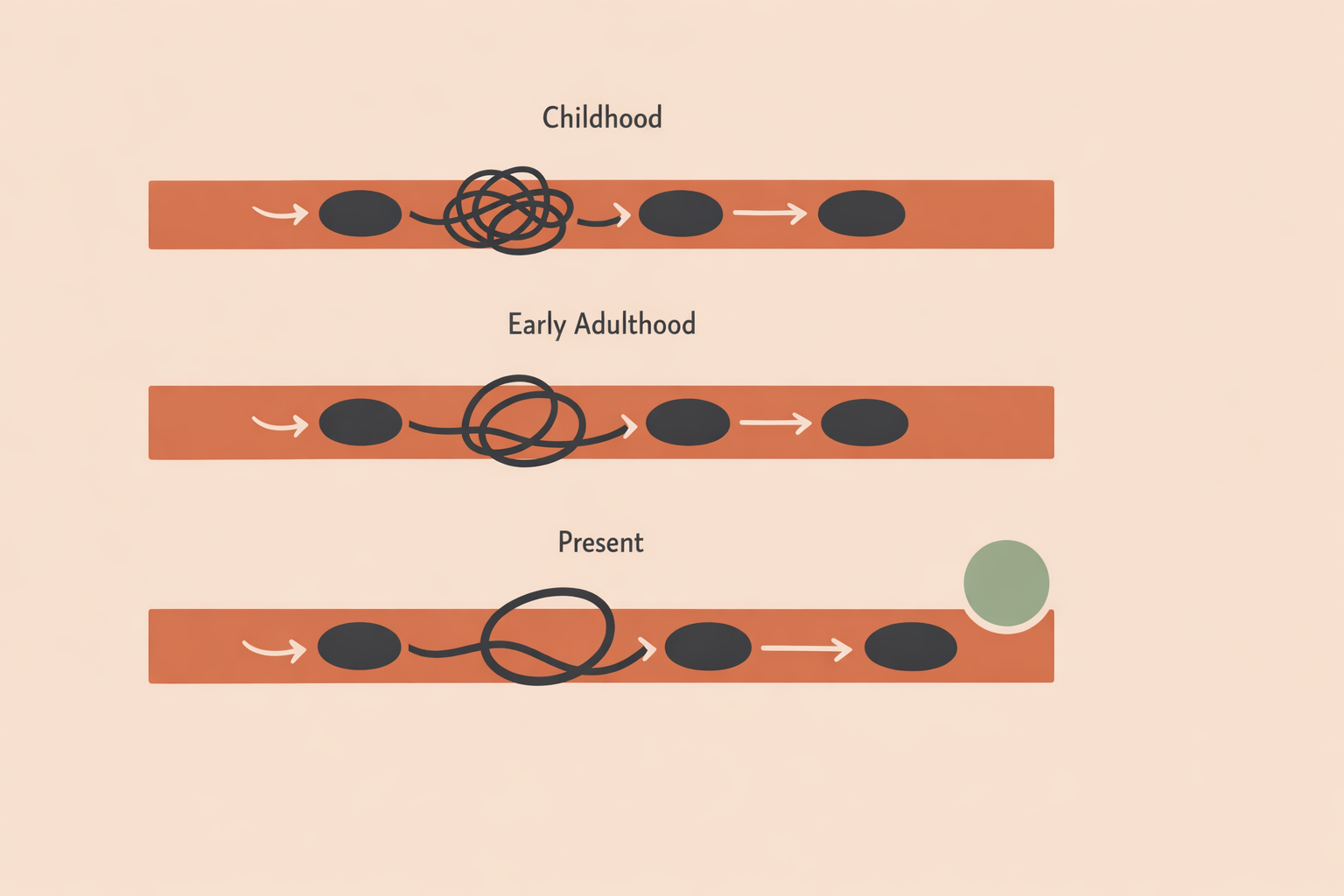
A three-timeline map turns insight into a practical picture. Instead of gathering stories, you track one repeating sequence across different eras: what the body did, what behavior followed, and what meaning was assigned.
This usually reveals the same script in three forms:
- an early imprint
- an echo in adolescence or early adulthood
- a present-day micro-pattern that still runs automatically
Seeing the layers side by side makes interruption easier. The loop stops looking random or “personal,” and starts looking like learned sequencing that can be updated.
Timeline 1: Childhood and family imprints
Begin with the original learning environment, focusing on pattern rather than detailed retelling. The goal is to understand what the body learned about closeness, difference, conflict, and belonging.
Simple prompts often open the right doors:
- What happened when you had a need?
- What happened when you disagreed?
- Who became big, small, silent, or responsible?
- What did your body learn to do to stay connected?
Much of this is stored as felt sense rather than clear memory. A client might not recall many events yet still notice their chest collapses when asking for support, or their jaw tightens the moment tension appears. Those signals are highly relevant because they show implicit learning still running today.
It can also be helpful to include family and ancestral themes with care and respect. Many people inherit relational rules such as “stay useful,” “keep the peace,” “don’t need too much,” or “handle it alone.” These are often carried through posture, pacing, tone, and attention long before anyone names them.
A short map might look like this:
- Early rule: Don’t make a fuss.
- Body response: shoulders round, voice softens.
- Family theme: love is shown through duty.
- Adaptation: become easy, helpful, low-maintenance.
Timeline 2: Early-adult echoes of the same script
Next, track the same pattern into later relationships and roles. This is where the template often reappears with partners, friendships, work dynamics, and authority figures. The surface details change, but the emotional logic stays familiar.
Common examples include:
- moving quickly toward intense closeness, then panicking when distance appears
- becoming indispensable in order to feel secure, then feeling unseen
- withholding needs until resentment builds
- equating inconsistency with chemistry
This timeline shows how hope can turn into reenactment. The person usually is not “choosing pain”; they are moving toward a kind of connection their system already knows how to navigate.
When early love and chaos were tangled together, later relationships often carry the same charge. That pull makes sense when you remember that early attachment shapes later relational expectations and threat-safety encoding.
A practical way to map this is with a simple grid: across the top, list key relationships or roles; down the side, note what pulled the person in, what felt at risk, what happened in the body, and how they responded. The repeating logic usually appears quickly.
Timeline 3: Present-day micro-patterns and state shifts
This is the most actionable layer. Look for small, repeatable moments that flip the system from settled into activated, braced, appeasing, or shut down.
Keep the focus on what happens now:
- What cue starts the spiral?
- What changes first in the body?
- What action follows within seconds or minutes?
- What story appears right after that?
Common cues include a delayed reply, a flat tone, a cancelled plan, praise that feels too intense, or a moment of emotional distance. The visible behavior might be texting again, overexplaining, going silent, becoming hyper-useful, or mentally checking out. Underneath, there is always a state shift, and that is what you want to track.
Link each behavior to the inner sentence it carries. The loop becomes clear when it can be written like this: “Cue: delayed response. State: chest tightens, breath holds. Behavior: sends three more messages. Meaning: I am being left.”
That specificity shows exactly where support belongs.
Weaving the three timelines into one relational loop
Once the timelines are mapped, bring them into one sequence:
- cue
- state shift
- behavior
- consequence
- meaning
This helps the client experience one coherent pattern rather than a pile of separate memories. Childhood reveals the original rule, early adulthood shows how it was reinforced, and the present shows how it still runs in daily moments.
A combined loop might read like this:
- Core rule: needing others is risky.
- Cue: someone becomes less responsive.
- State: chest contracts, thoughts speed up.
- Behavior: overfunctions or chases.
- Consequence: exhaustion, resentment, less genuine closeness.
- Meaning: I must work to keep connection.
Also notice where the loop has already begun to soften. If the client pauses sooner, names a need more directly, or recovers faster after relational stress, those shifts are meaningful evidence that the system is learning a new outcome.
Bringing the map alive with somatic and vibrational repatterning
Once the loop is visible, introduce a different experience right where the old sequence usually takes over. This is where Deep Neural Repatterning becomes practical, using sensation, rhythm, breath, voice, and attention to support a new response.
Work with state before story, a core principle in both nervous system regulation and neuroscience and brain health. In a charged moment, short regulation is often more effective than more explanation. Reliable options include:
- lengthening the exhale
- pressing the feet into the floor
- softening the jaw and tongue
- placing a hand over heart or low belly
- orienting to the room with slow eye movement
Then add vibrational support where it fits the client and the context. Humming, toning, rhythmic rocking, gentle tapping, or slow stepping can help the body settle enough to stay present with a new choice, especially when talking makes the loop louder.
Keep micro-experiments small and repeatable, much like the body-led pacing used in shifting emotional triggers in real time:
- Instead of sending a fourth message, take two breaths and wait ten minutes.
- Before offering help, ask what is actually wanted.
- When the urge to disappear appears, name one true feeling out loud.
- After a tense exchange, return attention to the feet before speaking again.
Transitional states can offer useful material too. Many clients notice symbolic imagery as they drift to sleep or wake up, and those images can reflect ongoing inner processes with surprising clarity. Often it’s enough to notice the image, stay with the body’s response, and let breath or sound support integration without forcing an interpretation.
Close sessions clearly. A brief ending ritual helps the system register completion, and corrective experience is one way new predictions begin to take root.
How new relational patterns consolidate
Change comes through repetition. Repeated experiences of attunement, clearer boundaries, and reliable repair gradually reshape expectation toward safety, and repeated repair plays a central role in how relational security develops.
As a person’s baseline steadies, they can tolerate moments that don’t match the old script without rushing to fix, chase, or shut down. Expanding that capacity is part of loosening repetition over time, much like the window of tolerance framework suggests.
In real life, progress often looks modest at first: slower reactions, cleaner boundaries, less overexplaining, more rest after hard conversations, and a growing ability to stay connected without abandoning the self. These are strong markers of a new pathway forming.
Conclusion
Three-timeline mapping brings order and compassion to repeating relationship patterns. It helps a practitioner see what was learned, how it echoed through later experiences, and where it still lives in present-day state shifts.
From there, the work becomes grounded and practical. Support the client to notice the cue, meet the state, and practice a different response in real time, then repeat that new sequence until it becomes familiar.
A few cautions belong here. Move at a pace the nervous system can absorb, and choose practices that feel culturally respectful and personally safe for the client. When a pattern involves overwhelming activation or shutdown, it’s wise to keep experiments very small and prioritize steady support. The aim is not to erase the past; it is to help the system discover that connection can feel different now: steadier, kinder, and more spacious than the old script allowed.
Train in Deep Neural Repatterning
Deep Neural Repatterning Certification helps you apply timeline mapping with somatic and vibrational regulation in real sessions.
Explore Deep Neural Repatterning →