


Christian Marriage Rescue Coach Access
Faith-based marriage coaching strategies designed to strengthen connection, unity, and spiritual alignment.


11
Modules
14h 59min
Audio lessons
4.9/5
Course Reviews
∞
Lifetime access
Features
This course includes

11 modules
Complete curriculum

10 PDFs
Downloadable guides

14h 59min of audio course content.
Narrated lessons

Interactive quizzes
Test your knowledge

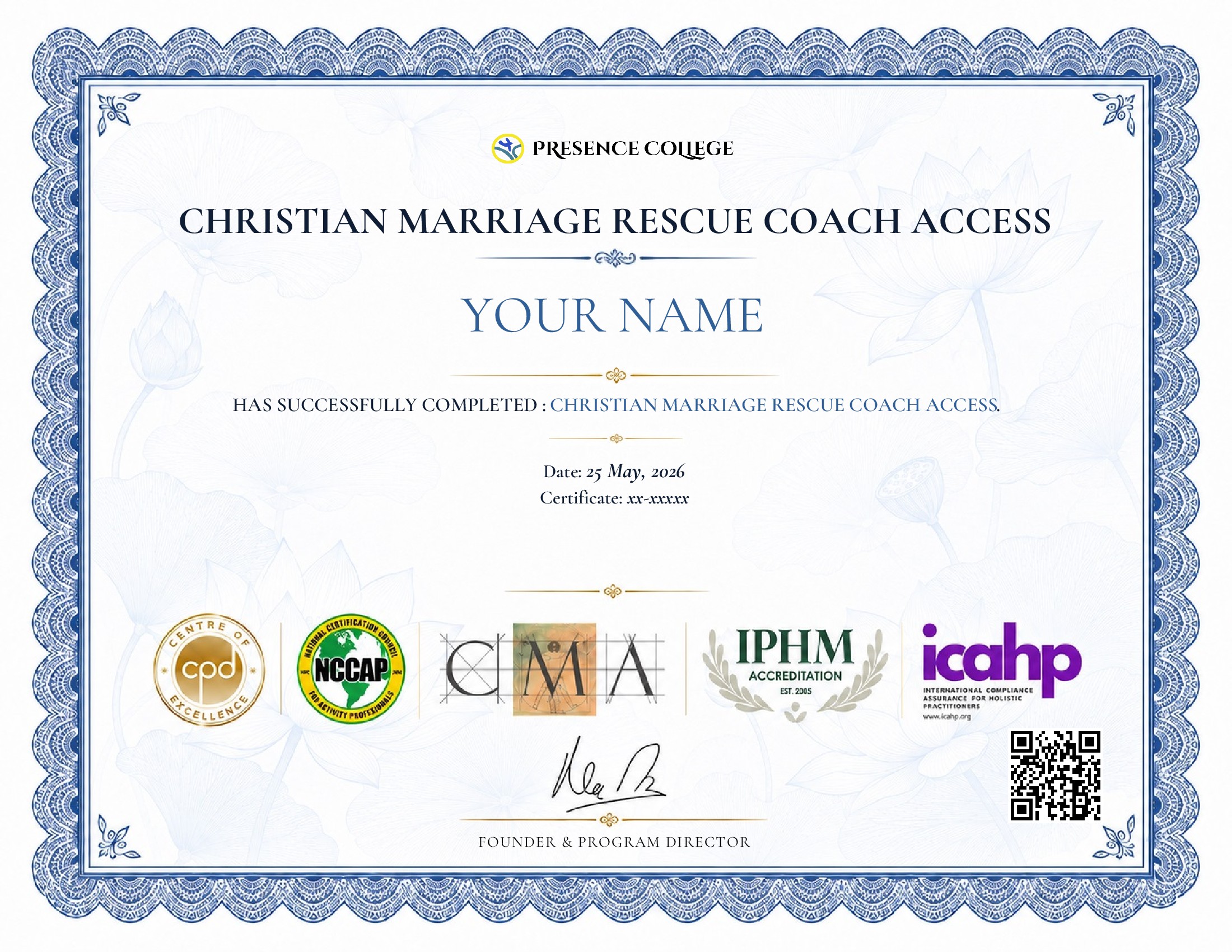
Certificate of completion
Awarded when you finish

Insurance eligible (ICHAP)
Coverage-ready credential

Lifetime access
Accessible 24/7 on any device

Weekly live Q&A
Live session every week
Overview
Course description
Not sure where to start? Follow a path
Curated routes through our accredited certifications — start with the foundations, then specialise. Each path concentrates the courses for one field in one place.
7 courses
Animal Wellness
Care for animals the holistic way. Accredited, self-paced certifications in natural animal...
5 courses
Child & Adolescent Development
Support children, teens and the adults raising them. Accredited, self-paced certifications...
4 courses
Creative & Expressive Therapies
Help people say what words alone can't. Accredited, self-paced certifications in art-based...
11 courses
Energy Healing
Learn to work with the body's subtle energy — professionally and with confidence. Accredit...
8 courses
Herbalism & Plant Medicine
From garden to apothecary. Accredited, self-paced certifications in herbal medicine — grow...
6 courses
Hypnotherapy & NLP
Work with the mind beneath the mind. Accredited, self-paced certifications in professional...
7 courses
Longevity & Biohacking
Coach the long game. Accredited, self-paced certifications in longevity science, biohackin...
12 courses
Mental Health Frameworks
Learn the frameworks the helping professions are built on. Accredited, self-paced certific...
9 courses
Mindset & Behavior Change
Change is a skill — learn to coach it. Accredited, self-paced certifications in transforma...
8 courses
Nature & Outdoor Therapy
Take your practice outside. Accredited, self-paced certifications in forest, water and gar...
10 courses
Neurodiversity & Learning Differences
Become the coach who understands how different minds work. Accredited, self-paced certific...
8 courses
Neuroscience & Brain Health
Coach with the brain in mind. Accredited, self-paced certifications in applied neuroscienc...
9 courses
Nutrition & Diet
Coach the way people eat — and the way they think about eating. Accredited, self-paced cer...
4 courses
Positive Psychology & Wellbeing
Coach what's strong, not just what's wrong. Accredited, self-paced certifications in the s...
6 courses
Purpose & Life Design
Help people design lives they actually want. Accredited, self-paced certifications in life...
4 courses
Relationships & Intimacy
Coach the connections that shape everything else. Accredited, self-paced certifications in...
8 courses
Self Sufficiency & Sustainability
Learn to provide for yourself — and teach others to. Accredited, self-paced certifications...
10 courses
Spirituality & Ritual
Hold space for the sacred. Accredited, self-paced certifications in spiritual coaching, ce...
4 courses
Traditional & Eastern Medicine
Study the world's great healing systems. Accredited, self-paced certifications in naturopa...
8 courses
Trauma & Emotional Healing
Support people through what hurt them. Accredited, self-paced certifications in trauma-inf...
9 courses
Women's Health & Fertility
Coach women through the transitions that matter most. Accredited, self-paced certification...
 Modules
Course syllabus
Module 1: Biblical Foundations of Marriage and Covenant
1:06:36
Marriage
is an integral part of the biblical framework for life, community, and
spiritual formation. The biblical paradigm views marriage as a God-established
covenant that defines and dictates the moral, relational and spiritual
dimension of all society. Since Genesis 1, marriage has appeared as part of
God's design, first and foremost as a description of humanity and the
purposeful plan of God to have human companions who work together for the
continuation of life, and finally as one aspect of his creational purpose to be
shared in covenant relationship. Understanding this creation of man and woman
as a design of marriage for coaching to marriage rescue provides the
theological framework for coaching intervention for couples experiencing
marriage failure.
Current
trends indicate that our culture tends to view marriage as something temporary
that should be based on a feeling of satisfaction with the relationship at a
given moment in time. The biblical paradigm for marriage, in contrast, views
marriage as a covenant, an agreement marked by faith, commitment, selfless
devotion to another person, and spiritual intimacy. Couples are likely to
experience instability in their marriage relationship when they cease to
function with this view of their marriage. Coaches who desire to work in
situations involving a marriage in crisis must be able to base their coaching
intervention on sound theology, which will not alter when cultural fads and
popular trends shift.
In
this module we examine the theology that defines Christian marriage, starting
from creation and an examination of the doctrine of covenant, as well as
exploring the duties each spouse has toward the other. Finally we will examine
the doctrine of marriage as found in the New Testament, which depicts marriage
as a living metaphor of the covenant relationship that exists between Christ
and the Church.
Through these biblical, theological foundations, marriage rescue coaches are equipped and grounded in a philosophy that provides principles by which to approach a troubled marriage. They understand marriage as a covenant, which enables coaches to minister to couples facing relational crises with assurance and clarity.
Module 2: Understanding the Causes of Marital Breakdown
1:22:57
To effectively
coach a marriage in distress, we must first have an understanding of the ways
in which relationships fail. Marriages do not often break down due to one or
more major incidents. Rather, a relationship often deteriorates as the
accumulation of many unresolved relational conflicts, emotional distancing and
disconnection, unmet expectations, and personal challenges occur. If we are to
assist a marriage in rescue, it is imperative that the coach knows the real
reason why they have broken down, in order to bring restoration to their
marriage.
Most couples that
present for coaching appear as if they are "just now" having problems
or that "just one thing" brought their marriage to crisis. Often, a
crisis occurs but the relational patterns are already under the surface. Communication
problems that arise between spouses, emotional hurts and pain that were not
dealt with, external pressures and challenges that place additional burdens on
a relationship, and individual insecurities or needs all contribute to a slow
erosion of trust and intimacy over time. As these influences continue to
undermine a relationship, hostility, bitterness, distance, and other relational
destructors often begin to take root and flourish in that marriage.
Having an
understanding of the root causes of marital problems and decay permits the
coach to move beyond the symptoms of the relational conflict and analyze the
deep underpinnings of that marriage. Once the coach understands relational
dynamics, they can guide a couple through discussion that truly addresses the
core issues that are causing the pain of the relationship instead of a
superficial examination of symptoms.
This module will
explore a number of major contributors to marriage breakdown. The topics
include: Relational dynamics that contribute to emotional distancing,
communication breakdown in marriage and the escalation of marital conflict,
external sources of stress on marital relationships and the toll they take, and
personal factors within a marriage that influence relationship dynamics.
It is crucial
that the coach can identify these underlying causal factors in the marriage in
order to wisely intervene.
Module 3: Marriage Crisis Assessment and Diagnosis
1:21:53
When
couples seek help for a marriage in crisis, they come with such intense
emotional charge that the nature of the crisis cannot always be readily
understood. One or both have recently felt such pain, or perhaps such hurt, or
perhaps such anger that their marriage feels like it cannot survive. Therefore,
it can feel necessary for couples that it be enough simply to eliminate the
most current problem or dispute. Successful marriage rescue coaching, however,
requires much more. One of the primary steps in effective marriage rescue must
involve accurate identification of the specific underlying dynamics within the
crisis marriage.
Marriage
crisis assessment takes into consideration the processes, behaviors, wounds and
relational history that contribute to the state of the marriage. In essence,
instead of simply focusing on immediate communication failure or anger,
coaching is able to address the more fundamental dynamics of the marriage
crisis. Marriage crises are typically the product of some sort of relationship
processes, the deep, invisible emotional wounds that were incurred, or simply
the sheer history of relational failure that has contributed to a feeling of
crisis.
Diagnosis
in the marriage crisis setting does not mean labeling people but understanding
the system of relational interaction that is happening between two people. A
marriage is a dynamic partnership where the attitudes of each partner influence
the other. One cannot work in marriage rescue without understanding that each
person contributes to the health or sickness of the relationship. Once an
appropriate assessment of the relational system can be made, a coach is able to
identify the appropriate approach to marriage rescue.
This
module introduces marriage crisis assessment: how to determine root causes and
relational processes and strategies for helping couples regain their
relationship from a state of crisis.
Module 4: Restoring Communication in Distressed Marriages
1:16:50
Communication is critical to the success of a marriage.
Communication in marriage consists of exchanging affection, defining
expectations, navigating disagreements, and creating shared meaning. As long as
couples communicate in a healthy and respectful manner, the relationship grows
stronger; but when the dialogue is negative or disrespectful, marriages tend to
enter a vicious cycle of misunderstanding, defensiveness, and escalation of
conflict. For most distressed couples, negative communication patterns are not
just a symptom; they are the means through which relationships are damaged.
During discussions, conversations are often full of
irritation, blame, or silence. Petty disagreements may quickly become angry
clashes and subsequent rounds of defense or silence will often take place.
These dysfunctional communication patterns will erode the emotional connection
and security of the marriage so that husband and wife may become incapable of
approaching one another openly, honestly and sympathetically even when
attempting to make up.
Helping troubled couples overcome this communication
breakdown is not as simple as asking them to talk more. Instead, spouses must
be educated regarding the particular negative patterns that interfere with
healthy communication, and taught how to engage in skillful behaviors that
create clarity, mutual respect, and emotional control. The basic components of
healthy communication include listening and responding with thoughtfulness and
sensitivity to one's spouse, and a manner of approaching disagreements with
respect rather than antagonism. Indeed, there must be an emphasis placed upon a
culture of respect in the marital relationship.
In the subsequent topics, we discuss those dysfunctional
communication patterns that cause relational damage, and also examine skillful
communications behaviors that repair it. It is by recognizing, disrupting, and
ultimately replacing unhealthy communication behaviors with healthier
communication skills that a marriage rescue coach can help the distressed
couple to create emotional and relational security again.
Module 5: Rebuilding Trust and Healing Betrayal
1:17:01
Though communication problems and conflict are slow to pull
couples apart, a betrayal often creates an immediate breach of trust. The
emotional safety of the marriage is compromised, and spouses can both feel a
sense of chaos, fear, and deep emotional woundedness. Coaching couples out of
that crisis is a role requiring wisdom, a steady presence, and a clear
framework of hope.
Trust is the bedrock of a close marriage. Without it,
intimacy will not thrive; without it, couples can hardly hope for cooperation,
transparency, or emotional safety. When trust is broken, as it so often is
through an affair, dishonesty or deception, secrecy, or simply repeated broken
promises, the betrayed spouse is often struck by confusion, shock, grief, and a
profound sense of grief. Simultaneously, the transgressing spouse may struggle
with remorse, guilt, fear of repercussions, and confusion.
Restoring trust is much more than an apology or a verbal
commitment. It is a long process of demonstrating trustworthiness and restoring
emotional safety.Healingfrom a betrayal involves both internal, individual work
on emotional recovery and a complete re-creation of the marital relationship
through long-term commitment, behavioral change, and renewed transparency. It
will involve healing from the emotional pain, while the relationship moves
toward reconstruction.
This module covers a model for navigating the difficult
process of reestablishing trust within a marriage after a betrayal. Through
exploring emotional wounding, taking accountability, finding forgiveness and
establishing long-term credibility, we hope couples can emerge from the crisis
stronger and wiser.
Module 6: Emotional Healing and Personal Growth in Marriage
1:27:02
A marriage is not about two heartless
people getting married, but about two individuals with two whole histories
entering a relationship together. A marriage brings two people together who
carry with them childhood experiences, previous relationships, personal
failures, life successes, and strongly defined beliefs about love and security.
Each couple is a couple made up of two whole histories influencing the couple's
behavior during times of conflict, intimacy, criticism, and vulnerability.
Emotional scars, if not dealt with, are brought to marriage in many contexts
that leave a husband or wife perplexed, frustrated or caught in cycles of
disappointment, grief and uncertainty
The basis for much conflict in a
marriage often lies not in current events but in past pain. “The thorns in
their flesh.” An insecure person who fears abandonment, may lash out at a
subtle instance of distance. An person who received criticism in childhood may
not receive feedback constructively and respond defensively. These two people,
if not awakened to their history, will view their responses as involuntary.
Slowly emotional reactivity overshadows empathy and insecurities become
perceived instead of being hidden. Emotional healing in marriage means
acknowledging our histories and developing emotional maturity about our
responses. Maturity requires self awareness and commitment. While the couple
begins to shed themselves of detrimental emotional habits, compassion and
stability can begin to replace their previous reactions and resentment.
This module covers individual
woundedness and its effects on marital interaction, developing emotional
maturity, releasing destructive emotional habits and the process of finding
wholeness through spiritual healing in marriage. Emotional healing goes beyond
reducing conflict, it can increase connection, and build a lasting strong
marriage.
Module 7: Restoring Intimacy and Sexual Connection
1:23:51
Married intimacy involves far more than just the physical
dimension of a relationship. Instead, it encompasses emotional unity, spiritual
oneness, mutual trust, and physical contact all integrated together within a
covenant relationship. Couples whose intimacy becomes threatened usually become
withdrawn, irritated, and disoriented. It is very rare for a couple's sexual
union to be disconnected and nothing more. Usually it's only one piece of a
larger problem like a strained relationship, insecurity, hurt feelings that
were never voiced, or spiritual alienation. To restore marriage intimacy, one
must address the entire marriage instead of just focusing on one particular
behavior.
The Scripture view on the married union views it as
relational as well as sacred. It claims that "The two shall become one
flesh" (Genesis 2:24 New King James Version). This one flesh includes
both emotional and physical unity. A sexual union should serve as a reminder of
commitment and unity with one's spouse, increase affection, and cultivate
delight in the other person. Conflict, betrayal, stress, and negligence in the
relationship will threaten and damage a couple's sexual unity and require an
extensive time for restoration.
Restoring intimate contact involves an investment from each
person's self. It requires humility, transparency, security in the
relationship, renewed trust, and gentleness. One cannot rush restoration after
experiencing deep wounds that inhibit openness and vulnerability to one
another; first, the couple must recreate the emotional bond.
This module will examine the relationship between emotional
union and sexual oneness, will identify obstacles which often get in the way of
marital intimacy, and will present practical and spiritual steps toward
achieving intimacy once again within a marriage.
Module 8: Conflict Resolution and Reconciliation Strategies
1:09:15
Conflict is inherent in marriage. Two people with different
personalities, pasts, perspectives, expectations and ways of communicating will
inevitably have disagreements. Conflict doesn't mean failure in marriage; it
means we will do a good job or a bad job of handling it. Conflict handled
poorly leads to bitterness, loss of trust, and deeper resentment. Conflict
handled well can lead to personal growth, intimacy, and a greater love and
understanding of your spouse.
The Bible does acknowledge that we as humans will struggle to
get along, but gives principles to help work through these conflicts. “A
soft answer turns away wrath, but a harsh word stirs up anger” (Proverbs
15:1 New King James Version). We can learn how our words will either pour oil
on the fire, or extinguish the flame. Often conflicts turn nasty not because of
what was said, but due to our tone, our defensiveness, or our unwillingness to
let go of what we have been feeling. Similarly, "Be angry, and do not
sin": do not let the sun go down on your wrath” (Ephesians 4:26 New
King James Version). Anger itself is permitted, but it must be handled
constructively instead of destructively.
Healthy conflict resolution requires skills that must be
practiced. These are active listening, respectful talking, identifying the core
issue, and seeking to bring peace instead of winning. “So then, my beloved
brethren, let every man be swift to hear, slow to speak, slow to wrath”
(James 1:19 New King James Version).
Reconciliation in marriage goes beyond making up after a
disagreement. It's about making sure emotional ties are re-established and the
covenant relationship is renewed. “If it is possible, as much as depends on
you, live peaceably with all men.” (Romans 12:18 New King James Version).
Making up will be a vital and important part of your marriage.
In this module we will be learning strategies that can aid a
couple in managing conflicts constructively and pursuing reconciliation. We can
work toward putting godly principles to work along with communication tools to
turn our conflicts from a source of destruction to one of intimacy.
Module 9: Coaching Strategies for Marriage Rescue
1:15:51
Beyond a sensitive presence and a willingness to believe, the
practice of marriage rescue coaching requires systematic intervention, clinical
insight, spiritual discernment, and deliberate strategy. Couples that arrive at
marriage rescue coaching are typically in crisis; communication has broken
down, trust may be damaged, emotional distance is palpable, and repetitive,
destructive argument patterns have taken hold. The coach’s role here is less
about comforting and more about discerning, stabilizing, directing and
equipping. Distressed marriages exist within heightened emotional worlds.
A conversation can quickly become out of control, blame can
take over, despair can feel absolute or defenses can become concrete barriers
to the partners connecting with and hearing one another. When the coach lacks a
coaching framework and strategy, a coaching session is apt to devolve into the
familiar airing of the latest dispute rather than equip the couple with skills
to manage conflict and grow connection. A coaching strategy holds the
conversation in a structured space. Marriage rescue coaching incorporates
principles of emotion regulation, accountability, skill building, and spiritual
formation where applicable. It endeavors to move beneath surface-level issues
and bring them to the core dynamics at play. It endeavors to transform the
dynamics that lead to argument and disconnect and cultivate new ways of
interacting, such as fostering deeper respect, repairing trust, rebuilding
intimacy, building more effective communication habits and fostering
accountability.
And yet, it simultaneously attends to issues such as power,
history, trauma and the reality of potential harm. This module addresses how to
guide couples through the process from crisis into stability. It details
assessment approaches, session design, intervention methods, and plans for
establishing long-term stability. While coaching cannot provide immediate
healing, it can create a framework within which healing may occur. Through
diligent strategy and the humble servant leadership, coaching may provide an
intentional path toward renewed connection, understanding, and covenant
commitment.
Module 10: Building a Christian Marriage Rescue Coaching Practice
1:18:39
The creation of a Christian marriage rescue coaching practice
is not the culmination but rather an integrated part of restoration. While
prior lessons focused on rescuing and reforming, this lesson will emphasize the
role of the coach in her leadership, stewardship and building role. The
development of a coaching practice demands: a coherent mission, diligent
organization and moral accountability. A lack of attention to the framework
will compromise even the most talented coaches' ability to impact the lasting
viability of her clients.
Solomon writes in Proverbs 24:3-4 (New King James Version), "Through
wisdom a house is built, and by understanding it is established; by knowledge
the rooms are filled with all precious and pleasant riches." A
coaching ministry follows the same blueprint. Wisdom inspires the vision.
Understanding creates the framework. Knowledge provides the service to clients.
And a Christian marriage rescue practice should be both biblical and competent.
In this module, we move into the nuts and bolts of
establishing and growing a coaching practice. We will touch upon the mechanics
of program structure, various coaching package options, ethical issues such as
maintaining boundaries, and increasing reach by teaching and generating
resources.
A Christian marriage coach is both an authority in faith
based relationship strategies and a servant. Clients who are suffering need to
be understood and have the opportunity to receive guidance and accountability.
Thus, a coaching practice should unite personal growth with practical,
measurable pathways to change.
A marriage rescue practice is also one of stewardship. It
demands that we protect confidentiality, establish boundaries, promote our
credibility and use systems that assist the couples we are called to help.
Where there is a vision coupled with ethical professionalism and Christian
character, a coaching practice becomes an anchor and haven for hurting
marriages.
Final Exam
This Quiz consists of 40
multiple-choice questions. The total
score of this Quiz is equivalent to 40. Students must score a total of 85% to
pass.
Benefits
Why Choose Naturalistico?
Instant access
Get instant lifetime access to all the course content
Certified in United States
Our Certification Protects and Insures Your Practice
475.8K Students
Join a Growing Global Community of Coaches
Try 30 days free
30-day money-back guarantee on all courses
 Certification
Our certifications are internationally recognized
Our certificates are accredited by IPHM (International Practitioners of Holistic Medicine), CMA (The Complementary Medical Association), and the CPD (Centre of Excellence), which means that they have been assessed and recognized internationally.
Course Provider
Meet the institution behind your course

Presence College
Specialization
Coaching & Counseling
Market your practice
Courses
Christian Counselor Certificate
Christian Life Coach Certificate
Christian Wellness Coach
Christian Finance Coach
Christian Deliverance Counselor
JesusLearn.com is an innovative online platform dedicated to fostering a deeper understanding of the teachings of Jesus Christ. The website offers a wealth of resources, including articles, videos, and interactive courses designed to engage users in exploring Christian faith and biblical principles. With a user-friendly interface, it caters to individuals of all ages, from those new to Christianity to seasoned believers seeking to deepen their knowledge. One of the standout features of JesusLearn.com is its community aspect, allowing users to connect with one another through discussion forums and study groups. This collaborative environment encourages shared learning and support among members. Additionally, the site provides valuable tools for personal reflection and spiritual growth, making it an essential resource for anyone looking to enhance their faith journey. Overall, JesusLearn.com is a comprehensive and accessible platform for anyone interested in exploring the teachings of Jesus in a meaningful way.
Compare
Why practitioners choose Naturalistico
| Features | Our approach Naturalistico $97.00, accredited, self-paced | ICF / PAAC Programs $4,000.00 to $13,000.00 | University Degrees $40,000.00 to $120,000.00 |
|---|---|---|---|
| Tuition | $97.00 | $4,000.00 to $13,000.00 | $40,000.00+ |
| Format | Self-paced, fully online | Live cohorts, scheduled | In-person or hybrid |
| Time to complete | Around 40 hours | 6 to 24 months | 2 to 6 years |
| Accreditation | IPHM, CPD, CMA | ICF, PAAC | Regional academic |
| Best for | Practitioners who want a credible, affordable credential | Those needing ICF or PAAC for a specific role | Clinical or academic career paths |
| Ongoing access | Lifetime access, no extra fees | Limited, varies by program | Alumni access only |
| Refund policy | 30-day money-back guarantee | Limited or none | None |
Instructors
Meet the Team and Speakers Guiding You Towards Success
Our team brings decades of experience and internationally recognized credentials to every course.






Cassidy R
Yoga, Meditation Instructor & Support Specialist
Bradley Kell
Clinical Dietitian

Practitioners certified across 6 continents
Limited Time Offer
$2,503.00
96% OFF
Total package value
Enroll today for only
$97.00
Pay $97.00 — get everything below included.
A $2,503.00 package — a premium Naturalistico certification, pro marketing training, live classes, business software, and a worldwide student community — all included with your enrollment today.
- Get certified to attract more clients
- Run your practice with pro business tools
- Learn live & connect with students worldwide
 Benefits
Frequently Asked Questions
You have the questions, we have the answers.
How do I sign up for a course?
Just pick the course you’re interested in and click “Add to cart.” When you’re ready, head to the checkout and complete your payment. You’ll get a confirmation email right away. If you want a printed certificate, you can choose that during checkout too!
How long does it take to complete a course?
That really depends on how many pages you go through per day or week, and of course, on your previous experience. The course is completely online and self-paced, so there are no deadlines. Once you’ve purchased the course, you’ll have lifetime access to all the material. It’s made up of several modules, some are lighter, while others a bit heavier. For most students, completing the entire course takes around 40 hours.
If I need help with the course, can I ask a question?
Yes, absolutely. The student forum is available for this purpose, you can post your questions and either a mentor or another student will get back to you, usually within 48 hours (excluding weekends and holidays). And feel free to share your wins too!
I can’t log in or forgot my password, what should I do?
Start by checking your inbox and spam folder for your login email, especially if it’s your first time logging in. Make sure you're using the same email address you used when signing up and that you're on the correct website. If needed, click “Forgot Password?” on the login page and follow the steps to reset it. If the email doesn't arrive, double-check your spam folder and try again. Still having trouble? Just reach out to our support team at [email protected], we're happy to help and usually respond within 48 hours (excluding weekends and holidays). We recommend saving your login details when you receive your registration email to avoid any issues later on.
Do I need to attend anything live, or can I study whenever it suits me?
The entire course takes place online and is fully self-paced, so you can study whenever it suits you best. There are no trips, workshops, or live classes required. You’ll get access to course modules as downloadable PDFs, audio files, and in some cases, videos. You study independently in your own time, and if you have any questions, you’re always welcome to ask them in the forum.
How am I assessed during the course?
You’ll find short quizzes at the end of each module to help you reflect on what you’ve learned, they’re NOT graded and are just for your own understanding. At the end of the course, there’s a final multiple-choice exam that is graded. You’ll need to score at least 80% to pass. Don’t worry, if you do not achieve 80% your first time, you can retake the exam at any time.
Are there any prerequisites?
There are no prerequisites or minimum educational requirements. All our courses are carefully designed to be accessible to as many people as possible. You can study from a computer, tablet, or smartphone. If your internet connection is unstable, we recommend downloading the PDF modules and audio files so you can access them offline whenever it suits you. Just keep in mind that you’ll need an internet connection to complete the quizzes and take the final exam.
Do I receive a certificate at the end of the course?
You will receive a printed certificate if you selected that option during registration. Otherwise, you can order it later at any time from your student portal under the "Certificates" section – OR download it for free as a PDF.
Are your certificates officially accredited, or are they just for personal development?
The professions for which our courses prepare you are part of the unregulated occupations in most countries. This means there is no official recognition. However, local regulations may vary. We recommend that you inquire with the relevant authorities. Our courses are designed to provide essential foundational knowledge, making them an excellent starting point for anyone looking to enter a new field or expand their expertise. They equip you with practical skills and a deep understanding of the subject matter, enabling you to either begin your career or enhance your existing expertise in a cost-effective way. Our courses are accredited by respected international organisations. That said, the fields we train for aren’t regulated in most countries, so recognition can vary depending on where you live. It’s always a good idea to double-check with local authorities if you're unsure.
Why are the courses sometimes discounted so much?
We believe that quality education should be accessible to everyone, not just a privilege for a few. From time to time, we offer significant discounts to open the door for more people to learn, grow, and discover new opportunities. It’s part of our mission to make personal and professional development more inclusive, regardless of budget.
Limited Time Offer
Christian Marriage Rescue Coach Access
30-day money-back guarantee on all courses
Enroll today for only
$97.00
$395.00 · 75% OFF
- Lifetime access
- Certificate included
- 30-day guarantee
30-day Refund

Naturalistico Support
Typically replies in seconds
🎓 Get certified today — 75% off
Hi — questions about this course? 👋
Ask me anything about the Christian Marriage Rescue Coach Access — the price, the accreditation, how it is taught, or the refund. Or pick a topic below.
Powered by Naturalistico
Christian Marriage Rescue Coach Access for $97.00
 30-days guarantee


