


Christian Homeschool Operator


11
Modules
12h 22min
Audio lessons
∞
Lifetime access
Features
This course includes

11 modules
Complete curriculum

10 PDFs
Downloadable guides

12h 22min of audio course content.
Narrated lessons

Interactive quizzes
Test your knowledge

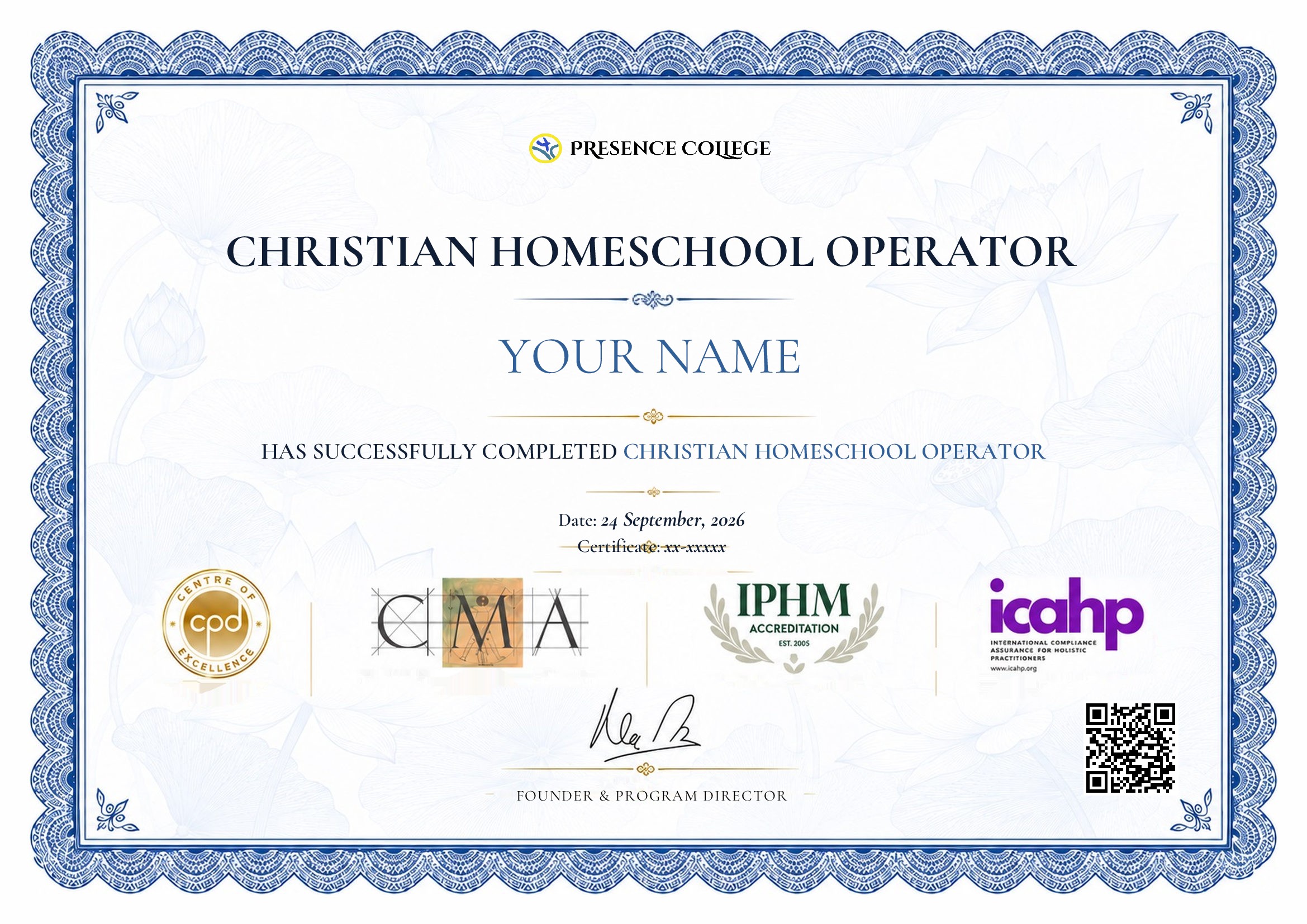
Certificate of completion
Awarded when you finish

Insurance eligible (ICHAP)
Coverage-ready credential

Lifetime access
Accessible 24/7 on any device

Weekly live Q&A
Live session every week
Overview
Course description
Not sure where to start? Follow a path
Curated routes through our accredited certifications — start with the foundations, then specialise. Each path concentrates the courses for one field in one place.
7 courses
Animal Wellness
Care for animals the holistic way. Accredited, self-paced certifications in natural animal...
5 courses
Child & Adolescent Development
Support children, teens and the adults raising them. Accredited, self-paced certifications...
4 courses
Creative & Expressive Therapies
Help people say what words alone can't. Accredited, self-paced certifications in art-based...
11 courses
Energy Healing
Learn to work with the body's subtle energy — professionally and with confidence. Accredit...
8 courses
Herbalism & Plant Medicine
From garden to apothecary. Accredited, self-paced certifications in herbal medicine — grow...
6 courses
Hypnotherapy & NLP
Work with the mind beneath the mind. Accredited, self-paced certifications in professional...
7 courses
Longevity & Biohacking
Coach the long game. Accredited, self-paced certifications in longevity science, biohackin...
12 courses
Mental Health Frameworks
Learn the frameworks the helping professions are built on. Accredited, self-paced certific...
9 courses
Mindset & Behavior Change
Change is a skill — learn to coach it. Accredited, self-paced certifications in transforma...
8 courses
Nature & Outdoor Therapy
Take your practice outside. Accredited, self-paced certifications in forest, water and gar...
10 courses
Neurodiversity & Learning Differences
Become the coach who understands how different minds work. Accredited, self-paced certific...
8 courses
Neuroscience & Brain Health
Coach with the brain in mind. Accredited, self-paced certifications in applied neuroscienc...
9 courses
Nutrition & Diet
Coach the way people eat — and the way they think about eating. Accredited, self-paced cer...
4 courses
Positive Psychology & Wellbeing
Coach what's strong, not just what's wrong. Accredited, self-paced certifications in the s...
6 courses
Purpose & Life Design
Help people design lives they actually want. Accredited, self-paced certifications in life...
4 courses
Relationships & Intimacy
Coach the connections that shape everything else. Accredited, self-paced certifications in...
8 courses
Self Sufficiency & Sustainability
Learn to provide for yourself — and teach others to. Accredited, self-paced certifications...
10 courses
Spirituality & Ritual
Hold space for the sacred. Accredited, self-paced certifications in spiritual coaching, ce...
4 courses
Traditional & Eastern Medicine
Study the world's great healing systems. Accredited, self-paced certifications in naturopa...
8 courses
Trauma & Emotional Healing
Support people through what hurt them. Accredited, self-paced certifications in trauma-inf...
9 courses
Women's Health & Fertility
Coach women through the transitions that matter most. Accredited, self-paced certification...
 Modules
Course syllabus
Module 1: Foundations of the Christian Homeschool Operator
1:01:28
Operating a homeschool
is almost like operating a ship. It involves many interconnected parts that
work best when properly coordinated. You have an academic program to navigate,
students to check in on, details to log, deadlines to meet, choices to make,
and a future trajectory to follow. Handled in isolation, the program itself
quickly feels unmanageable.
Homeschool Operators
don’t need to run everything alone, and they shouldn’t, but they must
understand how each component of the program works, how these components
interconnect, and when the route should change.
The course of study,
curriculum, or education program is where the content/subject matter lies and
how that subject matter is sequenced over time. The curriculum provider's role
involves a variety of services, from providing curricular material, exams, and
support to keeping student records or other items as required by the program.
An education authority role involves setting requirements to follow under law
or educational policy within its jurisdiction. The specific role and authority
will vary from case to case, but a person or group still needs to bring
together the different requirements/materials in a homeschooled context.
The role requires good
judgment, organization, a clear focus, and a grasp of how the different
elements of the program connect. When the homeschool is underpinned by
Christian faith, Scripture gives the convictions that shape the educational
direction of that program, whilst academic demands, or a sound framework for
education, dictate the structure within which the program functions.
This module introduced
the groundwork of this work and asks what makes education distinctively
Christian; what the obligations of the homeschool operator are; what framework
the program functions within; and it has begun to define the direction the
program must continue in.
Module 2: Organizing the Academic Program
47:32
After choosing the
curriculum, it must be shaped into a practical arrangement for the year. Where
the curriculum specifies what to teach, the program shows when it will happen.
Assigning a particular
subject to a certain school day is not enough for an academic program. The
curriculum requires various types of academic tasks, each requiring its own
time commitment. Lessons, reading, assignments, projects, tests, submissions,
etc., all need time. Some tasks depend on previous tasks, while others must
reach definite milestones at certain times.
The aim is to
integrate all these elements into a practical program.
This process starts
with the academic units defined in the curriculum. The sequence and significant
stages within the academic units are identified, and their respective locations
are plotted within the actual timeframes given throughout the school year.
School terms/holidays are mapped out so that all available course time is clear
from the outset.
Then, the program is
transposed onto individual school days and teaching periods. Resource time is
then divided among lessons, student work time, experiments, etc. The final step
is the implementation of materials, resources, and lessons, along with allocating
teaching responsibilities.
Each stage is
interconnected with the others, and each has a clear goal. Maintaining these
boundaries ensures clear distinctions and supports any required modifications.
From a teacher's perspective, it means keeping the curriculum, calendar,
program, and its practical considerations as three separate entities within one
educational system, none of which can be substituted for another.
The result should be
an executable program for the entire academic year, providing order and keeping
in mind the practical aspects necessary for it to work.
Module 3: The Practice of Teaching
1:03:55
A strong, organized
homeschool program provides a skeleton for what we do day by day, but no matter
how well organized, it does not teach anyone. We may have our calendar in
place, our well-structured curriculum, and the day's program on our desk, but
the core work of teaching still involves engaging directly with another
person's work, facing the ideas he or she is working through.
Learning involves more
than spouting material and giving students the space to go through it. At times
we need to explain the idea clearly for the first time; at times we need to
refine a student's thinking with a question; at times a discussion will allow
an idea to be developed in greater detail. Sometimes what a student has
achieved gives us a chance to respond in a way that helps her or him understand
what he or she has managed to do and where further effort is needed.
These moments give us
opportunities to teach. These moments are largely about watching, listening,
and communicating clearly so the work can advance. Good teaching isn't about
following the script, but about judgment: knowing when an explanation is needed,
when a student is ready for a minute or two of reflection, when to ask a
question to push the subject further, and when a discussion is worth having.
This module focuses on the practical work that happens within those moments:
how we question, explain, discuss, and respond to student work as the student
makes his or her way through the curriculum.
Module 4: Understanding How Learning Develops
1:15:40
Learning is often
obvious from the outside and hard to grasp from the inside. We can see a child
reading a page, solving a math problem, writing up an answer, submitting an
assignment. These concrete things are indicators that learning is occurring,
but they don't tell the whole story. Something more is happening inside that
learner as they encounter, make sense of, remember, link to what they already
know, and ultimately use new information in their thinking.
This adds another
layer to education that we need to understand. A curriculum offers content, and
a teacher offers a delivery system, but learning is the process as the student
internalizes that knowledge. This distinction matters: a finished lesson and a
matured mind are two very different things.
If we think of
learning as growing a field, then we can regard its development like planting a
seed. We introduce the seed to the soil, and nothing more happens for a while.
The seed must take root, be nourished, grow, and produce the fruit that it was
created for. Similarly, providing access to information initiates learning, but
understanding, remembering, connecting, and thinking keep the resulting growth
going longer.
Scripture offers us a
rich vision for this process of growth and forming. Paul says, "I
planted, Apollos watered, but God gave the increase" (1 Corinthians
3:6, NKJV). The image shows a process that takes a long time to reach full
maturity. As we do our work in a homeschool program, this understanding shapes
how we interpret student progress and respond when something takes longer than
we anticipate. It enables us to differentiate between mere exposure and genuine
understanding, between rote memory and working knowledge, and between isolated
knowledge and comprehension.
The challenge before
us is much deeper than working our way through materials. We are laying the
groundwork for knowledge to be established, linked, understood, and mature into
full-minded academic thinking.
Module 5: Working With Different Stages of Education
1:10:28
A homeschool is a
group that includes children and young people at vastly different stages of
education. Some children are just starting formal education, while others are
tackling increasingly challenging work, and a young person might be well ahead
in preparation for exams, further education or training, or another educational
route. Though they share a home and a learning space, these children and young
people have very different needs.
As we manage such a
broad span of educational ages and stages, we need to be aware of how
development shapes the way children and young people respond to education. As
children grow, they develop their capacity for responsibility and independence,
for working hard, for responding to others, for making and acting on decisions,
and for engaging with their education. Our responsibilities as educators need
to develop alongside them.
Put another way, while
we can use age as an index to broadly mark out stages of education, individual
development supplies us with additional information. Children or young people
at the same age may still be working on new words, writing skills, responding
to directions, engagement, reasoning skills, communication, reading, writing,
and self-management. SpLD or neurodiversity also tells us that pupils can be
very talented academically whilst engaging with some aspects of their education
differently.
This in turn asks us
to exercise measured educational judgment. We need to consider the educational
stage, the individual young person, the work on the desk, and the future
direction of their education. Our role as educators evolves with the young
person, gradually taking on less as they become more responsible and mature.
Within a Christian
approach to education, we see this development within God's wider purpose. We
are stewards of God's creation, educating image-bearers towards wisdom,
faithfulness, responsibility, integrity, and character. Working through stages
of education brings us closer to this goal as individual young people grow in
maturity.
Module 6: Academic Standards and Quality of Work
1:03:34
School is a large
portion of your homeschool day. Every assignment, written answer, problem,
research assignment, project, and paper can help each student develop habits
that will influence their approach to work outside of school. From the
homeschool administrator's perspective, responsibility for school isn't just
providing a curriculum and making sure things get done. We set the bar for the
quality of work in our homes.
Developing quality is
achieved through practice. Over time, children will learn to identify
high-quality work, be accountable for what they produce, identify the areas for
improvement in their work, and subsequently improve it. These tasks will not
come naturally to children and can't be assumed. Children differ greatly in
maturity, ability, experience, and learning style. The standard must thus be
consistently defined and skillfully applied.
Christian education
enhances this ability. Our classroom activities are an opportunity to develop
character as well as scholars. Paul encourages us that, “And whatever you
do, do it heartily, as to the Lord and not to men.” Colossians 3:23 (NEW
KING JAMES VERSION). Academic efforts are one of those everyday environments to
help develop this initiative, faithfulness, honesty, and stewardship.
This module explores
how we define standards for important academic work, develop personal work
habits, support our students in raising the standard of their work, and
encourage academic integrity. We strive for a homeschool environment where
students understand that good work comes with responsibility. In the long run,
we want students to value quality, seek it diligently, polish their own work,
and speak with integrity.
Module 7: Managing Academic Challenges
1:03:34
Some days in
homeschool go exactly as planned. Others do not. It might take a lot longer
than you thought to get through a lesson. A student who is usually so capable
struggles to get through an assignment. Work starts to build up. One subject
seems to be really irritating when we finally pull it out of the cupboard.
Before we know it, we are looking at the timetable and trying to remember how
we got so far behind. Sometimes our homeschool throws us a curveball just as we
have carefully created a solid academic program. Our first thought may be to
give the whole program a shove, try to pull things back into shape, or make up
for lost time in a hurry. On occasions, that will be the solution. Other times,
it will cause even more problems.
First, we need a clear
idea of what is actually happening. A child struggling with one assignment may
have simply stumbled across difficult material. A student who struggles with
the same kind of work week after week presents a different picture. A short-term
setback following a busy week is to be expected. Falling further week after
week suggests a different course of action. A long interruption following
extended family illness or a family crisis suggests yet another response.
Knowing the difference between these things is fundamental to doing homeschool
well.
And we need to
remember that difficulty in any area of our child's learning can have many
causes. There can be gaps in the knowledge being tested. The way the material
is put together can matter. The workload could have increased. A learning
profile can be impacted by another season of life. Sometimes we just get busy.
Whatever the cause, our job is to observe carefully, understand what we are
seeing, and then determine what to change.
The Bible uses a
proverb to describe the wisdom of making such careful choices: "The
simple believes every word, But the prudent considers well his steps"
(NEW KING JAMES VERSION). When an academic program starts to wobble, we do not
have to panic. Neither do we have to deny the wobble. We do need, though, to
understand what is going on well enough to take the right next step. This
module addresses what those next steps might be when we are experiencing
academic struggle.
Module 8: Assessment and Academic Evidence
1:00:25
Module 9: The Christian Formation of the Learner
53:23
What does it mean to
really teach? Is it memorizing data, or putting that data to use? Christian
homeschooling is lived out daily, character mingled with habits, conviction,
relationships, and responsibility. Our task is not only to communicate a
curriculum, but to consider each standard, each responsibility, each freedom,
correction, response, and submission to challenge, shape, and develop the
individuals we are teaching. Is learning just academics?
Scripture beautifully
speaks to the development of the entire person: "And Jesus increased in
wisdom and stature, and in favour with God and men." (Luke 2:52, New King James Version). That wisdom, stature, and favor include
relationship with God and others. Certainly, Christian education involves more
than academics. Homeschooling in day-to-day life creates opportunities for
students to practice faithfulness, diligence, humility, teachability,
discernment, and responsibility. We need wisdom to weigh maturity, set
expectations, offer support, and then delegate responsibility as they
demonstrate they are ready.
Discerning judgment is
no less important. Our learners will face so many claims, arguments, evidence,
and ideas to evaluate. Scripture exhorts: "Prove all things; hold fast
that which is good." (1 Thessalonians 5:21, NEW KING JAMES VERSION).
We must help our students develop the ability to critically analyze their world
while staying grounded in their faith. This module explores ways to
intentionally develop character, build discernment and responsibility, and
prepare learners for life outside the homeschool.
Module 10: The Educational Leader
1:02:08
Homeschool leadership
is not just about instruction and schoolwork. Envision the way a program
develops: who decides, who makes wise choices, who builds relationships, who
holds the whole thing together? The answer to that question is the most
fundamental feature of educational leadership.
In this certificate,
we have covered the principles and practices that make homeschool work. Now we
take a step back and consider how we lead the whole venture. Does it not call
for our stewardship of what binds these parts together?
If we think of a
household as a small educational organization, we can imagine how each aspect
fulfills its role, yet the operation only makes sense when someone recognizes
the whole, shares responsibilities, builds consensus, and attends to what
matters. Here lies the essence of leadership.
First, Christian
leadership begins in stewardship. The essentials entrusted to us require
faithfulness and prudence, humility and integrity. Responsibility is not just
given; it is God-given authority.
In the last module, we
covered four leadership concepts as a framework for the long-term health of our
homeschool: leading, governing, communicating, and sustaining. The goal is
mature educational leadership: confidence and humility, authority and accountability,
responsibility and faithful service.
Final Exam
Benefits
Why Choose Naturalistico?
Instant access
Get instant lifetime access to all the course content
Certified in United States
Our Certification Protects and Insures Your Practice
478.7K Students
Join a Growing Global Community of Coaches
Try 30 days free
30-day money-back guarantee on all courses
 Certification
Our certifications are internationally recognized
Our certificates are accredited by IPHM (International Practitioners of Holistic Medicine), CMA (The Complementary Medical Association), and the CPD (Centre of Excellence), which means that they have been assessed and recognized internationally.
Course Provider
Meet the institution behind your course

Presence College
Specialization
Coaching & Counseling
Market your practice
Courses
Christian Counselor
Christian Life Coach
Christian Wellness Coach
Christian Finance Coach
Christian Deliverance Counselor
JesusLearn.com is an innovative online platform dedicated to fostering a deeper understanding of the teachings of Jesus Christ. The website offers a wealth of resources, including articles, videos, and interactive courses designed to engage users in exploring Christian faith and biblical principles. With a user-friendly interface, it caters to individuals of all ages, from those new to Christianity to seasoned believers seeking to deepen their knowledge. One of the standout features of JesusLearn.com is its community aspect, allowing users to connect with one another through discussion forums and study groups. This collaborative environment encourages shared learning and support among members. Additionally, the site provides valuable tools for personal reflection and spiritual growth, making it an essential resource for anyone looking to enhance their faith journey. Overall, JesusLearn.com is a comprehensive and accessible platform for anyone interested in exploring the teachings of Jesus in a meaningful way.
Compare
Why practitioners choose Naturalistico
| Features | Our approach Naturalistico $97.00, accredited, self-paced | ICF / PAAC Programs $4,000.00 to $13,000.00 | University Degrees $40,000.00 to $120,000.00 |
|---|---|---|---|
| Tuition | $97.00 | $4,000.00 to $13,000.00 | $40,000.00+ |
| Format | Self-paced, fully online | Live cohorts, scheduled | In-person or hybrid |
| Time to complete | Around 40 hours | 6 to 24 months | 2 to 6 years |
| Accreditation | IPHM, CPD, CMA | ICF, PAAC | Regional academic |
| Best for | Practitioners who want a credible, affordable credential | Those needing ICF or PAAC for a specific role | Clinical or academic career paths |
| Ongoing access | Lifetime access, no extra fees | Limited, varies by program | Alumni access only |
| Refund policy | 30-day money-back guarantee | Limited or none | None |
Instructors
Meet the Team and Speakers Guiding You Towards Success
Our team brings decades of experience and internationally recognized credentials to every course.





Cassidy R
Yoga, Meditation Instructor & Support Specialist

Bradley Kell
Clinical Dietitian

Practitioners certified across 6 continents
Limited Time Offer
$2,503.00
96% OFF
Total package value
Enroll today for only
$97.00
Pay $97.00 — get everything below included.
A $2,503.00 package — a premium Naturalistico certification, pro marketing training, live classes, business software, and a worldwide student community — all included with your enrollment today.
- Get certified to attract more clients
- Run your practice with pro business tools
- Learn live & connect with students worldwide
 Benefits
Frequently Asked Questions
You have the questions, we have the answers.
How do I sign up for a course?
Just pick the course you’re interested in and click “Add to cart.” When you’re ready, head to the checkout and complete your payment. You’ll get a confirmation email right away. If you want a printed certificate, you can choose that during checkout too!
How long does it take to complete a course?
That really depends on how many pages you go through per day or week, and of course, on your previous experience. The course is completely online and self-paced, so there are no deadlines. Once you’ve purchased the course, you’ll have lifetime access to all the material. It’s made up of several modules, some are lighter, while others a bit heavier. For most students, completing the entire course takes around 40 hours.
If I need help with the course, can I ask a question?
Yes, absolutely. The student forum is available for this purpose, you can post your questions and either a mentor or another student will get back to you, usually within 48 hours (excluding weekends and holidays). And feel free to share your wins too!
I can’t log in or forgot my password, what should I do?
Start by checking your inbox and spam folder for your login email, especially if it’s your first time logging in. Make sure you're using the same email address you used when signing up and that you're on the correct website. If needed, click “Forgot Password?” on the login page and follow the steps to reset it. If the email doesn't arrive, double-check your spam folder and try again. Still having trouble? Just reach out to our support team at [email protected], we're happy to help and usually respond within 48 hours (excluding weekends and holidays). We recommend saving your login details when you receive your registration email to avoid any issues later on.
Do I need to attend anything live, or can I study whenever it suits me?
The entire course takes place online and is fully self-paced, so you can study whenever it suits you best. There are no trips, workshops, or live classes required. You’ll get access to course modules as downloadable PDFs, audio files, and in some cases, videos. You study independently in your own time, and if you have any questions, you’re always welcome to ask them in the forum.
How am I assessed during the course?
You’ll find short quizzes at the end of each module to help you reflect on what you’ve learned, they’re NOT graded and are just for your own understanding. At the end of the course, there’s a final multiple-choice exam that is graded. You’ll need to score at least 80% to pass. Don’t worry, if you do not achieve 80% your first time, you can retake the exam at any time.
Are there any prerequisites?
There are no prerequisites or minimum educational requirements. All our courses are carefully designed to be accessible to as many people as possible. You can study from a computer, tablet, or smartphone. If your internet connection is unstable, we recommend downloading the PDF modules and audio files so you can access them offline whenever it suits you. Just keep in mind that you’ll need an internet connection to complete the quizzes and take the final exam.
Do I receive a certificate at the end of the course?
You will receive a printed certificate if you selected that option during registration. Otherwise, you can order it later at any time from your student portal under the "Certificates" section – OR download it for free as a PDF.
Are your certificates officially accredited, or are they just for personal development?
The professions for which our courses prepare you are part of the unregulated occupations in most countries. This means there is no official recognition. However, local regulations may vary. We recommend that you inquire with the relevant authorities. Our courses are designed to provide essential foundational knowledge, making them an excellent starting point for anyone looking to enter a new field or expand their expertise. They equip you with practical skills and a deep understanding of the subject matter, enabling you to either begin your career or enhance your existing expertise in a cost-effective way. Our courses are accredited by respected international organisations. That said, the fields we train for aren’t regulated in most countries, so recognition can vary depending on where you live. It’s always a good idea to double-check with local authorities if you're unsure.
Why are the courses sometimes discounted so much?
We believe that quality education should be accessible to everyone, not just a privilege for a few. From time to time, we offer significant discounts to open the door for more people to learn, grow, and discover new opportunities. It’s part of our mission to make personal and professional development more inclusive, regardless of budget.
Limited Time Offer
Christian Homeschool Operator
30-day money-back guarantee on all courses
Enroll today for only
$97.00
$395.00 · 75% OFF
- Lifetime access
- Certificate included
- 30-day guarantee
30-day Refund

Naturalistico Support
Typically replies in seconds
🎓 Get certified today — 75% off
Hi — questions about this course? 👋
Ask me anything about the Christian Homeschool Operator — the price, the accreditation, how it is taught, or the refund. Or pick a topic below.
Powered by Naturalistico
Christian Homeschool Operator for $97.00
 30-days guarantee


