Many beginners try to learn meridians by memorizing point names, hunting for anatomical “proof,” or turning the meridian clock into a strict timetable. It can feel productive, but the practice stays in the head. The chart becomes information rather than something you can feel and work with.
A better starting point is to treat the 14 main meridians as a practical traditional language for daily balance within Traditional & Eastern Medicine. They help you organize sensations, mood shifts, and energy changes across the day, then respond through breath, posture, movement, and gentle touch.
Key Takeaway: The 14 meridians are easiest to learn when you use them as a traditional map rather than hidden anatomy. The 12 primary channels and 2 central vessels become much more memorable when grouped into Yin–Yang pairs and applied through short, non-invasive practices. For beginners, steady micro-practices, clear observation, and respectful use of tradition go further than trying to master every point at once.
Why the 14 Main Meridians Still Matter in Daily Practice
The classical meridian map matters because it gives structure to lived experience. Instead of seeing tension, restlessness, heaviness, or scattered focus as random, you start noticing patterns you can work with.
In traditional practice, meridian theory developed over centuries of observing how breath, posture, digestion, and emotions move together. That long, careful observation is part of its strength: it trains you to notice relationships, not isolated symptoms.
Even today, this framework remains widely recognized. Public overviews describe TCM-related traditions as widely used, and the reference map of 12 major meridians plus 2 central vessels continues to anchor most study and practice.
For beginners, the gift of the map is orientation without overwhelm. You do not need to memorize every point to get results. You only need a simple way to observe, choose one small lever, and notice what changes.
If you wake feeling rushed and tight through the chest, try exploring the Lung–Large Intestine pairing: take one minute of longer exhales, then briskly rub down the outer arms toward the hands. This kind of small reset often shifts “tight and stuck” into something more workable.
- Simple ways to start:
- Morning: 10 slow breaths with soft shoulders.
- Midday: roll the shoulders, then rub the outer arms toward the hands.
- Evening: warm the feet and massage the inner legs upward.
See Meridians as a Traditional Map, Not Hidden Anatomy
The most helpful early shift is to stop treating meridians as physical structures you should be able to locate under the skin. In practice, they function as a traditional map of relationships you learn through experience.
This distinction is also reflected in modern summaries. Reviews describing the meridian system discuss the 12 major meridians and 2 central vessels, while reporting no viable evidence for meridians as physiological structures. For a beginner, that is clarifying, not discouraging.
Within Traditional Chinese Medicine, names such as Lung, Liver, and Spleen describe functional networks rather than one-to-one matches with biomedical organs. That is why the language remains useful for guiding practice even when it does not map neatly onto modern anatomy.
Once you accept the map on its own terms, learning gets simpler. You focus on patterns like inner and outer, rising and settling, holding and releasing, then choose a small practice to influence that pattern.
It also improves how you speak about what you notice. Instead of declaring that something is “blocked,” you can describe the felt quality and the direction you want to encourage, which keeps the work grounded and practical.
During a late-night work sprint, for example, you might notice a tight upper back and a racing mind. Framing that through the Governing and Conception vessels, then spending 90 seconds on slower, lower breathing, often softens the shoulders and steadies mental pace enough to make a better next choice.
The 14 Meridians at a Glance
The traditional beginner’s map includes 12 primary meridians and 2 central vessels. Together, they create a whole-body framework that becomes easy to navigate once you learn its basic structure.
The 12 primaries are Lung, Large Intestine, Stomach, Spleen, Heart, Small Intestine, Bladder, Kidney, Pericardium, Triple Burner, Gallbladder, and Liver. The 2 central vessels are the Governing Vessel and the Conception Vessel.
A practical way to remember them is through the six Yin–Yang pairs:
- Lung – Large Intestine
- Spleen – Stomach
- Heart – Small Intestine
- Kidney – Bladder
- Pericardium – Triple Burner
- Liver – Gallbladder
Most practitioners keep the system usable by thinking in these pairs rather than trying to hold dozens of details at once. The pairings make the map teachable and easy to apply day to day.
You may also hear about the meridian clock, a traditional 24-hour rhythm that assigns a two-hour window to each channel. It works best as an orienting rhythm for noticing patterns, not as a rigid schedule you must follow.
Learn Through the Six Yin–Yang Partnerships
If you remember only one thing, remember the pairs. They give the system shape and help you connect reflection to a simple action.
The Yin side of a paired channel tends to be more interior, nourishing, and consolidating. The Yang side tends to be more exterior, moving, and protective. This single idea can carry a lot of practical learning.
Use the pairs as themes rather than fixed labels:
- Lung–Large Intestine: receive and let go.
- Spleen–Stomach: gather, transform, and sustain.
- Heart–Small Intestine: clarity and discernment.
- Kidney–Bladder: reserves, steadiness, and regulation.
- Pericardium–Triple Burner: boundaries and circulation.
- Liver–Gallbladder: direction and decision.
These qualities are not personality traits. They are changeable states, and they often respond well to breath, posture, warmth, pacing, and attention.
When you hit a mid-afternoon slump, explore the Spleen–Stomach theme with a warm, steadying reset. When you feel scattered before a decision, bring attention to the Liver–Gallbladder theme with grounding movement through the feet and gentle opening through the sides of the body.
Governing and Conception Vessels: Your Central Axis
After the six pairs, the two central vessels complete the picture. They give you a simple way to check front–back balance and adjust quickly.
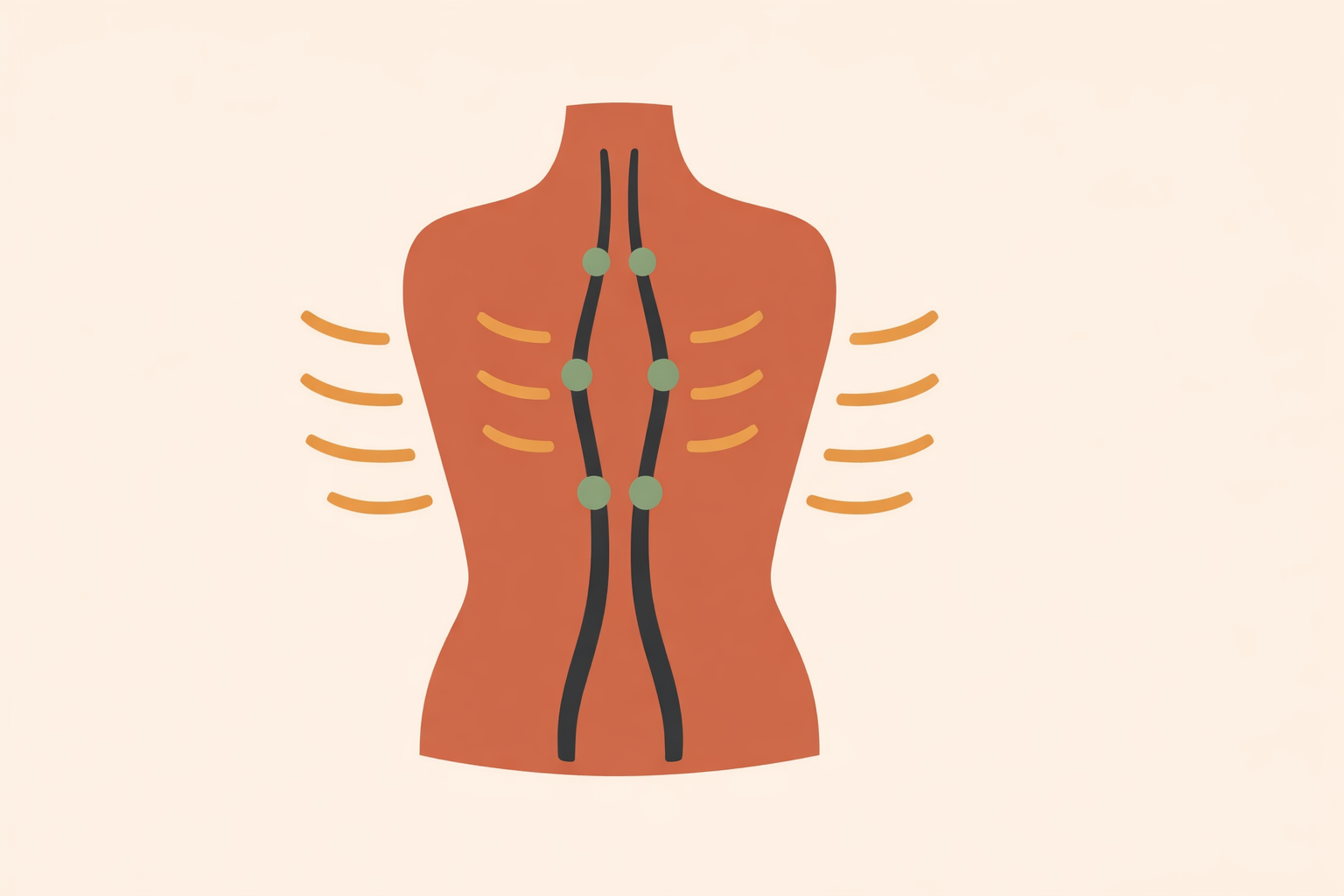
The Governing Vessel is associated with the back midline and a more Yang quality: uprightness, activation, outward expression. The Conception Vessel is associated with the front midline and a more Yin quality: settling, receiving, and nourishment.
This framing makes posture and breathing more informative. When you feel collapsed, back-body support often helps. When you feel overdriven, front-body softening often changes the whole tone.
- Try this 2-minute reset:
- Stand with feet hip-width apart.
- Place one hand on the lower belly and one on the upper back.
- Breathe lower and slower for 10 breaths.
- Notice whether front-body ease or back-body support changes things more.
Used this way, the two vessels become a direct, quick check-in for whether you need to settle, organize, or blend the two.
From Chart to Experience Through Breath and Movement
Charts teach names; movement teaches relationships. That is why slow, coordinated movement is taught across many lineages as a first step for sensing pathways and qualities.
Qigong is often understood as a blend of posture, breath, attention, and slow movement. For beginners, that combination turns the meridian map into something you can actually feel and repeat.
As you practice, channel qualities become easier to recognize: gathering and dispersing, rising and settling, bracing and softening. Over time, these differences get clearer and require less effort to notice.
- Beginner-friendly 5-minute sequence:
- Wave breathing: breathe into the belly and soften down through the legs.
- Arm tracing: sweep the hands up the front of the body and release them down the outer arms.
- Spinal line: imagine gentle length through the back body as the jaw and chest soften.
- Side flow: sway side to side with easy reaches through the arms.
- Close: rest one hand near the navel and one over the chest for a few slower breaths.
The goal is sensitivity, not performance. You are training awareness of how breath, movement, and attention shift your overall tone.
Gentle Acupressure and Self-Massage Along the Meridians
Once the pathways start to feel familiar, gentle touch can deepen the practice. For beginners, non-invasive touch is the right entry point.
This also supports good boundaries. Public guidance notes that when acupuncture is delivered improperly, there can be serious risks, which is why needle-based work belongs with qualified practitioners rather than self-experimentation.
Acupressure and self-massage keep things lighter and more exploratory while still being meaningful.
- Useful beginner guidelines:
- Hold a point for 30 to 90 seconds.
- Repeat 1 to 3 times if it still feels comfortable.
- Use pressure that feels clear but not forceful.
- Stop immediately if you notice sharp, burning, electric, or radiating pain, numbness, tingling, dizziness, nausea, faintness, or bruising.
A simple self-session might include the fleshy web of the hand, the inner forearm, or the top of the foot, followed by a quiet pause to notice the effect. In practice, a short and gentle session often teaches more than doing too much at once.
A brief note afterward helps you learn quickly. Over time, a simple log shows what feels settling, what feels activating, and what fits best at different times of day.
Use Reflection to Build a Personal Meridian Map
The meridian framework becomes far more valuable when you reflect consistently. The skill is noticing patterns, then responding with steadiness and kindness.
A classic organizer is the Eight Principles: interior and exterior, cold and heat, deficiency and excess, Yin and Yang. For beginners, it offers a straightforward way to categorize what you’re experiencing without locking you into a fixed conclusion.
This reflection stays practical when you keep it linked to action. Notice what tends to respond to warmth, rest, movement, slower breathing, steadier meals, or clearer boundaries, then choose one small adjustment.
- Try a 2-minute daily note:
- Where do I feel open, and where do I feel tight?
- Does my breath feel high and fast, low and slow, or mixed?
- Which Yin–Yang pair best matches today’s pattern?
- What micro-practice did I choose?
- What shifted afterward?
Tracking helps you recognize your own tendencies. Consistent micro-practices such as breath, warmth, tracing, gentle point-holding, and posture adjustments can add up to steadier energy and kinder pacing.
Practice with Respect, Simplicity, and Good Sense
Meridian work is most useful when it guides rather than judges. The map is there to support awareness, not to make you rigid or self-critical.
Keep the work simple and gentle, and let direct experience teach you over time. If something feels too intense, stop and return to a smaller step.
It also matters to respect the roots of these teachings. They come from long cultural lineages and deserve careful, non-superficial use. Approach them with openness, avoid appropriation, and remember that traditional knowledge and modern evidence use different kinds of language.
With steady practice, the 14 meridians become less like a chart and more like a usable inner vocabulary. You notice a pattern, choose a small adjustment, and create a little more space and steadiness in your day.
Go Further with TCM Foundations
Build on meridian basics with Traditional Chinese Medicine Foundations and turn observation into steady, practical daily routines.
Explore TCM Foundations →