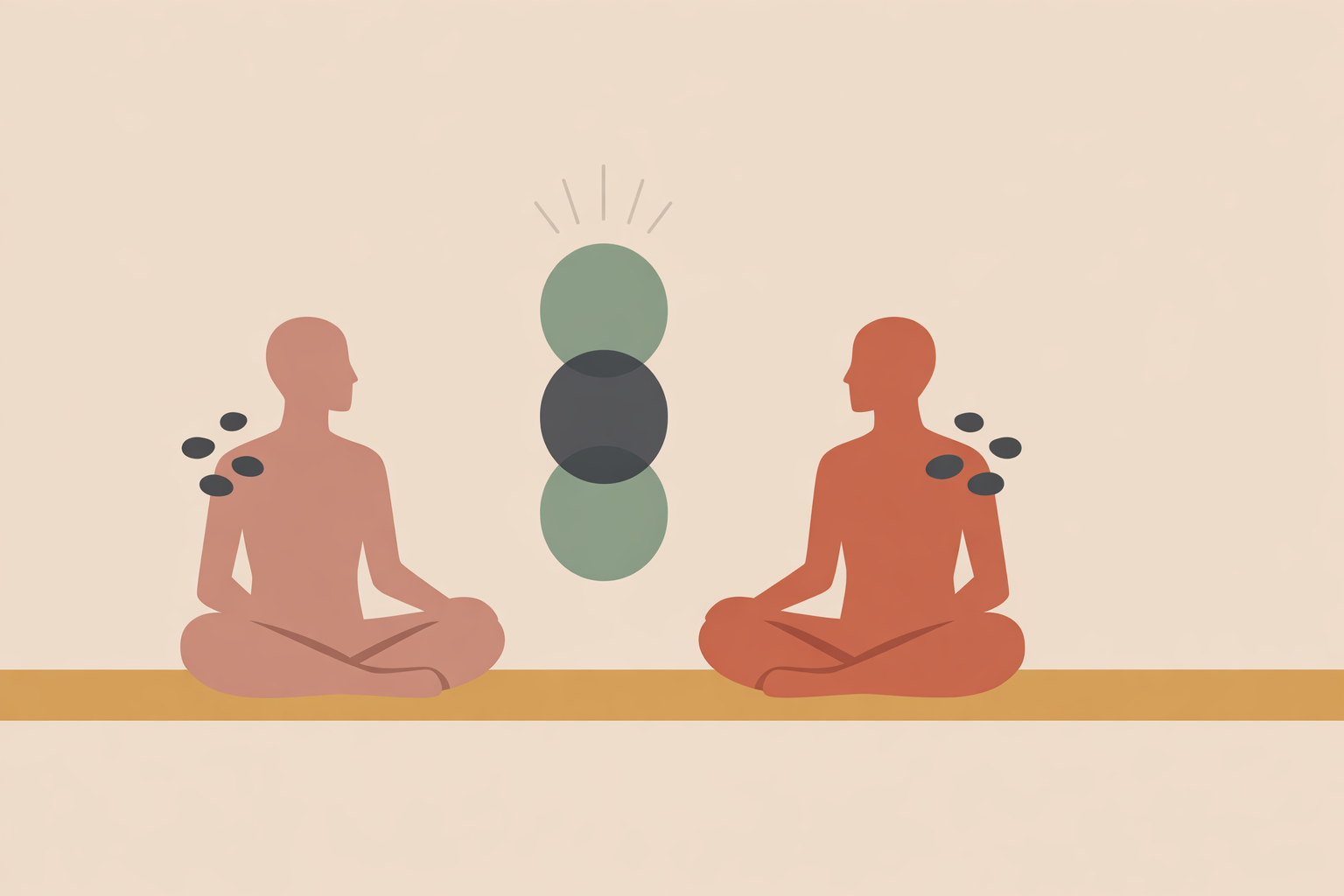
Many facilitators build cacao ceremonies by stacking activities—a playlist, a prompt, a partner share, a song—and hoping the room will open. Sometimes it does. Other times the space feels flat or overamped, with participants unsure how much to drink, whether to speak, or how to opt out.
Most of the difference comes down to structure: pacing, consent, and cultural clarity. When those are in place, cacao feels like a held ritual rather than another workshop.
Key Takeaway: A grounded cacao ceremony works best as a paced, consent-centered arc rather than a stack of activities. Awakening sets the tone through arrival, agreements, and a gentle first sip; Softening creates quiet space for inward attention without promising specific outcomes; Connecting widens the circle through respectful acknowledgments and opt-in sharing; Expressing gives the room a voice through sound and movement without pressure; Integrating closes the space with reflection, hydration, and clear closure. Across every stage, the essentials are steadiness, choice, and cultural respect.
1. Awakening: Begin with Grounding Before the First Sip
The strongest openings are simple. Before anyone drinks, let the room land. People arrive carrying the momentum of the day, and the ceremony changes when that momentum is gently slowed.
A short settling practice can shift the tone quickly: a few quiet breaths, a brief orientation, and a basic body scan usually move the group from social arrival into shared presence.
You might say: “We’ll sip cacao soon. First, feel the support beneath you. Inhale gently, exhale slowly. Notice your shoulders, jaw, and belly. Nothing to fix—just arriving.”
Only then invite the first taste. Cacao contains theobromine and smaller amounts of caffeine, and many facilitators associate that with a gentle wakeful quality. Starting slowly helps people notice what’s already present in their body before anything intensifies.
Set expectations with clean, respectful language. Name cacao as a sacred food and relational practice, not a shortcut and not a guarantee. It also helps to say plainly that cacao is not psychedelic, and that experiences vary with the blend, sensitivity, and the wider setting.
A simple opening flow might look like this:
- Arrival agreements: phones silent, participation is opt-in, stepping out is welcome.
- Grounding: a few slow breaths and a body scan from feet upward.
- Orientation: name the shape of the evening and normalize choice.
- First sip: smell, hold, and taste slowly together.
- Quiet: rest in silence or a single sustained tone.
When the beginning is steady, people tend to awaken gently rather than being pushed into intensity too soon.
2. Softening: Create Space for Warmth Without Forcing Meaning
After the first sip, the room often settles on its own. Attention turns inward, and conversation naturally drops away. This is where less facilitation is often more effective.
Hold the space with invitational language. You might say: “Notice your breath. Notice any warmth, heaviness, spaciousness, or nothing much at all. All responses are welcome.”
That last line protects the room. Some people feel tender, reflective, or emotionally open. Others feel neutral and simply appreciate the pause. A good ceremony makes space for the full range, rather than scripting a shared emotional outcome.
Short, low-pressure practices support this stage well:
- Breath: lengthen the exhale and let the body settle.
- Journaling: “What is more present now than when I arrived?”
- Listening: use spacious, minimal sound with plenty of room around it.
Boundaries are part of the softness. No one needs to make eye contact, finish their cup, or speak. Predictable pacing and clear exits help people relax because they know they have choice.
You can say this plainly: “You can pause, rest, or step outside at any time.”
Many things shape how people feel here: the pace, the music, the permission to slow down, and the experience of being held without demand. Cacao supports the container, and the container supports the people.
3. Connecting: Let Shared Cacao Become a Bridge
Once the room has softened, connection can widen naturally. Build it lightly. Moving too fast into deep sharing can create pressure before trust has had time to grow.
Begin with acknowledgment. Cacao has deep roots in Mesoamerica, where it has long held social, ceremonial, and communal significance, including as a social bond. Naming that history with care places the gathering in honest context.
A simple acknowledgment might sound like this: “We honor the Indigenous peoples of Mesoamerica who have tended cacao across generations. We gather with respect, gratitude, and humility.”
From there, keep early shared moments low-pressure and opt-in:
- One-word round: each person may share one word for how they are arriving.
- Name and boundary: each person may name a boundary they are honoring tonight.
- Silent witnessing: a minute of quiet shared presence, with eyes lowered if preferred.
If you include prayer, song, or invocation, be transparent about the source and your relationship to it. This keeps distinct traditions distinct, and it supports respect grounded in accuracy, restraint, and reciprocity.
Posting your agreements helps here too. Choice, consent, confidentiality, and non-judgment are what create felt safety, especially for newcomers and in sacred space.
Held this way, cacao becomes a bridge of belonging rather than a stage for performance.
4. Expressing: Use Sound and Movement as Invitation, Not Pressure
After connection has formed, expression gives the ceremony a shared voice. It can be powerful without being loud. Gentle expression often lands the deepest.
Think of the music as a tide. Open spaciously, add a little rhythm, allow a soft crest, and then recede again.
- Open: drones, bowls, or other spacious sounds.
- Rise: light rhythm, simple percussion, or a steady pulse.
- Crest: one or two songs that invite humming or soft singing.
- Recede: ambient sound or silence.
Consent still leads. If you use bowls or other strong sound tools, tell people what’s coming and offer an easy way to create distance. For example: “I’m going to play the bowl briefly; if you prefer more distance from the sound, please take it.”
Vocal toning works well when framed lightly. Invite a hum on the exhale, and name silence as full participation. The aim is to offer a channel for expression that stays spacious and choice-based.
The same is true for movement. If you open a movement phase, set clear agreements first:
- No touch without clear verbal consent.
- Staying seated is full participation.
- There is nothing to get right.
Invitational cues keep things grounded: “You might roll your shoulders,” or “If it feels good, let your breath guide your pace.”
This style of facilitation tends to support the quality many people describe as heart-opening: steadiness and permission, held by the group.
5. Integrating: Close Clearly So the Experience Can Settle
How you end matters as much as how you begin. Integration is where the energy of the evening is digested and carried back into ordinary life.
Start by reducing stimulation. Let the music fade. Bring attention back to the floor, the chair, and the room itself. Offer water. Because cacao’s methylxanthines can contribute to mild diuretic effects and mild gastric effects for some people, hydration and simple snacks are sensible to have available.
Then guide reflection without demanding a breakthrough:
- Journaling: “What, if anything, feels different now?”
- Optional share: one word or one sentence, with passing always welcome.
- Reorientation: notice the walls, the doorway, and your feet on the ground.
A clear closure gives shape to the whole evening. You might offer thanks to cacao, to the lands and peoples connected to its stewardship, and to the group for how they showed up. Keep it sincere and unforced.
Then mark the end plainly: “This ceremony is now complete. You’re welcome to sit quietly, speak softly, or step outside when you’re ready.”
That clarity supports a smooth transition. Some people want conversation; others want privacy. Some feel deeply moved; others simply calmer than when they arrived. All of it belongs.
Holding the Full Arc with Integrity
A well-held cacao ceremony follows a steady arc: ground first, soften into quiet, build connection with care, invite expression without pressure, then close clearly. People open more easily when they feel safe, unhurried, and respected.
Integrity runs through every stage. Speak accurately about what you’re doing. Avoid borrowing the authority of traditions you do not belong to. Honor cacao’s cultural roots with humility, and let your facilitation be shaped by reciprocity rather than aesthetics.
In practice, the strongest ceremonies are rarely the most elaborate. They are the ones that stay consent-centered, culturally respectful, and clearly held from beginning to end, whether you are deepening your spirituality and ritual practice or refining your cacao ceremonial guide skills.
Train in Cacao Ceremony Holding
Deepen your facilitation approach with the Cacao Ceremonial Guide Certification.
Explore the Certification →