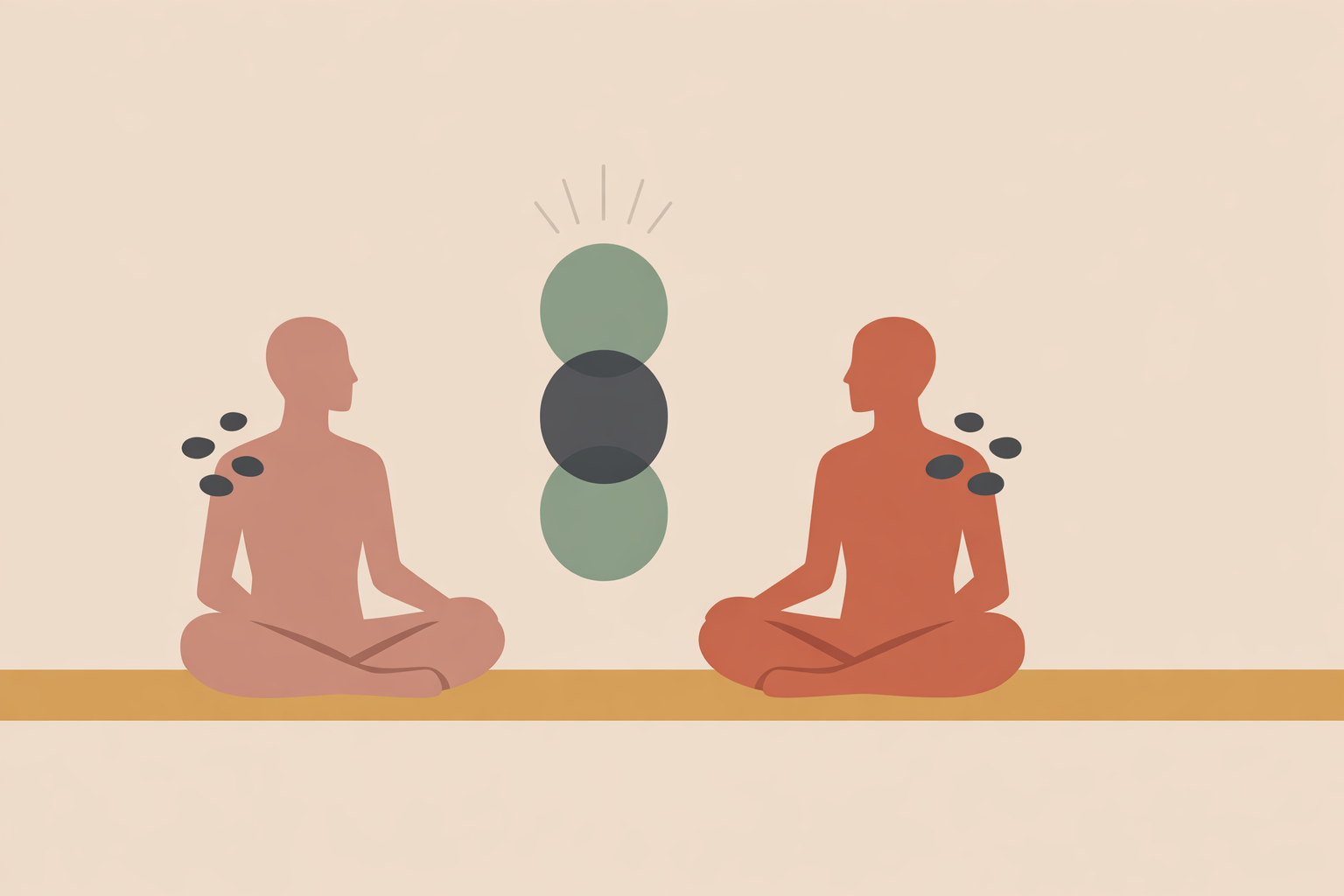
Breathwork training can easily turn into technique collecting: more ratios, more names, more cues. Then a real person arrives—wired from a commute or flat from poor sleep—and the session starts to wobble. The practitioner adds more instructions, the client tries harder, and effort (or dizziness) climbs.
What steadies the work is a reliable way to decide what to do, quickly, for this person, today. Autonomic-nervous-system (ANS)-informed templates do that. Read the current state, choose the lightest effective breathing pattern, pace it conservatively, watch for ease and response, then adjust one dial at a time.
Key Takeaway: ANS-informed breathwork templates help turn scattered techniques into a repeatable, grounded session flow. Start with state rather than style, choose one simple pattern, use minimal language, monitor ease and response, and close with integration. For many practitioners, breath awareness followed by gentle diaphragmatic breathing is a dependable first template because it is simple, adaptable, and easy to deliver with consent, choice, and clear boundaries.
Autonomic breathing basics: turning notes into templates
Most practitioners do not need more techniques. They need more coherence.
The ANS coordinates parasympathetic cardiac control and many background functions that shape whether someone feels settled or activated. In session terms, the question becomes straightforward: what state is here, and what kind of breathing meets it kindly?
Breath is especially workable because it runs on its own and can also be guided. That makes it a practical bridge between “what’s happening” and “what we can do next,” without burying the client in complexity.
Templates give that process a dependable container. They do not replace tradition or flatten your training; they make your choices easier to repeat with integrity. A good template helps you:
- identify the session’s immediate aim,
- notice the client’s present breathing state,
- choose one pattern rather than several,
- use clear, minimal cues,
- adapt gently if effort rises, and
- close in a way that carries into everyday life.
With that structure in place, notes get cleaner, the session feels calmer, and clients leave with something they can actually use.
A practical ANS lens for everyday breathwork decisions
The steadiest decisions come from reading state first and technique second.
Traditional breath lineages have long tracked shifts in energy, attention, and inner experience. Contemporary physiology offers another set of terms for similar terrain: mobilization, settling, alertness, recovery, activation, and ease. Together, they make moment-to-moment choices more practical.
If someone arrives keyed up—tight chest, fast speech, effortful breathing—start quieter and less forceful, with a gently longer exhale only if it stays comfortable. If someone arrives foggy or slumped, a more enlivening rhythm paired with clearer posture often fits better. The guiding principle stays the same: match the breath to the state that is present.
In many sessions, what matters most is slow breathing that stays comfortable. When that ease is there, autonomic shifts commonly show up as HRV changes. Research also suggests breathwork is linked with lower stress outcomes overall.
And practice-based knowledge matters here. Across lineages, calm, easeful breathing has been used to support steadier attention, clearer self-contact, and more grounded choices. That throughline is one reason simple work often lands deepest.
Keep the promise honest: what breathwork can support
Breathwork is most helpful when its promise stays modest and clear.
In real sessions, breathing practices often support a stronger sense of regulation, more body awareness, and smoother transitions between states. For many people, that is already a meaningful win: they arrive, reset, and reconnect with choice in the middle of a demanding day.
Because breath is always available, it’s also portable. A short pattern from a session can be repeated before a conversation, after a commute, or during a difficult afternoon. The aim is useful change the client can integrate, not intensity for its own sake.
Core ANS-aligned session template
One repeatable map can hold many different breathing patterns.
- Objective: Name a clear, modest aim. For example: “shift from post-commute agitation to workable focus.”
- Opening assessment: Ask what is present right now. Notice posture, speech pace, visible effort, and how easy or strained the breath appears.
- Consent: Explain what you are proposing in plain language, including the fact that the client can pause or stop at any time.
- Choose one pattern: Start with the simplest option that fits the state you are seeing.
- Guide with minimal language: One clear cue is often better than constant correction.
- Monitor and adapt: Track ease, tension, dizziness, emotional charge, and overall comfort. Change one variable at a time.
- Close and integrate: Return to natural breathing, orient to the room, and help the client notice what has shifted.
- Follow-up: If the person needs support beyond your scope, encourage them to seek appropriate additional support.
This structure keeps sessions dependable without making them rigid. Presence and lineage-informed skill still lead; the template just prevents the session from turning into a grab bag.
Useful script lines can stay very simple:
- “We’ll try a gentle breathing pattern for a few minutes, and you can pause at any time.”
- “Let the exhale finish softly—no pushing.”
- “If effort rises, come back to your natural breath.”
- “Keep your eyes open if that feels better today.”
When you need to adjust, make small changes. Shorten the exhale if it feels like a stretch. Soften the posture and set-up if tension builds. If the client starts striving, reduce instruction rather than adding more.
Template 1: breath awareness and gentle diaphragmatic breathing
When in doubt, begin with awareness.
Breath awareness is a respectful first step because it doesn’t rush change. It gives you clean information about what the breath is already doing, and that information often points to the next best move.
A simple awareness flow might look like this:
- Set-up: “Let’s notice the breath as it is.”
- Orientation: Invite awareness of feet, seat, and the support of the room.
- Observation: Notice where the breath is moving on its own—chest, ribs, belly, throat, or back body.
- Choice reminder: If anything feels off, return to ordinary breathing and look around the room.
- Reflection: Ask what the client notices now.
Even brief awareness can reveal a lot: held shoulders, a fixed chest, noisy effort, or a breath that is quiet but shallow. That beats guessing, and it keeps the session collaborative.
Diaphragmatic breathing as a gentle default
For many sessions, gentle diaphragmatic breathing is a strong place to begin, especially when you want clients to feel the pattern simply rather than overthink it.
It invites expansion through the lower ribs and abdomen without intensity. The inhale stays quiet, and any exhale lengthening stays comfortable. In beginner-friendly work, less force consistently delivers better results.
A practical version is simple:
- Set-up: Invite a hand to the lower ribs or sides of the waist if that feels comfortable.
- Pattern: Use an easy nasal rhythm such as 4-in/5-out or 4-in/6-out.
- Language: Suggest widening through the lower ribs rather than pushing the belly out.
- Autonomy: Keep reminding the client that they can return to natural breathing at any point.
- Monitoring: Notice jaw tension, shoulder effort, dizziness, temperature shifts, or the urge to yawn.
As a general direction, diaphragmatic breathing is associated with reduced stress and can support sustained attention. In everyday practice, many facilitators use it as an entry-point because it scales easily: you can soften it down or build it up without changing the core cueing.
If someone is new, unsure, or arrives with an unclear history, keep it nasal, gentle, and free from force. You can always build from simplicity later.
Trauma-sensitive refinements that improve access
Small refinements often make breathwork more usable for more people.
- Offer position choices such as seated, standing, or supported against a wall.
- Use eyes-open practice or a soft gaze when that feels more settling.
- Include present-time anchors such as naming colors in the room or feeling the contact of the feet with the floor.
- Avoid unexpected touch and keep boundaries explicit.
- Normalize pausing, changing position, or returning to ordinary breathing.
These small choices change the whole tone of a session. They signal that the client doesn’t need to perform or push through; they’re allowed to stay connected to their own pacing and preferences.
Integration is part of the method
The end of a breathing practice matters as much as the beginning.
After the guided pattern, return to natural breathing for a moment. Let the client look around, feel the room again, and notice what’s different now. That short integration phase helps the experience become lived, not just completed.
You might ask:
- “What feels different now?”
- “What do you notice in your face, jaw, chest, or belly?”
- “What is one small action you want to carry into the next hour?”
This is where many people find their “take-home”: a felt shift they can recognize again, and a simple way to return to it when life gets busy.
Closing perspective
When breathwork is anchored in state rather than technique collection, traditional insight and contemporary understanding work naturally side by side. A repeatable template—assess, gain consent, choose one simple pattern, monitor carefully, adjust gently, and integrate—keeps sessions clear and usable.
Begin with awareness. Add diaphragmatic ease where it fits. Let the person in front of you guide the next step. Over time, your technique library doesn’t shrink; it becomes organized around what works reliably in real life.
As a closing note, keep practices gentle, choice-led, and within your scope. If a client reports strong distress, persistent dizziness, or feels worse after practice, pause and encourage them to seek appropriate additional support.
Master ANS-Informed Breathwork
Deepen your session templates with the Breathwork Practitioner certification.
Explore Breathwork Practitioner →