The default in many coaching sessions is to stay in the head: ask sharper questions, reach for another model, talk faster when the stakes rise. That works until a client’s words and body start telling different stories: “I’m fine,” while their shoulders are up near their ears. In those moments, more talk can produce less truth.
Somatic awareness brings attention back to what is happening right now. By noticing breath, posture, contact, tension, and other body cues, coaches can support steadier presence, clearer intuitive discernment, and more grounded next steps without taking authority away from the client.
Key Takeaway: Somatic awareness helps coaches use the body as present-time information in a simple, client-led way. In practice, that means grounding yourself first, inviting clients with clear choice, using short embodied check-ins, separating sensation from interpretation, and turning what is noticed into small, testable actions. Kept light, respectful, and flexible, somatic work can deepen listening without overcomplicating the session.
Why somatic awareness belongs in coaching
Somatic awareness is the practice of noticing what the body is doing—breath, heartbeat, muscle tone, temperature, posture, impulse, rhythm—without rushing to explain it. In coaching, this kind of attention anchors presence, reveals subtle signals, and supports cleaner choices when pressure is high.
A coaching review links embodied practice with presence and hard-to-name felt impressions. That matters when a client sounds clear on the surface, yet something underneath still feels unresolved.
It also helps to recognize three channels of embodied awareness: interoception, proprioception, and exteroception. These relate to inner sensation, body position and movement, and awareness of the surrounding environment. When all three are included, it often becomes easier for clients to name what is true now and choose what matters next.
These skills are ancient. Breath-, posture-, and rhythm-based practices appear across yoga, qigong, and many Indigenous lineages because they cultivate clarity and orientation through lived experience. Coaching can draw from that wisdom with respect: credit the roots, avoid flattening cultural context, and keep practices practical.
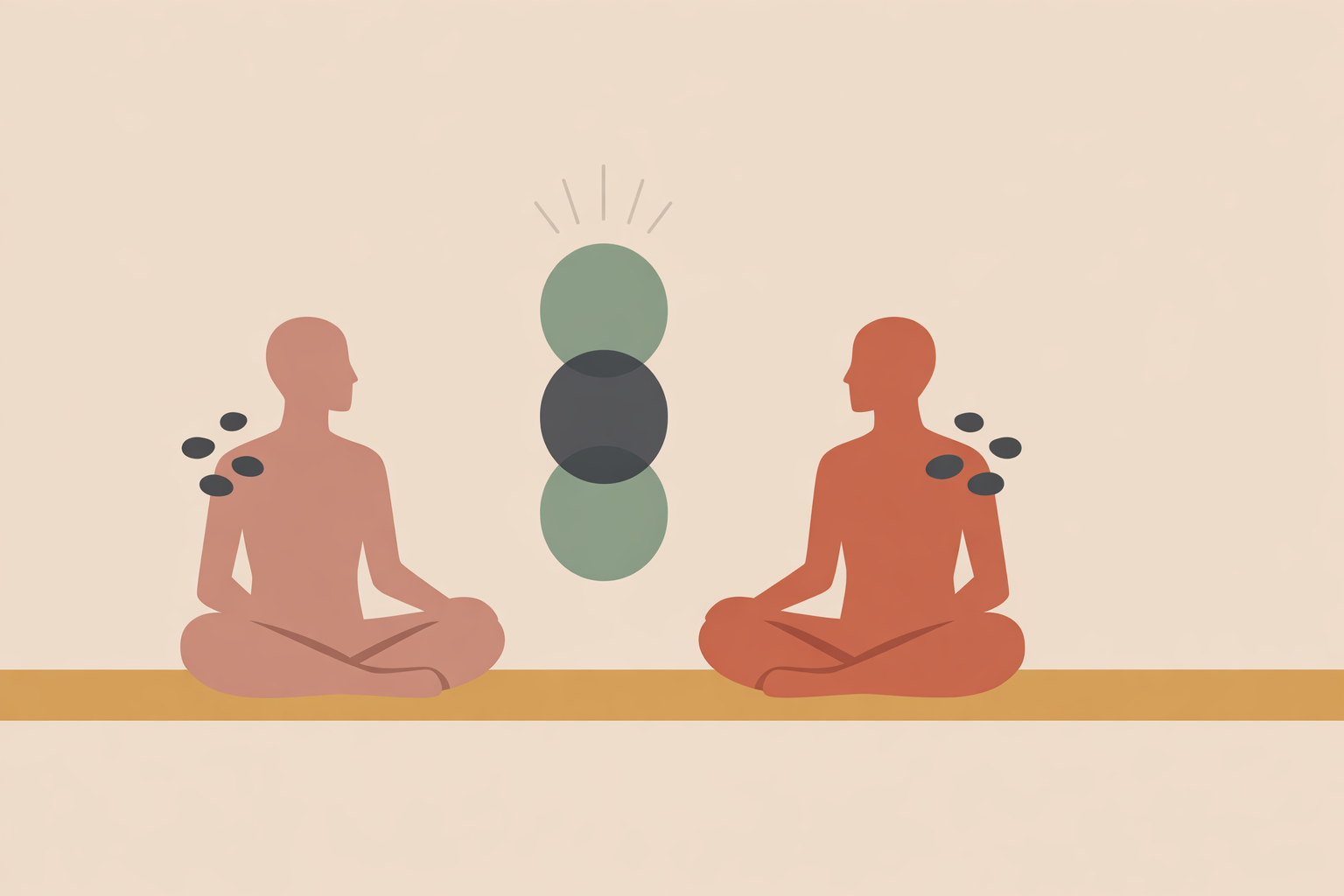
In session, it can be as simple as: “As you say that, what do you notice in your jaw, chest, or shoulders?” Clients often discover that what sounded like certainty is actually strain, excitement, or hesitation—and that discovery changes the conversation.
Ground yourself first
Before inviting a client into any somatic check-in, settle your own body. You do not need to be perfectly calm; you do need enough steadiness to listen well. When your pace is rushed or your attention is scattered, the session usually mirrors it.
A brief arrival practice is often enough:
- Orient: Look around and name three ordinary things you can see.
- Contact: Feel your feet on the floor or your body on the chair.
- Soften: Unclench the jaw, relax the shoulders, and let the breath stay natural.
- Intend: Silently name a simple coaching intention, such as “Stay curious” or “Ask more, fix less.”
- Remember autonomy: Remind yourself that the client chooses; you do not choose for them.
If you notice internal noise, label it lightly—planning, urgency, judging, anticipation—and return to the room. The aim is availability, not a blank mind.
Even a few seconds of orienting changes how you listen, and that shift alone can make a session feel more spacious and precise.
Invite, don’t impose
Somatic work lands best when it is offered lightly. Clients should never feel pushed into a body-based exercise or pressured to produce an “insight.” Clean consent keeps coaching ethical and effective.
Useful permission-based language includes:
- Invite: “I have a short awareness exercise we could try. It’s optional. Would you like to?”
- Normalize choice: “You can keep your eyes open, adjust it, or skip it.”
- Reduce pressure: “Noticing nothing is completely fine.”
- Clarify role: “We can explore what you notice and how it relates to your goal, but you decide what it means.”
- Create a stop switch: “If this feels unhelpful, just say pause and we’ll change direction.”
Cultural humility matters here. Some people prefer silence; others prefer narration. Some prefer eyes down, movement, touch points, or an object in hand. The best question is: “What helps you feel at ease and respected here?”
When pressure drops, awareness tends to rise. People notice more when they are not trying to do it “right.”
Use short somatic micro-practices in session
In most sessions, shorter works better. A brief check-in can surface meaningful information without pulling focus away from the client’s goal.
A simple sequence is:
- Orient: Look around and name one color or object.
- Contact: Feel feet on the floor, hands together, or the support of the chair.
- Notice: Track one neutral or manageable sensation for a few breaths.
- Choose: Ask, “Given that, what feels like the next clear step?”
Three reliable options:
- Grounding: “Notice the chair, the floor, and three things you can see. Let the breath be natural. What stands out now?”
- Breath noticing: “Track three easy breaths without changing them. What do you notice?”
- Posture choice: “What posture would help you feel more present right now? Try it and see what changes.”
These practices keep the body in the conversation while preserving momentum. A client may notice that sitting back, uncrossing their arms, or feeling both feet on the ground gives them more room to think—and that can be enough to support a wiser decision.
Help clients move from signal to meaning to action
Body cues are valuable information, but they are not automatic instructions. A tight chest, clenched jaw, or sudden exhale can point to many different things depending on context. Strong coaching keeps curiosity alive.
A simple structure is:
- Signal: What is the raw sensation?
- Story: What meaning are you giving that sensation?
- Strategy: What small experiment could help you test that meaning?
You might hear, “My stomach dropped, so this opportunity must be wrong.” Slow it down. Ask what else that sensation could mean: excitement, pressure, unfamiliarity, old memory, or a real values conflict. The goal is to work with body information skillfully, with choice intact.
This is where somatic work supports intuitive coaching especially well. It gives intuition something concrete to relate to, while still leaving room for reflection and practical reality.
Work inclusively when sensation feels intense, vague, or inaccessible
People experience the body differently. Some clients feel flooded quickly. Others feel very little. Both are normal, and both respond well to flexibility.
When sensation is intense, go smaller. Shorten the check-in, choose neutral contact points like feet or hands, and keep eyes open if that helps. If inward attention feels too activating, orient to the room and let the environment do some of the stabilizing.
For some people, breath-focused attention increases discomfort. In those moments, skip breath as the anchor and use contact, sound, movement, or visual tracking instead.
When clients feel numb or distant, external anchors often work better than internal scanning. Invite them to stand, walk a few steps, hold a textured object, describe the room, or tap gently with a steady rhythm. Many ancestral traditions have long understood that embodiment can begin through sound, rhythm, gesture, and relationship, including within spirituality and ritual, not only through inner sensation.
Some clients also prefer more concrete language. Visual scales, emotion word lists, behavior examples, and sensory words (temperature, pressure, weight) can make noticing easier. “Nothing noticeable” is still useful data.
For neurodivergent clients especially, explicit options can support engagement. A qualitative study on neuro-inclusive coaching highlights the importance of trust, active listening, and a nonjudgmental space. That often looks like predictable timing, literal language, movement options, fidgets, written prompts, and clear permission to adapt the exercise.
- If overwhelmed: “Keep your eyes open. Name five things you see. Feel your feet. Would standing help?”
- If numb: “Can you notice the texture of this object or the pressure of your hands together?”
- If breath-sensitive: “Let’s leave the breath alone and track contact points instead.”
- If unsure: “Is this too much, too little, or about right?”
Turn somatic awareness into small next steps
Somatic insight becomes useful when it shapes action. Without a bridge into daily life, awareness stays interesting but vague.
One easy integration is to weave it into a familiar structure such as GROW:
- Goal: “What do you want, and how do you want to feel as you move toward it?”
- Reality: “As you describe the current situation, what do you notice in your body?”
- Options: “Which option brings more steadiness, openness, or clarity? What practical factors also matter?”
- Will: “What is the smallest next action, and what will show you whether it helped?”
Visualization can also help. A client imagines taking the next step—having the conversation, sending the message, setting the boundary—and notices where they feel resourced, hesitant, braced, or clear. That feedback can refine the action until it feels workable and aligned.
Keep experiments small: one conversation, one draft, one request, one boundary, one week of observation. Small actions make learning faster and keep body information in proportion.
Afterward, debrief simply:
- Did this increase clarity or create more confusion?
- Did the client feel more able to choose?
- What signals showed up before, during, and after the action?
Build the habit gently
Somatic awareness becomes more useful with repetition. Over time, coaches and clients get better at spotting patterns, questioning assumptions, and telling the difference between a passing reaction and a meaningful signal.
A short post-session log can help:
- Context: What was happening?
- Sensation: What was noticed?
- Interpretation: What meaning was given?
- Action: What happened next?
- Later evidence: What became clearer afterward?
This reflection keeps intuition grounded and strengthens discernment over time. It also helps you notice when a “read” was accurate, when it was shaped by habit, and when the body was pointing toward something worth exploring more carefully.
Somatic coaching works best when it stays quiet and respectful. Notice the body, stay humble about meaning, protect choice, and translate awareness into one honest next step.
As with any body-based approach, it’s wise to keep consent central, adapt for accessibility, and avoid pushing through discomfort. When that care is in place, somatic awareness becomes a steady, culturally rooted way to deepen listening and support real-world follow-through, including in intuitive coach training.
Train Intuitive Coaching Skills
Deepen your somatic listening and decision support with the Intuitive Coach Certification.
Explore Intuitive Coach Certification →