Most teachers make this call in real time: you scan the room, notice a mix of newer and seasoned bodies, feel the group mood, and have about a minute to choose a direction. The schedule might say “Hatha” or “Vinyasa,” but those labels don’t always match what students expect—or what the room needs. Choose well, and breath does half the work.
Key Takeaway: Choosing between a Hatha-led or Vinyasa-led class is about matching intention and pacing to the room. Use Hatha-led structure when students need steadiness, clearer instruction, and space for breathwork; use Vinyasa-led rhythm when they need heat, coordination, and uplift, then adjust tempo and load by watching breath.
Hatha vs Vinyasa: one lineage, two modern class styles
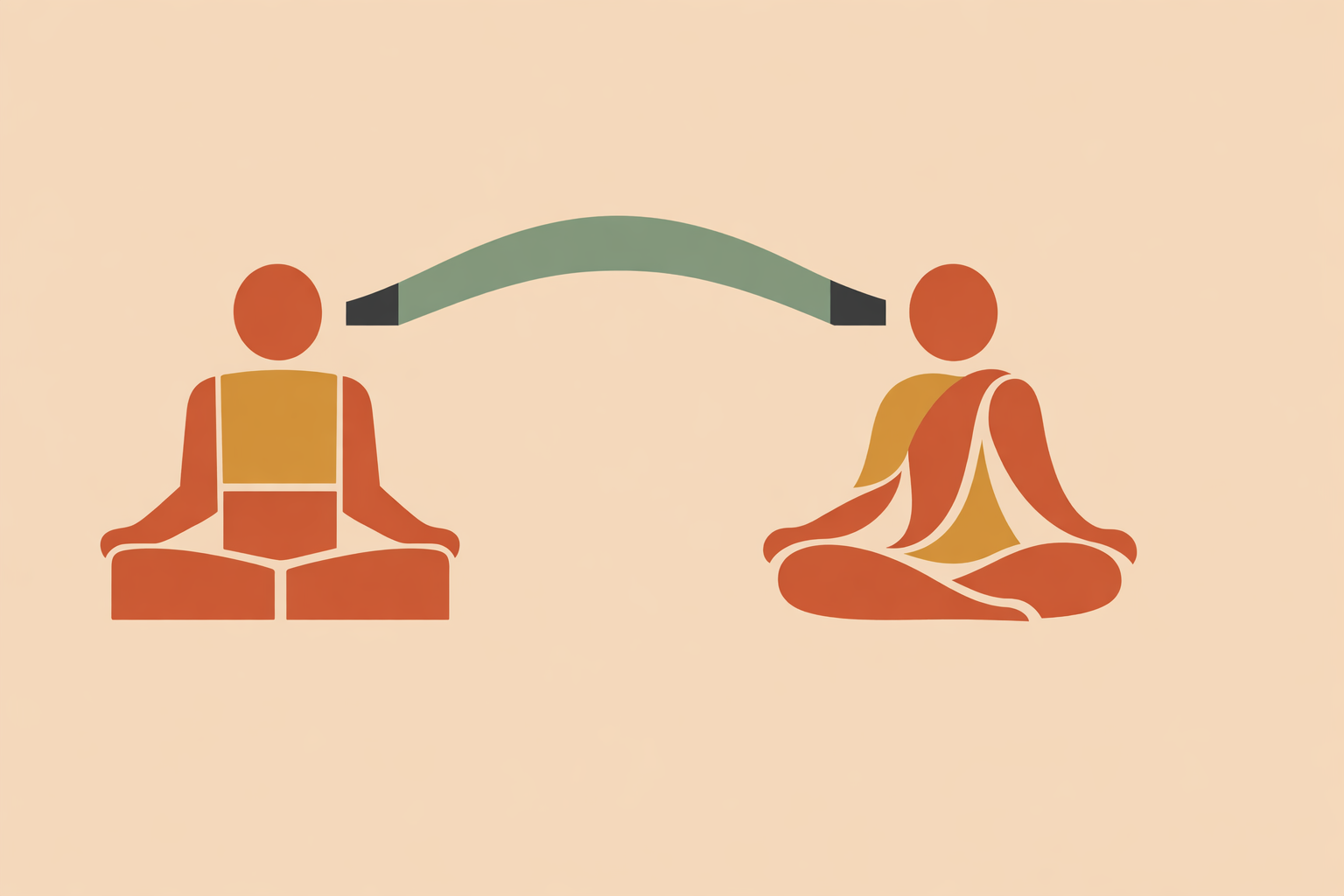
Hatha and Vinyasa aren’t opposing camps. They come from the same broad yogic family, even if modern classes can feel very different. In teaching terms, you’re not choosing “old vs new”—you’re choosing two ways of shaping attention and energy.
Contemporary flow styles grew through lineages rooted in medieval hatha yoga, with modern Vinyasa later developing from Ashtanga’s linked, breath-led structure. That shared ancestry matters: it keeps both styles in conversation rather than in competition.
Traditionally, Hatha points to a wide set of physical and energetic practices—asana, pranayama, mudra, and bandha—used to cultivate steadiness and inner clarity. In most studios today, “Hatha” usually means slower pacing, distinct holds, simpler transitions, and more time to feel each posture from the inside.
Vinyasa, by contrast, is linked movement: an intelligent arrangement of poses into a breath-paced arc where transitions matter as much as the shapes. Many modern Vinyasa classes still carry strong Ashtanga roots in Sun Salutations, gaze, breath rhythm, and progressive sequencing.
“Hatha offers a slower, more structured approach… while Vinyasa adds movement and intensity… Practicing both… can help you build a balanced practice.”
For planning, two simple labels can clarify everything: Hatha-led for a steadier, pause-friendly arc, and Vinyasa-led for a more continuous, breath-driven one. Once you name the “engine” of the class, the rest of your design choices get easier.
How Hatha and Vinyasa feel in practice
Think of Hatha as a lantern and Vinyasa as a river. One illuminates a shape in stillness; the other carries you in rhythm. The real question is how you want prana to move.
Hatha-led classes tend to run slow-to-moderate, with clear pauses and longer holds. Those holds give students time to organize themselves, notice effort patterns, and refine alignment—excellent for building confidence, “shape literacy,” and steadiness without being rushed.
Vinyasa-led classes put breath at the center. In Ashtanga-influenced approaches, practice is defined by synchronising breath with movement, and that same principle is what gives Vinyasa its continuity. When each transition has an inhale or an exhale, the sequence often becomes a moving meditation rather than a set of separate poses.
Ujjayi-style breathing can reinforce that internal cadence. Essentially, it gives the practice a steady “pulse,” helping the room move together without turning the class into rushed choreography.
Hatha also tends to give pranayama a more obvious seat at the table. With fewer moving parts, it’s easier to build in simple breath ratios and unhurried transitions that land as grounded and settling. “For many, a Hatha practice is known to result in a ‘grounding’ effect as the nervous system down-regulates,” notes teacher Mary Sue Meader.
Vinyasa often lands as clear, awake, warm, and sometimes lightly sweaty. Meader adds that it can “release stress and tension… with an added cardio benefit,” which many students experience as energizing rather than settling. Here’s why that matters: when a group needs containment, Hatha-led pacing often holds the room beautifully; when it needs circulation and uplift, stress and anxiety-aware Vinyasa-led rhythm can do that naturally.
How to choose the right style for your students
Start with the outcome. When you know what the group needs today, the “Hatha vs Vinyasa” decision usually makes itself.
If the priority is steadiness, breath awareness, or downshifting, Hatha-led practice often fits best. In a comparison discussed by David Keil, a meditative Hatha session was linked to lower salivary cortisol and reduced stress immediately afterward. That aligns with what many teachers see: slower pacing can help people settle enough to actually feel what they’re doing.
Hatha-led design also supports beginners and mixed-level rooms because it gives you time to teach: fewer transitions, clearer shape education, and a steadier container from start to finish.
Vinyasa-led practice shines when students want rhythm, heat, stamina, or a stronger sense of flow. Breath-linked sequencing can be especially supportive for people who enjoy continuous movement or already know common transitions. It often pairs well with other movement training because it builds coordination, mobility, and breath-paced endurance in one connected thread.
- Choose Hatha-led when the goal is: steadiness, clearer instruction, shape refinement, gentle strength, pranayama, or a quieter close.
- Choose Vinyasa-led when the goal is: heat, rhythm, stamina, coordinated movement, or a more energizing group feel.
- Choose slow flow when the group is mixed: enough pause to teach well, enough linking to keep energy moving.
The schedule label matters less than the people in front of you. Read the room first, then teach the style that fits.
Planning a Hatha-led class
A Hatha-led class works best when it feels spacious but not vague. Slower pacing isn’t an excuse to drift—it’s your chance to be precise and unhurried.
A dependable arc is straightforward: centering, gradual mobilization, held asana, a distinct pranayama or meditation segment, and an unhurried rest. The alternation of effort, awareness, and integration helps attention stay steady.
Longer holds give students time to stack joints, recruit stabilizers, and distribute load more intelligently. Put simply, the shape has time to teach—students can feel what’s happening instead of guessing while they rush to the next pose.
Hatha-led space also makes it easier to weave in more than posture work. The eight limbs are traditionally held as an integrated path—yama, niyama, asana, pranayama, pratyahara, dharana, dhyana, samadhi. In a modern class, that might look like a short reflection up front, clear asana in the middle, simple breath awareness afterward, and a few quiet moments before rest.
- Sample 60-minute Hatha-led arc:
- 5 minutes centering: seated or constructive rest, simple breath awareness, intention
- 10 minutes warm-up: cat-cow, shoulder circles, hip mobilization, gentle back-body activation
- 25 minutes held postures: a few standing shapes, balances, and accessible backbends, each held for several breaths with props as needed
- 8 minutes pranayama: equal breath or gentle breath lengthening
- 2 minutes seated stillness: gaze awareness or quiet mantra
- 10 minutes downshift and rest: twists, forward fold, savasana
An Ashtanga lens can still serve beautifully here. You can weave in drishti, light bandha awareness, and clear internal organization without speeding things up. In fact, those tools often land more deeply when there’s time to feel them.
Use props freely. Lead with clear verbal cues, then offer consent-based hands-on support only when it’s genuinely educational and stabilizing. Hatha’s power is clarity, not intensity.
Planning a Vinyasa-led class
Vinyasa-led design turns breath into momentum. The real challenge isn’t making class “hard enough”—it’s building a flow that feels coherent, sustainable, and satisfying from start to finish.
For most teachers, the simplest foundation is Sun Salutations plus standing sequences, organized around a clear theme (hips, twists, balance, side-body, back-body strength). When each movement has a breath relationship, students can follow the arc with their nervous system as much as with their mind.
That breath-led integrity is a clear inheritance from Ashtanga: Surya Namaskar variations, steady gaze, and consistent internal rhythm. A strong Vinyasa class may look fluid on the surface, but underneath it’s carefully arranged.
- Sample 60-minute Vinyasa-led arc:
- 5 minutes arrival: simple breath awareness and light joint prep
- 12 minutes Sun Salutations: pace options, wrist and shoulder care, clear breath cues
- 20 minutes standing flow: two repeating loops built around lunges, twists, balances, or side-body actions
- 8 minutes focused strength or mobility: plank variations, chaturanga skill work, or core integration
- 5 minutes downshift: supine release, folds, or gentle hip openers
- 10 minutes close: short pranayama and savasana
Continuous sequences can dovetail nicely with running or strength work because they ask for coordination, mobility, and sustained effort in one integrated practice.
At the same time, good Vinyasa programming isn’t just repeated chaturangas. Keep elbows close to ribs when relevant, vary or skip vinyasas when needed, limit excessive shoulder extension, and balance pushing with pulling-style actions (like locust or strap rows). Sustainability is part of the practice, not an optional extra.
How to scale intensity without losing the room
Intensity is a dial, not a switch. Strong facilitation comes from adjusting that dial early—before the room gets scattered.
If you want immediate settling, contemplative Hatha-led pacing is often the most reliable vehicle. If you want uplift, coordinated effort, and brighter group energy, Vinyasa-led rhythm tends to deliver. Neither is “better”; each asks something different of the same human system.
Breath is your clearest feedback tool. Jagged, strained, panicky-sounding breathing usually means the class needs less speed, less complexity, or more pause. If the breath feels dull and attention is fading, a little more pace—or repetition—can restore focus.
For students with anxiety sensitivity, keep breathwork simple and avoid turning the room into an energetic pressure cooker. Non-retentive breathing and straightforward sequencing are often more supportive than stacking vigorous flow on top of long holds and complex transitions.
- Useful intensity dials:
- Lengthen the exhale to settle the room
- Shorten holds if students are losing shape or attention
- Add pauses between sides to restore clarity
- Reduce load by skipping vinyasas or changing leverage
- Simplify transitions when coordination starts to fray
- Keep drishti soft and steady to support focus
Watch breath first, then faces, then shoulders. Those three signals usually tell you what to adjust before anyone says a word.
Blending Hatha and Vinyasa over time
The strongest teaching rarely lives at one extreme. Over weeks, many groups thrive with a blend: Hatha’s steadiness to build foundations, and Vinyasa’s fluidity to integrate them.
A practical progression is to start with a Hatha-led structure so students can learn spinal actions, joint organization, and breath pacing without hurry. Then, as those fundamentals become familiar, weave them into smoother Vinyasa transitions. Think of it like learning letters clearly before writing in full sentences.
This middle ground is often called slow flow, and it’s especially kind to mixed-level rooms: enough pause to teach, enough linking to feel the thread of breath-led movement.
- Example four-week progression:
- Week 1: Hatha-led foundation work with props and simple breath ratios
- Week 2: Slow flow with deliberate transitions and short pauses for reorganization
- Week 3: More Vinyasa-led pacing with options for load and repetition
- Week 4: Integrated practice with stronger sequencing and a longer quiet close
Joint care matters in both directions. Dynamic Vinyasa can overload wrists, shoulders, core, and hips when sequences get repetitive. Longer Hatha holds can also irritate knees, hamstrings, or low back when end-range shapes aren’t supported. Props, bounded ranges, and intelligent variation aren’t compromises—they’re hallmarks of mature teaching.
Teach progressions, not poses. That mindset naturally brings Hatha and Vinyasa into relationship rather than conflict.
Choosing well for your next class
When in doubt, come back to three questions: What’s the energy in the room? What outcome do you want? What pace will best support it?
- Read the room: Are students scattered, heavy, wired, or already focused?
- Name the outcome: steadiness, clarity, heat, rhythm, stamina, or integration
- Choose the vehicle: Hatha-led, Vinyasa-led, or a slow-flow blend
- Set the dials: breath, tempo, hold time, load, and transition complexity
- Leave space to land: savasana is where learning lands
From an Ashtanga Vinyasa lens, both styles share the same essential roots: attentive breath, steady gaze, intelligent sequencing, and respect for practice as a vehicle for inner evolution. Choose the branch that serves your people today, trust your read of the room—and let the practice become what it needs to be.
Explore Yoga Teacher Certification
Bring these Hatha-led and Vinyasa-led design skills into your teaching through the Yoga Teacher Certification.
Explore Yoga Teacher →